 Download Free Sample



Get a Quote
Receive a tailored pricing based on your needs.
- Choose license type
- Multiple user options
- Custom scope & coverage
- Fast turnaround
"Electrifying your pathway to success through in-depth market research"
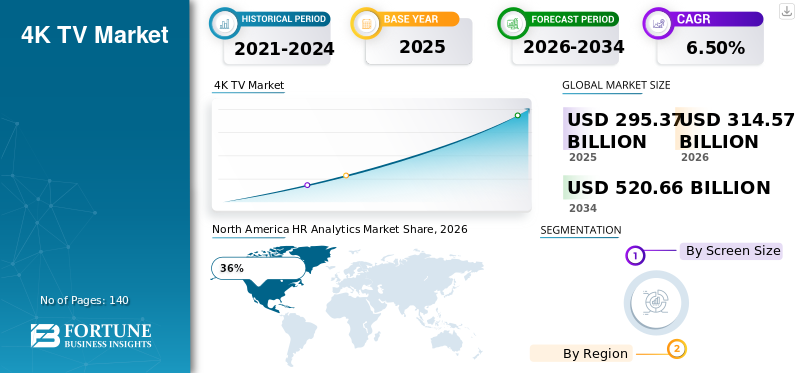
The global 4K TV market size was valued at USD 295.37 billion in 2025. The market is projected to grow from USD 314.56 billion in 2026 to USD 520.66 billion by 2034, exhibiting a CAGR of 6.50% during the forecast period.

The 4K TV market has experienced substantial transformation due to the rising demand for ultra-high-definition entertainment systems, smart home integration, and immersive viewing experiences. Consumers are increasingly shifting from traditional HD televisions to advanced 4K display technology that delivers sharper visuals, enhanced color accuracy, and AI-powered picture optimization. The growing adoption of streaming platforms, gaming consoles, and connected home ecosystems continues to support 4K TV market growth across residential and commercial sectors. Manufacturers are introducing energy-efficient panels, OLED and QLED technologies, and voice-enabled features to strengthen competitive positioning. The 4K TV market report indicates strong demand from hospitality, education, retail display, and gaming industries globally.
The USA 4K TV market is witnessing significant expansion due to high consumer purchasing power, rapid smart home adoption, and growing demand for premium entertainment systems. Large-screen television demand has increased among households seeking cinematic experiences and gaming optimization. Retailers and electronics manufacturers are focusing on AI-enhanced smart televisions integrated with streaming applications and cloud connectivity. The country also benefits from advanced broadband infrastructure, supporting seamless ultra-HD content consumption. The USA remains a major innovation hub for smart display technologies, strengthening the overall 4K TV market outlook and supporting continuous product replacement cycles among consumers and enterprises.
Download Free sample to learn more about this report.
 Global Market Size & Forecast
 Market Share
 Key Regional Highlights
North America
North America held around 36% of the global market, supported by strong streaming and gaming adoption.
Asia-Pacific
Asia-Pacific accounted for nearly 32%, driven by electronics manufacturing and rising consumer demand.
Europe
Europe represented approximately 24%, supported by premium entertainment devices and smart home adoption.
U.S.
Demand is supported by streaming, gaming, and advanced smart TV technologies.
Japan
Market growth is supported by strong electronics capabilities and demand for premium 4K televisions.
Read More

The 4K TV market trends indicate increasing adoption of OLED, Mini-LED, and QLED display technologies across both premium and mid-range television categories. Manufacturers are emphasizing thinner bezels, flexible displays, and AI-enhanced image processing to attract technologically advanced consumers. The growing integration of voice assistants and IoT compatibility has transformed televisions into multifunctional smart home devices. Gaming-focused 4K TVs with high refresh rates, HDMI 2.1 compatibility, and low latency modes are becoming increasingly popular among younger consumers and professional gamers.
Another significant trend shaping the 4K TV industry analysis is the rapid shift toward larger screen sizes exceeding 65 inches. Consumers are increasingly investing in home entertainment systems due to higher streaming consumption and hybrid work lifestyles. Subscription-based streaming platforms are accelerating demand for ultra-high-definition televisions capable of delivering cinematic viewing experiences. Additionally, manufacturers are focusing on sustainable production methods and energy-efficient technologies to comply with environmental standards. The introduction of AI-based upscaling technology and cloud-connected operating systems continues to improve user experience and strengthen the overall 4K TV market forecast globally.
Download Free sample to learn more about this report.
Rising Demand for Immersive Home Entertainment and Gaming Experiences
The rapid increase in demand for premium entertainment systems is one of the strongest drivers supporting 4K TV market growth. Consumers are increasingly seeking ultra-high-definition displays capable of delivering cinema-like viewing quality within residential environments. Streaming platforms are producing large volumes of 4K-compatible content, encouraging households to upgrade from HD televisions to ultra-HD smart TVs. The increasing popularity of esports and console gaming has also accelerated adoption of 4K televisions with advanced refresh rates and enhanced response times.
The 4K TV market research report highlights how gaming-focused features such as variable refresh rate, HDR optimization, and low latency modes are attracting younger consumer groups. Hospitality providers, luxury apartments, and commercial entertainment venues are also investing in advanced display systems to improve customer engagement. Technological improvements in display panels, combined with falling manufacturing costs, have made premium televisions more accessible to broader consumer groups. Rising disposable income levels and expanding internet penetration further support strong market demand across developed and emerging economies.
High Replacement Costs and Pricing Pressure in Premium Segments
Despite strong demand growth, the 4K TV market faces restraints associated with premium pricing and replacement expenses. Advanced display technologies such as OLED and Mini-LED televisions remain expensive for many middle-income consumers. Large-screen televisions also involve additional installation costs, sound system upgrades, and higher electricity consumption, limiting adoption in price-sensitive regions.
The 4K TV market analysis indicates that pricing competition among manufacturers has significantly reduced profit margins across the industry. Frequent product launches and rapid technological evolution shorten product lifecycles, forcing companies to continuously invest in innovation and inventory management. Consumers in emerging economies often delay upgrades due to economic uncertainty and limited purchasing power. Furthermore, supply chain disruptions affecting semiconductor availability and display panel manufacturing continue to influence production schedules and component pricing. These factors collectively create operational challenges for manufacturers attempting to maintain profitability while competing aggressively in global markets.
Expansion of Smart Ecosystems and AI-Enabled Televisions
The integration of smart home ecosystems presents major opportunities for the 4K TV market. Modern televisions are increasingly functioning as centralized digital hubs that connect voice assistants, security systems, smart appliances, and cloud-based entertainment services. AI-powered televisions capable of personalized recommendations and automated picture optimization are gaining strong consumer attention.
The growing popularity of hybrid work environments also supports demand for multifunctional smart displays that can be used for entertainment, virtual meetings, and educational applications. Emerging economies offer substantial untapped growth potential as internet infrastructure improves and digital streaming platforms expand. Manufacturers are increasingly targeting these regions with affordable smart 4K televisions featuring localized content integration and language support. The 4K TV industry report also identifies opportunities in commercial sectors such as hospitality, healthcare, transportation, and retail advertising, where ultra-high-definition displays are being used for customer engagement and digital communication purposes.
Intense Competition and Rapid Technological Obsolescence
One of the primary challenges affecting the 4K TV market size is the extremely competitive landscape among global electronics manufacturers. Companies continuously compete through aggressive pricing strategies, frequent product launches, and technological differentiation. Rapid innovation cycles often make existing products obsolete within short periods, increasing inventory management risks and research expenditures.
The 4K TV market insights reveal that maintaining supply chain efficiency while meeting evolving consumer expectations remains a major operational challenge. Display technologies continue to evolve rapidly, with manufacturers investing heavily in OLED, QLED, MicroLED, and AI-powered image enhancement systems. Consumer expectations regarding design aesthetics, connectivity, and smart features are also increasing continuously. In addition, counterfeit products and low-cost regional manufacturers create pricing pressure for established global brands. Environmental regulations concerning electronic waste management and energy efficiency standards further add compliance complexities for producers operating across multiple international markets.
The below 52 inches segment remains important within the 4K TV market because of its affordability and suitability for apartments, bedrooms, student housing, and compact residential spaces. These televisions are widely preferred among first-time smart TV buyers and consumers seeking budget-friendly ultra-high-definition entertainment systems. Manufacturers continue introducing compact smart televisions equipped with AI-enabled voice control, streaming platform integration, and energy-efficient technologies. This segment accounts for approximately 34% of the overall 4K TV market share.
The 4K TV market research report indicates that smaller televisions are witnessing rising adoption among urban consumers due to limited living spaces and increasing demand for secondary home entertainment devices. Educational institutions, hotels, and office environments also contribute to demand for compact 4K televisions. Manufacturers are emphasizing slim designs, enhanced audio systems, and cloud-based connectivity to maintain competitiveness within this segment. The growing availability of affordable streaming subscriptions and gaming devices further supports sustained market demand globally.
The 52 to 65 inches category dominates the 4K TV market size because it provides an ideal balance between immersive viewing and affordability. Consumers increasingly prefer medium-to-large screen televisions for family entertainment, streaming, and gaming purposes. This segment represents nearly 43% of the global 4K TV market share due to strong demand from residential consumers and commercial establishments.
The segment benefits from continuous innovation in OLED, QLED, and Mini-LED technologies, enabling manufacturers to improve picture quality and energy efficiency. Smart connectivity, integrated voice assistants, and AI-driven content optimization are becoming standard features within this screen category. Retailers frequently promote this segment during seasonal sales and entertainment-focused marketing campaigns. The growing trend of home theater systems and hybrid work environments continues to support strong demand for medium-sized ultra-high-definition televisions worldwide.
The greater than 65 inches segment is gaining strong momentum within the 4K TV market forecast due to increasing consumer interest in luxury entertainment experiences. Large-screen televisions are highly preferred among gaming enthusiasts, affluent households, hospitality providers, and commercial entertainment venues. This segment accounts for nearly 23% of global market demand.
Manufacturers are heavily investing in advanced display technologies for larger screens, including AI-enhanced image processing, HDR optimization, and premium sound integration. Demand for cinematic viewing experiences has increased substantially with the expansion of streaming services offering ultra-HD content. Commercial applications such as conference rooms, digital signage, and luxury hotels are also driving adoption. Although premium pricing remains a challenge, declining panel manufacturing costs are gradually improving accessibility for broader consumer groups.
To know how our report can help streamline your business, Speak to Analyst
North America remains a major application-driven market for 4K televisions due to advanced digital infrastructure, high streaming adoption, and strong consumer purchasing capacity. The region contributes around 36% of global 4K TV market share. Consumers actively seek televisions compatible with gaming consoles, AI-powered entertainment systems, and cloud-based streaming platforms.
Commercial sectors including hospitality, sports bars, educational institutions, and corporate environments are increasingly integrating ultra-HD display systems for communication and entertainment purposes. Retailers frequently introduce promotional campaigns to accelerate replacement demand. Technological innovation from regional electronics companies further strengthens market competitiveness and product adoption rates.
Europe represents approximately 24% of the global 4K TV market share, supported by growing demand for premium entertainment devices and sustainable consumer electronics. Consumers in Germany, the United Kingdom, France, and Italy are increasingly adopting OLED and QLED televisions with advanced connectivity features.
The 4K TV industry analysis highlights increasing demand from gaming communities, luxury residential developments, and hospitality businesses. Energy efficiency regulations across Europe encourage manufacturers to introduce environmentally sustainable televisions with reduced power consumption. Streaming platform growth and smart home integration continue supporting strong regional demand for advanced ultra-high-definition televisions.
Asia Pacific holds nearly 32% of the global 4K TV market share due to strong manufacturing capabilities and rising consumer electronics adoption. China, Japan, South Korea, and India represent major production and consumption hubs for smart televisions. Rapid urbanization and expanding middle-class populations continue to drive demand for affordable and premium 4K televisions.
The region benefits from large-scale electronics manufacturing infrastructure, enabling cost-efficient production and technological innovation. Gaming culture, e-commerce expansion, and digital streaming growth are major contributors to regional market development. Manufacturers are introducing localized smart platforms and affordable models to target emerging consumer groups across developing Asian economies.
Latin America and the Middle East & Africa collectively contribute around 8% of global 4K TV market share. Growing urbanization, rising internet penetration, and expanding retail distribution networks are supporting demand for smart televisions across these regions.
Consumers increasingly seek affordable ultra-HD televisions compatible with streaming services and gaming platforms. Government investments in digital infrastructure and smart city projects are indirectly supporting demand for connected entertainment systems. Regional manufacturers and international brands are expanding their distribution channels to strengthen market penetration across emerging economies.
North America HR Analytics Market Share, 2026 (%)
To get more information on the regional analysis of this market, Download Free sample
North America remains the leading regional contributor to the 4K TV market, accounting for nearly 36% of global market share. The region benefits from strong consumer spending on premium electronics, advanced broadband infrastructure, and widespread adoption of streaming platforms. Consumers increasingly prefer televisions with AI-enabled interfaces, gaming optimization, and integrated voice control technologies. Smart home adoption across the United States and Canada further supports demand for connected entertainment devices.
The 4K TV market outlook for North America remains positive due to strong replacement demand and continuous innovation in OLED and QLED technologies. Gaming communities and home theater enthusiasts significantly influence purchasing trends within the region. Commercial sectors such as hospitality, retail advertising, and corporate communication are also expanding their adoption of ultra-high-definition display systems. Retail chains and e-commerce platforms play a crucial role in product accessibility and promotional campaigns.
Europe contributes approximately 24% to the global 4K TV market share due to strong demand for technologically advanced and energy-efficient televisions. Consumers across Germany, the United Kingdom, France, and Italy increasingly prefer smart televisions integrated with AI-powered features and streaming applications. Environmental regulations encouraging energy-efficient electronics also influence product development strategies within the region.
The 4K TV market research report highlights increasing adoption of premium televisions among residential users seeking immersive entertainment experiences. Hospitality providers and commercial establishments are upgrading digital display systems to enhance customer engagement. Growing gaming communities and digital content consumption continue supporting sustained market demand across Europe.
Germany represents nearly 29% of the European 4K TV market share due to strong consumer preference for premium electronics and advanced home entertainment systems. German consumers prioritize high-quality display performance, energy efficiency, and long-term product durability. Smart televisions equipped with AI-based optimization and cloud connectivity are gaining significant traction among urban households.
The country also benefits from strong retail infrastructure and widespread availability of high-speed internet services supporting ultra-HD streaming. Commercial sectors including hospitality, education, and corporate offices increasingly invest in large-format 4K display systems. The Germany 4K TV market analysis indicates strong demand for OLED and QLED televisions with gaming-focused features and smart home compatibility.
The United Kingdom accounts for approximately 24% of Europe’s 4K TV market share due to increasing digital entertainment consumption and rising smart home adoption. Consumers actively upgrade televisions to access premium streaming content, gaming platforms, and voice-controlled home ecosystems. Retail promotions and seasonal electronics sales significantly influence purchasing behavior.
The 4K TV market trends within the UK indicate growing demand for large-screen televisions exceeding 65 inches. Hospitality and commercial sectors are also investing in ultra-HD displays for customer communication and entertainment purposes. Increasing broadband penetration and widespread streaming subscriptions continue strengthening long-term market demand across the country.
Asia-Pacific contributes nearly 32% of global 4K TV market share and remains one of the fastest-growing regional markets. Strong electronics manufacturing infrastructure in China, Japan, and South Korea enables efficient production and technological innovation. Rising disposable income and urbanization continue accelerating consumer demand for smart televisions across developing Asian economies.
The region also benefits from expanding e-commerce platforms and affordable product availability. Gaming culture, digital streaming adoption, and smart home integration strongly support regional market expansion. Manufacturers are aggressively introducing localized content ecosystems and competitively priced products to capture broader customer segments.
Japan contributes approximately 21% of the Asia-Pacific 4K TV market share due to its advanced consumer electronics ecosystem and strong demand for premium display technologies. Japanese consumers actively adopt high-performance televisions with AI-enhanced image processing, advanced gaming features, and energy-efficient designs.
The country’s strong innovation capabilities continue supporting the development of OLED and Mini-LED display technologies. Gaming communities, digital entertainment consumption, and smart home integration remain major drivers of market demand. Commercial applications including transportation, retail, and hospitality also contribute significantly to the Japan 4K TV market outlook.
China accounts for nearly 38% of the Asia-Pacific 4K TV market share and serves as both a major manufacturing hub and a leading consumer market. Rising middle-class populations, urbanization, and affordable smart television availability continue driving strong demand across the country.
Domestic manufacturers aggressively compete through innovation, competitive pricing, and AI-powered smart television features. E-commerce expansion and digital streaming services significantly influence consumer purchasing patterns. Commercial sectors including education, hospitality, and public advertising increasingly utilize ultra-high-definition display technologies, strengthening the China 4K TV market forecast.
The Rest of World region contributes around 8% of global 4K TV market share. Latin America, the Middle East, and Africa are experiencing rising demand for affordable smart televisions as internet infrastructure and digital streaming services expand. Urban consumers increasingly seek premium entertainment systems capable of supporting ultra-HD content consumption.
The 4K TV market opportunities continue expanding as manufacturers invest heavily in OLED, QLED, Mini-LED, and AI-driven display technologies. Companies are increasing research and development spending to improve screen brightness, energy efficiency, and smart connectivity features. Investments in semiconductor manufacturing and display panel production are becoming increasingly important to ensure supply chain stability and cost optimization.
The 4K TV market forecast indicates strong opportunities in emerging economies where smart television penetration remains comparatively low. E-commerce platforms are helping manufacturers access new customer groups while reducing retail distribution costs. Strategic partnerships between streaming platforms and television manufacturers are also creating bundled entertainment ecosystems that strengthen consumer engagement.
Commercial sectors including hospitality, healthcare, education, and transportation are increasingly investing in large-format ultra-HD displays for communication and entertainment applications. Gaming-focused televisions with high refresh rates and advanced graphics compatibility represent another high-potential investment segment. Sustainable manufacturing technologies and recyclable display materials are also attracting investor attention as environmental regulations become stricter globally.
Innovation remains a core competitive factor within the 4K TV industry analysis. Manufacturers are increasingly introducing AI-powered televisions capable of real-time picture optimization and voice-controlled smart home integration. OLED and Mini-LED technologies are becoming more widely adopted due to improved brightness, contrast performance, and energy efficiency.
Gaming-centric televisions with ultra-fast refresh rates, low input lag, and HDMI 2.1 compatibility are gaining strong traction among younger consumers. Companies are also introducing bezel-free and ultra-slim designs to improve aesthetic appeal within residential and commercial environments. Flexible and rollable display technologies continue to attract premium consumer interest.
The 4K TV market research report highlights increasing development of cloud-connected operating systems that enable seamless streaming, app integration, and personalized recommendations. Manufacturers are also focusing on sustainable product development using energy-efficient panels and recyclable materials. AI-enhanced upscaling technology capable of improving lower-resolution content quality is becoming a major differentiating feature across premium product categories.
The 4K TV market report provides extensive analysis of market trends, technological developments, competitive landscapes, and regional demand patterns influencing industry expansion. The report evaluates evolving consumer preferences regarding smart connectivity, display quality, gaming optimization, and AI-powered entertainment systems. It also examines manufacturing trends associated with OLED, QLED, Mini-LED, and other advanced display technologies.
The 4K TV market analysis covers segmentation by screen size, regional performance, and commercial applications across residential, hospitality, retail, healthcare, and educational sectors. Detailed assessment of supply chain dynamics, pricing competition, and emerging market opportunities is included within the study. The report also analyzes the strategic positioning of leading manufacturers and their investments in research, sustainability, and smart ecosystem integration.
Request for Customization to gain extensive market insights.
Additionally, the report evaluates regulatory developments related to energy efficiency and electronic waste management. Consumer behavior trends, digital streaming adoption, and smart home integration are comprehensively examined to provide deeper insights into long-term industry expansion opportunities and evolving competitive strategies across global markets.
Fortune Business Insights says that the global market value stood at USD 295.37 billion in 2025 and is projected to reach USD 520.66 billion by 2034.
The market is expected to exhibit a CAGR of 6.50% during the forecast period of 2026-2034.
52 to 65 inches was the leading screen-size segment, accounting for nearly 43% of the market, supported by its balance of immersive viewing and affordability.
Key players include Samsung Electronics Co., Ltd., LG Electronics, Inc., Sony Corporation, Panasonic Corporation, Sharp Corporation, and Hisense USA (Hisense International).
Major trends include rising adoption of OLED, Mini-LED, QLED, and AI-enhanced picture technologies, alongside growing demand for gaming-focused and larger-screen 4K TVs. North America leads the market with around 36% share.


(Offer valid till 31st Oct 2026)
Get 30-60 hrs Free Customization
Expand Regional and Country Coverage, Segments Analysis, Company Profiles, Competitive Benchmarking, and End-user Insights.




















Get In Touch With Us
US +1 833 909 2966 ( Toll Free )
Receive a tailored pricing based on your needs.
Discuss your questions with our industry experts.
Have questions? Get quick answers before you purchase.

