5G Base Station Market Size, Share & Industry Analysis, By Component, By Network Architecture, By Core Network, By Operational Frequency, By End Use and Regional Forecast, 2026-2034
 Download Free Sample
5G Base Station Market Overview
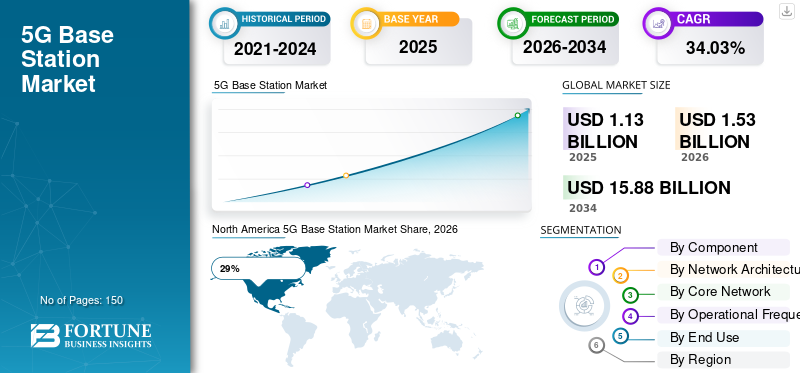
The global 5G base station market size was valued at USD 1.13 billion in 2025. The market is projected to grow from USD 1.53 billion in 2026 to USD 15.88 billion by 2034, exhibiting a CAGR of 34.03% during the forecast period.

The global 5G base station market is expanding rapidly due to increasing deployment of next-generation wireless communication infrastructure across telecom, industrial automation, smart city, and connected mobility applications. 5G base stations serve as the backbone of ultra-fast wireless connectivity by supporting low latency, high bandwidth, and massive device connectivity. The 5G base station market Report highlights rising investments in standalone and non-standalone network architectures, edge computing integration, and cloud-native telecom infrastructure. Telecom operators worldwide are accelerating deployment of macro and small cell base stations to support growing data consumption and IoT connectivity. Increasing digital transformation initiatives continue to strengthen 5G base station market growth globally.
The United States 5G base station market is witnessing strong growth due to rapid telecom infrastructure modernization and increasing demand for high-speed mobile connectivity. Telecom operators across the country are heavily investing in nationwide 5G rollout programs, edge computing systems, and cloud-based network architectures. The 5G base station industry analysis highlights growing deployment of millimeter wave and mid-band spectrum technologies to improve network coverage and data performance. Smart city development, industrial IoT adoption, and connected vehicle infrastructure are also driving market demand. Increasing investments in private 5G networks and enterprise digital transformation continue to strengthen the long-term outlook of the USA 5G base station market.
Download Free sample to learn more about this report.
5G Base Station Market Key Takeaways
 Global Market Size & Forecast
- 2025 Market Size: USD 1.13 Billion
- 2026 Market Size: USD 1.53 Billion
- 2034 Forecast Market Size: USD 15.88 Billion
- CAGR: 34.03% from 2026-2034
 Market Share
- Asia-Pacific dominated with a 39% regional market share in 2025.
- Components held the largest share at approximately 58%.
- Network architecture accounted for approximately 42% share.
 Key Regional Highlights
Asia-Pacific
Asia-Pacific held the largest regional share at 39%, supported by rapid 5G network deployment.
North America
North America accounted for 29% of the market, driven by investments in advanced telecom infrastructure.
Europe
Europe represented 24% of the market, supported by expanding 5G coverage and network modernization.
U.S.
Demand is supported by continued 5G infrastructure expansion and telecom network upgrades.
Japan
Japan accounted for 26% of the Asia-Pacific market, supported by ongoing 5G deployment and advanced wireless technologies.
Read More

5G Base Station Market Latest Trends
The 5G base station market is evolving rapidly with increasing focus on network virtualization, Open RAN architecture, and AI-driven telecom automation. One of the most significant 5G base station market trends is the growing deployment of small cell infrastructure to improve urban connectivity and support high-density wireless traffic environments. Telecom operators are increasingly integrating edge computing capabilities into 5G base stations to reduce latency and improve real-time data processing performance.
Download Free sample to learn more about this report.
The market is also witnessing increasing integration of AI and machine learning technologies into network optimization and predictive maintenance systems. Manufacturers are developing energy-efficient base stations with advanced antenna technologies, beamforming capabilities, and reduced power consumption. The 5G base station industry report further highlights growing investment in private 5G infrastructure supporting smart factories, autonomous systems, healthcare connectivity, and industrial automation applications worldwide.
5G Base Station Market Dynamics
DRIVER
Rising Demand for Ultra-Fast Wireless Connectivity and Digital Transformation.
The increasing demand for high-speed internet connectivity, low-latency communication, and massive IoT integration is a major factor driving 5G base station market growth globally. Telecom operators are rapidly expanding 5G infrastructure to support growing mobile data consumption, cloud services, and connected device ecosystems. Industries including manufacturing, healthcare, transportation, and smart cities are increasingly adopting 5G-enabled technologies to improve operational efficiency and automation capabilities. The 5G base station market analysis highlights strong investment in standalone 5G architecture and edge computing systems designed to support real-time analytics and mission-critical applications. Rising smartphone penetration and increasing use of video streaming, gaming, and cloud applications are further accelerating demand for advanced telecom infrastructure. Governments across multiple regions are also supporting 5G deployment through spectrum allocation programs and digital infrastructure initiatives. Increasing adoption of private 5G networks in industrial automation and enterprise connectivity continues to strengthen long-term 5G base station market opportunities worldwide.
RESTRAINT
High Deployment Costs and Infrastructure Complexity.
Despite rapid adoption, the 5G base station market faces restraints associated with high infrastructure deployment costs and complex network integration requirements. Telecom operators must invest heavily in spectrum acquisition, fiber backhaul systems, advanced antennas, and dense small cell infrastructure to support reliable 5G coverage. The 5G base station market research report highlights that rural and remote area deployment remains challenging because of lower return on investment and limited supporting infrastructure. Integration of 5G systems with existing 4G and legacy telecom networks can also increase technical complexity and operational expenses. Another restraint involves power consumption and thermal management challenges associated with high-capacity base station equipment. Regulatory approvals, zoning restrictions, and environmental concerns related to tower installation may further slow deployment timelines in certain regions. Supply chain disruptions affecting semiconductor components and telecom hardware can also impact manufacturing and network rollout schedules across the global 5G base station industry.
OPPORTUNITY
Expansion of Private 5G Networks and Industrial IoT Infrastructure.
The growing deployment of private 5G networks presents substantial opportunities for the 5G base station market. Industrial facilities, ports, airports, mining operations, and smart manufacturing plants are increasingly implementing dedicated 5G infrastructure to support automation, robotics, and real-time machine communication. Private 5G systems provide secure, low-latency connectivity capable of supporting mission-critical industrial applications. The 5G base station market Forecast highlights rising demand for edge-enabled base stations integrated with AI analytics and cloud-native networking technologies. Telecom operators are also expanding infrastructure deployment to support autonomous vehicles, connected healthcare systems, and smart city ecosystems. Open RAN architecture and network virtualization technologies are creating new opportunities for smaller telecom equipment providers and software developers. Increasing adoption of mmWave spectrum and advanced beamforming technologies further strengthens growth potential.
CHALLENGE
Spectrum Management and Cybersecurity Risks.
One of the major challenges in the 5G base station market is effective spectrum allocation and network interoperability across different frequency bands and telecom environments. Operators must manage complex spectrum resources including low-band, mid-band, and millimeter wave frequencies to ensure optimal network performance and coverage consistency. The 5G base station industry report identifies cybersecurity as another significant challenge because increasing network virtualization and cloud integration expand potential attack surfaces within telecom infrastructure. Protecting critical communication networks from cyber threats and unauthorized access requires continuous investment in advanced security solutions. Another challenge involves maintaining network reliability and energy efficiency while supporting rapidly growing data traffic volumes. High-density urban deployments require sophisticated interference management and optimization technologies. Telecom operators also face challenges related to skilled workforce shortages, infrastructure modernization costs, and evolving regulatory requirements affecting 5G deployment strategies worldwide.
5G Base Station Market Segmentation
By Component
Components account for approximately 58% of the global 5G base station market share due to increasing deployment of advanced radio units, massive MIMO antennas, processors, power amplifiers, and network chips. Telecom operators are investing heavily in high-performance hardware capable of supporting ultra-fast wireless connectivity and low-latency communication systems. The 5G base station market Report highlights strong demand for advanced semiconductor technologies and beamforming systems designed to improve spectrum efficiency and network performance. Manufacturers are developing energy-efficient base station components with integrated AI optimization capabilities and cloud-native compatibility. Expansion of edge computing and industrial IoT infrastructure is also increasing demand for scalable hardware solutions capable of supporting high-density network environments. Telecom equipment suppliers are focusing on modular component architectures that simplify deployment and maintenance operations.
To know how our report can help streamline your business, Speak to Analyst
By Network Architecture
Network architecture represents nearly 42% of the 5G base station market share and continues to expand due to rapid deployment of standalone and non-standalone 5G systems worldwide. Telecom operators are increasingly transitioning toward standalone architectures capable of delivering enhanced network slicing, lower latency, and greater scalability. The 5G base station market analysis identifies growing adoption of cloud-native infrastructure and virtualized radio access networks designed to improve operational flexibility and reduce deployment costs. Open RAN technologies are also gaining popularity as operators seek interoperability between multiple equipment vendors. Network architecture innovation is supporting integration of edge computing systems, AI-driven traffic management, and automated network orchestration platforms. Telecom providers are investing heavily in software-defined infrastructure capable of supporting future smart city, industrial automation, and autonomous mobility applications.
By Core Network
Core network applications account for approximately 37% of the global 5G base station market share and play a critical role in supporting network management, authentication, data routing, and cloud-based telecom operations. Telecom operators are increasingly deploying cloud-native core network infrastructure capable of handling massive device connectivity and low-latency communication requirements. The 5G base station market research report highlights rising demand for virtualized core networks integrated with AI-driven automation and edge computing capabilities. Core network modernization is becoming essential for supporting industrial IoT, smart city connectivity, and enterprise digital transformation initiatives. Manufacturers are focusing on scalable and software-defined core network solutions that improve operational flexibility and network reliability. Increasing adoption of private 5G systems and mission-critical communication networks is also accelerating demand for secure and high-performance core network infrastructure.
By Operational Frequency
Operational frequency applications represent nearly 34% market share within the 5G base station market due to increasing deployment of low-band, mid-band, and millimeter wave spectrum technologies. Telecom operators are strategically utilizing different frequency bands to optimize coverage, capacity, and network performance across urban and rural environments. The 5G base station industry analysis highlights strong demand for mid-band frequencies because they provide balanced coverage and high-speed connectivity for large-scale commercial deployment. Millimeter wave technologies are gaining traction in dense urban areas and industrial applications requiring ultra-high bandwidth and low latency. Manufacturers are developing advanced antenna systems and beamforming technologies designed to improve signal quality and spectrum efficiency across multiple frequency bands. Governments worldwide are supporting spectrum allocation initiatives to accelerate nationwide 5G deployment.
By End Use
End-use applications contribute approximately 29% of the global 5G base station market share and continue to expand rapidly across telecommunications, manufacturing, healthcare, transportation, and smart city infrastructure sectors. Telecom operators remain the primary end users due to ongoing investment in nationwide 5G network deployment and capacity expansion projects. The 5G base station market Forecast highlights increasing adoption of private 5G infrastructure in smart factories, logistics centers, airports, and mining operations where low-latency communication is essential for automation and real-time data processing. Healthcare organizations are also implementing 5G-enabled systems to support telemedicine, connected diagnostics, and remote patient monitoring. Automotive manufacturers are utilizing 5G connectivity for autonomous driving systems and vehicle-to-everything communication technologies. Smart city projects integrating intelligent traffic management, surveillance systems, and connected public infrastructure are further increasing demand for advanced 5G base stations.
5G Base Station Market Regional Outlook
North America
North America 5G Base Station Market Share, 2026 (%)
To get more information on the regional analysis of this market, Download Free sample
North America accounts for approximately 29% of the global 5G base station market share and remains one of the leading regions for advanced telecom infrastructure deployment and wireless network modernization. The region benefits from strong investments by telecom operators in standalone 5G architecture, edge computing systems, and cloud-native networking platforms. The United States dominates regional demand due to rapid expansion of mobile broadband services, increasing smartphone penetration, and rising enterprise digital transformation initiatives. The 5G base station market Report highlights growing deployment of millimeter wave and mid-band spectrum technologies to improve network speed, coverage, and capacity across urban and industrial areas. Telecom companies are investing heavily in dense small cell infrastructure to support high data traffic and low-latency communication applications. Increasing adoption of private 5G networks in manufacturing, healthcare, logistics, and smart city projects is further strengthening market demand. Cloud providers and telecom operators are collaborating to integrate edge computing capabilities into 5G base station infrastructure. Open RAN technologies are also gaining traction across North America as operators seek flexible and cost-efficient network deployment models.
Europe
Europe holds nearly 24% of the global 5G base station market share and continues to witness strong growth driven by industrial digitalization, smart manufacturing initiatives, and increasing Open RAN adoption. Countries such as Germany, the United Kingdom, France, and Italy are heavily investing in next-generation wireless communication infrastructure to support enterprise connectivity and advanced automation systems. The 5G base station market research report highlights rising deployment of standalone 5G networks and cloud-native telecom platforms across manufacturing, transportation, healthcare, and public infrastructure sectors. European telecom operators are focusing on energy-efficient base station systems and sustainable network expansion strategies to align with environmental regulations. Governments across the region are supporting spectrum allocation initiatives and digital transformation programs aimed at strengthening connectivity infrastructure. The market is also witnessing increasing deployment of private 5G networks within smart factories and industrial IoT environments. Open RAN ecosystems are becoming increasingly important as telecom providers seek vendor interoperability and network flexibility.
Germany 5G Base Station Market
Germany accounts for approximately 33% share within the European 5G base station market and remains one of the region’s strongest industrial and telecom innovation hubs. The country’s advanced manufacturing sector and Industry 4.0 initiatives are driving significant demand for private 5G infrastructure and low-latency communication systems. German telecom operators are rapidly deploying standalone 5G networks and edge-enabled base stations to support industrial automation, autonomous systems, and connected logistics operations. The 5G base station market analysis highlights increasing investment in Open RAN technologies and AI-driven network optimization platforms throughout Germany. Automotive manufacturers are also utilizing 5G connectivity for smart mobility solutions and intelligent factory operations. Government support for digital infrastructure modernization and spectrum expansion continues to strengthen market growth. Increasing adoption of cloud-native networking technologies and smart city infrastructure further enhances Germany’s long-term 5G base station market opportunities.
United Kingdom 5G Base Station Market
The United Kingdom represents approximately 22% share of the European 5G base station market and continues to expand due to rising demand for high-speed mobile connectivity and enterprise digital transformation. Telecom operators across the country are investing heavily in nationwide 5G rollout programs, Open RAN infrastructure, and cloud-based telecom systems. The 5G base station market Forecast highlights growing deployment of small cell base stations and edge computing solutions within urban centers and industrial environments. Financial services, healthcare, and manufacturing sectors are increasingly adopting private 5G networks to improve automation and operational efficiency. Government initiatives supporting telecom innovation and smart infrastructure development continue to accelerate market expansion. AI-powered network optimization and predictive maintenance technologies are also gaining popularity among telecom providers throughout the country.
Asia-Pacific
Asia-Pacific dominates the global 5G base station market with approximately 39% market share and remains the largest region for telecom infrastructure deployment and wireless technology manufacturing. Countries including China, Japan, South Korea, and India are aggressively expanding 5G network coverage to support growing mobile data traffic, industrial automation, and digital transformation initiatives. The 5G base station market Report highlights increasing investments in standalone 5G architecture, massive MIMO antennas, and edge computing systems throughout the region. Telecom operators are deploying large-scale macro and small cell infrastructure to improve connectivity across urban and rural environments. Asia-Pacific also benefits from strong semiconductor manufacturing capabilities and advanced telecom equipment production ecosystems. Governments are supporting rapid 5G deployment through spectrum allocation policies and national digital infrastructure programs. The region is witnessing increasing demand for private 5G networks in manufacturing, logistics, mining, and smart transportation applications. Open RAN adoption is also expanding as operators seek scalable and cost-effective deployment models. AI-driven network management systems and energy-efficient telecom equipment are becoming increasingly important across regional markets.
Japan 5G Base Station Market
Japan holds approximately 26% share within the Asia-Pacific 5G base station market and remains a global leader in advanced telecom technologies, smart manufacturing systems, and AI-enabled network innovation. Japanese telecom operators are rapidly deploying standalone 5G infrastructure and edge computing platforms to support connected mobility, robotics, and industrial automation applications. The 5G base station market research report highlights strong demand for energy-efficient base station systems and advanced beamforming technologies throughout Japan. Manufacturers are focusing on integrating AI-driven automation and cloud-native networking capabilities into telecom infrastructure to improve operational efficiency. Government support for digital transformation and next-generation connectivity continues to strengthen market development. Automotive companies are increasingly utilizing 5G infrastructure for autonomous driving systems and intelligent transportation networks. Expansion of smart city projects and industrial IoT ecosystems further supports long-term growth opportunities within the Japan 5G base station market.
China 5G Base Station Market
China accounts for approximately 44% share within the Asia-Pacific 5G base station market and continues to dominate regional growth because of aggressive nationwide 5G deployment programs and strong telecom manufacturing capabilities. The country’s telecom operators are rapidly expanding macro and small cell infrastructure to support high-speed mobile broadband services, industrial automation, and smart city development. The 5G base station market Outlook highlights rising investment in standalone 5G architecture, Open RAN technologies, and edge computing systems throughout China. Telecom equipment manufacturers are developing advanced massive MIMO antennas and AI-enabled network optimization platforms designed for high-density urban deployment environments. Government support for digital infrastructure modernization and industrial digitalization initiatives continues to accelerate market expansion.
Rest of World
The Rest of World region contributes approximately 8% of the global 5G base station market share and includes Latin America, the Middle East, and Africa. These regions are gradually increasing investment in next-generation wireless communication infrastructure to improve digital connectivity and support economic modernization initiatives. The 5G base station market Report highlights growing deployment of mobile broadband networks, smart city infrastructure, and enterprise connectivity systems throughout emerging economies. Telecom operators in the Middle East are investing heavily in advanced 5G infrastructure to support smart government services, industrial automation, and connected transportation projects. Latin American countries are expanding telecom modernization programs and deploying small cell networks to improve urban connectivity and mobile data performance. African telecom providers are gradually introducing 5G infrastructure to support growing smartphone penetration and digital transformation initiatives. Governments across these regions are supporting spectrum allocation programs and digital infrastructure investment to accelerate wireless network expansion. Increasing adoption of cloud computing, IoT applications, and connected healthcare systems continues to create demand for advanced 5G base station technologies.
List of Top 5G Base Station Companies
- Ericsson
- Huawei Technologies
- Nokia
- Samsung Electronics
- Qualcomm
- ZTE Corporation
- Cisco Systems
- Intel Corporation
- NEC Corporation
- Mavenir
Top Two Companies by Market Share
- Huawei Technologies – Approximately 31% market share
- Ericsson – Approximately 24% market share
Investment Analysis and Opportunities
The 5G base station market is attracting substantial investment from telecom operators, semiconductor manufacturers, cloud service providers, and infrastructure development companies. Increasing global demand for high-speed connectivity, edge computing infrastructure, and industrial automation is encouraging strong capital investment across advanced telecom networks. Governments worldwide are supporting spectrum allocation programs and digital infrastructure initiatives to accelerate nationwide 5G deployment.
Asia-Pacific remains a major investment hub because of aggressive 5G rollout programs and strong telecom manufacturing ecosystems. North America and Europe continue to lead innovation in edge computing integration, network virtualization, and enterprise connectivity solutions. Increasing collaboration between telecom operators, cloud providers, and semiconductor companies continues to create long-term commercialization opportunities throughout the global 5G base station market.
New Product Development
New product development in the 5G base station market is centered around AI-enabled telecom infrastructure, energy-efficient radio systems, cloud-native networking technologies, and advanced antenna architectures. Manufacturers are introducing compact and modular base station systems capable of supporting high-density urban deployments and edge computing integration. The 5G base station market trends highlight increasing innovation in Open RAN-compatible hardware and software platforms designed to improve interoperability and reduce telecom infrastructure costs.
AI-driven network automation and predictive maintenance systems are becoming increasingly important for telecom operators seeking improved operational efficiency. Manufacturers are focusing on low-power base station equipment and sustainable telecom infrastructure capable of reducing energy consumption and operational costs. Expansion of industrial IoT applications, autonomous systems, and smart manufacturing infrastructure continues to accelerate innovation across the global 5G base station market.
Five Recent Developments (2023-2025)
- Ericsson expanded Open RAN infrastructure capabilities in 2024 to support scalable cloud-native telecom networks.
- Huawei Technologies introduced advanced energy-efficient 5G base station systems in 2025 designed for ultra-dense urban deployments.
- Nokia strengthened AI-driven telecom automation solutions in 2023 for predictive network optimization and operational efficiency.
- Samsung Electronics increased investment in mmWave base station technologies during 2024 to improve high-speed urban connectivity.
- Mavenir expanded private 5G deployment partnerships in 2025 to support enterprise digital transformation and industrial IoT applications.
Report Coverage of 5G base station market
The 5G base station market Report provides comprehensive analysis of telecom infrastructure modernization, wireless communication technologies, edge computing integration, and network virtualization trends shaping the global 5G ecosystem. The report evaluates key market growth drivers including rising demand for ultra-fast mobile connectivity, industrial automation, smart city infrastructure, and enterprise digital transformation.
Request for Customization to gain extensive market insights.
Regional analysis spans North America, Europe, Asia-Pacific, and Rest of World markets with country-level insights focused on telecom investment, spectrum deployment strategies, and digital infrastructure modernization initiatives. The 5G base station industry report also evaluates competitive strategies adopted by leading telecom equipment manufacturers, including product innovation, Open RAN development, AI integration, and network virtualization expansion. Emerging innovations such as cloud-native telecom systems, AI-driven optimization platforms, and energy-efficient antenna technologies are extensively analyzed to provide strategic insights for investors, telecom operators, semiconductor manufacturers, and infrastructure developers.
Frequently Asked Questions
Fortune Business Insights says that the global market value stood at USD 1.13 billion in 2025 and is projected to reach USD 15.88 billion by 2034.
The market is expected to exhibit a CAGR of 34.03% during the forecast period of 2026-2034.
Components was the leading segment, accounting for approximately 58% of the market, supported by strong demand for radio units, massive MIMO antennas, processors, and network chips.
Key players include Ericsson, Huawei Technologies, Nokia, Samsung Electronics, Qualcomm, and ZTE Corporation.
Major trends include growing adoption of Open RAN, network virtualization, AI-driven automation, and small-cell infrastructure, along with increasing integration of edge computing. Asia-Pacific leads with approximately 39% market share, driven by rapid 5G deployment.


- 2021-2034
- 2025
- 2021-2024
- 150
-

(Offer valid till 15th Sep 2026)
Get 30-60 hrs Free Customization
Expand Regional and Country Coverage, Segments Analysis, Company Profiles, Competitive Benchmarking, and End-user Insights.




















-
US +1 833 909 2966 ( Toll Free )
-
Get In Touch With Us