 Download Free Sample



Get a Quote
Receive a tailored pricing based on your needs.
- Choose license type
- Multiple user options
- Custom scope & coverage
- Fast turnaround
"Designing Growth Strategies is in our DNA"
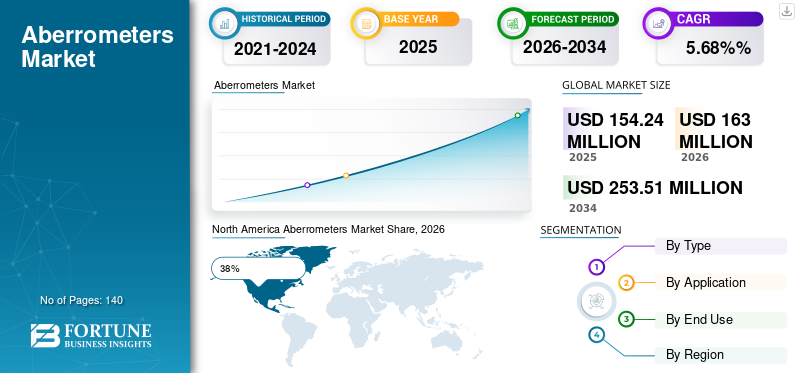
The aberrometers market size was valued at USD 154.24 Million in 2025. The market is projected to grow from USD 163 Million in 2026 to USD 253.51 Million by 2034, exhibiting a CAGR of 5.68% during the forecast period. The market in Germany dominated with a revenue share of 28% in 2025.

The aberrometers market is witnessing steady expansion due to the growing emphasis on advanced ophthalmic diagnostics and precision vision correction. Aberrometers are specialized instruments used to measure optical imperfections in the eye, enabling ophthalmologists and optometrists to diagnose visual disorders with greater accuracy. The increasing prevalence of refractive errors, rising demand for customized laser vision correction procedures, and advancements in wavefront technology are supporting market development. Healthcare providers are integrating aberrometry systems into routine eye examinations to improve treatment outcomes and patient satisfaction. The aberrometers market Report indicates that innovation in diagnostic imaging, artificial intelligence integration, and digital eye care solutions is reshaping the competitive landscape. The aberrometers market Analysis highlights increasing adoption across hospitals, specialty eye clinics, and vision correction centers worldwide.
Download Free sample to learn more about this report.
 Global Market Size & Forecast
 Market Share
 Key Regional Highlights
North America
North America held the largest regional share at 38% in 2025, supported by advanced ophthalmic infrastructure.
Europe
Europe accounted for 29% of the global market, driven by increasing adoption of advanced eye-care technologies.
Asia-Pacific
Asia-Pacific represented 25% of the market, supported by rising vision disorders and expanding healthcare infrastructure.
U.S
The U.S. remains a major market, supported by strong demand for advanced ophthalmic diagnostics and refractive procedures.
Japan
Japan accounted for 24% of the Asia-Pacific market, supported by advanced eye-care facilities and growing adoption of precision diagnostics.
Read More

The United States represents one of the most technologically advanced markets for aberrometry systems. The growing burden of myopia, hyperopia, astigmatism, and age-related vision disorders has increased the demand for accurate diagnostic tools. Eye care providers across the country are investing in sophisticated wavefront-guided technologies to enhance refractive surgery planning and postoperative evaluation.
The expansion of private ophthalmology clinics, growing awareness of personalized vision correction, and strong adoption of premium ophthalmic equipment continue to strengthen the USA aberrometers market. Increasing utilization of diagnostic platforms in LASIK centers and cataract surgery facilities further contributes to market expansion. The presence of leading manufacturers, extensive healthcare infrastructure, and continuous technological innovation support the long-term outlook of the Aberrometers Industry Report in the United States.
One of the most significant aberrometers market Trends is the growing adoption of wavefront-guided refractive surgery procedures. Eye surgeons increasingly rely on detailed aberration mapping to customize treatments and improve visual outcomes. This trend is encouraging healthcare facilities to invest in high-precision diagnostic systems capable of identifying higher-order aberrations.
Download Free sample to learn more about this report.
Another notable trend in the aberrometers market Research Report is the integration of digital technologies and artificial intelligence into ophthalmic diagnostics. Modern devices offer automated analysis, enhanced imaging capabilities, and faster data processing. Manufacturers are also focusing on portable and compact systems that improve accessibility in smaller clinics. The increasing popularity of premium intraocular lenses and customized vision correction procedures is creating demand for highly accurate diagnostic measurements. Furthermore, teleophthalmology initiatives and digital eye care ecosystems are encouraging the adoption of advanced aberrometry platforms across both developed and emerging healthcare markets.
Rising Demand for Precision Vision Correction Procedures
The primary driver of the aberrometers market Growth is the increasing demand for highly personalized vision correction treatments. Patients undergoing LASIK, PRK, cataract surgery, and other refractive procedures increasingly seek superior visual outcomes beyond standard vision correction. Aberrometers provide detailed measurements of optical imperfections that cannot be detected through conventional eye examinations, enabling clinicians to create individualized treatment plans.
Growing awareness regarding eye health, increasing screen exposure, and rising prevalence of refractive disorders are encouraging patients to seek advanced diagnostic evaluations. Ophthalmologists are utilizing wavefront analysis to improve surgical precision and reduce postoperative complications. The adoption of premium intraocular lenses and customized laser treatments is further accelerating demand for aberrometry systems. As healthcare providers focus on delivering enhanced patient experiences and improved clinical outcomes, investments in advanced diagnostic technologies continue to expand. This trend significantly strengthens the aberrometers market Outlook and supports widespread adoption across hospitals, specialty clinics, and vision correction centers.
High Acquisition and Maintenance Costs of Advanced Systems
One of the key restraints affecting the aberrometers market is the substantial cost associated with acquiring and maintaining advanced diagnostic equipment. Modern aberrometry systems incorporate sophisticated imaging technologies, software platforms, and analytical tools, resulting in significant capital expenditure for healthcare facilities.
Small clinics and independent practitioners often face budget limitations that restrict the adoption of premium ophthalmic devices. In developing healthcare markets, financial constraints and limited reimbursement policies further impact purchasing decisions. Regular calibration, software upgrades, and maintenance requirements also contribute to ongoing operational expenses. Additionally, specialized training is often required for clinicians and technicians to utilize advanced systems effectively. These factors may slow adoption among cost-sensitive healthcare providers. Although technological advancements continue to improve device capabilities, affordability remains an important challenge influencing the overall aberrometers market Size and limiting penetration in certain regions.
Expansion of Personalized Ophthalmic Care Solutions
The growing trend toward personalized healthcare presents substantial opportunities for the aberrometers market. Patients increasingly expect customized treatment plans tailored to their unique visual requirements. Aberrometry technology plays a critical role in supporting individualized diagnosis, surgical planning, and postoperative assessment.
The increasing use of premium cataract procedures, customized contact lenses, and advanced refractive surgeries creates a favorable environment for market expansion. Emerging healthcare markets are investing in modern ophthalmic infrastructure, opening new growth avenues for manufacturers. Technological advancements such as artificial intelligence-assisted diagnostics and cloud-based patient management systems further enhance the value proposition of aberrometry platforms. Companies developing integrated diagnostic ecosystems can capitalize on rising demand for comprehensive eye care solutions. As precision medicine gains greater acceptance across healthcare sectors, the aberrometers market Opportunities continue to expand, creating favorable conditions for long-term industry development.
Limited Availability of Skilled Ophthalmic Professionals
A major challenge confronting the aberrometers market is the shortage of trained professionals capable of interpreting complex wavefront data and integrating findings into clinical decision-making. Advanced aberrometry systems generate extensive diagnostic information that requires specialized expertise for accurate analysis.
In several developing regions, access to qualified ophthalmologists and refractive surgery specialists remains limited. Healthcare facilities may hesitate to invest in advanced diagnostic equipment if adequate training resources are unavailable. Additionally, variations in clinical protocols and diagnostic standards can affect utilization efficiency. The challenge becomes more significant as technologies become increasingly sophisticated and data-intensive. Manufacturers must invest in education programs, user-friendly software interfaces, and technical support services to address these concerns. Overcoming workforce-related limitations is essential for maximizing the benefits of advanced aberrometry technologies and supporting broader market adoption.
Harmann-Shack Wavefront systems account for approximately 68% of the aberrometers market Share, making them the leading technology segment within the industry. These systems utilize a lenslet array to measure wavefront distortions and generate detailed maps of optical aberrations. Their ability to provide highly accurate and repeatable measurements has made them a preferred choice among ophthalmologists and refractive surgeons.
The widespread adoption of Harmann-Shack Wavefront technology is supported by its proven effectiveness in LASIK planning, cataract surgery assessment, and comprehensive vision analysis. Healthcare providers value the technology's ability to identify both lower-order and higher-order aberrations, contributing to improved patient outcomes. Many premium ophthalmic diagnostic platforms incorporate Harmann-Shack technology because of its reliability and compatibility with advanced treatment systems. Continuous improvements in imaging resolution, software algorithms, and data processing capabilities further strengthen the segment's position within the aberrometers market Forecast.
The segment also benefits from growing demand for customized refractive procedures and personalized eye care services. Hospitals and specialty clinics increasingly prefer Harmann-Shack-based systems due to their established clinical validation and broad application range. As investments in ophthalmic infrastructure continue to increase globally, the adoption of these systems is expected to remain strong.
Ray Tracing Wavefront systems represent approximately 32% of the aberrometers market Share. These devices employ multiple laser rays projected into the eye to measure optical performance and create detailed aberration profiles. Ray tracing technology is recognized for its ability to provide highly individualized measurements, particularly in complex clinical cases.
The increasing use of advanced refractive surgery techniques and premium vision correction procedures is supporting growth within this segment. Ray Tracing Wavefront systems are particularly valuable for patients with irregular corneas, previous surgical interventions, or unique optical characteristics. Their ability to deliver precise diagnostic information enhances treatment customization and supports superior visual outcomes.
Manufacturers continue to improve system speed, accuracy, and user experience, making ray tracing technology increasingly attractive to ophthalmic specialists. Growing awareness of personalized vision correction and rising investments in specialized eye care facilities are contributing to greater adoption. As healthcare providers seek innovative diagnostic solutions capable of supporting advanced clinical workflows, the Ray Tracing Wavefront segment continues to gain recognition within the broader Aberrometers Industry Analysis.
To know how our report can help streamline your business, Speak to Analyst
Myopia applications account for approximately 46% of the aberrometers market Share. The increasing prevalence of myopia worldwide has made this segment a major focus area for ophthalmologists and vision correction specialists. Aberrometry systems help identify subtle optical irregularities that influence visual quality in myopic patients.
The growing use of customized LASIK procedures, orthokeratology treatments, and advanced contact lens solutions supports demand for aberrometry technology within this application area. Eye care professionals rely on detailed wavefront measurements to optimize treatment outcomes and improve patient satisfaction. Increasing digital device usage and prolonged screen exposure continue to contribute to rising myopia incidence across various age groups.
The segment benefits from strong clinical demand, technological innovation, and growing awareness regarding early vision correction. As healthcare providers prioritize personalized treatment planning, myopia-related applications are expected to remain a key contributor to overall aberrometers market Growth.
Hyperopia applications represent approximately 24% of the aberrometers market Share. Patients experiencing farsightedness often require comprehensive diagnostic assessments to identify underlying optical aberrations and determine suitable treatment options. Aberrometry systems provide valuable information that supports customized correction strategies.
Growing demand for refractive surgery and premium intraocular lens implantation procedures contributes significantly to segment expansion. Ophthalmologists utilize detailed wavefront data to enhance treatment precision and optimize visual performance. The increasing aging population and greater awareness regarding vision correction options further support adoption within this application category.
Technological advancements enabling more accurate measurements and improved patient outcomes continue to strengthen the role of aberrometry in hyperopia management. Healthcare providers increasingly recognize the benefits of detailed optical analysis when designing individualized treatment plans for farsighted patients.
End-use applications account for approximately 30% of the aberrometers market Share and encompass hospitals, ophthalmology clinics, ambulatory surgical centers, academic institutions, and specialized vision correction facilities. These healthcare settings represent the primary users of advanced aberrometry systems.
Hospitals continue to invest in sophisticated ophthalmic diagnostic equipment to support comprehensive eye care services. Specialty eye clinics increasingly adopt advanced wavefront technologies to enhance refractive surgery planning and patient management. Academic institutions utilize aberrometry systems for research and training purposes, contributing to technological advancement and clinical education.
Growing demand for premium eye care services, increasing surgical volumes, and continuous improvements in diagnostic accuracy support expansion across all end-use categories. The segment remains essential to the overall aberrometers market Outlook because healthcare providers increasingly prioritize precision diagnostics and personalized treatment approaches.
North America Aberrometers Market Share, 2026 (%)
To get more information on the regional analysis of this market, Download Free sample
North America remains the leading regional market for aberrometers, accounting for approximately 38% of the global market share. The region benefits from advanced healthcare infrastructure, strong adoption of ophthalmic diagnostic technologies, and a high volume of refractive surgeries. Eye care providers continue to invest in wavefront-guided diagnostic equipment to improve treatment precision and patient outcomes. The widespread availability of specialized ophthalmology centers and vision correction clinics supports consistent demand for advanced aberrometry systems.
The region also benefits from favorable healthcare spending patterns and continuous technological innovation. Increasing awareness of personalized vision correction procedures and growing demand for premium cataract surgeries contribute to market expansion. Research institutions and academic medical centers actively participate in clinical studies focused on enhancing ophthalmic diagnostics. The growing prevalence of myopia, hyperopia, and age-related visual disorders further strengthens the demand for advanced diagnostic solutions. Manufacturers continue to introduce enhanced imaging capabilities, software improvements, and integrated diagnostic platforms, reinforcing North America's position in the aberrometers market Report.
Europe accounts for approximately 29% of the global aberrometers market Share. The region demonstrates strong demand for advanced eye care technologies due to increasing awareness regarding visual health and the growing adoption of customized refractive treatments. Healthcare providers across major European countries are investing in precision diagnostic equipment to improve clinical outcomes and support patient-specific treatment planning.
The market benefits from well-established healthcare systems, strong ophthalmology research activities, and growing utilization of premium intraocular lenses. Refractive surgery centers increasingly incorporate advanced wavefront analysis into clinical workflows to enhance procedural accuracy. Continuous investments in healthcare modernization and digital diagnostics contribute to market development. The increasing prevalence of visual disorders among aging populations creates sustained demand for comprehensive eye examinations and advanced diagnostic tools. As innovation continues across the ophthalmology sector, Europe remains an important contributor to the global Aberrometers Industry Analysis.
Germany represents approximately 28% of the European aberrometers market. The country has a highly developed healthcare system and a strong tradition of medical technology adoption. Ophthalmologists and vision correction specialists increasingly utilize advanced wavefront technologies to improve diagnostic precision and treatment customization. The growing demand for premium eye care services continues to support market expansion.
German healthcare facilities maintain a strong focus on technological excellence and clinical quality. Eye clinics frequently invest in sophisticated diagnostic platforms to support refractive surgery planning and postoperative assessments. Research collaborations between healthcare institutions and medical device manufacturers contribute to innovation within the ophthalmology sector. Rising awareness regarding preventive eye care and increasing demand for personalized vision correction procedures further strengthen the market outlook. Germany remains one of the most influential markets for advanced ophthalmic diagnostics within Europe.
The United Kingdom accounts for approximately 22% of the European aberrometers market. Demand for advanced ophthalmic diagnostic technologies continues to rise as healthcare providers focus on improving patient outcomes and expanding access to specialized eye care services. The increasing popularity of customized refractive surgeries contributes significantly to market growth.
Eye care professionals in the United Kingdom increasingly rely on advanced diagnostic tools to support treatment planning and patient management. The country's established network of hospitals, specialty clinics, and vision correction centers provides a favorable environment for technology adoption. Investments in digital healthcare transformation and modern ophthalmology infrastructure further enhance market prospects. Growing awareness regarding visual health, coupled with increasing demand for precision diagnostics, supports continued expansion of the United Kingdom aberrometers market.
Asia-Pacific holds approximately 25% of the global aberrometers market Share and represents one of the fastest-developing regional markets. The increasing prevalence of myopia, expanding healthcare infrastructure, and rising awareness regarding advanced eye care solutions are key factors supporting regional growth. Countries throughout the region are investing heavily in modern ophthalmic facilities and diagnostic technologies.
Rapid urbanization, changing lifestyles, and increased screen exposure contribute to higher rates of refractive disorders. As a result, demand for sophisticated diagnostic tools continues to rise. Private healthcare providers and specialty eye care centers are increasingly adopting advanced aberrometry systems to enhance service quality and support customized treatment approaches. Government initiatives aimed at improving healthcare accessibility further contribute to market expansion. The Asia-Pacific aberrometers market Outlook remains highly favorable due to ongoing investments in healthcare modernization and technological advancement.
Japan represents approximately 24% of the Asia-Pacific aberrometers market. The country is recognized for its advanced healthcare system and early adoption of innovative medical technologies. Ophthalmologists frequently utilize sophisticated diagnostic equipment to support accurate vision assessments and personalized treatment planning.
The growing elderly population contributes to increased demand for cataract surgeries and comprehensive eye care services. Japanese healthcare providers emphasize precision and quality, encouraging the adoption of advanced wavefront analysis systems. Continuous innovation in ophthalmic diagnostics and strong investments in healthcare technology support market development. The country's commitment to clinical excellence and patient-centered care positions Japan as a key market within the regional ophthalmology sector.
China accounts for approximately 34% of the Asia-Pacific aberrometers market. Rapid healthcare infrastructure development and increasing awareness regarding eye health are driving demand for advanced diagnostic technologies. The country experiences a significant burden of myopia and other refractive disorders, creating substantial opportunities for ophthalmic equipment manufacturers.
Investments in specialized eye hospitals, vision correction centers, and healthcare modernization initiatives continue to strengthen market growth. The increasing availability of advanced medical technologies across urban healthcare facilities supports wider adoption of aberrometry systems. Rising disposable incomes and growing demand for premium healthcare services further contribute to market expansion. China's large patient population and ongoing healthcare transformation make it one of the most important growth markets within the global Aberrometers Industry Report.
The Rest of World region accounts for approximately 8% of the global aberrometers market Share. This segment includes Latin America, the Middle East, and Africa, where demand for advanced ophthalmic diagnostics continues to increase gradually. Improving healthcare infrastructure and expanding access to specialized eye care services support market development across these regions.
Governments and private healthcare providers are investing in modern medical equipment to improve diagnostic capabilities and address growing vision care needs. Rising awareness regarding refractive disorders and preventive eye examinations contributes to increasing adoption of advanced diagnostic technologies. Although market penetration remains lower than in developed regions, ongoing healthcare investments and growing demand for quality ophthalmic services create favorable opportunities for future growth. The Rest of World market is expected to benefit from continued healthcare modernization initiatives and increasing access to advanced vision correction solutions.
The aberrometers market presents attractive investment opportunities driven by the growing demand for advanced ophthalmic diagnostics and personalized vision correction. Investors are increasingly focusing on companies developing innovative wavefront technologies, artificial intelligence-assisted diagnostic systems, and integrated ophthalmic platforms. The expansion of specialty eye care centers and refractive surgery clinics creates favorable conditions for equipment manufacturers and technology providers.
Emerging markets offer particularly strong opportunities due to healthcare infrastructure development and increasing awareness regarding eye health. Investments in portable diagnostic systems, cloud-based patient management platforms, and advanced imaging technologies are expected to generate significant returns. Strategic partnerships between healthcare providers and technology developers are also supporting market expansion. The increasing demand for premium cataract procedures and customized refractive treatments enhances the long-term investment outlook for the aberrometers market.
Innovation remains a major focus within the aberrometers market. Manufacturers are introducing advanced diagnostic systems that combine wavefront analysis, corneal topography, and ocular imaging within a single platform. These integrated solutions improve clinical efficiency and provide comprehensive diagnostic information for treatment planning.
Artificial intelligence and machine learning technologies are increasingly incorporated into new product designs. Enhanced software capabilities enable automated data interpretation, faster diagnostics, and improved clinical decision support. Manufacturers are also developing compact and portable devices to improve accessibility in smaller clinics and remote healthcare settings. Advanced connectivity features support seamless integration with electronic medical records and digital healthcare ecosystems. Continuous product innovation strengthens competitive positioning and supports future market expansion.
The aberrometers market Research Report provides comprehensive analysis of industry trends, market dynamics, competitive developments, technological advancements, and regional growth patterns. The report evaluates key factors influencing demand for advanced ophthalmic diagnostic equipment and examines the role of wavefront technology in modern vision correction procedures.
Request for Customization to gain extensive market insights.
The report includes detailed segmentation by type, application, and geography, providing insights into market share distribution and growth opportunities across various regions. It assesses competitive strategies, product innovation activities, and investment trends shaping the industry landscape. The analysis also examines healthcare infrastructure developments, emerging technologies, and evolving patient preferences influencing market performance. Comprehensive coverage of major manufacturers, regional outlooks, and future opportunities makes the report a valuable resource for stakeholders, investors, healthcare providers, and industry participants seeking strategic insights into the global aberrometers market.
Fortune Business Insights says that the global market value stood at USD 154.24 million in 2025 and is projected to reach USD 253.51 million by 2034.
The market is expected to exhibit a CAGR of 5.68% during the forecast period of 2026-2034.
Harmann-Shack Wavefront was the leading type segment, accounting for approximately 68% of the market, owing to its accurate and repeatable measurement of optical aberrations.
Key players include Topcon Healthcare, Carl Zeiss Meditec, Essilor Instruments, Luneau Technology USA, SCHWIND eye-tech-solutions, and Alcon Inc.
Major trends include increasing adoption of wavefront-guided refractive surgery and integration of AI and digital technologies into ophthalmic diagnostics. North America led the market with approximately 38% share.


(Offer valid till 31st Oct 2026)
Get 30-60 hrs Free Customization
Expand Regional and Country Coverage, Segments Analysis, Company Profiles, Competitive Benchmarking, and End-user Insights.













.webp)






Get In Touch With Us
US +1 833 909 2966 ( Toll Free )
Receive a tailored pricing based on your needs.
Discuss your questions with our industry experts.
Have questions? Get quick answers before you purchase.

