Activated Bleaching Earth Market Size, Share & Industry Analysis, By Application (Edible Oil & Fats, Mineral Oil & Lubricants) and Regional Forecast, 2026-2034
 Download Free Sample
Activated Bleaching Earth Market Overview
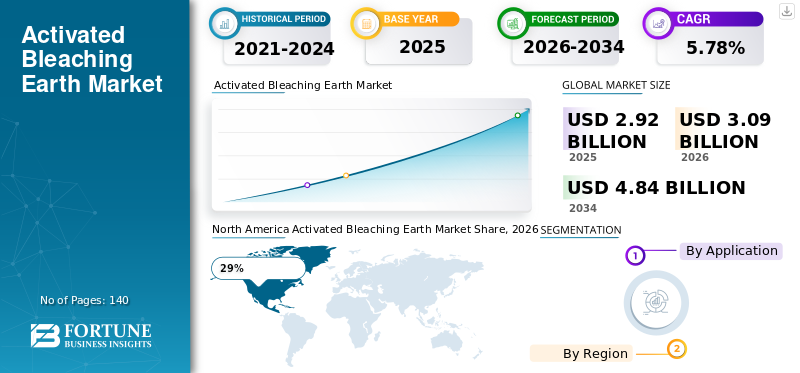
The global activated bleaching earth market size was valued at USD 2.92 billion in 2025. The market is projected to grow from USD 3.09 billion in 2026 to USD 4.84 billion by 2034, exhibiting a CAGR of 5.78% during the forecast period.

The Activated Bleaching Earth Market is witnessing strong demand from edible oil refining, lubricant purification, and industrial filtration industries due to increasing requirements for high-quality purification materials. Activated bleaching earth is extensively utilized for removing pigments, impurities, phospholipids, and oxidation products from vegetable oils and mineral oils. Growing consumption of processed edible oils, palm oil, sunflower oil, and soybean oil has accelerated product penetration across refining facilities worldwide. Activated Bleaching Earth market analysis indicates that manufacturers are focusing on high adsorption efficiency, improved filtration capacity, and low residual oil retention. Increasing industrialization, expansion of food processing infrastructure, and rising lubricant recycling activities continue supporting activated bleaching earth market growth globally.
The United States Activated Bleaching Earth Market is expanding steadily because of rising edible oil processing activities and advanced lubricant purification operations. The country accounts for nearly 18% share in the global Activated Bleaching Earth Market due to strong demand from soybean oil refining and industrial mineral oil treatment sectors. Food-grade oil purification standards across the United States are driving the adoption of high-performance activated clay solutions with superior adsorption characteristics. Activated Bleaching Earth Industry Analysis also highlights increasing investment in sustainable refining technologies and environmentally efficient bleaching earth disposal systems. Large-scale food manufacturing facilities, industrial lubricant recycling units, and biofuel production plants continue contributing significantly to market demand across the United States.
Download Free sample to learn more about this report.
Activated Bleaching Earth Market Key Takeaways
 Global Market Size & Forecast
- 2025 Market Size: USD 2.92 Billion
- 2026 Market Size: USD 3.09 Billion
- 2034 Forecast Market Size: USD 4.84 Billion
- CAGR: 5.78% from 2026-2034
 Market Share
- Asia-Pacific dominated with a 38% market share in 2025.
- Acid activated bleaching earth held the largest type share at 58%.
- Edible oil and fats applications led with a 74% market share.
 Key Regional Highlights
Asia-Pacific
Asia-Pacific led the market, supported by expanding edible oil refining industries.
North America
North America accounted for a 29% share, driven by industrial and lubricant purification demand.
Europe
Europe held a 24% share, supported by advanced refining infrastructure and environmental standards.
U.S.
Strong demand is supported by expanding edible oil refining and lubricant purification activities.
Japan
Demand is supported by established food processing and industrial refining applications.
Read More

Activated Bleaching Earth Market Latest Trends
The Activated Bleaching Earth market trends are evolving rapidly with increasing focus on high-purity edible oil refining and sustainable industrial filtration technologies. Manufacturers are introducing advanced activated clay grades with enhanced surface area and improved adsorption capacity to improve refining efficiency. Palm oil processing facilities are increasingly utilizing customized bleaching earth formulations to reduce color pigments and oxidation compounds more effectively. Activated Bleaching Earth market research report findings indicate that low-oil-retention products are gaining substantial popularity because refiners aim to reduce operational losses and improve profitability.
Download Free sample to learn more about this report.
Another major trend in the Activated Bleaching Earth Industry Report is the growing adoption of environmentally sustainable regeneration and recycling technologies. Several manufacturers are investing in thermally regenerated bleaching earth systems to minimize waste generation and support circular economy initiatives. Asia-Pacific remains a major production hub because of abundant bentonite clay reserves and rapidly growing edible oil industries. The demand for activated bleaching earth in lubricant purification is also increasing due to rising industrial automation and machinery maintenance requirements.
Activated Bleaching Earth Market Dynamics
DRIVER
Rising Demand for Refined Edible Oils
The increasing global demand for refined edible oils is one of the primary growth drivers for the Activated Bleaching Earth market size. Rising urbanization, packaged food consumption, and changing dietary habits are encouraging higher utilization of sunflower oil, palm oil, soybean oil, and canola oil across food manufacturing industries. Activated bleaching earth plays a critical role in removing impurities, chlorophyll, phosphatides, and carotenoids during refining processes. More than 72% of global edible oil refiners utilize activated bleaching earth during purification operations. Countries such as India, China, Indonesia, and the United States are witnessing rapid expansion of refining capacities, creating continuous demand for high-efficiency bleaching earth products. Activated Bleaching Earth market forecast studies also indicate strong growth in premium food-grade refining technologies due to rising food quality standards and increasing exports of refined oils globally.
RESTRAINT
Disposal and Environmental Management Concerns
Environmental concerns associated with spent bleaching earth disposal remain a major restraint affecting the activated bleaching earth market growth. Used bleaching earth contains absorbed oil residues, organic contaminants, and impurities that require controlled disposal or regeneration. Improper disposal may lead to soil contamination and fire hazards due to residual oil oxidation. Environmental regulations across Europe and North America are becoming increasingly strict regarding industrial waste management and landfill disposal. Approximately 28% of medium-scale oil refiners report higher operational expenses linked to bleaching earth disposal management. Activated Bleaching Earth market outlook assessments reveal that small refining companies often struggle with waste treatment infrastructure investments. Additionally, increasing awareness regarding sustainable industrial practices is encouraging industries to seek alternative purification technologies, which may slightly restrict the adoption of conventional bleaching earth products in certain regions.
OPPORTUNITY
Expansion of Lubricant Recycling Industries
The growing lubricant recycling and re-refining sector is creating substantial opportunities for the Activated Bleaching Earth market opportunities landscape. Industrial lubricant recycling facilities extensively utilize activated bleaching earth to remove contaminants, oxidation compounds, and metal particles from used oils. Global industrial automation and manufacturing growth have increased lubricant consumption significantly, resulting in rising demand for purification solutions. Activated Bleaching Earth market insights show that industrial lubricant recycling facilities expanded by nearly 16% globally during the last three years. Increasing focus on sustainable industrial operations and reduced petroleum waste generation is encouraging governments and industries to support oil re-refining projects. Emerging economies are investing heavily in industrial infrastructure and automotive manufacturing, which further increases demand for lubricants and associated purification materials. This trend is expected to create long-term opportunities for specialized activated bleaching earth suppliers.
CHALLENGE
Fluctuating Raw Material Quality and Supply
Maintaining consistent raw material quality remains a major challenge for the Activated Bleaching Earth Industry Analysis. Activated bleaching earth production depends heavily on high-quality bentonite clay reserves with specific adsorption and mineral properties. Variations in clay composition can directly affect bleaching efficiency, filtration performance, and oil retention characteristics. Mining regulations, transportation costs, and environmental restrictions are impacting the availability of suitable raw materials in several countries. Nearly 34% of manufacturers report operational inefficiencies due to fluctuations in clay quality and supply disruptions. Activated Bleaching Earth market research report findings also highlight that increasing fuel prices and logistics costs are affecting procurement expenses for manufacturers. In addition, intense competition among suppliers is pressuring companies to maintain high-quality standards while controlling production costs, creating operational challenges across the global market.
Activated Bleaching Earth Market Segmentation
By Type
Natural activated bleaching earth accounts for nearly 42% share of the Activated Bleaching Earth Market because of its cost efficiency and environmentally friendly processing characteristics. This type is widely used in medium-scale edible oil refining operations where moderate adsorption capacity is sufficient for purification requirements. Natural activated bleaching earth is extensively utilized for removing pigments, gums, and oxidation compounds from vegetable oils. Countries with large agricultural oil production sectors, including India, Indonesia, and Malaysia, are major consumers of natural activated bleaching earth products. Activated Bleaching Earth market analysis indicates that demand is increasing steadily due to rising consumption of refined cooking oils and expansion of regional food processing industries. Manufacturers are also focusing on improving mineral consistency and filtration properties to enhance operational performance and reduce residual oil retention during refining procedures.
Acid activated bleaching earth holds approximately 58% share in the Activated Bleaching Earth Market due to its superior adsorption efficiency and enhanced decolorization capability. Acid activation significantly improves surface area and pore structure, making this product highly suitable for advanced edible oil refining and lubricant purification applications. Large-scale palm oil and soybean oil refiners increasingly prefer acid activated bleaching earth because of its ability to remove trace contaminants and improve oil clarity. Activated Bleaching Earth Industry Report findings highlight growing utilization across high-capacity industrial refining facilities in Asia-Pacific, Europe, and North America. The segment is also benefiting from increasing demand for premium-quality food-grade oils and industrial lubricants. Manufacturers are investing in advanced acid activation technologies to improve product consistency, filtration speed, and adsorption performance while reducing environmental impact.
To know how our report can help streamline your business, Speak to Analyst
By Application
Edible oil and fats applications account for nearly 74% share of the Activated Bleaching Earth market size because bleaching earth remains an essential material in vegetable oil refining processes. Activated bleaching earth is widely utilized for refining palm oil, sunflower oil, soybean oil, rice bran oil, and canola oil. Growing consumption of packaged foods, processed snacks, bakery products, and ready-to-cook meals is increasing demand for refined edible oils worldwide. Activated Bleaching Earth market trends reveal that food manufacturers are emphasizing improved oil stability, color reduction, and oxidation control to enhance product quality and shelf life. Countries including China, India, Indonesia, and the United States continue expanding edible oil refining capacities to meet growing domestic demand. In addition, stringent food safety regulations are encouraging refiners to adopt high-performance bleaching earth products with superior adsorption efficiency.
Mineral oil and lubricant applications contribute approximately 26% share to the activated bleaching earth market growth and are witnessing steady expansion due to industrial automation and rising machinery utilization. Activated bleaching earth is utilized for removing contaminants, oxidation compounds, and impurities from lubricating oils and transformer oils. Manufacturing industries, automotive maintenance facilities, and lubricant recycling plants are major end users of bleaching earth products in this segment. Activated Bleaching Earth market outlook studies indicate that industrial lubricant recycling activities are increasing significantly because industries are emphasizing sustainable resource utilization and waste reduction. North America and Europe remain key markets for lubricant purification applications due to advanced industrial infrastructure and stringent environmental standards. Furthermore, increasing industrialization across Asia-Pacific is supporting additional growth opportunities for activated bleaching earth suppliers serving lubricant purification operations.
Activated Bleaching Earth Market Regional Outlook
North America
North America Activated Bleaching Earth Market Share, 2026 (%)
To get more information on the regional analysis of this market, Download Free sample
North America holds approximately 29% share of the Activated Bleaching Earth Market owing to strong industrial refining infrastructure and rising consumption of refined edible oils. The United States dominates regional demand because soybean oil refining facilities extensively utilize activated bleaching earth for impurity removal and color reduction. Canada also contributes significantly through industrial lubricant recycling and transformer oil purification activities. Activated Bleaching Earth market research report findings indicate that more than 64% of large-scale edible oil refiners in North America utilize advanced acid activated bleaching earth solutions for improved adsorption efficiency. Food-grade quality regulations and environmental waste management standards are encouraging refiners to adopt premium purification technologies. Industrial lubricant recycling plants are expanding rapidly across the region, supporting additional market demand. Manufacturers are increasingly focusing on sustainable spent bleaching earth disposal and regeneration systems to reduce environmental impact. Rising investments in food manufacturing facilities and industrial automation continue supporting long-term growth prospects for the North American Activated Bleaching Earth Market.
Europe
Europe represents nearly 24% share of the Activated Bleaching Earth Market and remains a technologically advanced region for edible oil purification and industrial filtration applications. Countries including Germany, France, Italy, and the United Kingdom have established refining industries that rely heavily on high-performance bleaching earth products. Activated Bleaching Earth Industry Analysis highlights strong demand for premium-grade activated clays with low residual oil retention and improved filtration characteristics. Environmental regulations regarding industrial waste management are encouraging manufacturers to invest in recyclable and sustainable bleaching earth solutions. More than 58% of European refiners have adopted enhanced adsorption technologies to comply with strict food safety and industrial purification standards. Lubricant recycling industries across Europe are also expanding steadily because of increasing focus on resource efficiency and environmental sustainability. Rising demand for processed food products, bakery items, and packaged cooking oils continues supporting market expansion throughout the region.
Germany Activated Bleaching Earth Market
Germany accounts for approximately 27% share within the Europe Activated Bleaching Earth Market due to advanced industrial refining infrastructure and strong food manufacturing activities. The country is a major consumer of activated bleaching earth for edible oil purification, industrial lubricants, and transformer oil treatment applications. Activated Bleaching Earth market forecast studies indicate increasing investment in sustainable refining technologies and efficient waste disposal systems across Germany. Industrial automation, automotive manufacturing, and lubricant recycling facilities continue driving product demand. Food-grade refining standards and quality certification requirements are encouraging oil processors to adopt premium acid activated bleaching earth products with improved adsorption performance and lower oil retention characteristics.
United Kingdom Activated Bleaching Earth Market
The United Kingdom holds nearly 18% share of the Europe Activated Bleaching Earth Market because of increasing edible oil processing activities and expanding industrial lubricant purification operations. Food manufacturers are emphasizing high-quality refined oils to meet consumer demand for packaged and processed food products. Activated Bleaching Earth market opportunities are increasing across the United Kingdom due to rising investments in sustainable industrial filtration technologies and lubricant recycling infrastructure. Industrial sectors including automotive, food processing, and manufacturing continue utilizing activated bleaching earth products for purification and contaminant removal applications. Regulatory emphasis on food safety and environmental protection is further supporting demand for advanced bleaching earth solutions.
Asia-Pacific
Asia-Pacific dominates the Activated Bleaching Earth Market with approximately 38% share due to rapid industrialization, abundant bentonite clay reserves, and massive edible oil refining capacities. China, India, Indonesia, Malaysia, and Japan are among the leading contributors to regional demand. Palm oil refining industries across Indonesia and Malaysia extensively utilize activated bleaching earth for decolorization and impurity removal processes. Activated Bleaching Earth market insights reveal that more than 68% of global palm oil refining activities are concentrated in Asia-Pacific. Rapid growth in processed food consumption and urbanization is accelerating demand for refined cooking oils throughout the region. China and India continue expanding refining infrastructure to support domestic consumption and export activities. Industrial lubricant recycling operations are also increasing significantly because of rising manufacturing output and machinery utilization. Manufacturers in the region are investing in advanced activation technologies and customized bleaching earth grades to improve refining efficiency and reduce operational costs.
Japan Activated Bleaching Earth Market
Japan contributes approximately 12% share within the Asia-Pacific Activated Bleaching Earth Market because of its highly advanced food processing and industrial purification industries. The country emphasizes premium-quality edible oil refining technologies and stringent industrial filtration standards. Activated Bleaching Earth market size in Japan is supported by rising demand for refined vegetable oils used in packaged foods, convenience meals, and industrial food manufacturing operations. Lubricant recycling and transformer oil purification sectors are also contributing steadily to market demand. Japanese manufacturers focus heavily on high adsorption efficiency, low residual oil retention, and environmentally sustainable purification technologies to maintain operational quality standards.
China Activated Bleaching Earth Market
China accounts for nearly 36% share within the Asia-Pacific Activated Bleaching Earth Market due to extensive edible oil refining infrastructure and strong industrial manufacturing activities. The country is one of the largest consumers of soybean oil, sunflower oil, and palm oil, resulting in significant demand for activated bleaching earth products. activated bleaching earth market growth is further supported by expanding industrial lubricant recycling operations and increasing food processing investments. More than 61% of large-scale Chinese oil refiners utilize acid activated bleaching earth for advanced decolorization and purification applications. Domestic manufacturers are also increasing investments in production capacity expansion and export-oriented activated clay manufacturing facilities.
Rest of World
The Rest of World region holds approximately 9% share of the Activated Bleaching Earth Market and includes Latin America, the Middle East, and Africa. Increasing edible oil consumption and industrial development are driving demand for activated bleaching earth products across these regions. Brazil and Argentina remain major consumers because of growing soybean oil refining industries. Middle Eastern countries are witnessing increasing utilization in industrial lubricant purification and transformer oil treatment operations. Activated Bleaching Earth market analysis shows that African countries are gradually expanding food processing infrastructure and edible oil refining capacities to meet domestic consumption requirements. Rising industrialization, urban population growth, and increasing packaged food demand are supporting market expansion throughout emerging economies. Manufacturers are focusing on regional distribution networks and localized production strategies to strengthen market presence across developing regions.
List of Top Activated Bleaching Earth Companies
- Clariant
- Taiko Group of Companies
- Indian Clay & Mineral Co.
- Ashapura Perfoclay Limited (APL)
- The W Clay Industries
- AMC (UK) Ltd.
- HRP Industries
- Manek Active Clay Pvt. Ltd.
- Oil-Dri Corporation of America
- Zeotec Adsorbents Private Limited
- EP Minerals
- Pheonix Chemicals (Pvt.) Ltd.
- 20 Microns Minerals Limited
- Musim Mas
- Shenzhen Aoheng Science and Technology
- Korvi Fullers Earth Processing Industry
- Refoil Earth PVT LTD.
- Global Bleach Chem Pvt. Ltd.
- PT. Tunasinti Bhaktimakmur
Top Two Companies with Highest Market Share
- Clariant – 14% market share
- Taiko Group of Companies – 11% market share
Investment Analysis and Opportunities
The Activated Bleaching Earth market opportunities landscape is attracting increasing investments due to rising edible oil refining capacities and expanding industrial lubricant purification activities. Manufacturers are investing heavily in production facility expansion, advanced activation technologies, and environmentally sustainable processing systems. Asia-Pacific remains a primary investment destination because of abundant bentonite reserves and growing demand from palm oil refining industries. Activated Bleaching Earth market forecast reports indicate that nearly 46% of recent investments are focused on improving adsorption efficiency and reducing residual oil retention.
Industrial lubricant recycling is creating substantial opportunities for activated bleaching earth suppliers as industries prioritize sustainable oil re-refining processes. Food processing companies are also increasing investments in high-purity oil refining technologies to comply with food safety regulations and improve product quality. Emerging economies including India, Indonesia, Vietnam, and Brazil are witnessing increased establishment of edible oil refining facilities, creating long-term procurement opportunities for bleaching earth manufacturers. Companies are additionally investing in research related to spent bleaching earth regeneration technologies to minimize waste disposal costs and improve environmental sustainability. Strategic collaborations between clay mining firms and refining companies are further strengthening supply chain stability and market expansion opportunities globally.
New Product Development
New product development activities in the Activated Bleaching Earth Market are primarily focused on improving adsorption efficiency, reducing oil retention, and enhancing environmental sustainability. Manufacturers are introducing advanced acid activated bleaching earth formulations with optimized pore structures and increased surface area to improve impurity removal performance. Several companies are developing customized bleaching earth grades specifically designed for palm oil, soybean oil, sunflower oil, and lubricant purification applications. Activated Bleaching Earth market trends indicate growing demand for low-dust and high-filtration-efficiency products that improve operational safety and refining productivity.
Research activities are also targeting regeneration and reuse technologies for spent bleaching earth to reduce disposal costs and environmental impact. Manufacturers are investing in thermally regenerated bleaching earth solutions capable of maintaining adsorption performance across multiple purification cycles. Advanced granulation and moisture control technologies are being integrated into product manufacturing to improve storage stability and operational handling. In addition, companies are developing eco-friendly activation processes aimed at reducing acid consumption and industrial emissions during production. These innovations are expected to strengthen product efficiency and support long-term sustainability goals across the Activated Bleaching Earth Industry Report landscape.
Five Recent Developments (2023-2025)
- In 2023, Clariant expanded its activated bleaching earth production capacity to support growing edible oil refining demand in Asia-Pacific.
- In 2023, Oil-Dri Corporation of America introduced enhanced adsorption bleaching earth products for industrial lubricant purification applications.
- In 2024, Taiko Group of Companies invested in advanced regeneration technology for sustainable spent bleaching earth recycling operations.
- In 2024, Ashapura Perfoclay Limited expanded export distribution networks across Europe and the Middle East for activated bleaching earth products.
- In 2025, Musim Mas implemented high-efficiency bleaching earth processing systems to improve palm oil refining performance and reduce filtration losses.
Report Coverage of Activated Bleaching Earth Market
The Activated Bleaching Earth Market Report provides comprehensive analysis of global industry performance, market trends, competitive landscape, and industrial purification developments. The report evaluates market segmentation based on type, application, and regional demand patterns across major refining industries. Activated Bleaching Earth market research report coverage includes detailed assessment of edible oil refining operations, lubricant purification activities, adsorption technologies, and environmental sustainability initiatives influencing market expansion.
Request for Customization to gain extensive market insights.
The Activated Bleaching Earth Industry Analysis further highlights regional market performance across North America, Europe, Asia-Pacific, and Rest of World with detailed evaluation of country-level refining activities and industrial growth trends. Competitive profiling of leading manufacturers, strategic investments, production expansions, and product innovation initiatives are included to provide extensive industry insights. Additionally, the report covers emerging opportunities in lubricant recycling, sustainable regeneration technologies, and premium food-grade oil purification solutions. Market dynamics including drivers, restraints, opportunities, and challenges are analyzed comprehensively to provide strategic understanding of the evolving Activated Bleaching Earth market outlook.
Frequently Asked Questions
Fortune Business Insights states that the global Activated Bleaching Earth Market was valued at USD 2.92 billion in 2025 and is projected to reach USD 4.84 billion by 2034.
The market is expected to grow at a CAGR of 5.78% during the forecast period of 2026–2034.
Edible oil and fats was the leading application segment, accounting for nearly 74% of the market, driven by its essential role in vegetable oil refining. By type, acid activated bleaching earth led with approximately 58% share due to its superior adsorption and decolorization capabilities.
Key players include Clariant, Taiko Group of Companies, Indian Clay & Mineral Co., Ashapura Perfoclay Limited (APL), The W Clay Industries, and AMC (UK) Ltd.
Major trends include rising demand for high-purity, low-oil-retention bleaching earth and growing adoption of sustainable regeneration and recycling technologies. Asia-Pacific remains a major production hub, supported by abundant bentonite reserves and rapidly expanding edible oil industries.



- 2021-2034
- 2025
- 2021-2024
- 140
-

(Offer valid till 15th Oct 2026)
Get 30-60 hrs Free Customization
Expand Regional and Country Coverage, Segments Analysis, Company Profiles, Competitive Benchmarking, and End-user Insights.


















-
US +1 833 909 2966 ( Toll Free )
-
Get In Touch With Us