 Download Free Sample



Get a Quote
Receive a tailored pricing based on your needs.
- Choose license type
- Multiple user options
- Custom scope & coverage
- Fast turnaround
"Designing Growth Strategies is in our DNA"
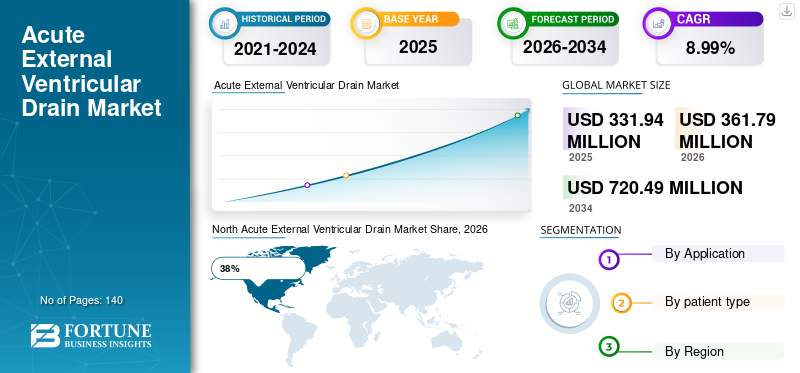
The global acute external ventricular drain market size was valued at USD 331.94 million in 2025. The market is projected to grow from USD 361.79 million in 2026 to USD 720.49 million by 2034, exhibiting a CAGR of 8.99% during the forecast period.

The acute external ventricular drain market is built around emergency neurosurgical care for patients who need immediate cerebrospinal fluid diversion and intracranial pressure control. In this market, external ventricular drain systems, ventricular catheters, drainage kits, and monitoring accessories are used in acute hydrocephalus, hemorrhagic stroke, and severe head trauma. Demand is shaped by ICU readiness, neurosurgical response time, and the need for short-term, sterile, high-reliability drainage solutions. The acute external ventricular drain market report, acute external ventricular drain market analysis, and acute external ventricular drain market research report all point to a niche but clinically essential device category with strong hospital dependence and high procedural urgency.
In the USA, the acute external ventricular drain market is supported by high emergency neurosurgery utilization, major trauma volume, and broad access to tertiary and quaternary care hospitals. U.S. ventriculostomy use has been estimated at about 20,000 patients annually, while traumatic brain injury continues to generate millions of emergency department visits, hospitalizations, and deaths each year. That clinical burden makes the United States the core demand center for the acute external ventricular drain market Size, acute external ventricular drain market growth, and acute external ventricular drain market outlook.
Download Free sample to learn more about this report.
 Global Market Size & Forecast
 Market Share
 Key Regional Highlights
North America
North America led the market with a 38% share, supported by advanced neurocritical care infrastructure and strong demand for emergency neurosurgical interventions.
Europe
Europe accounted for 27% of the market, driven by established healthcare systems and increasing demand for advanced neurological care.
Asia-Pacific
Asia-Pacific held a 25% share, supported by expanding healthcare infrastructure and growing adoption of neurosurgical technologies.
U.S
The U.S. remains a key market, supported by advanced neurocritical care facilities and high demand for external ventricular drainage systems.
Japan
Japan accounted for approximately 20% of the Asia-Pacific market, supported by advanced healthcare infrastructure and growing demand for specialized neurosurgical devices.
Read More

The acute external ventricular drain market trends are increasingly centered on infection reduction, procedural standardization, and smarter drainage control. Hospitals are prioritizing closed-system designs, antimicrobial-impregnated catheters, and protocol-driven insertion bundles because EVD-associated infections remain one of the most important complications in this category. Clinical literature shows that infection rates can be materially reduced through structured care pathways, and antimicrobial or silver-impregnated devices are frequently highlighted as effective options. This is pushing the Acute External Ventricular Drain industry report narrative toward safer, more standardized care pathways rather than simple hardware replacement.
Download Free sample to learn more about this report.
Another major trend in the acute external ventricular drain market analysis is the move toward better pressure monitoring and more consistent drainage control. Manufacturers are promoting systems that support accurate cerebrospinal fluid handling, controlled drainage, and easier bedside management in neurocritical care units. Recent product development also reflects a preference for short-term, clinically practical systems designed for emergency use rather than long-duration implantable infrastructure. In parallel, purchasing decisions are becoming more sensitive to workflow efficiency, nurse usability, and the ability to reduce repeat interventions. These themes are central to the acute external ventricular drain market forecast and acute external ventricular drain market Insights because they link directly to ICU utilization and neurosurgical throughput.
Rising Acute Neurocritical Care Demand and Emergency Neurosurgical Utilization.
The main growth driver in the acute external ventricular drain market is the sustained need for rapid cerebrospinal fluid diversion in life-threatening neurologic events. External ventricular drains are used as first-line or rescue treatment in acute hydrocephalus associated with aneurysmal subarachnoid hemorrhage, intracerebral hemorrhage, traumatic brain injury, and other causes of raised intracranial pressure. The procedure is widely viewed as lifesaving in neurocritical care, and U.S. procedure volume remains substantial. That creates recurring demand for catheters, drainage systems, monitoring accessories, and replacement kits across acute care hospitals. As emergency departments and neuro-ICUs seek faster response time and better outcomes, the acute external ventricular drain market growth profile remains tied to trauma load, stroke care, and intensive care infrastructure.
Infection Risk, Complication Burden, and Strict Clinical Handling Requirements.
The biggest restraint in the acute external ventricular drain market is the complication profile associated with the device. EVD placement is invasive, and published literature consistently identifies infection, hemorrhage, occlusion, and malposition as meaningful risks. EVD-related infections have historically been reported across a wide range, and hospital surveillance shows that poor handling, line breaks, and nonstandard practices can quickly erode outcomes. This constrains adoption in smaller facilities that lack trained neurocritical care teams or robust infection-control protocols. It also raises purchasing scrutiny because hospitals do not evaluate the system only on acquisition cost; they evaluate downstream cost from ventriculitis, ICU delay, and repeat procedures. These constraints continue to shape the Acute External Ventricular Drain industry analysis and the acute external ventricular drain market report landscape.
Infection-Resistant Systems, Protocolized Care Bundles, and Navigation-Enhanced Placement.
The strongest opportunity in the acute external ventricular drain market lies in products that reduce occlusion, infection, and placement variability. Hospitals are willing to pay for systems that support safer line management, fewer breaks in the drainage chain, and more reliable bedside operation. This opens opportunities for antimicrobial-impregnated catheters, closed drainage sets, better fixation components, and systems that simplify nurse handling and ICU monitoring. A further opportunity exists in standardized insertion kits and best-practice bundles that hospitals can deploy across neuro-ICU and emergency settings. Manufacturers that combine product performance with training support, workflow design, and infection-control messaging are well positioned in the acute external ventricular drain market opportunities space.
Clinical Variability, Reimbursement Pressure, and Dependence on Specialist Teams.
A major challenge in the acute external ventricular drain market is the variability in how hospitals manage placement, drainage targets, and removal protocols. EVD care depends heavily on neurosurgeons, neuro-intensivists, ICU nurses, and local institutional training, so adoption is uneven across care settings. Smaller hospitals may transfer patients rather than build full procedural capability, which limits addressable volume for certain suppliers. Reimbursement and procurement pressure also make it difficult for manufacturers to justify premium pricing unless they demonstrate lower complication risk and easier workflow integration. As a result, the acute external ventricular drain market outlook depends not just on clinical need, but on the ability of vendors to prove operational value in highly regulated hospital environments.
Traumatic Brain Injury holds an estimated 42% market share within the acute external ventricular drain market. This is the largest type segment because severe head trauma frequently demands urgent intracranial pressure management and CSF diversion in neurocritical care units. TBI is a major public health burden in the United States, and severe cases often require an EVD when intracranial pressure rises or hydrocephalus develops after injury. Hospitals use this segment heavily in emergency surgery, ICU stabilization, and monitoring workflows. The TBI-led share supports the acute external ventricular drain market Size and acute external ventricular drain market growth narrative because trauma care remains one of the most consistent sources of urgent neurosurgical intervention.
Subarachnoid Hemorrhage accounts for an estimated 33% market share in the acute external ventricular drain market. This segment is important because acute hydrocephalus after aneurysmal SAH is one of the clearest and most common indications for EVD placement. The need for immediate fluid diversion, pressure relief, and temporary drainage makes SAH a core use case for drainage systems in tertiary hospitals. Because SAH patients often require prolonged ICU observation and repeated pressure monitoring, hospitals tend to favor dependable drainage kits and consistent protocol adherence. This keeps the SAH segment highly visible in the acute external ventricular drain market forecast and the acute external ventricular drain market outlook.
Subarachnoid Hemorrhage: Intracerebral Hemorrhage represents an estimated 25% market share in the acute external ventricular drain market. In many ICH cases, acute hydrocephalus and elevated intracranial pressure create a direct need for external ventricular drainage, particularly when intraventricular extension is present. This segment is clinically important because patient outcomes depend on fast decompression and tightly managed drainage in intensive care. Although the patient population may be smaller than trauma, the intensity of use is high and the need for fast intervention is nonnegotiable. That makes ICH a stable contributor to the acute external ventricular drain market analysis and a meaningful driver of catheter and drainage kit usage.
To know how our report can help streamline your business, Speak to Analyst
Adults account for an estimated 78% share of the acute external ventricular drain market, while pediatric cases represent the remaining 22%. Adult demand is larger because aneurysmal SAH, ICH, severe TBI, and many ICU-linked hydrocephalus cases are concentrated in adult neurosurgery and neurocritical care. Adult patients also have broader hospital access, higher trauma exposure, and greater need for invasive emergency monitoring. This dominance makes adults the central demand base for the acute external ventricular drain market report, acute external ventricular drain market share discussion, and acute external ventricular drain market opportunities analysis.
Pediatric patients hold an estimated 22% share in the acute external ventricular drain market, and the segment is clinically sensitive rather than volume-dominant. Children require careful sizing, specialized neurocritical management, and close infection prevention because the clinical margin for error is smaller. Pediatric hydrocephalus, trauma, hemorrhage, and postoperative CSF diversion create a recurring but narrower demand base. Hospitals with pediatric ICUs and children’s neurosurgery programs often rely on customized drainage kits and dedicated training protocols. Even though the segment is smaller, it remains strategically important because product reliability, safe handling, and staff training are critical in pediatric care.
North America Acute External Ventricular Drain Market Share, 2026 (%)
To get more information on the regional analysis of this market, Download Free sample
North America holds 38% market share in the acute external ventricular drain market and remains the largest regional contributor. The region benefits from advanced neurocritical care infrastructure, a high concentration of trauma centers, and widespread access to specialized neurosurgical services. Hospitals across the United States and Canada routinely utilize external ventricular drain systems for managing traumatic brain injuries, subarachnoid hemorrhage, and intracerebral hemorrhage. The growing number of emergency neurological procedures continues to support product demand. Healthcare providers focus on improving intracranial pressure monitoring and patient outcomes through advanced drainage technologies. Strong adoption of infection-control protocols further drives procurement of high-quality ventricular drainage systems. Continuous investments in intensive care units and neurological treatment facilities strengthen market expansion. The presence of leading medical device manufacturers also contributes to product innovation and commercialization. These factors collectively reinforce North America's dominant position in the market.
Europe accounts for 27% market share in the acute external ventricular drain market and represents a mature healthcare region with strong neurosurgical capabilities. The market is supported by increasing incidence of stroke, traumatic brain injury, and hydrocephalus requiring emergency intervention. Hospitals throughout Europe are adopting advanced drainage systems to improve neurological care and reduce treatment complications. Growing investments in critical care infrastructure are enhancing the availability of specialized treatment services. Healthcare providers emphasize patient safety, infection prevention, and clinical efficiency when selecting ventricular drainage technologies. The region also benefits from active clinical research and continuous technological advancements in neurocritical care. Increasing awareness regarding early intervention for neurological emergencies further supports demand. University hospitals and specialized neuroscience centers play an important role in product utilization. Ongoing modernization of healthcare systems continues to create favorable conditions for market growth across Europe.
Germany represents 32% market share in the acute external ventricular drain market and remains one of Europe's leading healthcare technology markets. The country has a strong network of hospitals, university medical centers, and specialized neurosurgical facilities that frequently perform acute neurological interventions. Demand for external ventricular drainage systems is driven by increasing treatment volumes for traumatic brain injuries, intracerebral hemorrhage, and hydrocephalus. German healthcare providers prioritize advanced monitoring technologies and infection-prevention measures to improve patient outcomes. Hospitals continue investing in modern neurocritical care equipment and procedural capabilities. The country's strong medical device sector supports continuous innovation and product availability. Clinical standards emphasizing treatment accuracy further encourage adoption of high-quality drainage systems. research collaborations between healthcare institutions and manufacturers contribute to technological development. These factors position Germany as a key contributor to the European market landscape.
The United Kingdom holds 25% market share in the acute external ventricular drain market and continues to demonstrate stable demand for advanced neurocritical care technologies. The country benefits from a well-established healthcare system and increasing focus on improving emergency neurological treatment pathways. Hospitals utilize external ventricular drainage systems for the management of elevated intracranial pressure and acute cerebrospinal fluid diversion. Rising cases of stroke and traumatic brain injury contribute to sustained product demand. Healthcare providers emphasize clinical effectiveness, infection reduction, and efficient patient management when selecting drainage technologies. Ongoing investments in intensive care units and neurosurgical departments support technology adoption. The expansion of specialized neuroscience centers further strengthens utilization rates. Training initiatives aimed at improving critical care outcomes also contribute to market development. These factors collectively support the United Kingdom's position within the global market.
Asia-Pacific accounts for 25% market share in the acute external ventricular drain market and represents one of the fastest-developing regional markets. Rapid healthcare infrastructure expansion, increasing hospital construction, and rising investment in critical care facilities are major growth drivers. Countries throughout the region are improving access to advanced neurological treatment services and emergency care capabilities. Growing awareness regarding neurocritical care management supports adoption of external ventricular drainage systems. Increasing diagnosis rates for traumatic brain injuries, stroke, and hydrocephalus further contribute to demand. Healthcare providers are investing in modern monitoring and drainage technologies to enhance treatment quality. Expanding patient populations and improving healthcare accessibility create significant opportunities for manufacturers. Government healthcare initiatives continue to strengthen hospital infrastructure development. The combination of rising healthcare expenditure and growing clinical awareness supports long-term market expansion across Asia-Pacific.
Japan contributes 20% market share in the acute external ventricular drain market and maintains a highly advanced healthcare environment. The country has extensive experience in neurological disease management and sophisticated neurocritical care practices. An aging population contributes to increased incidence of stroke and other neurological disorders requiring intracranial pressure monitoring. Hospitals and specialized treatment centers invest heavily in advanced drainage technologies to improve patient safety and treatment accuracy. Healthcare providers emphasize precision, reliability, and infection prevention when selecting ventricular drainage systems. Strong clinical standards support widespread adoption of high-quality medical devices. Continuous technological innovation within the healthcare sector further strengthens market demand. research institutions actively contribute to improvements in neurocritical care practices. These factors make Japan an important market for acute external ventricular drainage products.
China represents 23% market share in the acute external ventricular drain market and continues to experience significant market expansion. Rapid development of healthcare infrastructure and increasing hospital capacity are driving demand for advanced neurocritical care technologies. Government initiatives focused on improving healthcare accessibility have accelerated the adoption of modern drainage and monitoring systems. Rising awareness regarding the treatment of traumatic brain injuries and hemorrhagic stroke supports market growth. Healthcare providers are investing in specialized neurosurgical services and intensive care units to address growing patient needs. Expanding trauma care networks further increase utilization of ventricular drainage products. Domestic manufacturing capabilities are also improving product availability throughout the country. Urban hospitals are increasingly adopting advanced technologies to enhance treatment outcomes. These developments continue to strengthen China's position within the global market.
Rest of World holds 10% market share in the acute external ventricular drain market and includes Latin America, the Middle East, and Africa. Healthcare systems across these regions are gradually modernizing through investments in hospital infrastructure and critical care services. Demand for external ventricular drainage systems is increasing as access to neurosurgical treatment becomes more widely available. Governments and private healthcare organizations are expanding emergency care capabilities and improving neurological treatment facilities. Rising awareness of intracranial pressure management is encouraging adoption of advanced drainage technologies. Healthcare providers are focusing on improving patient outcomes through enhanced critical care practices. Growing numbers of trauma and stroke cases support sustained demand for neurocritical care products. International collaborations and medical training initiatives are strengthening clinical capabilities. These developments continue to create growth opportunities across emerging healthcare markets.
The acute external ventricular drain market continues to attract investment due to the growing clinical importance of neurocritical care and emergency neurosurgical interventions. Healthcare providers are increasingly allocating capital toward advanced intracranial pressure management technologies and cerebrospinal fluid drainage systems that improve patient outcomes in intensive care settings. Investment activity is particularly focused on products that reduce infection rates, enhance drainage accuracy, and simplify bedside management.
Hospitals are expanding neurocritical care units to address rising cases of traumatic brain injury, intracerebral hemorrhage, and subarachnoid hemorrhage. This expansion creates procurement opportunities for manufacturers supplying ventricular catheters, drainage kits, and monitoring accessories. Investors are also supporting the development of antimicrobial-impregnated catheters and integrated monitoring platforms that align with hospital infection-control priorities.
Product innovation within the acute external ventricular drain market is focused on improving safety, infection prevention, and procedural efficiency. Manufacturers are developing advanced ventricular drainage systems incorporating antimicrobial technologies designed to reduce catheter-related infections and improve patient outcomes during extended neurocritical care treatment. Modern drainage systems increasingly feature enhanced pressure monitoring capabilities, allowing clinicians to manage cerebrospinal fluid drainage more accurately. Closed-system drainage designs are gaining popularity because they minimize contamination risks while supporting standardized clinical workflows. Companies are also introducing improved catheter materials that offer greater flexibility, durability, and biocompatibility during acute neurosurgical procedures.
Several manufacturers are investing in integrated solutions that combine drainage management with intracranial pressure monitoring functions. These systems support real-time clinical decision-making and improve operational efficiency within intensive care units. User-friendly designs aimed at reducing setup complexity and facilitating nursing management are becoming important differentiators in competitive markets. Innovation is also expanding into pediatric-specific products, where catheter dimensions and drainage systems are tailored to younger patients. Continued development of radiopaque materials, advanced fixation systems, and precision-engineered drainage components is helping healthcare providers improve treatment reliability. These technological advancements are expected to support long-term adoption across trauma centers, neurosurgical departments, and critical care facilities.
The acute external ventricular drain market report provides comprehensive coverage of products, technologies, applications, competitive developments, and clinical factors influencing industry expansion. The report evaluates external ventricular drainage systems used in neurocritical care environments for the management of elevated intracranial pressure, hydrocephalus, traumatic brain injury, intracerebral hemorrhage, and subarachnoid hemorrhage. The study includes detailed analysis of ventricular catheters, drainage systems, monitoring accessories, and related neurosurgical products used in hospitals and specialized treatment centers. It examines technological advancements, procurement trends, regulatory considerations, and product innovation strategies shaping competitive positioning across the industry.
Request for Customization to gain extensive market insights.
The report further analyzes market segmentation by clinical indication and patient type, providing insights into utilization patterns across adult and pediatric populations. Regional assessments evaluate healthcare infrastructure, neurosurgical capacity, critical care availability, and adoption trends affecting demand across major geographic markets. In addition, the report reviews strategic developments including mergers, acquisitions, product launches, manufacturing expansion initiatives, and research investments undertaken by leading industry participants. Competitive benchmarking highlights market share positioning, portfolio strengths, and innovation activities among key companies.
Fortune Business Insights says that the global market value stood at USD 331.94 million in 2025 and is projected to reach USD 720.49 million by 2034.
The market is expected to exhibit a CAGR of 8.99% during the forecast period of 2026-2034.
Traumatic Brain Injury led the application segment with approximately 42% market share, driven by the need for urgent intracranial pressure management and cerebrospinal fluid diversion in severe head trauma cases.
Key players include Medtronic, Integra LifeSciences, Spiegelberg GmbH & Co. KG, Sophysa, Natus Medical Incorporated, and Neuromedex GmbH.
Major trends include increasing adoption of infection-resistant and antimicrobial-impregnated drainage systems and improved pressure monitoring and controlled drainage technologies. North America led with approximately 38% market share.


(Offer valid till 15th Nov 2026)
Get 30-60 hrs Free Customization
Expand Regional and Country Coverage, Segments Analysis, Company Profiles, Competitive Benchmarking, and End-user Insights.













.webp)






Get In Touch With Us
US +1 833 909 2966 ( Toll Free )
Receive a tailored pricing based on your needs.
Discuss your questions with our industry experts.
Have questions? Get quick answers before you purchase.

