Adaptive Clothing Market Size, Share & Industry Analysis, By Type (Top Wear, Bottom Wear, Innerwear, One-Piece Apparel, and Others), By Function (Sensory-friendly Wear, Medical & Care Access Wear, and Others), By Gender (Men, Women, and Unisex), By Distribution Channel (Offline and Online), By End-User (Children, Adults, and Geriatric), and Regional Forecast, 2026-2034
 Download Free Sample
(Offer valid till 15th Oct 2026)

KEY MARKET INSIGHTS
 Listen to Audio Version
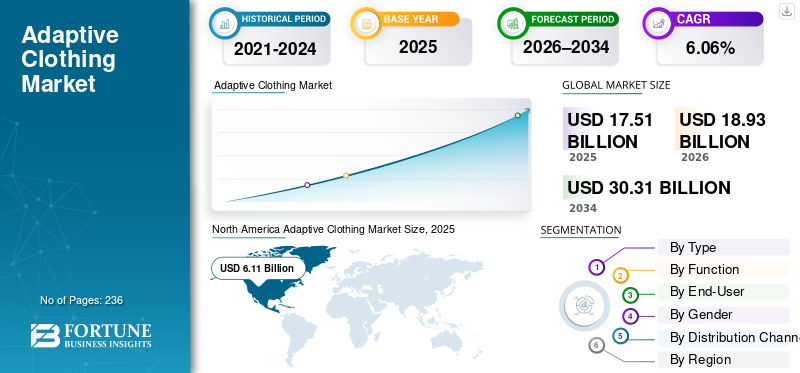
The global adaptive clothing market size was valued at USD 17.51 billion in 2025. The market is projected to grow from USD 18.93 billion in 2026 to USD 30.31 billion by 2034, exhibiting a CAGR of 6.06% during the forecast period. North America dominated the adaptive clothing market with a market share of 34.89% in 2025.
Adaptive clothing features magnetic closures, easy-access openings, and soft fabrics, making it easier for individuals with disabilities or mobility issues to dress. The growing awareness of the availability of products with unique designs is driving demand for adaptive clothing. Additionally, advancements in the development of adaptive wearables, which incorporate sensors and medical assistive devices, are positively contributing to the industry's growth. For instance, in January 2025, Primark, a U.K.-based High Street fashion industry retailer, launched an affordable range of adaptive garments for kids. The range of products includes trench coats, tees, jumpers, and jeans.
Key companies in the global market include PVH Corp., Nike, Inc., American Eagle Outfitters, Inc. (AEO), Creation Confort, and NBZ Apparel International.
Download Free sample to learn more about this report.
ADAPTIVE CLOTHING MARKET KEY TAKEAWAYS
 Market Size & Forecast
- 2025 Market Size: USD 17.51 Billion
- 2026 Market Size: USD 18.93 Billion
- 2034 Forecast Market Size: USD 30.31 Billion
- CAGR: 6.06% from 2026–2034
 Market Share
- North America dominated the adaptive clothing market with a 34.89% share in 2025.
- Top wear led the market with a 28.74% share in 2025.
- Sensory-friendly wear is projected to grow at the fastest CAGR of 6.81% from 2026–2034.
 Key Regional Highlights
North America
North America held a 34.91% share in 2025.
Europe
Europe accounted for 30.19% of global revenue in 2025.
Asia Pacific
Asia Pacific reached USD 4.40 billion in 2025 and will grow at a 7.23% CAGR.
U.S.
The market was valued at USD 4.92 billion in 2025, representing 28.08% of global revenue.
Japan
The market reached USD 0.65 billion in 2025, accounting for 3.69% of global revenue.
Read More

ADAPTIVE CLOTHING MARKET TRENDS
Rising Demand for Wearables With Personalized Features to Augment Market Growth
The rising demand for wearables with personalized features that cater to individuals' varying mobility levels, medical conditions, and body types is driving product demand. In addition, advancements in digital design tools, online configuration platforms, and flexible manufacturing models are making personalized adaptive wearables more scalable, driving global market growth.
Download Free sample to learn more about this report.
MARKET DYNAMICS
MARKET DRIVERS
Growing Disability Prevalence and Increasing Adaptive Wearable Benefits to Drive Market Growth
The growing prevalence of disabilities or mobility issues, along with increasing awareness of the benefits of wearing adaptive apparel that assists individuals in disease control and prevention, is driving the global adaptive clothing market growth. In addition, the rising number of the geriatric population suffering from reduced mobility, arthritis, and surgeries increases the demand for adaptive wearables across many countries. According to the U.K. Parliament, the percentage of people with disabilities as a percentage of the total population in the U.K. increased from 20% in 2014-15 to 25% in 2022-23.
MARKET RESTRAINTS
High Product Cost Compared to Conventional Apparel to Restrain Market Growth
Adaptive wearables are usually designed with alternative closures, reinforced openings for caregivers’ access, and sensory-friendly construction. These products are typically sold at higher prices than conventional apparel. The high price of such products is limiting their demand among middle-income consumer groups worldwide. Furthermore, the absence of universally accepted design guidelines for adaptive apparel is leading to inconsistencies among buyers regarding fitting comfort and functionality, which negatively impacts global product demand.
MARKET OPPORTUNITIES
Growing Manufacturers’ Partnerships with Hospitals and Rehabilitation Centers to Create New Market Growth Opportunities
The growing partnerships between manufacturers and retailers, hospitals, rehabilitation centers, and old age hostels that require significant usage of adaptive wearables for assisted living, are creating new market growth opportunities. Additionally, consistent recommendations from healthcare professionals for the use of adaptive wearables to aid patients with mobility issues are expected to favor product demand.
MARKET CHALLENGES
Supply Chain & Manufacturing Complexities to Challenge Key Players’ International Business Operations
Adaptive wearables require specialized components, including magnetic closures, reinforced openings, and customized pattern construction, that are not readily available through the standard apparel supply chain. Uncertainty in the availability of such components poses challenges to key players conducting their business operations. In addition, increasing fuel costs and transport delays due to uncertain incidents of war or natural disasters are threatening key players' supply chains and hampering their product sales growth.
Segmentation Analysis
By Type
Greater Need for Functional Modifications in Top Wear for User Adoption Led Dominance of the Segment
By type, the market is segmented into top wear, bottom wear, innerwear, one-piece apparel, and others. The top wear segment exhibited a leading global adaptive clothing market share of 28.74% in 2025. Top wear, including shirts, blouses, jackets, and others, is designed with magnetic closures and side openings, making them essential for users’ upper body movement. The segment’s leading share is attributed to the greater need of users to wear top wear that exhibits enhanced functional modification features. In addition, the growing use of adaptive tees as a regular wearable and the increasing trend of home rehabilitation are driving the segment’s growth.
To know how our report can help streamline your business, Speak to Analyst
The one-piece apparel segment is projected to grow at the fastest CAGR of 6.91% from 2026 to 2034. The growing adoption of one-piece clothing among hospitals, elderly care facilities, and rehabilitation centers, where minimal dressing effort is required, is driving the growth of the segment.
By Function
High Number of Patients Requiring Access Wears for Daily Dressing Led the Dominance of the Medical & Care Access Wear Segment
Based on function, the market is divided into sensory-friendly wear, medical & care access wear, and others. The medical & care access wear segment exhibited a leading global market share of 43.38% in 2025. The segment’s leading share is attributed to the significant number of disabled consumers and patients at hospital facilities needing access to wearables for daily dressing, medical care, or mobility support. In addition, the growing aging population and increasing prevalence of chronic conditions are expanding the demand for medical wearables worldwide.
The sensory-friendly wear segment is projected to grow at the fastest CAGR of 6.81% from 2026 to 2034. The rising demand for wearable devices for sensory sensitivity among children with autism spectrum disorder (ASD) and neurodivergent individuals is driving segment growth. Furthermore, the growing number of mainstream brands launching sensory-friendly apparel collections of specialized designs is positively contributing to the segment’s growth.
By End-User
Greater Awareness of Functional and Inclusive Apparel among Adults Led Segment’s Dominance
Based on end-user, the market is divided into children, adults, and the geriatric. The adult segment exhibited a leading global market share of 62.22% in 2025. The segment’s leading share is attributed to the greater awareness of functional and body-inclusive apparel among adults suffering from physical disabilities, chronic conditions, and post-surgery recovery worldwide. Additionally, the high purchasing power of adult consumers, compared to their younger counterparts, is generating considerable revenue from the segment.
The children's segment is projected to grow at the second-fastest rate, 5.87%, from 2026 to 2034. The growing awareness of neurodiversity and inclusive education has led to an increased acceptance of adaptive wearables among children. The increasing prevalence of early-age physical disabilities & sensory sensitivities and increasing acceptance of such products are driving the segment’s growth.
By Gender
High Apparel Consumption and Significant Emphasis on Comfort and Aesthetic Appeal Led to the Dominance of the Women's Segment
Based on gender, the market is divided into men, women, and unisex. The women's segment exhibited a leading global market share of 48.65% in 2025. The segment’s leading share is attributed to the greater emphasis on ease of dressing, comfort, and aesthetic appeal among women consumers worldwide, and their high consumption of adaptive apparel. Additionally, changing women's apparel fashion trends are augmenting the segment’s growth.
The men segment is projected to grow at the second-fastest rate of 6.11% from 2026 to 2034. The growing prevalence of chronic diseases & mobility issues among men, combined with increasing consumers’ accessibility to innovative sensor-based adaptive wearables, is accelerating the growth of the segment.
By Distribution Channel
Physical Stores Enabling Users' Physical Evaluation and Fit Assessment of Product Led Offline Segment’s Dominance
Based on distribution channel, the market is segmented into offline and online. The offline segment exhibited a leading global market share of 65.01% in 2025. Specialty clothing shops and supermarkets allow users to evaluate product performance through fit assessments, physical evaluations, and personal assistance provided at the store. Significant adaptive wearables purchases at physical retailing shops are generating considerable revenues from the offline segment. Additionally, the increasing number of specialty shops offering products at discounted rates is positively contributing to the segment’s growth.
The online segment is projected to grow at the fastest rate, with a 7.08% increase from 2026 to 2034. The rising adoption of online shopping for specialty clothing among consumers, combined with the growing number of online platforms offering a greater variety of products with mobility assistance features, is favoring the growth of the segment.
Adaptive Clothing Market Regional Outlook
By region, the market is categorized into North America, Europe, Asia Pacific, South America, and the Middle East & Africa.
North America
North America Adaptive Clothing Market Size, 2025 (USD Billion)
To get more information on the regional analysis of this market, Download Free sample
The North America region exhibited a leading global market share of 34.91% in 2025 and is expected to maintain its leading position during the forecast period from 2026 to 2034. The region’s market size reached USD 5.62 billion in 2023 and USD 5.78 billion in 2024. High prevalence of physical disability & mobility issues and greater adoption of lifestyle apparel are generating considerable product sales across the region. In addition, the consistent introduction of AI technology-based wearables by manufacturers, which provide real-time monitoring status for users, is uplifting demand for such products across the region.
U.S Adaptive Clothing Market
The U.S. market size reached USD 4.92 billion in 2025. The U.S. market accounted for around 28.08% of the global market sales in 2025. The presence of well-established healthcare, rehabilitation, and assisted living facilities, along with high demand for innovative clothing, is generating considerable product revenues across the U.S.
Asia Pacific
The Asia Pacific region’s market is projected to grow at the fastest rate of 7.23% from 2026 to 2034. The region’s market size reached USD 4.40 billion in 2025, securing the third-largest market position in the region. The growing elderly population and increasing awareness of the benefits of adaptive clothing in mobility assistance are driving product demand across the region. Furthermore, the expansion of infrastructural facilities, including hospitals, medical clinics, and rehabilitation centers, utilizing innovative products, is positively contributing to market growth across the region.
Japan Adaptive Clothing Market
In Japan, the market in 2025 is around USD 0.65 billion, accounting for roughly 3.69% of global product revenues. The growing collaborations between manufacturers and healthcare and elderly care systems are favoring market growth across Japan.
China Adaptive Clothing Market
China’s market is projected to be one of the largest worldwide, with revenues estimated at around USD 1.95 billion in 2025, representing roughly 11.16% of global product sales.
India Adaptive Clothing Market
In India, the market in 2025 stood at around USD 1.05 billion, accounting for roughly 6.00% of the global market revenues.
Europe
In Europe, the region is expected to exhibit a second leading global market position during the forecast period (2026-2034). The market size reached USD 5.29 billion in 2025, accounting for approximately 30.19% of the global product sales. The rising demand for easy-to-wear adaptive garments for home-based eldercare and post-surgery recovery is driving growth in the region.
U.K Adaptive Clothing Market
The U.K. market in 2025 reached around USD 0.91 billion, representing approximately 5.20% of global product revenues.
Germany Adaptive Clothing Market
Germany’s market reached approximately USD 1.31 billion in 2025, equivalent to around 7.48% of global product sales.
South America and the Middle East & Africa
The market in the South America and Middle East & Africa regions is expected to witness a moderate growth from 2026 to 2034. The market in South America in 2025 reached a valuation of USD 0.90 billion. The growing urbanization and increasing construction of hospitals and medical clinics, which prefer easy-to-access wearables for their patients, are driving the growth of the South American market. The government's assistance in building commercial infrastructure facilities, including rehabilitation centers that require extensive use of adaptive wearables, is positively contributing to market development across the Middle East & African regions. In the Middle East & African market, South Africa reached a market value of USD 0.32 billion in2025.
UAE Adaptive Clothing Market
The UAE market is projected to reach approximately USD 0.28 billion in 2025, accounting for roughly 1.58% of the global market revenues.
COMPETITIVE LANDSCAPE
Key Industry Players
Consistent Focus on Portfolio Expansion and Retail Partnerships to Help Key Players Maintain their Market Position
The key players operating in the global market include PVH Corp., Nike, Inc., American Eagle Outfitters, Inc. (AEO), Creation Confort, and NBZ Apparel International. These players focus on launching innovative products to expand their product portfolio, increase their brand reach, and provide enhanced adaptive clothing solutions worldwide. Additionally, these players partner with specialty clothing retailers and online shopping portals to expand their product reach across global markets.
LIST OF KEY ADAPTIVE CLOTHING COMPANIES PROFILED
- PVH Corp. (U.S.)
- Nike, Inc. (U.S.)
- American Eagle Outfitters, Inc. (AEO) (U.S.)
- Creation Confort (Canada)
- NBZ Apparel International (U.S.)
- Adaptions by Adrian (U.S.)
- Active Adaptive (Australia)
- Easy Fashion (Canada)
- Tommy Hilfiger Licensing LLC (U.S.)
- Buck & Buck (U.S.)
KEY INDUSTRY DEVELOPMENTS
- December 2025: The Scottish Rite for Children corporation teamed up with Texas Woman’s University to manufacture adaptive apparel for children with mobility and medical issues.
- December 2025: Adaptt Apparel partnered with Beyond 21 to launch an adaptive apparel collection focused on mobility support and inclusive design.
- September 2025: Silverts, a North American brand, acquired IZ Adaptive, an award-winning adaptive apparel line, to broaden its innovation and distribution capabilities of stylish & functional clothing in North America.
- January 2025: Primark expanded its portfolio of adaptive apparel by launching a 49-piece adaptive apparel collection designed for people suffering from disabilities.
- September 2024: Zalando, a German retailer, launched a line of new adaptive fashion designer assortment of kids’ apparel, footwear, and other sportswear.
- August 2023: Denim & Co., an adaptive brand, launched a new apparel collection, Denim & Co. Adaptive, for patients using wheelchairs and those suffering from disabilities, post-surgery, and during recovery. The line includes a washable faux suede jacket, a denim shirt with full zipper access, a zipper cardigan, knit ankle pants, and knit jeans that are available for wheelchair users.
- November 2024: Rachel Thompson, a clothing upcycler, launched the adaptive fashion brand ‘Adapted Trends Clothing UK’ in the U.K. market.
REPORT COVERAGE
Request for Customization to gain extensive market insights.
Report Scope & Segmentation
|
ATTRIBUTE |
DETAILS |
|
Study Period |
2021-2034 |
|
Base Year |
2025 |
|
Estimated Year |
2026 |
|
Forecast Period |
2026-2034 |
|
Historical Period |
2021-2024 |
|
Growth Rate |
CAGR of 6.06% from 2026 to 2034 |
|
Unit |
Value (USD Billion) |
|
Segmentation |
By Type, Gender, Function, Distribution Channel, End-User, and Region |
|
By Type |
· Top Wear · Bottom Wear · Innerwear · One-Piece Apparel · Others |
|
By Gender |
· Men · Women · Unisex |
|
By Function |
· Sensory-friendly Wear · Medical & Care Access Wear · Others |
|
By Distribution Channel |
· Offline · Online |
|
By End-User |
· Children · Adults · Geriatric |
|
By Geography |
· North America (By Type, Gender, Function, Distribution Channel, End-User, and Country) o U.S. (By Type) o Canada (By Type) o Mexico (By Type) · Europe (By Type, Gender, Function, Distribution Channel, End-User, and Country) o Germany (By Type) o France (By Type) o Italy (By Type) o Spain (By Type) o U.K. (By Type) o Russia (By Type) o Rest of Europe (By Type) · Asia Pacific (By Type, Gender, Function, Distribution Channel, End-User, and Country) o China (By Type) o India (By Type) o Japan (By Type) o Australia (By Type) o Rest of Asia Pacific (By Type) · South America (By Type, Gender, Function, Distribution Channel, End-User, and Country) o Brazil (By Type) o Argentina (By Type) o Rest of South America (By Type) · Middle East & Africa (By Type, Gender, Function, Distribution Channel, End-User, and Country) o South Africa (By Type) o UAE (By Type) o Rest of the Middle East & Africa (By Type) |
Frequently Asked Questions
Fortune Business Insights says that the global market value stood at USD 17.51 billion in 2025 and is projected to reach USD 30.31 billion by 2034.
In 2025, the market value stood at USD 6.11 billion.
At a CAGR of 6.06%, the global market is forecasted to grow from 2026-2034.
By type, the top wear segment held the leading market share.
Growing prevalence of disabilities and increasing benefits of adaptive wearables are key factors driving the global market.
PVH Corp., Nike, Inc., American Eagle Outfitters, Inc. (AEO), Creation Confort, and NBZ Apparel International are among the prominent players in the market.
North America dominated the market in 2025.



- 2021-2034
- 2025
- 2021-2024
- 236
-
(Offer valid till 15th Oct 2026)
Get 30-60 hrs Free Customization
Expand Regional and Country Coverage, Segments Analysis, Company Profiles, Competitive Benchmarking, and End-user Insights.



















Related Reports
-
US +1 833 909 2966 ( Toll Free )
-
Get In Touch With Us