Adaptive Optics Market Size, Share & Industry Analysis, By Component (Deformable Mirrors, Wavefront Sensors, Control Systems), By End-use, and Regional Forecast, 2026-2034
 Download Free Sample
Adaptive Optics Market Overview
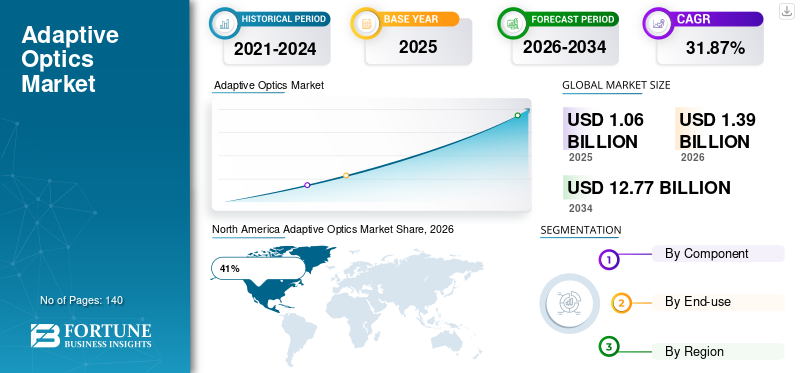
The global adaptive optics market size was valued at USD 1.06 billion in 2025. The market is projected to grow from USD 1.39 billion in 2026 to USD 12.77 billion by 2034, exhibiting a CAGR of 31.87% during the forecast period.

The adaptive optics market is experiencing significant expansion due to increasing demand for high-resolution imaging systems across astronomy, healthcare, defense, microscopy, and laser communication applications. Adaptive optics technology improves image quality by correcting optical distortions in real time using advanced sensors, deformable mirrors, and control systems. adaptive optics market Analysis indicates rising investments in retinal imaging, space observation programs, and directed energy systems continue accelerating global market demand. Research institutions, healthcare facilities, and defense organizations increasingly deploy adaptive optics solutions to improve imaging precision and operational efficiency. Growing focus on advanced optical technologies and scientific innovation continues strengthening adaptive optics market Growth globally.
The United States adaptive optics market remains one of the largest global markets because defense agencies, medical institutions, and research laboratories increasingly invest in advanced optical imaging technologies. Adaptive optics systems are widely utilized across astronomical observatories, ophthalmology centers, military surveillance platforms, and laser communication networks throughout the country. Adaptive Optics Industry Report findings indicate strong demand for wavefront correction technologies, high-speed deformable mirrors, and AI-integrated optical systems across the U.S. market. Expansion of defense modernization initiatives, biomedical imaging research, and space exploration projects continues strengthening the competitive landscape across the United States adaptive optics industry.
Download Free sample to learn more about this report.
Adaptive Optics Market Key Takeaways
 Global Market Size & Forecast
- 2025 Market Size: USD 1.06 Billion
- 2026 Market Size: USD 1.39 Billion
- 2034 Forecast Market Size: USD 12.77 Billion
- CAGR: 31.87% from 2026-2034
 Market Share
- North America dominated with a 41% market share in 2025.
- Deformable mirrors led by component with approximately 44% market share.
- Astronomy and defense led by end-use with nearly 58% market share.
 Key Regional Highlights
North America
North America held the largest regional share at 41%.
Europe
Europe accounted for 27% of the global market.
Asia-Pacific
Asia-Pacific represented 24% of the global market.
U.S.
The U.S. is a major market, supported by growing adoption of adaptive optics in astronomy, defense, and biomedical imaging.
Japan
Japan accounted for 22% of the Asia-Pacific market, driven by increasing demand for advanced optical technologies.
Read More

Adaptive Optics Market Latest Trends
The adaptive optics market Trends reveal increasing integration of artificial intelligence, machine learning algorithms, and high-speed computational imaging technologies into adaptive optics systems. Organizations increasingly utilize AI-powered adaptive optics platforms capable of improving wavefront correction accuracy and real-time imaging performance across scientific and industrial applications.
Download Free sample to learn more about this report.
Another major trend shaping the Adaptive Optics Industry Analysis is the rapid expansion of adaptive optics applications within ophthalmology and biomedical imaging. Healthcare institutions increasingly deploy adaptive optics retinal imaging systems to improve diagnosis of retinal diseases and microscopic abnormalities. Space agencies and astronomy research organizations are also investing heavily in next-generation adaptive optics technologies to improve telescope performance and deep-space observation capabilities.
Adaptive Optics Market Dynamics
DRIVER
Rising Demand for High-Resolution Imaging And Precision Optical Systems
The increasing requirement for high-resolution imaging technologies and precision optical correction systems remains one of the major drivers supporting adaptive optics market Growth globally. Healthcare providers, astronomy research institutions, and defense organizations increasingly adopt adaptive optics technologies to improve image quality and operational performance in challenging environments. adaptive optics market Analysis indicates rising deployment of adaptive optics in retinal imaging, laser communication, and space observation systems continues accelerating market demand. Advanced wavefront correction technologies and deformable mirror systems are increasingly utilized to reduce optical distortions and improve imaging accuracy. Expansion of scientific research activities and advanced defense surveillance initiatives further strengthens demand for adaptive optics solutions worldwide.
RESTRAINT
High Development Costs and Technical Complexity
One of the major restraints affecting the adaptive optics market is the high cost associated with system development, calibration, and advanced optical component manufacturing. Adaptive optics systems require precision engineering, high-speed sensors, and complex control algorithms, increasing operational and installation expenses for end users. Adaptive Optics Industry Report findings indicate limited technical expertise and expensive maintenance requirements continue restricting adoption among smaller organizations and research facilities. Integration challenges with existing imaging platforms and laser systems may also affect deployment efficiency. Additionally, long product development cycles and the need for specialized engineering expertise continue creating financial and operational limitations across the global adaptive optics industry.
OPPORTUNITY
Expansion of Biomedical Imaging and Space Research Applications
The rapid expansion of biomedical imaging technologies and advanced space exploration initiatives presents substantial opportunities for the adaptive optics market. Healthcare institutions increasingly seek adaptive optics systems capable of improving retinal imaging, microscopic diagnostics, and non-invasive medical imaging accuracy. adaptive optics market Opportunities are also growing because of rising investments in astronomical observation projects, quantum optics research, and laser communication infrastructure. Space agencies and scientific research organizations worldwide are increasingly deploying adaptive optics platforms to improve telescope imaging capabilities and optical system performance. Emerging economies investing in healthcare modernization and scientific research infrastructure continue creating strong commercial opportunities for adaptive optics manufacturers globally.
CHALLENGE
System Integration and Performance Optimization Requirements
The adaptive optics market faces significant challenges related to system integration complexity, real-time processing requirements, and performance optimization in dynamic operational environments. Adaptive optics systems require precise coordination between wavefront sensors, deformable mirrors, and control systems to maintain high imaging accuracy and operational stability. adaptive optics market Forecast studies indicate maintaining system responsiveness and calibration precision remains a major challenge for manufacturers and end users. Environmental factors such as atmospheric turbulence and optical interference may also impact system efficiency. Additionally, continuous technological advancements and increasing customer demand for compact and energy-efficient systems continue creating innovation pressures across the global adaptive optics industry.
Adaptive Optics Market Segmentation
By Component
Deformable mirrors account for approximately 44% share of the adaptive optics market because they are essential for correcting wavefront distortions and improving imaging precision in real-time optical systems. adaptive optics market Research Report findings indicate strong demand for deformable mirrors across astronomical telescopes, retinal imaging systems, laser communication platforms, and defense surveillance technologies. These mirrors are increasingly utilized because they provide rapid optical correction capabilities and high operational flexibility. Manufacturers continue introducing lightweight and high-actuator deformable mirror technologies designed to improve response speed and imaging resolution. Expansion of advanced microscopy applications and space observation projects continues strengthening growth within the deformable mirrors segment globally.
Wavefront sensors contribute nearly 33% share of the adaptive optics market because scientific research institutions and healthcare providers increasingly require accurate optical distortion measurement systems. adaptive optics market Trends indicate strong demand for Shack-Hartmann sensors and advanced wavefront analysis technologies across retinal imaging, laser systems, and telescope platforms. These sensors help improve optical system calibration and real-time image correction capabilities. Manufacturers increasingly develop compact and high-speed wavefront sensing technologies designed for precision imaging and defense communication systems. Expansion of biomedical imaging research and optical communication infrastructure continues supporting strong growth within the wavefront sensors segment worldwide.
Control systems account for approximately 23% share of the adaptive optics market because intelligent processing and real-time system coordination are critical for adaptive optics performance optimization. adaptive optics market Analysis highlights increasing deployment of advanced control electronics, AI-based processing platforms, and high-speed computational systems across scientific and defense imaging applications. These systems enable rapid synchronization between sensors and deformable mirrors to maintain imaging precision under dynamic operational conditions. Manufacturers increasingly invest in machine learning-enabled adaptive optics control systems designed to improve automation and operational efficiency. Expansion of autonomous defense systems and advanced microscopy technologies further supports strong demand within the control systems segment globally.
To know how our report can help streamline your business, Speak to Analyst
By End-use
The astronomy and defense sector holds nearly 58% share of the adaptive optics market because advanced optical correction systems are increasingly utilized in telescopes, surveillance technologies, directed energy systems, and laser communication platforms. adaptive optics market Trends indicate strong demand for adaptive optics technologies capable of improving long-range imaging accuracy and atmospheric distortion correction. Space agencies and defense organizations increasingly invest in high-resolution optical systems to improve observation and targeting capabilities. Healthcare and biomedical imaging contribute approximately 42% share because hospitals and research institutions increasingly deploy adaptive optics systems for retinal imaging, microscopy, and precision diagnostics. Expansion of healthcare research and scientific imaging applications continues driving global market growth.
Adaptive Optics Market Regional Outlook
North America
North America holds approximately 41% share of the adaptive optics market and remains one of the most technologically advanced regions for scientific imaging, defense modernization, and biomedical research. The United States dominates regional demand because healthcare institutions, defense agencies, and astronomy research organizations increasingly invest in advanced adaptive optics systems and optical correction technologies. adaptive optics market Analysis indicates strong deployment of deformable mirrors, wavefront sensors, and high-speed control systems across retinal imaging centers, telescope facilities, and laser communication platforms throughout the region. Canada also contributes significantly because of increasing investments in scientific research infrastructure and healthcare imaging modernization. adaptive optics market Trends reveal rising demand for AI-integrated adaptive optics technologies, compact optical correction systems, and advanced microscopy platforms across North America. Research institutions increasingly prioritize high-resolution imaging systems capable of improving scientific observation and medical diagnostics. Expansion of defense surveillance programs and biomedical innovation initiatives further strengthens demand for adaptive optics solutions throughout the region.
North America Adaptive Optics Market Share, 2026 (%)
To get more information on the regional analysis of this market, Download Free sample
Europe
Europe accounts for nearly 27% share of the adaptive optics market and remains a significant center for astronomy research, healthcare innovation, and optical engineering advancements. Scientific research organizations and healthcare institutions across the region increasingly adopt adaptive optics technologies to improve imaging precision and optical system performance. adaptive optics market Research Report findings indicate strong demand for deformable mirror systems, wavefront sensing platforms, and advanced retinal imaging technologies across Germany, the United Kingdom, France, and Italy. adaptive optics market Trends also highlight increasing investments in space observation infrastructure, laser communication systems, and biomedical microscopy applications throughout European industries. Governments and research institutions continue supporting optical science innovation and high-resolution imaging projects. Expansion of precision healthcare technologies and astronomy research facilities further contributes to market growth across the region. Manufacturers increasingly develop energy-efficient and compact adaptive optics systems designed for advanced research and healthcare environments. Rising demand for high-performance imaging solutions and scientific observation technologies continues strengthening Europe’s competitive position within the global adaptive optics industry.
Germany adaptive optics market
Germany represents nearly 26% share of the Europe adaptive optics market due to advanced engineering capabilities, strong scientific research infrastructure, and increasing adoption of precision optical technologies. German research institutions and healthcare organizations increasingly deploy adaptive optics systems across microscopy laboratories, astronomical observatories, and retinal imaging facilities. adaptive optics market Analysis in Germany highlights strong demand for high-speed wavefront correction technologies and advanced deformable mirror systems across scientific and defense sectors. Manufacturers increasingly invest in AI-powered optical correction platforms and biomedical imaging solutions to improve operational efficiency and imaging precision. Expansion of industrial research activities and healthcare modernization initiatives further strengthens Germany’s position within the European adaptive optics market.
United Kingdom adaptive optics market
The United Kingdom accounts for approximately 18% share of the Europe adaptive optics market because research laboratories and healthcare providers increasingly prioritize high-resolution optical imaging and advanced wavefront correction systems. adaptive optics market Trends indicate strong adoption of adaptive optics technologies across astronomy research, biomedical imaging, and laser communication applications throughout the country. Universities and scientific institutions continue investing in precision optical systems and advanced microscopy platforms designed to improve research capabilities and healthcare diagnostics. Expansion of defense surveillance modernization and optical communication research further supports market growth. Increasing focus on scientific innovation and medical imaging efficiency continues strengthening the United Kingdom adaptive optics industry.
Asia-Pacific
Asia-Pacific holds approximately 24% share of the adaptive optics market and is emerging as one of the fastest-growing regions due to expanding healthcare infrastructure, increasing scientific research investments, and rising space exploration initiatives. Countries such as China, Japan, India, and South Korea are witnessing strong demand for adaptive optics technologies across biomedical imaging, astronomy research, and defense surveillance applications. adaptive optics market Insights reveal increasing investments in retinal imaging systems, high-resolution microscopy platforms, and advanced telescope infrastructure throughout the region. Governments and research organizations increasingly prioritize optical science innovation and healthcare modernization to improve research and diagnostic capabilities. adaptive optics market Trends also indicate rising adoption of AI-integrated wavefront correction systems and compact adaptive optics technologies across Asia-Pacific scientific and industrial sectors. Expansion of semiconductor research, quantum optics programs, and laser communication infrastructure further strengthens demand for advanced adaptive optics systems throughout the region. Manufacturers increasingly introduce cost-effective and miniaturized optical correction platforms tailored for regional healthcare and scientific research requirements. Rising investments in space exploration and precision healthcare technologies continue supporting long-term market opportunities across Asia-Pacific.
Japan adaptive optics market
Japan contributes nearly 22% share of the Asia-Pacific adaptive optics market due to advanced optical engineering capabilities, strong healthcare infrastructure, and increasing investments in scientific imaging technologies. Japanese healthcare institutions and research laboratories increasingly deploy adaptive optics systems across retinal imaging, microscopy, and astronomy applications. adaptive optics market Analysis indicates strong demand for compact wavefront sensors, high-speed deformable mirrors, and intelligent optical control systems across scientific and industrial sectors. Manufacturers continue investing in miniaturized adaptive optics technologies and AI-enabled imaging platforms designed to improve precision and operational flexibility. Expansion of biomedical imaging research and space observation programs further supports Japan’s position within the regional adaptive optics industry.
China adaptive optics market
China represents approximately 44% share of the Asia-Pacific adaptive optics market due to rapid scientific infrastructure development, expanding healthcare modernization, and increasing investments in space exploration technologies. adaptive optics market Forecast studies indicate strong deployment of adaptive optics systems across astronomical observatories, healthcare imaging centers, and defense surveillance platforms throughout the country. Research institutions increasingly adopt advanced optical correction technologies to improve telescope performance and biomedical imaging capabilities. Expansion of laser communication infrastructure and precision optical manufacturing continues accelerating market growth across China. The country remains one of the largest emerging markets within the global adaptive optics industry because of rising investments in scientific innovation and advanced imaging technologies.
Rest of World
The Rest of World region accounts for nearly 8% share of the adaptive optics market and includes expanding scientific research and healthcare sectors across Latin America, the Middle East, and Africa. Increasing investments in advanced imaging infrastructure, optical communication systems, and biomedical research are supporting market expansion throughout these regions. adaptive optics market Analysis indicates growing adoption of adaptive optics systems among research laboratories, healthcare institutions, and defense organizations seeking high-resolution imaging and precision optical correction technologies. Latin American countries increasingly invest in healthcare modernization and scientific research facilities to improve diagnostic and research capabilities. The Middle East continues experiencing strong demand for advanced optical systems because of expanding defense modernization programs and space research initiatives. African markets are gradually increasing adoption of adaptive optics technologies because of improving healthcare infrastructure and scientific development programs. adaptive optics market Trends also reveal increasing collaboration between global adaptive optics manufacturers and regional research institutions to strengthen technology accessibility and innovation capabilities.
List of Top Adaptive Optics Companies
- Imagine Optic
- Boston Micromachines Corporation
- Thorlabs, Inc.
- Northrop Grumman Corporation
- Teledyne Technologies Incorporated
- ALPAO
- Hamamatsu Photonics
- Active Optical Systems LLC
- Iris AO
- Adaptica
Top Two Companies by Market Share
- Thorlabs, Inc. – Approximately 18% market share
- Boston Micromachines Corporation – Approximately 15% market share
Investment Analysis and Opportunities
The adaptive optics market is attracting substantial investments due to increasing demand for precision optical imaging, biomedical diagnostics, and space observation technologies. Research institutions, defense organizations, and healthcare providers are heavily investing in wavefront correction systems, deformable mirror technologies, and AI-integrated optical platforms designed to improve imaging accuracy and operational efficiency. adaptive optics market Opportunities are particularly strong in retinal imaging, laser communication, and advanced microscopy applications.
Investments in miniaturized adaptive optics systems, quantum imaging technologies, and intelligent optical processing platforms are increasing significantly because organizations increasingly prioritize high-resolution scientific imaging and precision healthcare diagnostics. adaptive optics market Research Report findings indicate strong funding activity within biomedical optics, defense surveillance systems, and space telescope modernization programs. Expansion of optical communication networks and healthcare research initiatives continues creating favorable commercial opportunities for adaptive optics manufacturers globally.
New Product Development
New product development within the adaptive optics market is heavily focused on AI-integrated imaging systems, compact deformable mirrors, and advanced wavefront sensing technologies. Manufacturers are increasingly introducing miniaturized adaptive optics platforms, high-speed control electronics, and intelligent optical correction systems designed to improve imaging precision and operational flexibility. adaptive optics market Trends indicate strong innovation in retinal imaging systems, laser communication technologies, and quantum optics applications.
Companies are also investing heavily in lightweight optical components, MEMS-based deformable mirrors, and automated calibration technologies capable of supporting advanced biomedical and scientific imaging environments. Real-time wavefront correction systems and cloud-enabled optical processing platforms are gaining substantial popularity because organizations increasingly seek scalable and high-performance imaging solutions. Adaptive Optics Industry Analysis highlights increasing demand for adaptive optics technologies tailored for microscopy, astronomy, and defense surveillance applications.
Five Recent Developments (2023-2025)
- Boston Micromachines Corporation expanded high-actuator deformable mirror production for astronomy and defense applications in 2024.
- Thorlabs, Inc. introduced advanced adaptive optics microscopy platforms for biomedical imaging in 2025.
- ALPAO strengthened development of ultra-fast wavefront correction technologies in 2023.
- Hamamatsu Photonics expanded adaptive optics imaging systems for retinal diagnostics and laser communication in 2024.
- Imagine Optic launched upgraded AI-enabled wavefront sensing platforms for scientific imaging applications in 2025.
Report Coverage of Adaptive Optics Market
The adaptive optics market Report provides comprehensive analysis of market trends, competitive landscape, regional performance, and technological advancements across the global precision optical imaging industry. The report evaluates major market segments including deformable mirrors, wavefront sensors, and control systems while analyzing end-use applications across healthcare, astronomy, defense, and scientific research sectors. adaptive optics market Research Report coverage includes detailed examination of AI-powered wavefront correction technologies, biomedical imaging systems, laser communication platforms, and advanced microscopy innovations influencing market expansion.
Request for Customization to gain extensive market insights.
The report further analyzes key growth drivers such as increasing demand for high-resolution imaging systems, expanding biomedical diagnostics infrastructure, and rising investments in astronomy and defense technologies. Market restraints related to high system development costs, technical complexity, and integration challenges are also assessed extensively. adaptive optics market Insights additionally highlight emerging opportunities associated with quantum optics, retinal imaging technologies, and intelligent optical communication systems.
Frequently Asked Questions
Fortune Business Insights says that the global market value stood at USD 1.06 billion in 2025 and is projected to reach USD 12.77 billion by 2034.
The market is expected to exhibit a CAGR of 31.87% during the forecast period of 2026-2034.
Deformable mirrors led the component segment with approximately 44% market share, as they are essential for correcting wavefront distortions and improving real-time imaging precision.
Key players include Imagine Optic, Boston Micromachines Corporation, Thorlabs, Inc., Northrop Grumman Corporation, Teledyne Technologies Incorporated, and ALPAO.
Major trends include growing integration of AI, machine learning, and high-speed computational imaging, along with expanding use in ophthalmology and biomedical imaging. North America leads the market with approximately 41% share.



- 2021-2034
- 2025
- 2021-2024
- 140
-

(Offer valid till 15th Sep 2026)
Get 30-60 hrs Free Customization
Expand Regional and Country Coverage, Segments Analysis, Company Profiles, Competitive Benchmarking, and End-user Insights.




















-
US +1 833 909 2966 ( Toll Free )
-
Get In Touch With Us