Advanced Composites Market Size, Share & Industry Analysis, By Resin Type (Thermoset and Thermoplastic), By Product Type (Glass Fiber, Carbon Fiber, Aramid Fiber, and Others), By Application (Automotive, Wind Energy, Aerospace & Defense, Sporting Goods, and Others), and Regional Forecast, 2026-2034
 Download Free Sample
Advanced Composites Market Analysis & Outlook
 Listen to Audio Version
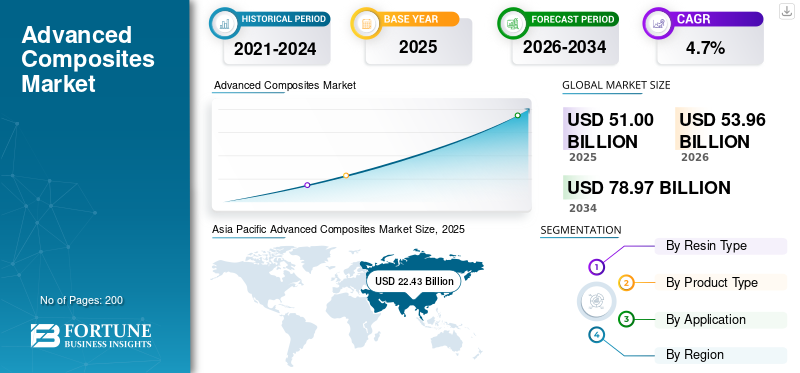
The global advanced composites market size was valued at USD 51.00 billion in 2025 and is projected to grow from USD 53.96 billion in 2026 to USD 78.97 billion by 2034, exhibiting a CAGR of 4.7% during the forecast period. Asia Pacific dominated the advanced composites market, with a 43.98% share in 2025.
Advanced composites are high-performance fiber-reinforced material systems engineered to deliver superior strength-to-weight ratio, corrosion resistance, fatigue durability, and thermal stability compared with conventional metals and standard plastics. The market includes thermoset and thermoplastic matrix systems reinforced primarily with glass fiber, carbon fiber, aramid fiber, and selected specialty fibers for structural and semi-structural applications. The growth of the market is driven by sustained demand from lightweight transportation, commercial aerospace, wind energy, and high-performance sporting applications.
The global advanced composites market is entering a new phase of industrial expansion as manufacturers increasingly prioritize lightweight, high-strength materials to improve performance, reduce lifecycle costs, and meet increasingly stringent sustainability objectives. Once concentrated primarily in aerospace applications, advanced composites have become integral to automotive manufacturing, renewable energy infrastructure, defense systems, marine engineering, sporting goods, and industrial equipment. This broadening application base is reshaping market size, investment priorities, and competitive positioning across the advanced composites industry.
Commercial adoption is increasingly supported by the convergence of material science innovation, automated manufacturing, and stricter environmental regulations. Original equipment manufacturers are evaluating advanced composites based on total lifecycle value rather than material substitution alone. Reduced structural weight, enhanced fatigue resistance, corrosion protection, and improved design flexibility contribute to measurable operational efficiencies, particularly in transportation and energy applications where performance improvements translate directly into lower operating costs and reduced emissions.
Carbon fiber composites continue expanding into premium structural applications where maximum strength-to-weight performance is essential, while glass fiber composites remain attractive for high-volume manufacturing because of their cost efficiency and processing versatility. Thermoplastic composite systems are attracting growing commercial interest due to shorter production cycles, recyclability, and compatibility with automated manufacturing processes, complementing the established position of thermoset materials across demanding structural applications.
Capital investment increasingly targets production automation, advanced resin systems, digital manufacturing, and supply chain localization. Manufacturers are expanding capacity while investing in automated fiber placement, resin transfer molding, and simulation-driven engineering to improve production efficiency and component consistency. These developments are reducing manufacturing complexity while supporting broader commercial adoption across multiple industries.
The market is dominated by several major players, including Toray Industries, Inc., Hexcel Corporation, Teijin Limited, SGL Carbon SE, and Johns Manville, which are at the forefront of the industry. Strong positions in reinforcement fibers, resin systems, prepregs, structural composites, and application engineering continue to reinforce their global market presence.
Download Free sample to learn more about this report.
Advanced Composites Market Key Takeaways
 Market Size & Forecast
- 2025 Market Size: USD 51.00 billion
- 2026 Market Size: USD 53.96 billion
- 2034 Forecast Market Size: USD 78.97 billion
- CAGR: 4.7% from 2026–2034
 Market Share
- Asia Pacific dominated the advanced composites market with a 43.98% share in 2025.
- The glass fiber segment accounted for the largest market share of 83.8% in 2025.
- The automotive segment accounted for the largest market share of 30.2% in 2025.
 Key Regional Highlights
Asia Pacific
Asia Pacific held the leading market position in 2025, valued at USD 22.43 billion, and is projected to reach USD 23.86 billion in 2026.
Europe
Europe is projected to grow at a CAGR of 4.2%, reaching a market value of USD 11.63 billion by 2026.
North America
North America is expected to witness steady growth, supported by strong aerospace, defense, wind energy, and high-performance industrial applications.
U.S.
U.S. The market is projected to reach USD 13.15 billion by 2026, driven by strong demand across aerospace, automotive, and industrial sectors.
Japan
Japan: Growing adoption of lightweight, high-performance composite materials in automotive, electronics, and advanced manufacturing is supporting market expansion.
Read More

Advanced Composites Market Trends
Investment Activities Across High-Performance Composites Are Boosting Market Demand
A notable trend in the market is the shift from purely commodity glass-fiber growth toward more engineered material systems tailored for aerospace, electric mobility, wind blades, hydrogen pressure vessels, and automated thermoplastic processing. Carbon fiber continues to expand in premium applications, but thermoplastic composites are also gaining relevance as they support faster cycle times, weldability, and better compatibility with high-volume manufacturing.
Investment activities across high-performance composites and downstream applications support the trend. For instance, Toray INDUSTRIES, INC’s carbon fiber outlook highlights rising demand from aerospace, pressure vessels, wind turbine blades, and sports equipment, while Hexcel Corporation’s recent performance reflects continued recovery in commercial aerospace. At the same time, Europe’s composites market data shows that thermoplastics are capturing a larger share of regional volume, indicating that process efficiency and application-specific material selection are becoming more important than simple tonnage growth.
The advanced composites market is increasingly characterized by the convergence of lightweight engineering, manufacturing automation, and sustainability-driven material innovation. Industries that traditionally relied on metals are expanding the use of advanced composites to improve structural performance while meeting stricter energy efficiency and emissions requirements. This transition is no longer limited to premium applications, as improvements in manufacturing processes are making composite materials commercially viable across broader industrial sectors.
Technologies such as automated fiber placement, automated tape laying, resin transfer molding, and robotic inspection are improving production consistency while reducing labor intensity and material waste. These advancements enable manufacturers to achieve higher production volumes without compromising dimensional accuracy or structural integrity, making advanced composites increasingly suitable for automotive, aerospace, and industrial manufacturing environments.
Demand is rising for thermoplastic composites that offer shorter processing cycles, enhanced impact resistance, weldability, and improved recyclability compared with conventional thermoset systems. At the same time, next-generation resin formulations are delivering greater thermal stability, chemical resistance, and durability, expanding the operational envelope of composite structures in demanding applications.
Furthermore, sustainability and circularity are becoming stronger competitive levers across the market. OEMs and material suppliers are increasingly prioritizing lower-emission manufacturing routes, recyclability, and lightweight substitution strategies that support fuel efficiency and electrification. As a result, advanced composites market growth is becoming more closely tied to technical qualifications, end-use performance, and the ability to deliver application-ready solutions rather than relying solely on raw material supply.
Download Free sample to learn more about this report.
Advanced Composites Market Growth Factors
Growing Usage of Product in Various Sectors Boosts Industry Expansion
Advanced composites continue to gain importance in applications where lightweighting, mechanical performance, and durability directly influence total system efficiency. In aerospace and defense, composite-intensive structures remain central to reducing fuel burn, optimizing aircraft range, improving corrosion resistance, and enhancing structural fatigue performance. Boeing’s 2025 Commercial Market Outlook forecasts demand for 43,600 new airplanes through 2044, while Airbus projected 42,430 deliveries between 2024 and 2043, supporting long-term structural demand for carbon-fiber-rich materials and advanced resin systems.
The automotive sector is also strengthening market demand, particularly through electric-vehicle platforms, battery enclosures, structural reinforcements, underbody systems, and lightweight thermoplastic parts. International Organization of Motor Vehicle Manufacturers (OICA) vehicle production and sales data continue to show Asia as the largest automotive manufacturing center, reinforcing the role of advanced composites in next-generation mobility. This demand is increasingly supported by thermoplastic systems, which are better suited to automated processing and higher-volume production.
Meanwhile, wind-energy expansion remains a major growth catalyst, especially for glass-fiber and carbon-assisted composite structures in blades and related components. Global wind additions reached another record in 2024, according to Global Wind Energy Council (GWEC), with China accounting for the largest portion of new installations. Consequently, the demand for the product continues to be supported by a combination of premium aerospace requirements and high-volume transportation and renewable energy applications.
The accelerating demand for lightweight, high-performance materials across transportation and industrial sectors remains the principal growth catalyst for the advanced composites market. Manufacturers are replacing conventional metals with composite materials to improve fuel efficiency, increase payload capacity, and enhance structural durability. This transition is particularly evident in aerospace, automotive, marine, and rail applications, where reducing component weight directly contributes to lower operating costs and improved environmental performance.
Aerospace and defense continue to represent a major source of market expansion. Commercial aircraft manufacturers, defense contractors, and space technology companies increasingly specify advanced composites for primary and secondary structures because of their superior strength-to-weight ratio, corrosion resistance, and fatigue performance. Rising investments in aircraft modernization, next-generation military platforms, unmanned aerial systems, and space exploration programs are sustaining long-term demand for carbon fiber-reinforced composite materials and advanced resin technologies.
Restraining Factors
High Process Complexity to Limit Product Adoption
A major restraint in the market is the high cost and complex processing of advanced composite systems compared to metals and conventional plastics. Carbon fiber, high-performance prepregs, engineered thermoplastics, and qualified resin systems remain substantially more expensive than incumbent material options, especially in cost-sensitive industrial applications. This limits adoption in programs where performance gains do not clearly justify the material and manufacturing premium.
Qualification requirements also slow market penetration, particularly in aerospace, defense, automotive, structural components, and energy applications. Composite material systems typically require application-specific testing for fatigue, impact resistance, fire behavior, long-term durability, and process reproducibility. These long validation cycles can delay commercialization and favor incumbent suppliers with established relationships, production history, and technical-service capabilities.
High production costs remain one of the most significant constraints affecting the advanced composites market. Compared with conventional materials such as steel and aluminum, advanced composites require specialized raw materials, precision manufacturing equipment, and technically skilled labor. Carbon fiber, advanced resin systems, and engineered reinforcement materials continue to command premium prices, limiting adoption in cost-sensitive industries where purchase decisions are heavily influenced by capital expenditure and total manufacturing costs.
Manufacturing complexity also presents a substantial challenge. Composite fabrication often involves multi-stage production processes, including material preparation, lay-up, curing, molding, machining, and quality inspection. Maintaining consistent fiber orientation, resin distribution, and structural integrity requires rigorous process control. Variations during production can affect component performance, increase rejection rates, and extend manufacturing lead times, particularly for highly engineered structural applications.
Supply chain concentration introduces additional operational risks. The production of high-performance carbon fibers and specialty resin systems remains concentrated among a relatively limited number of global suppliers. Disruptions related to raw material availability, logistics, geopolitical developments, or energy costs can influence procurement timelines and manufacturing expenses. Industries operating under long-term production schedules, particularly aerospace and defense, are especially sensitive to supply continuity and material qualification requirements.
Market Opportunities
Growing Use of Advanced Composites in Thermoplastic Processing Routes Presents Several Growth Opportunities
A significant opportunity lies in the growing use of the product in thermoplastic processing routes that support faster production, improved design integration, and potential recyclability benefits. Europe’s composites market data continue to indicate thermoplastics gaining share, reflecting stronger adoption in transport and industrial applications where productivity and assembly efficiency matter. Suppliers able to offer semi-finished materials, tapes, organo-sheets, and optimized joining solutions are well-positioned to benefit from this transition.
Hydrogen storage and pressure-vessel applications also present an attractive growth path, particularly for carbon-fiber-intensive composites. Toray Industries Inc.’s demand outlook explicitly identifies pressure vessels as one of the fastest-growing end uses for carbon fiber. As hydrogen mobility, gas storage, and energy-transition infrastructure advance, these applications can create premium demand channels that favor high-performance reinforcement systems and resin technologies.
The accelerating transition toward sustainable manufacturing presents significant long-term opportunities for the advanced composites market. Industries are increasingly seeking materials that reduce product weight, improve energy efficiency, and extend operational life without compromising structural performance. As governments and manufacturers pursue decarbonization strategies, advanced composites are becoming an important enabling technology for reducing emissions across transportation, renewable energy, construction, and industrial equipment. This shift is expected to broaden commercial adoption beyond traditional high-performance sectors.
Electric mobility continues to create attractive growth prospects throughout the advanced composites industry. Vehicle manufacturers are expanding the use of lightweight composite structures to improve battery efficiency, increase driving range, and optimize overall vehicle performance. Demand is rising for composite battery enclosures, body panels, structural reinforcements, suspension systems, and interior components as automotive producers seek scalable solutions that balance performance, safety, and manufacturing efficiency across both premium and mass-market electric vehicles.
The rapid expansion of offshore wind energy offers another substantial market opportunity. Larger turbine designs require longer, lighter, and more durable rotor blades capable of withstanding demanding environmental conditions over extended operating lifecycles. Advanced composite materials provide the mechanical strength, fatigue resistance, and corrosion protection necessary for next-generation wind turbines, supporting continued investment in renewable energy infrastructure across both developed and emerging economies.
Furthermore, urban air mobility, next-generation aircraft programs, defense modernization, and offshore wind represent additional long-term opportunities. Producers with integrated positions across fibers, prepregs, process support, and part-level engineering are better placed to capture these high-value programs, especially where customers require qualification assistance, design optimization, and reliable supply continuity.
Market Challenges
Strict Delivery Schedules to Hamper Market Development
The market faces persistent challenges in balancing growth with manufacturability, recyclability, and raw material availability. Carbon fiber and specialty resin systems require capital-intensive production, and supply imbalances can arise when demand from aerospace, energy, and industrial sectors accelerates simultaneously. This creates pressure on lead times, pricing, and customer planning, particularly in programs with strict delivery schedules.
At the same time, end users and regulators are paying closer attention to sustainability and end-of-life treatment. While advanced composites provide important in-use efficiency benefits through lightweighting, recycling and reprocessing pathways remain more complex than for many metals and commodity polymers. The challenge is therefore not limited to material performance; it also includes circularity, waste recovery, and practical reuse options for production scrap and retired components.
Furthermore, ramping production from prototype and qualification stages to stable commercial volumes can be difficult. Tooling, automation, fiber placement, resin control, cure consistency, and part inspection all affect execution quality. Suppliers must therefore compete on material properties and on throughput capability, reliability, and technical partnership throughout the product-development cycle.
Segmentation Analysis
By Resin Type
Thermoset Segment Led due to Rising Demand for Lightweight Automotive Structures
Based on resin type, the market is segmented into thermoset and thermoplastic.
Thermoset
The thermoset segment dominated the market in 2025, holding a substantial market share. This growth is driven by rising demand for lightweight automotive structures, battery-adjacent components, and industrial parts, where process efficiency, weldability, and design integration provide strong commercial advantages.
Thermoset composites continue to account for the largest market share within the advanced composites industry due to their proven structural performance, excellent dimensional stability, and broad acceptance across high-performance engineering applications. Epoxy, polyester, vinyl ester, and phenolic resin systems remain widely utilized because they provide superior mechanical strength, thermal resistance, chemical durability, and long-term fatigue performance under demanding operating conditions. These characteristics make thermoset composites the preferred material for aerospace structures, wind turbine blades, marine components, industrial equipment, and defense applications where structural integrity and reliability are critical over extended service lives.
Established manufacturing processes further reinforce market leadership. Resin transfer molding, vacuum-assisted resin infusion, filament winding, compression molding, and autoclave curing have undergone decades of industrial optimization, enabling manufacturers to achieve consistent product quality and certification across complex structural components. Aerospace and defense manufacturers continue relying on thermoset composites because extensive qualification data, established regulatory standards, and proven operational performance reduce certification risks while supporting stringent safety requirements.
Thermoplastic
The thermoplastic segment is anticipated to attain the highest compound annual growth rate (CAGR) of 4.5% throughout the forecast period. This growth is supported by its broad use in automotive, electrical, industrial, and semi-structural applications that benefit from faster cycle times and greater suitability for automated processing. Europe’s composites industry data also show thermoplastics accounting for the larger share of regional volume, reinforcing the commercial relevance of this material family in high-throughput manufacturing environments.
Thermoplastic composites are expected to register the fastest growth throughout the forecast period as manufacturers increasingly prioritize production efficiency, recyclability, and compatibility with automated manufacturing systems. Unlike conventional thermoset materials, thermoplastic composites can be reheated and reshaped, enabling faster manufacturing cycles, simplified assembly, and improved end-of-life material recovery. These advantages align closely with evolving sustainability objectives and circular economy initiatives adopted across multiple industrial sectors.
Automotive manufacturers represent one of the strongest demand drivers for thermoplastic composite adoption. High-volume vehicle production requires manufacturing technologies capable of supporting shorter cycle times while maintaining consistent quality standards. Thermoplastic composite systems satisfy these requirements through rapid molding processes, automated welding capabilities, and excellent impact resistance. Their use is expanding across structural body components, battery enclosures, interior modules, underbody protection systems, and lightweight reinforcement structures designed for electric vehicles.
Aerospace manufacturers are also increasing investment in thermoplastic composite technologies to improve production flexibility and reduce maintenance requirements. Enhanced damage tolerance, superior impact resistance, and reduced moisture absorption make thermoplastic materials attractive for aircraft interiors, secondary structures, and increasingly sophisticated structural applications. Improvements in high-performance polymers such as polyetheretherketone (PEEK) and polyetherketoneketone (PEKK) continue expanding commercial opportunities.
By Product Type
Glass Fiber Segment Dominated, Driven by its Extensive Use Across Transportation
Based on product type, the market is segmented into glass fiber, carbon fiber, aramid fiber, and others.
Glass Fiber
The glass fiber segment accounted for the largest advanced composites market share of 83.8% in 2025, supported by its extensive use across transportation, wind energy, marine, infrastructure, and general industrial applications. Even though advanced composites often attract attention through carbon-rich applications, industry volume remains strongly anchored in glass-fiber systems because they offer a favorable balance between cost, strength, corrosion resistance, and manufacturing flexibility.
Glass fiber composites continue to hold the largest market share within the advanced composites market owing to their balanced combination of mechanical performance, affordability, and manufacturing versatility. Although carbon and aramid fibers offer higher performance for specialized applications, glass fiber remains the preferred reinforcement material for industries requiring large production volumes and cost-efficient structural solutions. Its favorable strength-to-weight ratio, corrosion resistance, electrical insulation properties, and compatibility with multiple resin systems support widespread adoption across diverse industrial sectors.
Wind energy remains one of the largest consumers of glass fiber composites. RoInc .’s rotor blades for onshore and offshore wind turbines require lightweight structures capable of withstanding continuous cyclic loading and harsh environmental conditions over extended operating periods. Glass fiber provides the durability and fatigue resistance necessary for these demanding applications while maintaining commercially viable production costs. Continuous expansion of renewable energy infrastructure therefore remains a significant contributor to segment growth.
Carbon Fiber
The carbon fiber segment is expected to grow at a CAGR of 4.7% during the forecast period. Demand is being propelled by commercial aerospace recovery, hydrogen and gas pressure vessels, premium sporting goods, and selected automotive and wind applications. Toray Industries Inc.’s demand outlook for carbon fiber continues to highlight strong growth momentum across these end uses, reinforcing the long-term strategic significance of carbon-based composite systems.
Carbon fiber composites represent the premium segment of the advanced composites industry, serving applications where maximum structural performance, stiffness, and weight reduction are essential. Despite higher production costs, demand continues to expand because carbon fiber delivers exceptional strength-to-weight characteristics, outstanding fatigue resistance, low thermal expansion, and superior dimensional stability. These properties enable manufacturers to engineer complex lightweight structures capable of operating under demanding mechanical and environmental conditions.
Aerospace and defense remain the largest consumers of carbon fiber composites. Commercial aircraft, military platforms, helicopters, satellites, and launch vehicles increasingly incorporate carbon fiber structures to reduce overall weight while improving fuel efficiency, payload capacity, and operational reliability. Long service life and resistance to corrosion further strengthen the material's value proposition in safety-critical environments requiring certified structural performance.
Automotive electrification is broadening commercial adoption beyond traditional aerospace markets. Premium vehicle manufacturers and an increasing number of electric vehicle producers utilize carbon fiber for monocoque structures, roof systems, battery enclosures, suspension components, and performance-oriented body panels. Although widespread use in mass-market vehicles remains constrained by material costs, manufacturing innovations and economies of scale are gradually improving commercial feasibility.
Aramid Fiber
Aramid fiber composites occupy a strategically important position within the advanced composites market because they offer an exceptional combination of high tensile strength, impact resistance, and low weight. Unlike conventional reinforcement materials, aramid fibers demonstrate excellent energy absorption, abrasion resistance, and vibration damping, making them particularly suitable for applications where durability and occupant protection are critical. Although the segment represents a smaller market share than glass fiber and carbon fiber, its specialized performance characteristics continue to support stable demand across defense, aerospace, transportation, and industrial safety applications.
The aramid fiber segment retains a specialized but important position in ballistic protection, high-impact sporting goods, and selected aerospace and industrial applications.
The others category includes specialty reinforcements and hybrid systems that serve niche performance requirements.
By Application
To know how our report can help streamline your business, Speak to Analyst
Automotive Segment Led due to Lightweighting Requirements
By application, the market is segmented into automotive, wind energy, aerospace & defense, sporting goods, and others.
Automotive
The automotive segment accounted for the largest market share of 30.2% in 2025, driven by lightweighting requirements, changes in electric-vehicle architecture, and the rising use of composite-intensive thermoplastic and glass-fiber systems in structural and semi-structural parts. Asia’s dominant position in vehicle manufacturing further reinforces the commercial importance of this application group.
The automotive segment is emerging as one of the fastest-growing applications within the advanced composites market as vehicle manufacturers intensify efforts to improve fuel economy, reduce emissions, and enhance electric vehicle efficiency. Advanced composites provide substantial weight savings compared with conventional steel and aluminum while maintaining structural rigidity, crash performance, and long-term durability. These advantages are becoming increasingly important as automakers seek to offset battery weight and comply with increasingly stringent environmental regulations across major automotive markets.
Electric vehicles are accelerating demand for composite-intensive vehicle architectures. Manufacturers are integrating advanced composites into battery enclosures, body structures, roof systems, front-end modules, suspension components, and interior assemblies to maximize driving range while improving safety and vehicle dynamics. Composite materials also support greater design flexibility, enabling engineers to consolidate multiple metal components into integrated lightweight structures that simplify assembly and improve manufacturing efficiency.
Wind Energy
Wind energy represents one of the largest and most strategically important application segments within the advanced composites industry. Modern wind turbines require lightweight yet exceptionally durable materials capable of maintaining structural integrity under continuous cyclic loading, fluctuating wind conditions, and prolonged environmental exposure. Advanced composites satisfy these requirements by combining high stiffness, excellent fatigue resistance, corrosion protection, and low weight, making them indispensable for utility-scale renewable energy infrastructure.
Rotor blades account for the largest share of composite material consumption within wind energy applications. Increasing turbine capacities require progressively longer blades to improve energy capture and generation efficiency. Advanced composite materials enable manufacturers to produce larger blade structures without proportionally increasing weight, thereby reducing mechanical stress on nacelles, towers, and drivetrain systems while enhancing overall turbine performance.
The wind energy segment is projected to achieve the highest compound annual growth rate (CAGR) of 4.7% over the forecast period, driven by large blades and related components. At the same time, Sporting Goods remains an important niche for premium carbon- and aramid-based systems.
Aerospace & Defense
Aerospace and defense remain the highest-value application segment within the advanced composites market due to the industry's stringent performance, reliability, and certification requirements. Aircraft manufacturers, defense contractors, and space organizations increasingly rely on advanced composite materials to reduce structural weight while improving fuel efficiency, payload capacity, corrosion resistance, and fatigue performance. These materials have become fundamental to modern aircraft design, supporting both commercial aviation and next-generation defense platforms.
Commercial aerospace continues driving substantial demand for carbon fiber-reinforced composites in fuselage sections, wings, empennages, engine nacelles, landing gear components, and cabin interiors. Reduced aircraft weight contributes directly to lower fuel consumption, extended operating range, and reduced lifecycle maintenance costs. Composite structures also provide greater design flexibility, enabling engineers to develop aerodynamically optimized airframes with fewer assembled components and improved structural efficiency.
The aerospace & defense segment is projected to achieve the highest CAGR throughout the forecast period. Aircraft backlogs, fleet renewal, defense modernization, and emerging mobility platforms continue to sustain demand for qualified composite structures, prepregs, and high-performance carbon-fiber materials.
Sporting Goods
Sporting goods represent a mature yet continuously evolving application segment within the advanced composites market, driven by growing consumer demand for lightweight, durable, and high-performance equipment. Manufacturers increasingly utilize advanced composite materials to improve product strength, reduce weight, enhance energy transfer, and optimize overall athletic performance. These material advantages support premium product differentiation while extending equipment durability across professional and recreational sports.
Regional Insights
By geography, the market is categorized into North America, Europe, Asia Pacific, Latin America, the Middle East, and Africa.
Asia-Pacific Advanced Composites Market Analysis
Asia Pacific Advanced Composites Market Size, 2025 (USD Billion)
To get more information on the regional analysis of this market, Download Free sample
Asia Pacific held the dominant share in 2025, valued at USD 22.43 billion, and is expected to maintain its leading share in 2026, valued at USD 23.86 billion, supported by its concentration of automotive manufacturing, wind-energy installations, electronics production, and broad reinforcement-fiber demand. The region remains the primary demand center as China, Japan, South Korea, and broader Asia combine high-volume glass-fiber applications with growing carbon-fiber consumption in transportation, energy, and industrial uses.
Asia-Pacific is expected to record the fastest growth in the advanced composites market due to expanding manufacturing capacity, rapid industrialization, automotive production, and increasing renewable energy investment. Rising domestic demand, competitive production costs, and government support for advanced manufacturing strengthen regional competitiveness. Growing aerospace capabilities and infrastructure development continue accelerating composite adoption across multiple industrial sectors.
Japan Advanced Composites Market
Japan remains a global leader in advanced composite materials through technological expertise, precision manufacturing, and strong capabilities in carbon fiber production. Demand is supported by aerospace innovation, automotive lightweight engineering, electronics manufacturing, and industrial automation. Continuous investment in material science, high-performance polymers, and sustainable manufacturing technologies reinforces Japan's strategic importance within the global advanced composites industry.
China Advanced Composites Market
In 2025, the Chinese market reached USD 13.53 billion. China is the largest hub in the Asia Pacific for the product, driven by its scale in automotive production, wind energy installations, industrial composites processing, and broad materials manufacturing. The country also exerts a strong influence on global demand patterns, as it combines high-volume glass-fiber use with rapidly expanding markets for structural thermoplastics and selected carbon-intensive applications.
China represents one of the fastest-expanding advanced composites markets, supported by large-scale industrial manufacturing, renewable energy deployment, electric vehicle production, and growing aerospace capabilities. Government initiatives promoting advanced materials and domestic manufacturing continue strengthening supply chain capacity. Expanding investments in carbon fiber production, automated manufacturing, and infrastructure modernization support sustained long-term market growth.
To know how our report can help streamline your business, Speak to Analyst
Europe Advanced Composites Market Analysis
Europe is expected to experience steady growth over the forecast period. The region benefits from a strong foundation in automotive engineering, industrial composites, wind-energy manufacturing, and advanced material research. Germany remains the primary regional hub, while Italy, France, the U.K., and broader Europe contribute meaningful demand across transportation, sporting, industrial, and specialty applications. The region is projected to grow at a CAGR of 4.2%, reaching a valuation of USD 11.63 billion by 2026.
Europe remains a strategically important advanced composites market, supported by stringent environmental regulations, mature aerospace capabilities, and expanding renewable energy infrastructure. Manufacturers increasingly adopt lightweight composite materials to improve industrial efficiency and reduce lifecycle emissions. Ongoing investments in sustainable materials, circular economy initiatives, and advanced manufacturing technologies continue strengthening regional competitiveness while supporting innovation across transportation, energy, marine, and industrial engineering sectors.
U.K. Advanced Composites Market
The U.K. market in 2025 stood at around USD 1.44 billion, representing approximately 3.7% of global market revenue. The United Kingdom maintains a strong position in the advanced composites market through aerospace engineering, defense technologies, motorsport innovation, and advanced materials research. Universities, technology centers, and industrial partnerships continue accelerating commercial development of next-generation composite manufacturing processes. Government support for sustainable manufacturing and industrial innovation further encourages investment across transportation, renewable energy, marine, and defense applications.
Germany Advanced Composites Market
Germany’s market reached approximately USD 2.52 billion in 2025, equivalent to around 4.8% of global sales. Germany serves as a major innovation hub within the European advanced composites industry through its globally competitive automotive, industrial machinery, aerospace, and advanced manufacturing sectors. Demand is supported by engineering excellence, strong research capabilities, and continuous investment in lightweight manufacturing technologies. Composite adoption continues expanding across electric mobility, industrial automation, renewable energy equipment, and high-performance structural applications requiring precision engineering.
North America Advanced Composites Market Analysis
The North American market is anticipated to expand steadily throughout the forecast period. North America is a key technology market, underpinned by aerospace and defense manufacturing, carbon-fiber demand, premium sporting goods, wind-energy use, and high-performance industrial applications. The region also benefits from a strong base of material suppliers, prepreg producers, and application-development capabilities. Projections indicate that by 2026, the U.S. market will reach USD 13.15 billion.
North America holds a significant share of the advanced composites market, supported by established aerospace manufacturing, defense modernization, renewable energy investment, and advanced automotive engineering. Strong research capabilities, widespread automation, and continuous material innovation reinforce regional competitiveness. Demand remains concentrated in high-value structural applications requiring lightweight performance, durability, and regulatory compliance, while increasing investments in composite recycling and domestic supply chains strengthen long-term industry resilience.
U.S. Advanced Composites Market
In 2025, the U.S. market reached USD 11.98 billion. Aerospace and defense programs, automotive lightweighting, wind-energy systems, and advanced sporting applications are some of the key factors that support market expansion. The United States represents the largest national market in North America, driven by commercial aerospace production, defense procurement, electric vehicle innovation, and expanding wind energy capacity. Continuous investments in advanced manufacturing technologies, carbon fiber production, and next-generation composite materials support sustained market development. Collaboration among manufacturers, research institutions, and government agencies continues accelerating commercialization across transportation, industrial, and space technology applications.
Latin America and the Middle East & Africa
Latin America and the Middle East & Africa are expected to experience moderate market growth throughout the forecast period. While these regions hold a smaller share than Asia Pacific, Europe, and North America, they are witnessing gradual demand through transportation, industrial composites, wind-energy development, marine, infrastructure, and niche sporting applications. The Latin American market is projected to reach USD 2.46 billion by 2026.
Latin America is experiencing gradual growth in the advanced composites market as investments increase across renewable energy, transportation, marine industries, and industrial manufacturing. Improving infrastructure development and expanding automotive production support greater demand for lightweight engineering materials. Although manufacturing capacity remains comparatively limited, increasing industrial modernization and foreign investment continue creating opportunities for broader composite adoption.
The Middle East and Africa advanced composites market is gradually expanding through infrastructure development, aerospace investment, renewable energy projects, and industrial diversification initiatives. Demand remains concentrated in high-value engineering applications requiring corrosion resistance and structural durability. Continued investment in manufacturing capability, transportation infrastructure, and energy diversification is expected to support steady long-term market development.
GCC Advanced Composites Market
The GCC market in 2025 stood at USD 1.26 billion, accounting for approximately 5.3% of global revenues.
Competitive Landscape
Key Industry Players
Resin and Prepreg Integration and Process Know-How Define the Competitive Landscape
The market demonstrates a moderate to high level of concentration in premium segments, with competition influenced by reinforcement-fiber capability, resin and prepreg integration, manufacturing know-how, and downstream technical support. Competitive advantage is built on the ability to supply consistent fiber and resin systems, support qualification-intensive programs, and participate in downstream value chains, including aerospace structures, automotive lightweighting, wind-energy components, and sporting goods. Notable market participants include Toray Industries, Inc., Hexcel Corporation, Teijin Limited, SGL Carbon SE, and Johns Manville.
The market continues to be distinguished by suppliers’ ability to combine materials science with process support and long-term customer engagement. Large established companies with direct involvement in carbon fiber, glass reinforcements, thermoplastic tapes, prepregs, and engineered composite systems generally hold stronger positions than firms confined to narrow product niches. Consequently, strategic significance in this market is determined by tonnage and by application penetration, engineering support, and participation in premium growth sectors.
The advanced composites market is characterized by a competitive environment in which technological capability, proprietary material science, manufacturing scale, and long-term customer relationships collectively determine market positioning. Competition extends beyond supplying composite materials, with leading companies increasingly providing integrated solutions that combine high-performance fibers, advanced resin systems, engineering support, automated manufacturing technologies, and lifecycle optimization services. This evolution reflects growing customer demand for complete material ecosystems capable of improving production efficiency while meeting increasingly stringent performance and regulatory requirements.
Global market leaders maintain competitive advantages through continuous investment in research and development, manufacturing automation, and strategic capacity expansion. Product differentiation increasingly focuses on lightweight engineering, improved fatigue resistance, enhanced thermal stability, faster processing technologies, and sustainable material innovation. Companies are also investing in digital manufacturing, automated fiber placement, predictive quality control, and simulation-driven engineering to improve manufacturing consistency while reducing production costs across high-value applications.
Strategic partnerships continue shaping competitive dynamics throughout the advanced composites industry. Material suppliers are strengthening collaboration with aerospace manufacturers, automotive original equipment manufacturers, wind turbine producers, defense contractors, and industrial equipment manufacturers to accelerate product development and shorten commercialization timelines. Joint development programs enable early integration of advanced composite materials into next-generation platforms while supporting application-specific engineering requirements and regulatory certification processes.
Supply chain localization has emerged as an increasingly important competitive strategy. Manufacturers are expanding regional production facilities for carbon fiber, glass fiber, resin systems, and composite intermediates to improve supply security and reduce exposure to geopolitical and logistics-related disruptions. Vertical integration is becoming more common as companies seek greater control over raw material sourcing, manufacturing quality, and operational costs.
LIST OF KEY ADVANCED COMPOSITES COMPANIES PROFILED
- Toray Industries, Inc. (Japan)
- Hexcel Corporation (U.S.)
- Teijin Limited (Japan)
- SGL Carbon SE (Germany)
- Mitsubishi Chemical Group Corporation (Japan)
- Owens Corning (U.S.)
- Syensqo SA (Belgium)
- Gurit Holding AG (Switzerland)
- Johns Manville (U.S.)
- Advanced Composites Inc. (U.S.)
KEY INDUSTRY DEVELOPMENTS
- March 2025: Syensqo showcased its latest advanced composite portfolio at JEC World 2025, introducing sustainable composite technologies, fast-curing epoxy resin systems, and high-rate manufacturing solutions for aerospace, automotive, and industrial applications. The developments focused on improving production efficiency, reducing environmental impact, and supporting the broader adoption of recyclable and next-generation composite materials.
- June 2025: Toray Industries reinforced its long-term commitment to the aerospace, defense, and space sectors at the 2025 Paris Air Show, highlighting advancements in TORAYCA™ carbon fibers, thermoset prepregs, and Cetex® thermoplastic composites. The technologies are designed to support lightweight aircraft structures, enhanced manufacturing productivity, and resilient aerospace supply chains.
- December 2025: Toray Advanced Composites completed National Center for Advanced Materials Performance (NCAMP) qualification for its Cetex® high-performance thermoplastic composite materials. The qualification provides standardized material data that simplifies aerospace certification while accelerating the adoption of thermoplastic composite structures across commercial and defense aviation platforms.
- March 2026: Hexcel Corporation unveiled a new portfolio of advanced composite solutions at JEC World 2026, including HexPly® M51 rapid-cure prepregs, HexTow® IM11 R carbon fiber, thermoset towpregs, and scalable thermoplastic materials. The innovations target commercial aerospace, defense, and automotive manufacturers by improving manufacturing speed, structural performance, and lightweight component production.
- July 2026: Hexcel Corporation announced expanded long-term supply agreements with Boeing, strengthening collaboration across commercial aircraft, defense, and space programs. The agreements include an enterprise-wide composite materials supply framework and extended support for advanced acoustic honeycomb core technologies, reinforcing long-term composite material supply and next-generation aerospace manufacturing capabilities.
REPORT COVERAGE
The global market analysis provides an in-depth study of market size & forecast by all the market segments included in the report. It includes details on the market dynamics and market trends expected to drive the market in the forecast period. It offers information on the technological advancements, new product launches, key industry developments, and details on partnerships, mergers & acquisitions. The market research report also includes a detailed competitive landscape, with market share and profiles of key operating players.
Request for Customization to gain extensive market insights.
Report Scope & Segmentation
| ATTRIBUTE | DETAILS |
| Study Period | 2021-2034 |
| Base Year | 2025 |
| Estimated Year | 2026 |
| Forecast Period | 2026-2034 |
| Historical Period | 2021-2024 |
| Growth Rate | CAGR of 4.7% from 2026 to 2034 |
| Unit | Value (USD Billion) Volume (Kiloton) |
| Segmentation | By Resin Type, Product Type, Application, and Region |
| By Resin Type |
|
| By Product Type |
|
| By Application |
|
| By Geography |
|
Frequently Asked Questions
Fortune Business Insights estimates that the global market size was valued at USD 51.00 billion in 2025 and is projected to reach USD 78.97 billion by 2034.
Recording a CAGR of 4.7%, the market is slated to exhibit steady growth during the forecast period.
By application, the automotive segment led the market in 2025.
Asia Pacific held the highest market share in 2025.
Toray Industries, Inc., Hexcel Corporation, Teijin Limited, SGL Carbon SE, and Johns Manville are some of the top players in the market.
Growing usage of product in various sectors is the key factor driving market growth.



- 2021-2034
- 2025
- 2021-2024
- 200
Get 30-60 hrs Free Customization
Expand Regional and Country Coverage, Segments Analysis, Company Profiles, Competitive Benchmarking, and End-user Insights.


















Related Reports
-
US +1 833 909 2966 ( Toll Free )
-
Get In Touch With Us