Aeroponics Market Size, Share & Industry Analysis, By Crop Type (Fruits, Vegetables and Herbs, and Others), By End-Use (Commercial and Residential), By Cultivation Method (Outdoor and Indoor), and Regional Forecast, 2026-2034
 Download Free Sample
(Offer valid till 31st Oct 2026)

KEY MARKET INSIGHTS
 Listen to Audio Version
The global aeroponics market size was valued at USD 2.67 billion in 2025. The market is projected to grow from USD 2.98 million in 2026 to USD 6.99 billion by 2034, exhibiting a CAGR of 11.24% during the forecast period. North America dominated the aeroponics market with a market share of 32.73% in 2025.
Aeroponics is an innovative method of growing plants without the use of soil. It involves suspending plant roots in the air and regularly misting them with a nutrient solution. The method is gaining immense popularity due to its ability to maximize plant growth with minimal use of water and land. The market is witnessing robust growth, propelled by key urban and sustainable agriculture trends. Moreover, government funding and initiatives are further boosting the industry, recognizing the role of aeroponics in sustainable development and improving food security.
Major players in the market include AeroFarms, LettUs Grow, Living Greens Farm, Altius Farms, and CleanGreens Solutions.
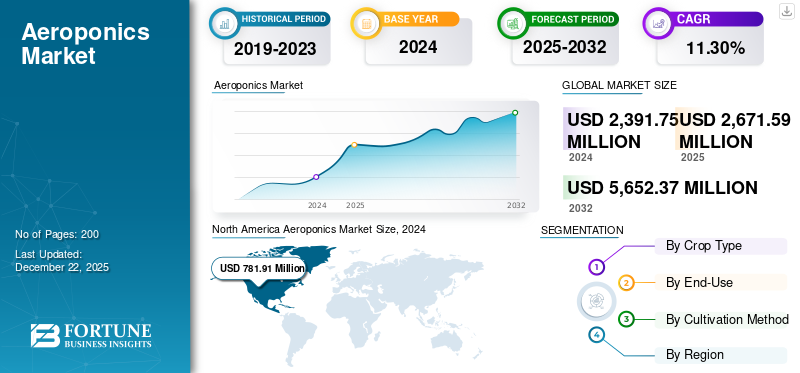
Download Free sample to learn more about this report.
Aeroponics Market KEY TAKEAWAYS
 Global Market Size & Forecast
- 2025 Market Size: USD 2.67 billion
- 2026 Market Size: USD 2.98 billion
- 2034 Forecast Market Size: USD 6.99 billion
- CAGR: 11.24% from 2026–2034
 Market Share
- North America dominated the aeroponics market with a 32.73% share in 2025.
- The vegetables and herbs segment is projected to lead the market with a 65.77% share in 2026.
- The commercial segment is expected to dominate with a 76.51% share in 2026.
 Key Regional Highlights
Asia Pacific
Asia Pacific reached USD 0.80 billion in 2025, driven by rapid urbanization and growing adoption of sustainable farming.
North America
North America generated USD 0.87 billion in 2025, supported by advanced agricultural technologies and strong R&D investments.
Europe
Europe reached USD 0.60 billion in 2025, fueled by increasing adoption of vertical farming and sustainable agriculture.
U.S.
The U.S. market is projected to reach USD 0.68 billion by 2026, driven by expanding commercial aeroponics and government support.
Japan
Japan is projected to reach USD 0.26 billion by 2026, supported by increasing demand for year-round, high-quality crop production.
Read More

MARKET DYNAMICS
Market Drivers
Year-round Crop Production Irrespective of Weather Conditions to Drive Market Growth
Indoor farming techniques such as aeroponics offer a sustainable solution by enabling year-round crop production, irrespective of external weather conditions. This leads to a more stable and reliable food supply, driving aeroponics system success and scalability. It creates a controlled environment system, such as a greenhouse and indoor facilities, that helps curb the limitation of plant growth by seasonal changes, making fresh products more widely available all year round. Moreover, vertical farming technologies maximize space usage.
For instance, a single vertical farm can significantly increase yields compared to traditional farms by using only a fraction of the land. According to the study by Agrilyst, vertical farms can produce 10 times more per square foot of land use than traditional farming methods. Therefore, the demand for vertical farming techniques is expected to surge, playing a pivotal role in the future of global agriculture.
Increase in Popularity of Urban and Indoor Farming to Drive Market Growth
The rapid growth in urbanization has resulted in the booming adoption of the aeroponics system, which helps in improving the availability of fresh food locally. According to the World Health Organization (WHO), over 55% of the global population lives in urban areas, and is expected to increase to 68% by 2050. As the demand for food supply in urban cities has increased, smart urban vertical farming has been booming in the market. With increasing urbanization and industrialization, there is growing concern about the limited arable land for agriculture. Urban agriculture makes use of unused indoor spaces, rooftops, and buildings to grow food efficiently and promote sustainable agriculture. Aeroponics has immense potential for transforming agriculture in both developing and developed nations, making it suitable for densely populated areas.
Market Restraints
High Initial Investment and Technological Complexity to Impede Market Growth
One of the significant challenges in the industry is high initial investment and technological complexity. Setting up an aeroponics farm requires investments in technology, equipment, and climate control systems. Additionally, the operational costs, which include labor expenses, land purchasing fees, and utilities, can further put strain on limited financial resources. Indoor farming majorly relies on climate control and lighting, which can lead to high electricity usage, further impeding the aeroponics market growth.
Market Opportunities
Rising Technological Advancements to Unlock New Growth Opportunities
Technology has been playing a crucial role in the success of aeroponics, enabling precise control of water conservation, pest & disease control, and space optimization. Leveraging technology offers nutrient-rich and high-quality crops with a reduced environmental footprint compared to traditional farming techniques. Key areas include the integration of AI and IoT, precision agriculture techniques, and other novel methods. Artificial Intelligence (AI) enables data-driven automation and decision-making. Such technologies help the commercial growers monitor plant health, optimize resource use, and improve overall operational efficiency, further creating lucrative opportunities for market growth.
Aeroponics Market Trends
Growing Consumer Demand for Organic and Pesticide-free Produce to Shape Industry
The rising organic food consumption globally is expected to fuel the growth of the industry significantly. The technique of aeroponics helps in minimizing the need for pesticides and herbicides. Additionally, it also creates a controlled environment, resulting in healthier and organic crop produce, and reducing the impact. People focused on health are increasingly opting for organic produce owing to its high nutritional value and absence of harmful pesticides. The heightened demand for organic foods among consumers is turning the focus toward more sustainable agricultural practices.
Download Free sample to learn more about this report.
Impact of Tariffs
The newly proposed U.S. tariffs significantly impacted the vertical farming market, including aeroponics. The U.S. imposed broad tariffs on imports from major trading partners, particularly China and Chinese-manufactured technology components, which would directly impact the input costs for aeroponics and vertical farming startups. This will lead to increased costs for high-tech farming components such as climate control systems, LED grow lights, sensors, and other systems, primarily sourced from international suppliers. The tariffs may delay or scale back projects, supply chain disruptions, and profit margins may shrink.
SEGMENTATION ANALYSIS
By Crop Type
Faster Growth and Reduced Water Usage Led to Vegetables and Herb Segment’s Highest Market Proportion
On the basis of the crop type, the market is segmented into fruits, vegetables & herbs, and others.
The vegetables and herbs is projecteed to dominate the market with a share of 65.77% in 2026. The usage of aeroponics is expanding beyond traditional vegetables and herbs as it includes a wider variety of crops and plant species. This diversification is mainly driven by growing understanding of plant requirements in controlled environments and technological advancements. Herbs and vegetables are mainly preferred in the system as they offer increased crop yields, faster crop growth, and reduced water usage. As the nutrients are directly sprayed onto the roots of the plants, there is typically 95% less water wastage than traditional irrigation methods.
The others segment, which includes ornamental crops, flowers, and microgreens, is expected to grow significantly over the forecast period. The cultivation of flowers and ornamental plants is gaining traction, offering new opportunities for urban beautification and the horticulture industry.
By End-Use
Growing Demand for Large Vertical Farms and High-Value Crops to Drive Commercial Segment's Dominance
On the basis of end-use, the market is segmented into commercial and residential.
The commercial segment is projecteed to dominate the market with a share of 76.51% in 2026, owing to the growing demand for large-scale vertical farming. Major consumers such as hotels, restaurants, high-end catering companies, and research institutions incorporate aeroponics and vertical farming gardens into their restaurant or rooftop spaces, offering fresh ingredients and high-value crops. Herbs, leafy green vegetables, and strawberries are among the most commonly grown in this farming, owing to their high market demand and rapid growth cycles. These crops help the restaurant owners and chefs to offer customized ingredients and experiment with unique flavors and dishes. Furthermore, large food retailers and leading agribusinesses are investing in aeroponics farming, further driving segment growth.
The residential segment is anticipated to grow at the fastest CAGR during the forecast period. Urban individuals with dual household incomes and health-conscious families drive the demand for microgreens, which are grown through aeroponics or vertical farming techniques, further fueling the market growth.
By Cultivation Method
To know how our report can help streamline your business, Speak to Analyst
Indoor Segment Accounts for Highest Market Share Due to Space Efficiency and Growing Food Demand
Based on the cultivation method, the market is segmented into indoor and outdoor.
The indoor segment is projecteed to dominate the market with a share of 85.23% in 2026 and is expected to grow at the highest CAGR as indoor farming emerges as a crucial component of modern agriculture. The global population is expected to reach up to 9.7 billion by 2050, and the demand for food is rising rapidly, putting immense pressure on traditional farming practices. Indoor farming offers sustainable solutions such as year-round crop production, efficient use of space, and ensuring consistent yields regardless of weather and pests. It also reduces water usage compared to outdoor farming, giving it a significant advantage.
Moreover, outdoor farming operations are susceptible to unpredictable weather, pests, and diseases, limiting crop quality and value. Therefore, there is less adoption of outdoor farming practices, resulting in the growth of the consumption of produce grown in the indoor farming segment. Furthermore, the advances in IoT and AI further improve the efficiency and demand for indoor farming techniques.
Aeroponics Market Regional Outlook
Regionally, the report covers the global market analysis across North America, Europe, Asia Pacific, South America, the Middle East & Africa.
North America
North America Aeroponics Market Size, 2025 (USD Million)
To get more information on the regional analysis of this market, Download Free sample
In 2025, the North America market stood at USD 0.87 Billion, representing 32.73% of global demand, and is projected to grow to USD 0.98 Billion in 2026. North America dominates the global aeroponics market share. The market growth in the region is due to its leadership in adopting advanced technologies in agriculture, sustainable farming, and substantial R&D investments. The region also boasts a well-developed agricultural sector, which offers a solid foundation for the growth of controlled-environment agriculture and aeroponics technologies. The U.S. and Canada are the two key markets, with the presence of major vertical farms. Aeroponics found significant application in both commercial and urban farming, especially in the U.S. Moreover, major stakeholders in the industry, such as the U.S. Department of Agriculture (USDA) experts, agronomists, economists, researchers, and others, support the field with the latest research and investments, leading to new operations and opportunities. The government agencies in the U.S. offer direct support for innovative producers through agencies such as the Farm Service Agency (FSA), the Natural Resources Conservation Service (NRCS), and others. These agencies help the farmers by financing, planning, and protecting the operations, thereby creating economic opportunities for the next generation of agricultural producers. The U.S. market is valued at USD 0.68 billion by 2026.
Europe
The Europe region captured 22.43% of the global market in 2025, generating USD 0.6 Billion in revenue, and is projected to reach USD 0.66 Billion in 2026. The European market is expected to grow at a rapid pace owing to strict environmental regulations and growing consumer awareness toward sustainable farming practices. Furthermore, countries such as Germany, the Netherlands, the U.K., and France lead the market in the adoption of aeroponics by investing in new farming technologies and vertical farms, thereby creating lucrative opportunities for market growth. The region is experiencing a rising demand for high-quality, fresh produce, especially in urban areas. Aeroponics technology allows for the production of crops closer to consumers, further minimizing food waste, transportation costs, and ensuring a consistent supply of fresh produce. This approach helps build more resilient and sustainable food systems. The U.K. market is valued at USD 0.08 billion by 2026, while the Germany market is valued at USD 0.15 billion by 2026.
Asia Pacific
Asia Pacific maintained a strong presence in the global market, reaching USD 0.8 Billion in 2025, accounting for 29.76% share, and is expected to reach USD 0.89 Billion in 2026. Asia Pacific is the fastest-growing region in the global market owing to rising population, rapid urbanization, and diminished arable land. Aeroponics is gaining rapid popularity in countries such as India and China owing to its ability to produce healthy crops year-round, minimize land use, and conserve water, which generates new market opportunities with remarkable growth. Furthermore, as research and development continue to improve crop yield and diversity, aeroponics is said to have great potential for revolutionizing the agricultural landscape in the Asia Pacific. It would also become an indispensable component of future food production systems. The Japan market is valued at USD 0.26 billion by 2026, the China market is valued at USD 0.21 billion by 2026, and the India market is valued at USD 0.04 billion by 2026.
South America
South America is expected to witness moderate market growth during the forecast period. The rapid urbanization in the region has been fueling the demand for innovative farming techniques that can operate efficiently in urban environments with limited land availability. The region has been experiencing an increase in consumer preference for locally grown produce, which is fresh and organic. This drives the demand for aeroponics farming techniques, offering year-round production of high-quality crops. Advanced farming technology has been transforming the region’s agricultural sector, as new startups are developing innovative automated aeroponics systems. One of the instances is CBA Sementes, a startup from Brazil, that introduced an innovative automated aeroponic system that produces disease-free and healthy seed potatoes. The growing support from such new startups and the rising demand for sustainable agricultural practices have been creating a favorable environment for the market to expand in the region.
Middle East & Africa
The Middle East & Africa market accounted for USD 0.14 Billion in 2025, representing 5.15% of the global industry, and is expected to reach USD 0.15 Billion in 2026. The Middle East & Africa region witnessed considerable advancement in aeroponics over recent years. The region experiences harsh environmental conditions such as barren soil lacking vital nutrients and extreme temperatures, impacting agricultural productivity and huge dependence on imports. Thus, vertical farming techniques such as aeroponics have emerged as a vital solution for offsetting reliance on imported food by minimizing land use and producing healthy crops year-round. One notable key development in this market was the installation of Kuwait's first aeroponic greenhouse. In April 2025, the Green Life Company collaborated with CleanGreens Solutions in order to build one of the world’s largest Aeroponics greenhouse farms in Kuwait. Such innovations would help minimize the region’s food dependency on imports and boost food security in the region.
Rest of the World
The Rest of the World market generated USD 0.27 Billion in 2025, representing 9.92% of the global market landscape, and is expected to reach USD 0.29 Billion in 2026.
COMPETITIVE LANDSCAPE
Key Industry Players
Focus on Partnership and Collaboration Strategies to Support Market Growth
The global market is characterized by the presence of established and smaller, innovative startups. This leads to increased competition among the players, wherein each company constantly develops new and innovative technologies and refines its operations. The prominent players in the market have been focusing on collaboration and partnership strategies to leverage their business and expand market reach. Some prominent players in the market include AeroFarms, LettUs Grow, Living Greens Farm, Altius Farms, and CleanGreens Solutions.
- For instance, in May 2025, LettUs Grow, an aeroponic irrigation technology company, partnered with KG Systems, a Netherlands-based horticultural company, to establish LettUs Grow’s advanced aeroponics technology across KG Systems' international operations. The partnership would help KG Systems integrate the yield and efficiency benefits of advanced aeroponics and establish new industrial standards for advanced irrigation in both greenhouses and vertical farms.
Key Players in Aeroponics Market
|
Rank |
Company Name |
|
1 |
AeroFarms |
|
2 |
LettUs Grow |
|
3 |
Living Greens Farm |
|
4 |
Altius Farms |
|
5 |
CleanGreens Solutions |
List of Key Aeroponics Companies Profiled
- AeroFarms (U.S.)
- LettUs Grow (U.K.)
- Living Greens Farm (U.S.)
- Altius Farms (U.S.)
- CleanGreenss Solutions (Switzerland)
- Aponic International (U.K.)
- Aeriz (U.S.)
- City Greens (India)
- Innovation Agritech Group (U.K.)
- Freight Farms (U.S.)
KEY INDUSTRY DEVELOPMENTS
- October 2024: LettUs Grow, an indoor farming technology provider, unveiled its latest Aeroponic Rolling Bench product at Heath Farm Aeroponic Innovation Centre in Bristol, U.K. The new product combines LettUs Grow’s ultrasonic aeroponic irrigation with industry standards and allows large-scale indoor growers to increase productivity and outperform annual yield targets.
- April 2024: LettUs Grow partnered with Innovative Growers Equipment to introduce ultrasonic aeroponics to greenhouse growers across the U.S. and Canada.
- February 2024: LettUs Grow announced a new partnership program that aimed to enhance the global reach of its ultrasonic aeroponic technology.
- January 2023: CleanGreens Solutions S.A., a Swiss agro-tech company, signed a contract with Midiflore to install a 3,500 square meter aeroponic project using CleanGreens' GREENOVA system. The new project would allow Midiflore to produce aromatic herbs locally and reduce imports.
- March 2022: Living Greens Farm, one of the largest indoor vertical aeroponic farms in the U.S., invested USD 70 million to establish a 200,000-square-foot farming, processing, and packaging facility. The farm would feature smart automation for transplanting, crop seeding, harvesting, and others.
REPORT COVERAGE
The global aeroponics market report analyzes the market in depth and highlights crucial aspects such as market trends, market dynamics, prominent companies, and end-use. Besides this, the market statistics report also provides insights into the market analysis and highlights significant industry developments.
Request for Customization to gain extensive market insights.
Report Scope & Segmentation
|
ATTRIBUTE |
DETAILS |
|
Study Period |
2021-2034 |
|
Base Year |
2025 |
|
Estimated Year |
2026 |
|
Forecast Period |
2026-2034 |
|
Historical Period |
2021-2024 |
|
Growth Rate |
CAGR of 11.24% from 2026 to 2034 |
|
Unit |
Value (USD Million) |
|
Segmentation |
By Crop Type
|
|
By End-Use
|
|
|
By Cultivation Method
|
|
|
By Region
|
Frequently Asked Questions
Fortune Business Insights says that the global market was USD 2.98 billion in 2026 and is anticipated to reach USD 6.99 billion by 2032.
At a CAGR of 11.24%, the global market will exhibit steady growth over the forecast period.
By cultivation method, the indoor segment leads the market.
North America holds the largest market share.
Year-round crop production, irrespective of weather conditions, drives the market growth.
AeroFarms, LettUs Grow, Living Greens Farm, Altius Farms, and CleanGreens Solutions are the leading companies in the market.
Growing consumer demand for organic and pesticide-free produce is shaping the industry.



- 2021-2034
- 2025
- 2021-2024
- 200
-
(Offer valid till 31st Oct 2026)
Get 30-60 hrs Free Customization
Expand Regional and Country Coverage, Segments Analysis, Company Profiles, Competitive Benchmarking, and End-user Insights.














Related Reports
-
US +1 833 909 2966 ( Toll Free )
-
Get In Touch With Us