Aerosol Market Size, Share & Industry Analysis By Material (Steel, Aluminum), By Type (Bag-in-Valve, Standard), By Application (Personal Care, Household, Food, Paints, Medical), and Regional Forecast, 2026-2034
 Download Free Sample
Aerosol Market Overview
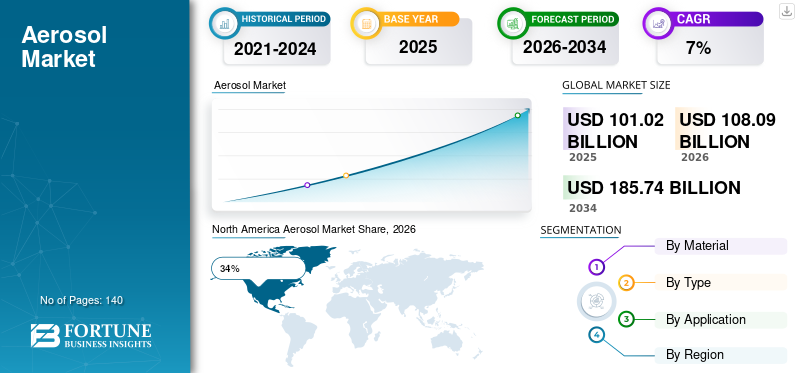
The global aerosol market size was valued at USD 101.02 billion in 2025. The market is projected to grow from USD 108.09 billion in 2026 to USD 185.74 billion by 2034, exhibiting a CAGR of 7% during the forecast period.

The aerosol market is witnessing sustained expansion due to increasing demand for personal care products, household cleaners, automotive sprays, pharmaceutical inhalers, industrial lubricants, and food-grade spray packaging solutions. Aerosol packaging offers convenience, controlled dispensing, longer shelf life, portability, and contamination prevention, making it highly preferred across multiple end-use industries. Manufacturers are focusing on recyclable aluminum and steel aerosol containers to align with environmental sustainability goals and regulatory standards. The aerosol market Report highlights growing adoption of bag-in-valve technology, low-emission propellants, and smart dispensing systems. Rising urbanization, changing consumer lifestyles, and increasing hygiene awareness are accelerating aerosol market Growth across developed and emerging economies worldwide.
The USA aerosol market continues to dominate global demand due to strong consumption of deodorants, hair sprays, shaving foams, household disinfectants, automotive care sprays, and pharmaceutical aerosols. The country accounts for nearly 28% market share in North America, supported by advanced packaging infrastructure and high consumer spending on convenience-based products. Aerosol Industry Analysis indicates rising adoption of eco-friendly propellants and recyclable packaging materials among American manufacturers. Industrial aerosol applications in lubricants, paints, coatings, and maintenance sprays are also expanding steadily. Increased preference for premium personal care products and stringent hygiene standards in healthcare and food industries are further supporting aerosol market Opportunities across the United States.
Download Free sample to learn more about this report.
Aerosol Market Key Takeaways
 Global Market Size & Forecast
- 2025 Market Size: USD 101.02 Billion
- 2026 Market Size: USD 108.09 Billion
- 2034 Forecast Market Size: USD 185.74 Billion
- CAGR: 7% from 2026-2034
 Market Share
- North America dominated with a 34% market share in 2025.
- Steel aerosol containers held the largest material share at 58%.
- Standard aerosol systems held the largest type share at 67%.
 Key Regional Highlights
Europe
Europe accounted for 29% of the global market.
Asia-Pacific
Asia-Pacific held a 27% share, supported by expanding consumer and industrial applications.
Rest of World
Rest of World accounted for 10% of the global market.
U.S.
The U.S. is a major market driven by strong demand for personal care, household, and industrial aerosols.
Japan
Japan accounted for 19% of the Asia-Pacific market.
Read More

Aerosol Market Latest Trends
The aerosol market Trends indicate a major shift toward sustainable packaging technologies and environmentally safer propellants. Manufacturers are increasingly introducing recyclable aluminum cans and lightweight steel aerosol containers to reduce carbon footprints and comply with evolving environmental regulations. Demand for bag-in-valve aerosol systems is rising rapidly because these systems improve product preservation, enable 360-degree dispensing, and reduce contamination risks. aerosol market Insights also show increased innovation in compressed air-based propellants and low-VOC formulations.
Download Free sample to learn more about this report.
Digital printing and smart labeling technologies are becoming popular in the Aerosol Industry Report, especially among personal care and cosmetic brands seeking premium shelf appeal and product differentiation. Consumers are increasingly favoring aerosol-based dry shampoos, deodorants, sanitizers, air fresheners, and skincare products because of ease of use and portability. Pharmaceutical companies are also increasing investments in aerosol inhalers and nasal spray technologies due to growing respiratory healthcare demand.
Aerosol Market Dynamics
DRIVER
Rising Demand for Personal Care and Household Aerosol Products
The increasing global consumption of personal care and household cleaning products is one of the strongest growth drivers for the aerosol market. Consumers prefer aerosol packaging because it offers convenience, hygienic dispensing, portability, and precise application. Products such as deodorants, shaving foams, dry shampoos, hair sprays, air fresheners, disinfectants, and furniture cleaners are witnessing strong sales growth across urban markets. The aerosol market Analysis shows that hygiene awareness has increased significantly in residential and commercial environments, boosting the use of sanitizing sprays and disinfectant aerosols. In addition, the expansion of premium cosmetic brands and grooming product lines is driving demand for aesthetically attractive aerosol packaging. Manufacturers are also developing ergonomic spray mechanisms and advanced valve technologies to improve user experience. Rapid urbanization, changing lifestyles, and rising disposable incomes in developing economies are increasing consumer preference for convenience-based packaging formats. Industrial sectors including automotive maintenance, paints, coatings, and lubricants are also supporting aerosol market Growth through rising adoption of spray-based solutions for efficiency and precision applications.
RESTRAINT
Environmental Concerns Related to Propellants and Disposal
Environmental concerns associated with aerosol propellants and container disposal remain a significant restraint for the aerosol market. Although chlorofluorocarbon propellants have largely been phased out, regulatory agencies continue to impose strict restrictions on volatile organic compounds and greenhouse gas emissions. Aerosol Industry Analysis indicates that compliance with environmental regulations often increases manufacturing and packaging costs for producers. Improper disposal of aerosol cans also creates waste management challenges, especially in regions with underdeveloped recycling infrastructure. Steel and aluminum containers require specialized recycling systems, and contamination risks from residual chemicals can complicate disposal procedures. Consumer awareness regarding sustainable packaging is increasing, leading some buyers to shift toward alternative dispensing formats such as pumps and roll-ons.
OPPORTUNITY
Expansion of Eco-Friendly and Recyclable Aerosol Packaging
The growing emphasis on sustainable packaging solutions is creating substantial opportunities in the aerosol market. Companies are increasingly investing in recyclable aluminum cans, lightweight steel containers, and eco-friendly propellants to meet environmental targets and attract environmentally conscious consumers. aerosol market Opportunities are particularly strong in regions where governments encourage circular economy initiatives and recycling programs. Manufacturers are introducing compressed air propellant systems and biodegradable formulations to reduce environmental impact. The healthcare sector offers additional opportunities due to rising demand for metered-dose inhalers and nasal sprays. Rapid expansion of e-commerce platforms is further supporting aerosol market Size because durable aerosol packaging ensures product safety during transportation. Emerging economies in Asia-Pacific and Latin America also present strong growth potential due to increasing industrialization and urban consumer spending.
CHALLENGE
High Production and Regulatory Compliance Costs
One of the major challenges in the aerosol market is the increasing cost of production and compliance with international packaging regulations. Aerosol products require specialized manufacturing infrastructure, pressure-resistant containers, valve systems, and safety testing procedures, all of which contribute to high operational expenses. Regulatory standards concerning flammability, emissions, transportation, and labeling vary across regions, creating additional compliance burdens for manufacturers. The aerosol market Research Report highlights that rising aluminum and steel prices continue to impact production costs significantly. Manufacturers are also required to invest heavily in research and development to create safer propellants and recyclable packaging technologies. Small and medium-sized aerosol producers often struggle to compete with multinational companies due to limited financial resources and technological capabilities.
Aerosol Market Segmentation
By Material
Steel aerosol containers hold nearly 58% of the aerosol market Share because they provide high strength, cost efficiency, and excellent resistance to pressure. These containers are widely used in industrial sprays, automotive lubricants, paints, insecticides, household cleaners, and air fresheners. Steel aerosol cans are preferred for products requiring durable and impact-resistant packaging solutions. Manufacturers are increasingly adopting lightweight steel technologies to reduce material consumption and transportation costs while maintaining structural integrity. The Aerosol Industry Report highlights that steel packaging remains highly attractive for large-scale commercial applications due to lower production costs compared to aluminum.
Aluminum: Aluminum aerosol packaging accounts for approximately 42% of the aerosol market Size and is gaining popularity because of its lightweight properties, corrosion resistance, and premium appearance. Aluminum aerosol cans are widely used in cosmetics, pharmaceuticals, deodorants, hair sprays, and skincare products where visual appeal and product protection are important purchasing factors. The aerosol market Analysis indicates that luxury personal care brands increasingly prefer aluminum containers because they enhance brand image and support sustainability initiatives. Aluminum is infinitely recyclable, making it highly attractive for environmentally conscious consumers and manufacturers.
To know how our report can help streamline your business, Speak to Analyst
By Type
Bag-in-valve aerosol systems account for nearly 33% of the aerosol market Share and are witnessing strong growth due to superior dispensing efficiency and contamination prevention. This technology separates the product from the propellant using an internal bag, ensuring longer shelf life and consistent spray performance. Bag-in-valve systems are widely used in pharmaceutical inhalers, nasal sprays, wound care products, cosmetic sprays, and food-grade aerosols. The aerosol market Forecast indicates increasing demand for bag-in-valve packaging because it supports 360-degree spraying and enables the use of environmentally friendly compressed air propellants. Pharmaceutical companies are heavily investing in this technology to improve dosage accuracy and patient safety.
Standard aerosol systems dominate the aerosol market with nearly 67% market share due to their extensive usage across household, industrial, automotive, and personal care applications. These systems utilize conventional propellants and valve mechanisms for effective spray dispensing. Products such as deodorants, disinfectants, paints, insecticides, lubricants, and air fresheners heavily rely on standard aerosol packaging because of cost efficiency and high-volume production capability. The aerosol market Research Report highlights that standard aerosol packaging remains the preferred choice for mass-market consumer products due to affordability and manufacturing scalability.
By Application
Personal Care applications account for nearly 41% of the aerosol market Share due to rising global demand for deodorants, hair sprays, shaving foams, dry shampoos, and skincare products. Consumers prefer aerosol packaging because it offers convenience, controlled dispensing, portability, and hygienic usage. Premium cosmetic and grooming brands are increasingly adopting aluminum aerosol containers with attractive designs to improve product visibility and brand value. The aerosol market Analysis highlights strong growth in spray-based beauty and grooming products across urban populations. Sustainable packaging technologies and eco-friendly propellants are also becoming important trends in the personal care aerosol segment.
Household applications contribute around 24% of the aerosol market Share and include air fresheners, disinfectant sprays, furniture cleaners, insecticides, and kitchen cleaning products. Increasing hygiene awareness and consumer preference for convenient cleaning solutions are driving demand for household aerosol products globally. Aerosol packaging allows efficient spray distribution and easy storage, making it highly preferred in residential applications. The aerosol market Report indicates rising sales of disinfectant aerosols due to growing sanitation awareness in homes and commercial environments.
Food applications hold nearly 11% share of the aerosol market and are expanding steadily due to increasing demand for cooking sprays, whipped cream dispensers, edible oils, and flavor sprays. Aerosol packaging helps maintain product freshness, controlled dispensing, and reduced contamination risks in food products. Bag-in-valve technology is increasingly being adopted in food aerosols because it improves product preservation and dispensing efficiency. The Aerosol Industry Analysis highlights growing consumer preference for convenience food products and ready-to-use cooking solutions.
Paint applications account for approximately 16% of the aerosol market Share and are widely used in automotive, industrial, construction, and DIY activities. Aerosol spray paints provide smooth coating, quick drying, portability, and precise application, making them highly popular among professional and household users. Automotive touch-up paints and anti-corrosion coatings are major contributors to this segment’s expansion. The aerosol market Outlook indicates increasing demand for industrial spray coatings and maintenance paints across manufacturing facilities.
Medical applications contribute nearly 8% of the aerosol market Share and are witnessing strong growth due to increasing use of inhalers, nasal sprays, wound care products, and topical medications. Aerosol delivery systems provide accurate dosage control, hygienic dispensing, and improved patient convenience in healthcare applications. The aerosol market Research Report highlights rising respiratory healthcare demand as a major factor supporting growth in pharmaceutical aerosols. Bag-in-valve technology is increasingly used in medical applications because it maintains product purity and prevents contamination.
Aerosol Market Regional Outlook
North America
North America Aerosol Market Share, 2026 (%)
To get more information on the regional analysis of this market, Download Free sample
North America holds nearly 34% of the global aerosol market Share and remains one of the strongest regional markets due to rising demand for personal care, household, pharmaceutical, and industrial aerosol products. The United States dominates the regional market because consumers widely prefer deodorants, disinfectants, hair sprays, air fresheners, shaving foams, and automotive maintenance sprays packaged in aerosol formats. Increasing hygiene awareness and strong purchasing power continue supporting aerosol market Growth across residential and commercial sectors. The region also benefits from advanced manufacturing infrastructure and high investments in sustainable aerosol packaging technologies. Manufacturers are increasingly introducing recyclable aluminum cans, lightweight steel containers, and low-emission propellants to comply with environmental regulations. The pharmaceutical sector contributes significantly through increasing use of inhalers and nasal sprays for respiratory healthcare applications. Industrial aerosol demand is also rising in automotive, construction, and machinery maintenance sectors.
Europe
Europe accounts for approximately 29% of the global aerosol market Share and is recognized for its strong focus on sustainability, innovation, and recyclable packaging solutions. Countries such as Germany, the United Kingdom, France, and Italy are major contributors to regional market expansion. The aerosol market Report highlights rising demand for deodorants, skincare sprays, household cleaners, pharmaceutical inhalers, and industrial lubricants throughout the region. European manufacturers are increasingly adopting biodegradable propellants and refillable aerosol systems to reduce environmental impact. Government regulations supporting circular economy initiatives are encouraging investments in recyclable aluminum packaging technologies. The cosmetics and personal care industry remains one of the largest end users of aerosol packaging in Europe due to high consumer preference for premium and convenient products. Industrial aerosol applications are also growing steadily in automotive and manufacturing sectors. Pharmaceutical aerosol demand continues increasing because of rising respiratory healthcare awareness. Strong retail networks, technological innovation, and sustainability-focused investments continue supporting aerosol market Growth across Europe.
Germany Aerosol Market
Germany holds nearly 24% share of the European aerosol market and remains a major center for aerosol manufacturing, packaging innovation, and industrial spray applications. The country has strong demand for automotive sprays, industrial lubricants, paints, coatings, and personal care aerosol products. The aerosol market Analysis indicates that German manufacturers are heavily investing in recyclable packaging materials and environmentally sustainable propellant technologies. Germany’s advanced industrial infrastructure supports development of precision valve systems and high-performance dispensing technologies. The automotive sector significantly contributes to aerosol product demand through increasing use of maintenance sprays and anti-corrosion coatings. Pharmaceutical aerosol products including inhalers and medical sprays are also witnessing strong demand due to expanding healthcare applications. Consumers in Germany increasingly prefer sustainable and premium-quality aerosol packaging solutions. The country’s highly developed recycling infrastructure further supports aerosol market Opportunities for environmentally friendly aerosol products and refillable packaging systems.
United Kingdom aerosol market
The United Kingdom accounts for approximately 18% share of the European aerosol market and demonstrates strong demand for personal care, household cleaning, and healthcare aerosol products. Deodorants, dry shampoos, shaving foams, air fresheners, and disinfectant sprays remain highly popular among consumers due to convenience and portability benefits. The aerosol market Outlook highlights increasing adoption of recyclable aerosol containers and compressed-air dispensing technologies across the country. British manufacturers are focusing heavily on sustainable packaging initiatives and lightweight aerosol materials to reduce environmental impact. Growth in retail and e-commerce sectors is improving accessibility to aerosol products across urban and suburban regions. Industrial aerosol applications in automotive maintenance, construction, and machinery servicing are also supporting market expansion. The cosmetics industry remains a major contributor to aerosol packaging demand because premium beauty brands continue launching innovative spray-based products. Rising hygiene awareness and investments in eco-friendly packaging technologies continue supporting aerosol market Growth throughout the United Kingdom.
Asia-Pacific
Asia-Pacific represents nearly 27% of the global aerosol market Share and remains the fastest-growing regional market due to rapid industrialization, urbanization, and rising disposable incomes. Countries including China, Japan, India, and South Korea are driving strong demand for deodorants, air fresheners, insecticides, household cleaners, and automotive sprays. The aerosol market Research Report highlights increasing consumer preference for convenient and hygienic packaging formats across densely populated urban areas. Industrial sectors such as automotive, construction, and electronics are also expanding their use of aerosol lubricants, paints, and maintenance sprays. Pharmaceutical aerosol demand is increasing due to rising respiratory healthcare awareness and expanding healthcare infrastructure. International cosmetic brands are investing heavily in regional production facilities to meet growing consumer demand for personal care aerosol products. Governments across the region are promoting sustainable packaging and recyclable materials, encouraging manufacturers to develop eco-friendly aerosol technologies. Expanding e-commerce platforms and retail modernization continue supporting long-term aerosol market Opportunities throughout Asia-Pacific.
Japan Aerosol Market
Japan contributes nearly 19% share of the Asia-Pacific aerosol market and is recognized globally for technological innovation and premium aerosol packaging quality. The country has strong demand for cosmetic sprays, deodorants, healthcare aerosols, and industrial maintenance products. Japanese manufacturers are investing significantly in precision dispensing systems, compact packaging designs, and sustainable propellant technologies. The aerosol market Insights indicate growing demand for pharmaceutical inhalers and medical sprays because of increasing respiratory healthcare requirements and aging population trends. Consumers in Japan strongly prefer high-performance and aesthetically appealing aerosol products, especially in skincare and grooming categories. Industrial sectors including automotive and electronics manufacturing also contribute substantially to aerosol product consumption through maintenance sprays and cleaning solutions. Sustainability remains an important focus area, with manufacturers introducing recyclable packaging and environmentally friendly dispensing systems. Strong innovation capabilities and advanced manufacturing technologies continue supporting aerosol market Growth across Japan.
China Aerosol Market
China accounts for nearly 38% share of the Asia-Pacific aerosol market and remains one of the largest aerosol manufacturing and consumption hubs globally. Rising urbanization, expanding middle-class populations, and increasing consumer spending are significantly boosting demand for aerosol-based products including deodorants, insecticides, disinfectants, automotive sprays, and air fresheners. The Aerosol Industry Report highlights strong manufacturing capabilities supported by cost-efficient production infrastructure and extensive supply chain networks. Industrial aerosol applications are expanding rapidly across automotive, electronics, machinery, and construction sectors. Chinese manufacturers are increasingly investing in recyclable aluminum containers and low-emission propellant technologies to comply with sustainability initiatives. The healthcare industry is also witnessing increasing use of aerosol inhalers and topical spray medications. Expansion of e-commerce and modern retail channels continues improving product accessibility across urban and rural markets. International companies are strengthening partnerships with domestic manufacturers to increase market penetration and production efficiency within China’s growing aerosol industry.
Rest of World
The Rest of World region accounts for approximately 10% of the global aerosol market Share and includes Latin America, the Middle East, and Africa. Rising urban populations, improving hygiene awareness, and expanding industrial activities are supporting demand for aerosol products across these regions. Latin American countries are experiencing increased consumption of deodorants, insecticides, household cleaners, and automotive maintenance sprays. The aerosol market Forecast highlights growing investments in industrial aerosol products used in manufacturing and construction activities. Middle Eastern markets are witnessing strong demand for premium cosmetic and personal care aerosol packaging due to rising consumer spending and retail expansion. In Africa, pharmaceutical aerosols and disinfectant sprays are gaining importance because of improving healthcare accessibility and sanitation awareness. Manufacturers are increasingly focusing on affordable aerosol packaging solutions to attract price-sensitive consumers. Expansion of e-commerce and modern retail infrastructure is also improving product distribution across developing economies. Sustainability initiatives and recyclable packaging investments are gradually creating new aerosol market Opportunities throughout the Rest of World region.
List of Top Aerosol Companies
- Crown Holdings
- Ball Corporation
- CCL Container
- Sonoco Products Company
- Trivium Packaging
- ITW Sexton
- Montebello Packaging
- Tecnocap S.p.A.
- PLZ Corp
- DS Containers
Top Two Companies by Market Share
- Ball Corporation – 16% market share
- Crown Holdings – 14% market share
Investment Analysis and Opportunities
The aerosol market is attracting significant investments due to rising demand for sustainable packaging technologies, pharmaceutical aerosols, and premium personal care products. Investors are increasingly focusing on recyclable aluminum packaging facilities, low-emission propellant systems, and advanced valve manufacturing technologies. aerosol market Opportunities are expanding in bag-in-valve packaging because of increasing applications in cosmetics, healthcare, and food industries.
Large manufacturers are investing in automated production lines to improve efficiency, reduce material waste, and enhance product consistency. Emerging economies in Asia-Pacific and Latin America are receiving increased foreign direct investments for aerosol packaging plants due to growing consumer demand and lower manufacturing costs. The aerosol market Analysis also highlights substantial investment activity in environmentally friendly compressed-air propellant technologies.
New Product Development
Innovation in the aerosol market is increasingly focused on sustainability, dispensing precision, and user convenience. Manufacturers are introducing lightweight aluminum cans with improved recyclability and reduced material usage. New product development activities are heavily concentrated on eco-friendly propellants, including compressed air and nitrogen-based systems, to reduce environmental impact. aerosol market Trends also show increasing demand for bag-in-valve technologies that improve product preservation and minimize contamination.
In the food industry, manufacturers are introducing aerosol-based cooking oils, whipped toppings, and flavor sprays with enhanced dispensing systems. Industrial aerosol innovations include anti-corrosion sprays, precision lubricants, and high-performance coating products designed for automotive and manufacturing applications. Digital printing technologies are enabling highly customized aerosol packaging with enhanced branding capabilities. The aerosol market Research Report indicates that sustainable refillable aerosol systems and biodegradable formulations are expected to remain major innovation priorities during the coming years.
Five Recent Developments (2023-2025)
- Ball Corporation introduced lightweight recyclable aluminum aerosol cans with reduced carbon emissions for personal care packaging applications in 2024.
- Crown Holdings expanded its sustainable aerosol packaging production capacity in North America to support rising demand for eco-friendly containers in 2023.
- Trivium Packaging launched advanced bag-in-valve aerosol systems designed for pharmaceutical and cosmetic applications in 2025.
- PLZ Corp invested in automated aerosol filling technologies to improve manufacturing efficiency and product consistency in 2024.
- CCL Container developed new digitally printed aerosol packaging solutions for premium cosmetic and personal care brands in 2025.
Report Coverage of Aerosol Market
The aerosol market Report provides comprehensive analysis of industry trends, packaging technologies, material innovations, competitive landscape, and regional demand patterns across global markets. The report examines aerosol market Size, aerosol market Share, aerosol market Growth, and aerosol market Opportunities across major end-use sectors including personal care, household cleaning, pharmaceuticals, automotive, food, and industrial applications. The report evaluates demand patterns for steel and aluminum aerosol containers along with technological advancements in bag-in-valve systems, recyclable packaging, and low-emission propellants.
Request for Customization to gain extensive market insights.
Regional analysis covers North America, Europe, Asia-Pacific, and Rest of World markets with country-level insights for major economies including the United States, Germany, the United Kingdom, Japan, and China. Competitive profiling of leading aerosol packaging manufacturers is also included, highlighting strategic developments, production expansions, sustainability initiatives, and innovation activities. The Aerosol Industry Analysis further examines regulatory frameworks, supply chain trends, raw material dynamics, investment opportunities, and emerging consumer preferences influencing future market expansion across global aerosol packaging and dispensing industries.
Frequently Asked Questions
Fortune Business Insights says that the global market value stood at USD 101.02 billion in 2025 and is projected to reach USD 185.74 billion by 2034.
The market is expected to exhibit a CAGR of 7.00% during the forecast period of 2026-2034.
Standard aerosol systems were the leading type segment, holding nearly 67% of the market, due to their affordability, scalability, and broad use across consumer and industrial applications.
Key players include Crown Holdings, Ball Corporation, CCL Container, Sonoco Products Company, Trivium Packaging, and ITW Sexton.
Major trends include growing adoption of recyclable packaging and eco-friendly propellants, along with rising demand for bag-in-valve systems and smart dispensing technologies. North America led the market with a 34% share, supported by strong personal care, household, pharmaceutical, and industrial demand.



- 2021-2034
- 2025
- 2021-2024
- 140
-

(Offer valid till 15th Oct 2026)
Get 30-60 hrs Free Customization
Expand Regional and Country Coverage, Segments Analysis, Company Profiles, Competitive Benchmarking, and End-user Insights.


















-
US +1 833 909 2966 ( Toll Free )
-
Get In Touch With Us