AI-Based Vessel Traffic Management Market Size, Share & Industry Analysis, By Core Offering (AI/Analytics & Decision Support Software, and Others), By Operational Service (Information Service (INS), Navigational Assistance Service (NAS), and Others), By Deployment Area (Smart Ports & Harbors, Strategic Straits, and Others), By Technology (AI/Machine Learning, Multi-Sensor Fusion & Integration, and Others), By Sensor (AIS-Based Inputs, Radar Inputs, and Others), By Deployment Model (On-Premise Mission-Critical VTS, Hybrid Cloud VTMIS, and Others), By End User and Regional Forecast 2026-2034
 Download Free Sample
AI-Based Vessel Traffic Management Market Size and Future Outlook
 Listen to Audio Version
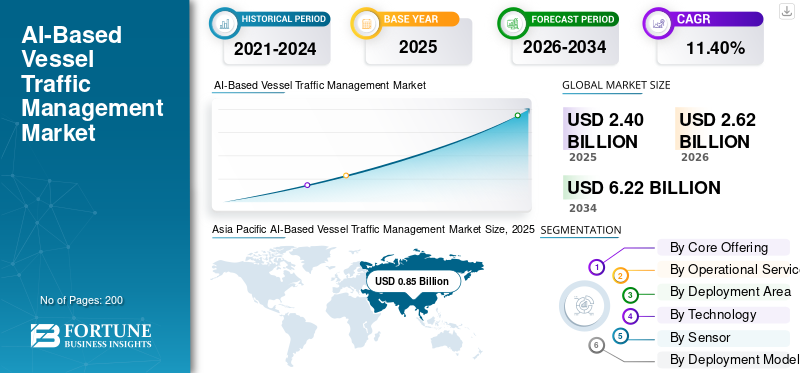
The global AI-based vessel traffic management market size was valued at USD 2.40 billion in 2025. The market is projected to grow from USD 2.62 billion in 2026 to USD 6.22 billion by 2034, exhibiting a CAGR of 11.40% during the forecast period. Asia Pacific dominated the AI-based vessel traffic management market with a market share of 35.41% in 2025.
AI-based vessel traffic management refers to digital VTS/VTMS platforms that use AI, analytics, automatic identification systems (AIS)/radar/CCTV/weather data fusion, and decision-support tools to help port authorities, coast guards, and maritime control centers manage vessel movements safely, enhancing operational efficiency and safety. The market is not yet a purely “AI-only” market; rather, it represents the modernization of conventional vessel traffic services into smarter, predictive, and more automated traffic-management systems. IMO defines VTS as shore-side systems designed to provide information services, traffic organization, and navigational assistance. At the same time, the organization’s e-navigation initiatives are pushing demand for electronic collection, integration, exchange, presentation, and analysis of maritime information.
Key market demand is being driven by rising port congestion, denser coastal traffic, safety and collision-risk reduction, environmental protection, autonomous/remote vessel trends, and pressure to improve port-call efficiency. IALA’s future-VTS guidance also highlights advanced decision support, automated data exchange, digital situational awareness, sea traffic management, and new sensing technologies as major trends shaping next-generation VTS.
Major players include Wartsila, Kongsberg Norcontrol, Indra, Leonardo, and Frequentis. These companies offer VTMS/VTS platforms, control-center systems, maritime surveillance, traffic planning, and integrated domain-awareness solutions. Competitive strategies are increasingly focused on long-term partnership with port and maritime authorities, deployment of AI-enabled next-generation platforms, integration of multi-sensor and communications data, modular/upgradeable control-center architectures, and solutions centered on safety, efficiency, compliance, and sustainability rather than standalone hardware sales.
Download Free sample to learn more about this report.
AI-BASED VESSEL TRAFFIC MANAGEMENT MARKET KEY TAKEAWAYS
 Global Market Size & Forecast
- 2025 Market Size: USD 2.40 billion
- 2026 Market Size: USD 2.62 billion
- 2034 Forecast Market Size: USD 6.22 billion
- CAGR: 11.40% from 2026-2034
 Market Share
- Asia Pacific captured 35.41% of the AI-based vessel traffic management market in 2025.
- The sensor & surveillance hardware segment held 25.70% of the global market in 2025 and is projected to expand at a 11.14% CAGR over the forecast period.
- The information service (INS) segment held 18.27% of the global market in 2025 and is expected to expand at a 8.75% CAGR during the forecast period.
 Key Regional Highlights
North America
The North America AI-based vessel traffic management market reached USD 0.63 billion in 2025 and is anticipated to reach USD 0.68 billion in 2026.
Europe
Europe AI-based vessel traffic management market was valued at USD 0.79 billion in 2025 and is projected to grow at a CAGR of 11.73%.
Asia Pacific
The Asia Pacific AI-based vessel traffic management market generated USD 0.85 billion in 2025 and is expected to expand at a 12.59% CAGR.
U.S.
The U.S. AI-based vessel traffic management market was valued at USD 0.46 billion in 2025 and is projected to grow at a 9.86% CAGR.
Japan
Japan is witnessing increasing adoption of AI-based vessel traffic management solutions driven by maritime digitalization and safety improvements.
Read More

AI-Based Vessel Traffic Management Market Trend
Growing Deployment of Remote Operations Centers to Boost Industry Development
A clear market trend is the convergence of VTS, autonomous shipping, maritime domain awareness, and port digital twins. AI-based VTMS is no longer only about watching vessel movements; it is evolving into a predictive control layer capable of supporting remote operations, autonomous feeder routes, and safer interaction between manned and unmanned vessels.
For instance, in April 2026, MPA and PSA launched an EOI to develop and test autonomous inter-gateway container feeder vessel operations within Singapore’s port. This initiative includes a remote operations centre that integrates vessel sensor data and port traffic data for real-time monitoring and intervention.
Market Dynamics
MARKET DRIVER
Download Free sample to learn more about this report.
Rising Need to Manage Denser Vessel Movements Without Increasing Navigational Risk Boosts Market Growth
The strongest growth driver is the need to manage denser vessel movements without increasing navigational risk. IMO states that VTS supports the safety of life at sea, navigation efficiency, and environmental protection, where traffic volume or risk levels justify such services. Similarly, the U.S. Coast Guard describes VTS as a system that uses VHF, AIS, radar, and digital cameras to prevent collisions, rammings, and groundings. AI-based vessel traffic management adds a higher-value layer by predicting traffic hotspots, detecting route conflicts earlier, and supporting faster decision-making by operators, thereby driving the global AI-based vessel traffic management market growth.
For instance, in April 2026, MPA Singapore and the Singapore Shipping Association signed an MoU to accelerate AI adoption across maritime operations, including port operations and operational decision-making.
MARKET RESTRAINT
Rising Cybersecurity Issues to Slow Product Adoption
The major restraint is that AI-based VTMS cannot be deployed like ordinary software, as it must integrate with safety-critical shore systems, vessel data, port databases, sensors, and communications networks. As shipboard and shore-based systems become increasingly digitized and interconnected, cybersecurity risk rises sharply, especially for navigation, propulsion, power management, and port control systems. The Maritime and Port Authority (MPA) cybersecurity programme specifically highlights that digitalized and interconnected shipboard systems increase cybersecurity risks, which directly affects AI-VTMS solutions and slows deployment rates.
For instance, in April 2026, MPA, SSA, SIT, and SUTD announced a Maritime Operational Technology Cybersecurity programme to train maritime IT professionals from August 2026.
MARKET OPPORTUNITY
Growing Adoption of AI-driven Predictive Analytics in Maritime Operations to Boost New Market Expansion
The largest opportunity lies in the shift from isolated VTS control rooms to connected digital-port ecosystems. AI-based VTMS can be integrated into the operational intelligence layer brain that links vessel traffic, port clearance, berth planning, pilotage, weather, cargo flows, emissions, and emergency response. Singapore’s OCEANS-X launch is important as it provides secure system-to-system connectivity, access to over 100 APIs and datasets, and expanded opportunities for data analytics and AI-enabled tools.
For instance, in April 2026, MPA launched OCEANS-X to support trusted data exchange between maritime companies and government agencies, improving port clearance, digital services, and global port connectivity.
MARKET CHALLENGES
Unresolved Issues Related to the Role of the Master Hinders Market Growth
The main challenge is that AI recommendations must be trusted in live maritime operations, where accountability remains with authorities, operators, masters, pilots, and regulators. IMO’s work on autonomous shipping highlights unresolved issues related to the role of the master, remote operator responsibilities, liability, search and rescue, watchkeeping, bridge alarms, and safe interaction with existing rules. As a result, AI-VTMS needs explainable alerts, clear escalation rules, human override, audit trails, and strong operator training before authorities can rely on it in high-density waterways.
For instance, in March 2026, IMO approved a maritime digitalization strategy and cybersecurity measures for maritime single windows, emphasizing interoperability, standardization, data governance, resilience, and cyber protection.
SEGMENTATION ANALYSIS
By Core Offering
AI/Analytics & Decision Support Software to Lead due to Rising Demand for Collision-Risk Prediction
By core offering, the global market is divided into AI/Analytics & decision support software, VTS /VTMIS/VTMS software platform, digital twin & port simulation platform, sensor & surveillance hardware, communications & connectivity, systems integration & control-centre infrastructure, training, simulation & certification, and managed & professional services.
The AI/analytics & decision support software is likely to be the fastest-growing segment, registering the highest CAGR of 12.71% during the forecast period. Growth is being pushed by rising demand for collision-risk prediction, congestion forecasting, route optimization, anomaly detection, and operator decision-making support capabilities. From a commercial perspective, port and coastal authorities are no longer investing only in “display and control” systems; they are increasingly adopting intelligence-driven software layers that help reduce delays, improve safety, and enable faster operational decision-making.
The sensor & surveillance hardware segment dominated the global market share of 25.70% in 2025 and is projected to grow at a CAGR of 11.14% during the forecast period.
By Operational Service
MASS/Autonomous Vessel Integration Segment to Dominate due to Gradual Move Toward Autonomous Vessels
By operational service, the global market is divided into Information Service (INS), Navigational Assistance Service (NAS), Traffic Organization Service (TOS), port operations interface, maritime security & law enforcement, SAR & Emergency Incident Management, environmental & emissions monitoring, and MASS/Autonomous Vessel Integration.
The MASS/autonomous vessel integration segment is poised to be the fastest-growing, registering the highest CAGR of 15.25% during the forecast period. Growth is being driven by the gradual move toward autonomous vessels, remote operations, smart ports, and machine-assisted navigation. Although this segment is growing from a smaller base, its strategic importance is high, as future VTS platforms will need to manage both manned and unmanned vessels within the same traffic environment.
The information service (INS) segment dominated the global market share of 18.27% in 2025 and is projected to grow at a CAGR of 8.75% during the forecast period.
By Deployment Area
Coastal/National VTMS Segment to Display Fastest Growth, Fueled by Increasing Investments in Maritime Domain Awareness
By deployment area, the global market is divided into smart ports & Harbors, coastal/national VTMIS, strategic straits, canals & chokepoints, offshore energy zones, inland waterways/river information services, arctic/polar routes, and others.
The coastal/national VTMIS is poised to be the fastest-growing segment, registering the highest CAGR of 12.59% during the forecast period. Growth is driven by increasing investments in maritime domain awareness, coastal security, EEZ monitoring, offshore asset protection, and multi-port traffic coordination. The trend shows that national-scale systems are likely to gain prominence over isolated port-level deployments over the forecast period.
The smart ports & Harbors segment dominated the global market share of 25.76% in 2025 and is projected to grow at a CAGR of 11.70% during the forecast period.
By Technology
AI/Machine Learning Segment to Showcase Fastest Growth, Driven by its Ability to Detect Traffic Patterns and Collision Prediction
By technology, the global market is divided into AI/Machine Learning, multi-sensor fusion & integration, Maritime Data & APIs, digital twin & simulation, Maritime Communications (VHF, VDES, SATCOM, and 5G), visualization & human-machine interface, cybersecurity & resilience, and MASS & autonomous vessel technology.
The AI/machine learning segment is poised to be the fastest-growing segment, registering the highest CAGR of 13.71% during the forecast period. Its expansion is being driven by applications such as collision prediction, vessel behavior analytics, traffic pattern learning, anomaly detection, automated alerts, and decision support for VTS operators. This technology layer converts raw maritime data into actionable operational intelligence, which is why it is growing faster than traditional communications and visualization technologies.
The multi-sensor fusion & integration segment held the dominant market share of 19.55% in 2025 and is also projected to grow at a CAGR of 12.20% during the forecast period.
By Sensor
UAV/Drone Inputs Segment to Dominate due to the Need for Rapid Inspection
By sensor, the global market is divided into AIS-Based Inputs, Radar Inputs, Optical/Video Inputs, Radio/Voice Inputs, satellite/remote sensing inputs, Port/Terminal IoT Inputs, Metocean Inputs, Vessel-Shared Inputs (ECDIS and VDR), and UAV/Drone inputs.
The UAV/drone inputs segment is estimated to be the fastest growing with the highest CAGR of 15.60% during the forecast period of 2026-2034. Growth is being supported by the need for rapid inspection, emergency response, harbor surveillance, offshore monitoring, and coverage of blind spots where fixed sensors are limited. Although the segment is expanding from a smaller base, drone-based inputs are becoming more valuable as they provide real-time visual intelligence during incidents, congestion, or maritime security events.
The radar inputs segment captured the key market share of 23.05% in 2025 and is also projected to grow at a CAGR of 9.98% during the forecast period.
By Deployment Model
Edge-AI Deployment Segment to Showcase Fastest Growth, Propelled by Rising Need to Process Sensor Data Close to the Port
By deployment model, the global market is divided into On-Premise Mission-Critical VTS, Hybrid Cloud VTMIS, Cloud-Native/SaaS VTS, Edge-AI Deployment, portable/mobile VTS, and VTS-as-a-Service (VTSaaS).
The edge-AI deployment segment is estimated to be the fastest-growing segment, registering the highest CAGR of 14.83% during the forecast period. Its growth is driven by the need to process radar, video, AIS, and sensor data close to the port or control center, instead of sending everything to the cloud. This deployment model is attractive for mission-critical global maritime operations as it improves response speed, reduces bandwidth pressure, and supports resilience during network disruption.
The on-premise mission-critical VTS segment dominated the global market share of 37.16% in 2025 and is projected to grow at a CAGR of 8.75% during the forecast period.
By End User
To know how our report can help streamline your business, Speak to Analyst
Navy/defense/Critical Infrastructure Segment to Display Fastest Growth due to Rising Need for AI-Supported Surveillance
By end user, the global market is divided into port authorities/harbor masters, national maritime safety agencies, coast guards/border agencies, offshore energy operators, navy/ defense/critical infrastructure, terminal operators, shipping companies/fleet operators, and environmental & regulatory agencies.
The navy/defense/critical infrastructure segment is estimated to be the fastest-growing, registering the highest CAGR of 12.95% during the forecast period. Demand is rising as naval bases, energy terminals, chokepoints, ports, and strategic waterways need AI-supported surveillance, threat detection, and traffic-control capabilities. The growth reflects a broader shift where VTMS is no longer witnessed as a civilian port tool, but also as part of national security and critical infrastructure protection.
The port authorities/harbor masters segment dominated the global market with a 25.24% share in 2025 and is also projected to grow at a CAGR of 11.31% during the forecast period.
AI-Based Vessel Traffic Management Market Regional Outlook
By region, the market is categorized into Europe, North America, Asia Pacific, and Rest of the World.
North America
Asia Pacific AI-Based Vessel Traffic Management Market Size, 2025 (USD Billion)
To get more information on the regional analysis of this market, Download Free sample
North America held a moderate market share in 2025, valued at USD 0.63 billion. The region is expected to maintain its leading share by 2026, reaching USD 0.68 billion. The region is experiencing robust growth, driven by the need for increased operational efficiency, safety, and decarbonization in maritime logistics. As a mature market, the region benefits from high investment in smart port technologies and advanced analytics to optimize vessel routing and port operations, fueling significant adoption of AI-driven solutions.
U.S. AI-Based Vessel Traffic Management Market
Based on North America's strong contribution and the U.S. dominance within the region, the U.S. market reached USD 0.46 billion in 2025 and is estimated to reach a CAGR of 9.86% during the forecast period.
Europe
Europe is projected to grow at the second-fastest growth rate, with a CAGR of 11.73% during the forecast period. In 2025, the market stood at USD 0.79 billion. Growth in the region is driven by the need for improved safety, operational efficiency, and environmental sustainability across busy shipping lanes. AI integration allows predictive analytics, collision avoidance, and route optimization, while regional initiatives increasingly focus on emission reductions and the management of autonomous vessels.
U.K. AI-Based Vessel Traffic Management Market
The U.K.’s market was valued at USD 0.09 billion in 2025 and is estimated to grow at a rate of 8.77% during the forecast period.
Eastern Europe AI-Based Vessel Traffic Management Market
The market in 2025 was valued at USD 0.15 billion and is estimated to grow at a rate of 13.20% during the forecast period.
Rest of Europe AI-Based Vessel Traffic Management Market
The market in 2025 was valued at USD 0.16 billion and is estimated to grow at a rate of 14.81% during the forecast period.
Asia Pacific
The Asia Pacific market is projected to be the fastest-growing region, registering the highest CAGR of 12.59% during the forecast period. The market was valued at USD 0.85 billion in 2025, holding the largest global AI-based vessel traffic management market share. The growth is driven by increasing maritime trade, port congestion, and government-led digital transformation initiatives across countries such as China, Japan, and India. The regional market is expanding through the adoption of AI-driven analytics, IoT, and 5G technologies to improve maritime safety, security, and operational efficiency.
China AI-Based Vessel Traffic Management Market
The Chinese market in 2025 was valued at USD 0.26 billion and is estimated to grow at a rate of 12.45% during the forecast period.
India AI-Based Vessel Traffic Management Market
The Indian market in 2025 was valued at USD 0.11 billion and is estimated to grow at a rate of 14.84% during the forecast period.
Southeast Asia AI-Based Vessel Traffic Management Market
The market in 2025 was valued at USD 0.18 billion and is estimated to grow at a rate of 13.80% during the forecast period.
Rest of the World
The Latin America and Middle East & Africa regions are expected to witness moderate growth in this market during the forecast period. The Latin America market was valued at USD 0.06 billion in 2025, while the Middle East & Africa market stood at USD 0.13 billion in 2025.
COMPETITIVE LANDSCAPE
Key Industry Players
Major Players Focus on Partnerships to Gain Competitive Edge
The competitive landscape is evolving around platform modernization, AI-driven decision support, multi-sensor fusion, and long-term digital partnerships rather than solely hardware supply. Major VTMS/VTS suppliers are increasingly competing to help port authorities, coast guards, and the global maritime industry move from reactive traffic monitoring systems to predictive traffic management. As a result, the market is becoming more collaborative and test-bed driven, with governments adopting pilot projects, innovation labs, and phased procurement to reduce technology risk before large deployment.
Technology competition is now centered on open architecture, AI route prediction, collision-risk alerts, sensor-independent integration, cybersecurity resilience, and control-centre modernization. Recent developments, such as the Port of London Authority VTS upgrade, AI-based route prediction platforms, Frequentis smartVTS control-centre solutions, and Leonardo’s maritime data-fusion approach, show that the industry growth is driven by smarter software layers rather than only new sensor installations. A stronger market trend is the rise of OEM-government collaboration, modular system upgrades, lifecycle support services, and an integrated digital ecosystem.
LIST OF KEY AI-BASED VESSEL TRAFFIC MANAGEMENT COMPANIES PROFILED
- Kongsberg Norcontrol AS (Norway)
- Tidalis B.V. (Netherlands)
- Wärtsilä Oyj Abp (Finland)
- Frequentis AG (Austria)
- Leonardo S.p.A. (Italy)
- Indra Sistemas, S.A. (Spain)
- Cybernetica AS (Estonia)
- Japan Radio Co., Ltd. (Japan)
- Terma A/S (Denmark)
- HENSOLDT AG (Germany)
- Kpler SAS/Kpler Group (Belgium)
- Airbus Defence and Space SAS (France)
- SRT Marine Systems plc (U.K.)
- Furuno Electric Co., Ltd. (Japan)
- Spire Global, Inc. (U.S.)
KEY INDUSTRY DEVELOPMENTS
- April 2026: India issued a contract/tender activity for comprehensive annual maintenance of the Vessel Traffic Service in the Gulf of Kutch for 2026-2027. This shows that mature VTS markets are moving into recurring lifecycle support, maintenance, and reliability-focused spending, not only new installations.
- March 2026: SRT signed a USD 261 million national SRT-MDA system contract with a new sovereign customer. This is directly relevant as national maritime domain awareness systems increasingly overlap with AI-enabled VTMS through vessel tracking, anomaly detection, coastal monitoring, and traffic intelligence.
- February 2026: Port Qasim Authority signed a contract with National Radio & Telecommunication Corporation for the installation of a modern Vessel Traffic Management System with HD cameras, modernized VTMS towers, advanced radar, recording systems, and weather/tide monitoring. This reflects strong port-level demand for integrated surveillance and real-time traffic control.
- December 2025: Vissim secured a contract with a Qatar-based oil and gas operator for a vessel collision-avoidance system at an offshore field. This indicates that VTMS-type technologies are expanding beyond ports into offshore energy zones, where vessel movement, restricted areas, and asset protection require automated monitoring.
- June 2025: MDA Space received a contract extension to provide satellite maritime surveillance data and analytics for dark-vessel detection. The system uses AI-based intelligence by combining SAR, optical, RF, AIS, and vessel-monitoring data, strengthening the data layer needed for future AI-enabled VTMS platforms.
REPORT COVERAGE
The global AI-based vessel traffic management market provides a comprehensive study of the market size & forecast by all the market segments included in the report. It contains details on the market dynamics and AI market trends expected to drive the market over the forecast period. It provides information on key aspects, including an overview of technological advancements, pipeline candidates, the regulatory environment, and product launches. Additionally, it details partnerships, mergers & acquisitions, supply chain analysis, and key marine industry developments and prevalence by key regions. The global market research report also provides a detailed competitive landscape with information on the market share and profiles of key operating players.
Request for Customization to gain extensive market insights.
Report Scope & Segmentation
| ATTRIBUTE | DETAILS |
| Study Period | 2021-2024 |
| Base Year | 2025 |
| Estimated Year | 2026 |
| Forecast Period | 2026-2034 |
| Historical Period | 2021-2024 |
| Growth Rate | CAGR of 11.40% from 2026 to 2034 |
| Unit | USD Billion |
|
Segmentation |
By Core Offering
By Operational Service
By Deployment Area
By Technology
By Sensor
By Deployment Model
By End User
By Geographic
|
Frequently Asked Questions
Fortune Business Insights says that the global market value stood at USD 2.40 billion in 2025 and is projected to reach USD 6.22 billion by 2034.
In 2025, the European market value stood at USD 0.79 billion.
The market is expected to exhibit a CAGR of 11.40% during the forecast period.
The Navy/Defense/Critical Infrastructure segment is expected to hold the highest CAGR over the forecast period.
Rising need to manage denser vessel movements without increasing navigational risk is a key factor driving market growth.
Major players include Wartsila, Kongsberg Norcontrol, Indra, Leonardo, and Frequentis are the top key players in the market.
Asia Pacific dominated the market in 2025.



- 2021-2034
- 2025
- 2021-2024
- 200
Get 30-60 hrs Free Customization
Expand Regional and Country Coverage, Segments Analysis, Company Profiles, Competitive Benchmarking, and End-user Insights.




















-
US +1 833 909 2966 ( Toll Free )
-
Get In Touch With Us