AI in Packaging Market Size, Share & Industry Analysis, By Technology (Machine Learning, Computer Vision, Natural Language Processing, Predictive Analysis, and Others), By Application (Packaging Design and Customization, Quality Control and Inspection, Data Labeling, Smart Warehousing, AI-based Recycling Systems, and Others), By End-use Industry (Food and Beverage, Healthcare, Personal Care & Cosmetics, Consumer Electronics, E-commerce & Retail, and Others), and Regional Forecast, 2026-2034
 Download Free Sample
(Offer valid till 30th Sep 2026)

KEY MARKET INSIGHTS
 Listen to Audio Version
The global AI in packaging market was valued at USD 2.84 billion in 2025. It is projected to grow from USD 3.20 billion in 2026 to USD 9.03 billion by 2034, exhibiting a CAGR of 13.85% during the forecast period. North America dominated the ai in packaging market with a market share of 39.13% in 2025.
Advancements in AI technology, a rise in demand for eco-friendly materials, and the broader adoption of automation and smart systems in packaging are boosting the demand for AI in packaging. The market is becoming increasingly important as industries look to streamline operations and meet sustainability targets.
The market is a rapidly growing segment, transforming traditional packaging processes across industries such as food & beverage, pharmaceuticals, consumer goods, and e-commerce. The integration of AI-driven technologies such as machine learning, computer vision, and predictive analytics into packaging systems is improving operational efficiency, reducing waste, enhancing sustainability, and creating innovative packaging solutions. Here's a comprehensive breakdown of key aspects of the market, its growth, trends, challenges, and insights.
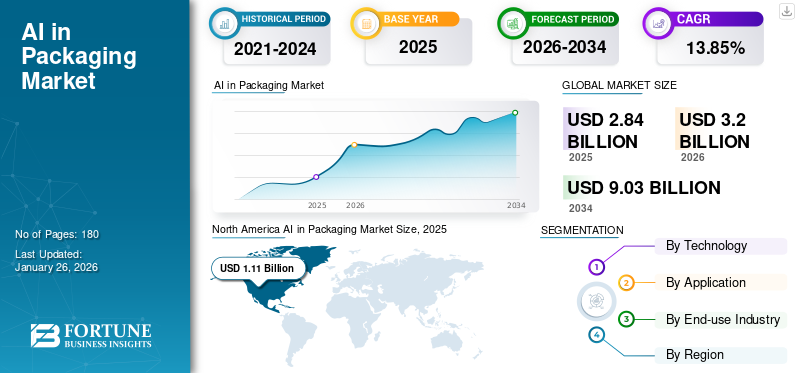
Download Free sample to learn more about this report.
AI IN PACKAGING MARKET KEY TAKEAWAYS
 Market Size & Forecast
- 2025 Market Size: USD 2.84 billion
- 2026 Market Size: USD 3.20 billion
- 2034 Forecast Market Size: USD 9.03 billion
- CAGR: 13.85% from 2026–2034
 Market Share
- North America dominated the ai in packaging market with a market share of 39.13% in 2025.
- The machine learning segment is projected to dominate the market with a share of 46.49% in 2026.
- The packaging design and customization segment will account for 36.89% market share in 2026.
 Key Regional Highlights
North America
The North America market generated USD 1.11 billion in 2025, representing 39.13% of the global market landscape, and is expected to reach USD 1.26 billion in 2026.
Europe
Europe contributed 22.32% to the global market in 2025, with a valuation of USD 0.63 billion, and is projected to reach USD 0.69 billion in 2026.
Asia Pacific
Asia Pacific accounted for USD 0.82 billion in 2025, representing 28.97% of the global market share, and is projected to reach USD 0.95 billion in 2026.
U.S.
The U.S. market is valued at USD 1.01 billion by 2026.
Japan
The Japan market is forecast to attain USD 0.19 billion by 2026.
Read More

MARKET DYNAMICS
MARKET DRIVERS
Development of Biodegradable Materials is Driving the Industry toward Less Waste and Smaller Ecological Footprint
As the packaging industry prioritizes sustainability, artificial intelligence (AI) is becoming a pivotal force in creating packaging solutions that utilize fewer materials, enhance recyclability, and minimize environmental effects. AI-driven design tools can process extensive datasets to refine packaging shapes, sizes, and materials, ensuring that material usage is kept to a minimum while still safeguarding product integrity. This methodology not only reduces waste but also improves recyclability and aligns with the principles of a circular economy.
Machine learning algorithms can model the performance of various materials under diverse conditions, allowing manufacturers to choose environmentally-friendly options that fulfill durability requirements while reducing resource use. For instance, AI can propose interlocking packaging designs with adhesives, thereby simplifying the recycling process and further mitigating environmental damage.
Moreover, AI-based life cycle assessment tools analyze the environmental impact of packaging from its creation to its disposal, pinpointing areas for enhancement and facilitating sustainable decision-making. The incorporation of AI solutions in packaging also fosters the advancement of biodegradable and compostable materials, hastening the development of innovative solutions that cater to consumer preferences and regulatory demands for environmental-friendly products. In conclusion, AI is significantly reshaping sustainable packaging by facilitating intelligent material selection, optimizing design, and managing life cycles, propelling the AI in packaging industry toward diminished waste and a reduced ecological footprint.
Automating Core Processes Leads to Faster Production, Lower Costs, and Superior Quality
Artificial Intelligence is swiftly revolutionizing the packaging industry by automating essential processes such as inspection, sorting, labeling, and handling. This transformation results in accelerated production cycles and decreased operational expenses. AI-enhanced vision systems and industrial image processing technologies facilitate real-time inspection of packaging materials, effectively identifying defects, mislabeling, or inconsistencies that would typically necessitate manual intervention and are prone to human error. Such automation guarantees that only products of superior quality proceed, thereby reducing waste and the likelihood of defective goods reaching consumers.
Furthermore, automated sorting systems leverage AI algorithms to categorize and direct items according to their size, shape, and material, significantly enhancing the speed and accuracy of packaging operations. The labeling process is also optimized, with AI-driven verification ensuring accurate and uniform labeling, which is vital for regulatory compliance and maintaining brand integrity. By substituting repetitive manual tasks with AI-powered machinery and robotics, businesses can achieve greater throughput, enhanced consistency, and reduced labor costs.
Additionally, predictive maintenance, made possible by AI, minimizes downtime by forecasting equipment failures and arranging timely repairs. In summary, AI-driven automation in packaging not only boosts productivity and quality assurance but also provides substantial cost reductions, positioning it as a key factor for the global AI in packaging market growth.
MARKET RESTRAINTS
Privacy and Security Risks are Leading to Regulatory and Compliance Challenges
AI-driven packaging solutions encounter considerable limitations due to challenges related to data privacy and security. These systems depend significantly on the gathering, storage, and analysis of extensive data sets, often containing sensitive information. The extensive data collection involved in AI-enhanced packaging can expose companies to threats such as unauthorized access, data breaches, and cyberattacks, potentially compromising personal or proprietary data. For instance, if AI systems used for packaging automation or customer personalization are compromised, sensitive customer or operational information may be revealed, resulting in identity theft, fraud, or damage to reputation. Furthermore, compliance with intricate and evolving privacy regulations like GDPR and CCPA poses another significant challenge. Companies must ensure that all data collection and processing practices comply with these stringent legal requirements. This compliance can be difficult due to the cross-border nature of digital packaging solutions and the rapid advancement of AI technologies. Failure to comply can lead to hefty fines, legal repercussions, and a decline in customer trust. It thus hampers the global AI in Packaging market expansion.
MARKET OPPORTUNITIES
Rising Demand for Smart, Sustainable Packaging Drives AI Innovation
The rising demand for intelligent and interconnected packaging, coupled with a strong focus on sustainability, is creating substantial opportunities for AI-driven advancements in the packaging industry. AI technologies facilitate the creation of smart packaging systems that extend beyond conventional roles. These systems integrate features such as real-time freshness tracking, product verification, and interactive consumer engagement through embedded sensors and digital platforms. These innovative packaging solutions improve supply chain transparency, enhance product safety, and offer brands valuable insights into consumer behavior, all while fulfilling the increasing consumer desire for connected experiences.
In terms of sustainability, AI is refining packaging design and material selection by analyzing extensive datasets to reduce resource consumption and environmental impact. AI-driven tools can model and visualize packaging performance, allowing for the development of recyclable, lightweight, and biodegradable packaging that adheres to circular economy principles. This not only aids companies in meeting changing environmental regulations but also attracts environmentally conscious consumers. Additionally, AI-enhanced automation in quality control, defect identification, and logistics is minimizing waste, boosting production efficiency, and reducing operational expenses. As e-commerce grows and consumer preferences evolve, AI’s capability to customize packaging and forecast supply chain requirements positions it as a key driver of innovation and expansion in the packaging sector.
MARKET CHALLENGES
Extensive Data Collection in AI-Driven Packaging Heightens Privacy and Security Risks, Resulting in Regulatory and Trust Challenges
A major challenge facing the AI sector in packaging is the necessity of maintaining strong data privacy and security in light of the extensive data collection needed for AI-based solutions. These systems frequently handle sensitive personal and proprietary data, rendering them appealing targets for cyberattacks and data breaches. The intricate nature of data flows, international data transfers, and the opacity of AI decision-making processes exacerbate compliance with changing privacy laws such as GDPR and CCPA. Neglecting to mitigate these risks may lead to regulatory fines, damage to reputation, and erosion of customer trust, which could impede the broader adoption of AI in the packaging industry.
AI IN PACKAGING MARKET TRENDS
Adoption of Machine Learning and AI-Powered Robotics in Packaging Drives Operational Optimization and Enhanced Efficiency
The use of machine learning (ML) algorithms to predict supply chain needs and optimize production schedules is one of the major trends in the market. Predictive analytics is also being used to anticipate demand fluctuations, enabling packaging companies to minimize waste and optimize inventory management. The ML-powered systems can forecast equipment failures, thereby reducing maintenance costs.
AI-driven smart packaging solutions are gaining popularity. These technologies enable packaging to respond dynamically to environmental factors (e.g., temperature, moisture), providing consumers with real-time product information and enhancing their engagement.
Robotics, powered by AI, is revolutionizing packaging lines. Automated robots equipped with computer vision systems can handle tasks such as picking, packing, and sorting with high precision, improving speed and accuracy.
Download Free sample to learn more about this report.
IMPACT OF COVID-19
The COVID-19 pandemic initially caused significant disruptions in the AI packaging market due to temporary manufacturing shutdowns and supply chain challenges. Nevertheless, the crisis expedited the integration of automation, AI, and digital technologies as companies aimed to bolster resilience, enhance efficiency, and implement contactless operations.
The surge in e-commerce and increased hygiene awareness heightened the demand for intelligent, AI-driven packaging solutions and real-time supply chain monitoring. Following the pandemic, the market experienced a robust recovery, with governments and businesses emphasizing the importance of AI integration to optimize production processes, minimize manual errors, and enhance cost efficiency, thereby establishing AI as a pivotal force for innovation in the packaging sector.
SEGMENTATION ANALYSIS
By Technology
Widespread Industry Adoption and Technology Advancements Drive Machine Learning’s Market Dominance
Based on technology, the market is segmented into machine learning, computer vision, natural language processing, predictive analysis, and others.
The machine learning segment holds the largest share in the market due to its wide-ranging applications across industries and its ability to process vast amounts of data efficiently. Key driving factors include the rising demand for automation, real-time data analysis, and intelligent decision-making systems. Machine learning enables improved accuracy in forecasting, personalized customer experiences, and streamlined operations. Its integration in sectors such as healthcare, finance, retail, and manufacturing further accelerates growth. Additionally, advancements in computing power, the availability of large datasets, and increased investment in AI research and development are propelling the adoption of machine learning technologies globally. The machine learning segment is projected to dominate the market with a share of 46.49% in 2026.
The computer vision segment holds the second-largest share in the market. Computer vision is expanding quickly, fueled by rising needs for automation in sectors such as quality control, security, self-driving cars, and face detection. Its ability to derive significant insights from images and videos is transforming industries like retail, healthcare, and manufacturing.
By Application
Rising Demand for Packaging Design and Customization Fuels the Dominance of AI-Driven Packaging
Based on application, the market is segmented into packaging design and customization, quality control and inspection, data labeling, smart warehousing, AI-based recycling systems, and others.
The segment for packaging design and customization dominates the market owing to a rising consumer preference for attractive and personalized packaging. AI-driven tools allow brands to refine designs according to consumer behaviors, preferences, and local trends, improving brand interaction and market adaptability. Automating design procedures shortens time-to-market and facilitates quick prototyping and revisions. The packaging design and customization segment will account for 36.89% market share in 2026.
Quality control and inspection represent the second-largest segment, propelled by the essential demand for precision, uniformity, and safety in manufacturing and packaging procedures. Moreover, the combination of computer vision and machine learning facilitates ongoing enhancement in identifying defects, leading to cost-effectiveness and improved product quality in various industrial applications.
By End-use Industry
Stringent Safety Standards and Consumer Trends Propel AI Adoption in Food and Beverage Packaging
Based on end-use industry, the market is segmented into food and beverage, healthcare, personal care & cosmetics, consumer electronics, e-commerce & retail, and others.
To know how our report can help streamline your business, Speak to Analyst
The food and beverage industry takes the lead owing to strict safety regulations, increased demand for longer shelf-life, and rising consumer interest in sustainable, personalized packaging. AI improves packaging design, traceability, and quality assurance, increasing product attractiveness and regulatory compliance. The rise in automation and intelligent labeling further promotes uptake in this segment. The food & beverage segment is expected to account for 34.46% of the market in 2026.
Healthcare is positioned as the second leading segment, propelled by the essential demand for accuracy, safety, and adherence to regulations in pharmaceutical and medical packaging. AI enables accurate labeling, detects tampering, and ensures traceability within the supply chain. Increasing demand for personalized healthcare, anti-counterfeiting solutions, and intelligent packaging innovations boosts AI implementation in this sector.
AI IN PACKAGING MARKET REGIONAL OUTLOOK
The market has been studied across five main regions: North America, Europe, Asia Pacific, Latin America, and the Middle East & Africa.
North America
North America AI in Packaging Market Size, 2025 (USD Billion)
To get more information on the regional analysis of this market, Download Free sample
North America excels in AI, manufacturing, and innovation, driving the market growth
The North America market generated USD 1.11 billion in 2025, representing 39.13% of the global market landscape, and is expected to reach USD 1.26 billion in 2026. The North America region holds the dominant position in the global AI in packaging market share because of its early adoption of AI, robust manufacturing infrastructure, and significant investment in R&D. Regulatory emphasis on food and drug safety increases the need for AI-powered quality assurance. Moreover, the involvement of prominent AI and packaging technology firms fosters ongoing innovation and collaboration across sectors, particularly in healthcare and retail. The U.S. market is valued at USD 1.01 billion by 2026.
- According to the American Medical Association, in 2023, health expenditures in the U.S. rose by 7.5% to reach USD 4.9 trillion, equating to USD 14,570 for each person. This growth rate is considerably above the 4.6% increase in 2022, and except for the 10.4% surge in 2020 caused by the COVID-19 pandemic, it marks the highest growth rate seen since 2003 (8.5%).
Europe
Europe’s Market Emphasizes Sustainability, Innovation, And Technology Cooperation, Augmenting The Demand
Europe contributed 22.32% to the global market in 2025, with a valuation of USD 0.63 billion, and is projected to reach USD 0.69 billion in 2026. Europe's AI in packaging market is influenced by stringent sustainability regulations, strong consumer desire for environmental friendly packaging, and extensive implementation of Industry 4.0. Governments and the EU are actively financing initiatives related to AI and automation. Innovations in packaging for food, cosmetics, and pharmaceuticals are additionally backed by robust industrial infrastructure and international technology cooperation. The UK market is expected to reach USD 0.09 billion by 2026, while the Germany market is assessed at USD 0.18 billion by 2026.
- In November 2022, European Bioplastics (EUBP) welcomes the proposed new rules on packaging and bioplastics adopted today by the European Commission. “We appreciate the Commission’s first comprehensive policy framework on innovative bioplastic materials, acknowledging their potential to provide genuine environmental benefits. EUBP, in particular, commends the Commission’s endorsement of the important role of compostable plastic packaging in the proposed packaging rules in reaching the ambitious waste and climate targets,” says Hasso von Pogrell, Managing Director of EUBP, “however, we would have expected stronger support for the use of biobased feedstock.”
Asia Pacific
Asia Pacific Growth is Driven By Manufacturing, E-Commerce, And Packaging
Asia Pacific accounted for USD 0.82 billion in 2025, representing 28.97% of the global market share, and is projected to reach USD 0.95 billion in 2026. The Asia Pacific region is experiencing significant growth driven by the expansion of manufacturing sectors, surge in e-commerce, and growing need for affordable, scalable packaging solutions. Government programs in nations such as China, Japan, and India promote AI incorporation. Increasing population and urban growth drive the need for effective packaging in the food, healthcare, and consumer electronics industries. The Japan market is forecast to attain USD 0.19 billion by 2026, the China market is set to reach USD 0.33 billion by 2026, and the India market is anticipated to achieve USD 0.21 billion by 2026.
- As per the Asia-Pacific Economic Cooperation, Southeast Asia part of the Asia-Pacific region is where e-commerce grew the fastest in 2022, with a rate of 20.6%, followed by Latin America at 20.4%.
Latin America
Latin America’s Growth Stems from Various Industries, Investment, And Innovation
Latin America contributed approximately USD 0.19 billion to the global market in 2025, accounting for 6.53% share, and is expected to reach USD 0.2 billion in 2026. The growth of Latin America is driven by advancements in industrial automation, a surge in foreign investment, and a growing demand for packaged food and healthcare items. As it continues to develop, the region demonstrates an increasing interest in AI for optimizing supply chains and ensuring quality control. Brazil and Mexico are becoming important centers for packaging innovation.
- As per UNEP, in 2020, 3.7 million tonnes of plastic pollution entered the ocean from countries in the Latin America and the Caribbean Region (LAC). Right now, 27 of the 33 countries in the LAC region have passed national or local laws for the reduction, prohibition, or elimination of single-use plastics.
Middle East & Africa
Middle East & Africa Market Grows With AI Advancements
In 2025, Middle East & Africa held 3.05% of the global market, reaching a valuation of USD 0.09 billion, and is projected to grow to USD 0.09 billion in 2026. In the Middle East and Africa, the growth of the AI in packaging market is fueled by the expanding food and beverage industries, increasing healthcare demands, and a movement towards industrial advancement. Gulf nations are putting money into smart technologies, such as AI, to improve operational effectiveness. Adoption is rising as knowledge of AI advantages in packaging grows.
- According to the International Fresh Produce Association, the WTO forecast also highlights the resilience of trade growth in the Middle East and Africa in 2022. These regions can expect small declines in exports in 2023, but imports will remain strong, with each region set to grow by 5.7%. Other regions can expect modest growth in both exports and imports in 2023.
COMPETITIVE LANDSCAPE
KEY INDUSTRY PLAYERS
Key Market Participants to Witness Significant Growth Opportunities with New Product Launches
The global market is highly fragmented and competitive, with a few players dominating by offering innovative packaging solutions. These major players constantly focus on expanding their customer base across regions by innovating their existing wide range of products.
Major players in the industry include Tetra Pak Group, Stora Enso, Greif Inc., Ardagh Group, Sealed Air Corporation, and others. Numerous other companies are focused on market trends and delivering advanced packaging solutions.
List of Key AI in Packaging Companies Profiled
- Tetra Pak Group (Switzerland)
- Stora Enso (Finland)
- Greif Inc. (U.S.)
- Ardagh Group (Luxembourg)
- Sealed Air Corporation (U.S.)
- Berry Global (U.S.)
- OJI Holdings Corporation (Japan)
- Avery Dennison Corp. (U.S.)
- Gerreshiemer AG (Germany)
- Georgia Pacific (U.S.)
- Sonoco (U.S.)
- Amcor Plc (Switzerland)
KEY INDUSTRY DEVELOPMENTS
- In March 2025, Unilever reinvents product shoots with AI for faster content creation. New technology that combines AI, physics, data, and material science is helping our Marketing teams create high-quality product imagery faster and more cost-effectively. Discover how digital twin technology is evolving our approach to content.
- In March 2025, Ranpak will introduce three innovative new products that push the boundaries of sustainable packaging forward, host an exclusive educational session, and share an MHI Innovation Award-nominated solution.
- In October 2024, Specright announced new AI features within its Specification Data Management platform, including a chatbot and intelligent document processing. This transformed how supply chain professionals digitize and interact with critical product and packaging data.
- In March 2024, Liberty Robotics, a Michigan-based supplier of 3D volumetric vision guidance systems for robot applications, announced the official launch of its flagship suite of robotic palletizing and depalletizing offerings, VPick and VPack. The robots use AI vision systems to enhance warehouse efficiency and reliability, according to Liberty Robotics, formerly known as Liberty Reach until early 2024.
- In August 2023, Tech start-up Sourceful launched what it claims is the first free-to-use generative AI tool by a company in the packaging category. The business, which describes itself as “the smarter sourcing platform for packaging”, said the new generative AI tool, Spring, will create packaging design ideas in minutes using word-based prompts and a few simple questions about brand colours and design style.
REPORT COVERAGE
The market research report provides a detailed market analysis. The global market overview also focuses on key aspects, such as top key players, competitive landscape, product types, market segments, Porter’s five forces analysis, and leading segments of the product. Besides, the report offers insights into the market trends and highlights key industry developments. In addition to the abovementioned factors, the report encompasses several factors that have contributed to the market growth in recent years.
Request for Customization to gain extensive market insights.
Report Scope & Segmentation
|
ATTRIBUTE |
DETAILS |
|
Study Period |
2021-2034 |
|
Base Year |
2025 |
|
Estimated Year |
2026 |
|
Forecast Period |
2026-2034 |
|
Historical Period |
2021-2024 |
|
Growth Rate |
CAGR of 13.85% from 2026 to 2034 |
|
Unit |
Value (USD Billion) |
|
By Technology, Application, End-use Industry, and Region |
|
|
Segmentation |
By Technology
|
|
By Application
|
|
|
By End-use Industry
|
|
|
By Region
|
Frequently Asked Questions
As per the Fortune Business Insights study, the market stood at USD 2.84 billion in 2025.
The market is likely to grow at a CAGR of 13.85% over the forecast period.
By technology, the machine learning segment leads the market.
The North America market size stood at USD 1.11 billion in 2025.
The development of biodegradable materials is driving the industry toward less waste and a smaller ecological footprint.
Some of the top players in the market are Tetra Pak Group, Stora Enso, Greif Inc., Ardagh Group, Sealed Air Corporation, and others.
The global market size is expected to reach USD 9.03 billion by 2034.



- 2021-2034
- 2025
- 2021-2024
- 180
-
(Offer valid till 30th Sep 2026)
Get 30-60 hrs Free Customization
Expand Regional and Country Coverage, Segments Analysis, Company Profiles, Competitive Benchmarking, and End-user Insights.











Related Reports
-
US +1 833 909 2966 ( Toll Free )
-
Get In Touch With Us