Military Truck Market Size, Share & Industry Analysis, By End User (Army/Land Forces, Defense Logistics & Support Agencies, and Paramilitary/Homeland Security Forces), By Drive Configuration (4x4, 6x6, 8x8, and 10x10 and Above), By Payload Capacity (Below 2.5 Tons, 2.5-5 Tons, 5-10 Tons, 10-15 Tons, and Above 15 Tons), By Truck Type (Light Military Trucks, Medium Military Trucks, Heavy Military Trucks, Tactical Trucks, Logistics/Transport Trucks, and Armored Military Trucks), and Regional Forecast, 2026-2034
 Download Free Sample
 Military Trucks Market Size and Future Outlook
 Listen to Audio Version
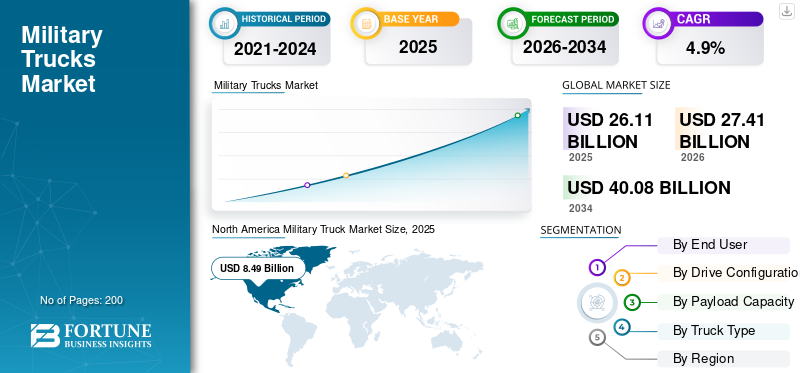
The global military truck market size was valued at USD 26.11 billion in 2025. The market is projected to grow from USD 27.41 billion in 2026 to USD 40.08 billion by 2034, exhibiting a CAGR of 4.9% during the forecast period. North America dominated the military truck market with a market share of 32.51% in 2025.
The market encompasses tactical and logistics vehicles designed to transport troops, equipment, ammunition, and supplies across diverse terrains in support of defense operations. These vehicles include light, medium, and heavy tactical trucks built for durability, mobility, and survivability in combat and non-combat environments. The market is shaped by ongoing modernization of defense fleets, replacement of aging vehicle inventories, and integration of advanced armor, electronics, and mobility systems. Manufacturers are focused on enhancing payload capacity, fuel efficiency, off-road performance, and protection levels to meet evolving operational requirements, supporting logistics, troop transport, and battlefield support missions across army, navy, and air force units globally.
Key players in the market include Oshkosh Defense, Rheinmetall, Daimler Truck, and Iveco Defence Vehicles. These companies compete through stronger payload and mobility performance, broader tactical and logistics vehicle portfolios, modular armor and protection packages, advanced powertrain and off-road capabilities, and integrated vehicle electronics tailored for army, defense logistics, peacekeeping, border security, and battlefield support applications.
Download Free sample to learn more about this report.
MILITARY TRUCKS MARKET KEY TAKEAWAYS
 Global Market Size & Forecast
- 2025 Market Size: USD 26.11 billion
- 2026 Market Size: USD 27.41 billion
- 2034 Forecast Market Size: USD 40.08 billion
- CAGR: 4.9% from 2026-2034
 Market Share
- North America dominated the military truck market with a market share of 32.51% in 2025.
- The defense logistics & support agencies segment is anticipated to rise with a CAGR of 5.7% over the forecast period.
- The 10x10 and above segment is projected to grow at a CAGR of 5.9% over the forecast period.
 Key Regional Highlights
North America
North America held the dominant share in 2024, valued at USD 8.05 billion, and also maintained its leading share in 2025, with USD 8.49 billion.
Europe
Europe is estimated to reach USD 8.14 billion in 2026 and secure the position of second-largest region in the market.
Asia Pacific
Asia Pacific is projected to record a CAGR of 5.0% during the forecast period, which is the second-highest among all regions.
U.S.
Based on North America’s strong contribution and the U.S. dominance within the region, the U.S. market is likely to reach around USD 8.04 billion in 2026, representing a CAGR of 4.6% during the forecast period.
Japan
The Japanese market is estimated to reach around USD 0.71 billion in 2026, accounting for roughly 3.7% of the CAGR during the forecast period.
Read More

MILITARY TRUCK MARKET TRENDS
Growing Adoption of Hybrid and Electric Propulsion Systems to Fuel Market Growth
Defense forces are increasingly exploring hybrid-electric and electric propulsion systems for military trucks to reduce fuel logistics burden and lower acoustic and thermal signatures during operations. This trend is driven by the need for quieter, more fuel-efficient vehicles that support stealth missions and reduce dependency on fuel supply chains in contested environments. Additionally, militaries are integrating digital battlefield management systems, telematics, and modular vehicle architectures into trucks, enabling better fleet monitoring and mission adaptability. This shift reflects a broader move toward sustainable, technologically advanced logistics and tactical vehicle fleets across global armed forces.
MARKET DYNAMICS
MARKET DRIVERS
Download Free sample to learn more about this report.
Rising Defense Modernization and Replacement of Aging Vehicle Fleets to Boost Industry Expansion
Demand for the product is rising as armed forces worldwide are prioritizing the replacement of outdated and aging tactical vehicle fleets to improve operational readiness and mobility. Modern conflicts increasingly require vehicles capable of rapid deployment, enhanced survivability, and adaptability across varied terrains, prompting militaries to invest in next-generation trucks with improved armor and payload capacity. Additional drivers include rising defense expenditure, expanding peacekeeping and humanitarian missions, and growing emphasis on logistics support for sustained military operations, all of which reinforce continued investment in tactical and logistics truck procurement programs globally.
MARKET RESTRAINTS
High Procurement and Lifecycle Maintenance Costs Limiting Fleet Expansion
High procuring, operating, and lifecycle maintenance costs are a key restraint on the military trucks market growth, particularly for budget-constrained defense forces. Advanced armor, specialized powertrains, and integrated electronics significantly raise unit costs, making large-scale fleet expansion financially challenging for smaller nations. Additional restraints include lengthy procurement cycles, complex regulatory and certification requirements, and budget reallocation toward other defense priorities such as air and naval capabilities. These factors collectively slow down the pace of new vehicle acquisitions and limit the scale of fleet renewal programs in several regions.
MARKET OPPORTUNITIES
Rising Demand for Fleet Modernization in Emerging Economies Creating Significant Opportunities
Emerging economies are increasingly investing in modernizing their aging military truck fleets, creating significant opportunities for manufacturers offering technologically advanced and cost-effective solutions. This opportunity is fueled by rising defense budgets in countries seeking to strengthen logistics and troop mobility capabilities amid evolving regional security dynamics. Additionally, growing interest in local manufacturing partnerships and technology transfer agreements allows global players to expand their footprint while supporting domestic defense industrial bases. These factors are encouraging collaborations, joint ventures, and localized production strategies, positioning manufacturers to capture untapped demand across developing defense markets.
MARKET CHALLENGES
Complex Supply Chains and Integration of Advanced Technologies to Hinder Market Development
Manufacturers face challenges in managing complex global supply chains for specialized components such as armor materials, drivetrains, and electronic systems required for military trucks. This challenge is compounded by the need to integrate advanced technologies, including connectivity, automation, and protection systems, without compromising vehicle reliability or increasing weight excessively. Additional challenges include meeting diverse and country-specific military specifications, ensuring interoperability with existing fleets, and navigating geopolitical restrictions on technology transfer. These factors make it difficult for manufacturers to scale production efficiently while maintaining quality, compliance, and timely delivery across multiple defense contracts.
Segmentation Analysis
By End User
Rising Defense Budgets Boosted the Army/Land Forces Segment Growth
Based on end user, the market is segmented into army/land forces, defense logistics & support agencies, and paramilitary/homeland security forces.
The army/land forces segment accounted for the largest military truck market share in 2025. The segment is rising as ground forces require reliable logistics and troop transport vehicles for sustained operations, border patrol, and rapid deployment. Increasing defense budgets and modernization of land-based military infrastructure are reinforcing this demand across both developed and developing nations.
The defense logistics & support agencies segment is anticipated to rise with a CAGR of 5.7% over the forecast period.
To know how our report can help streamline your business, Speak to Analyst
By Drive Configuration
Need For Superior Off-Road Mobility Encouraged the 6x6 Segment Growth
Based on drive configuration, the market is segmented into 4x4, 6x6, 8x8, and 10x10 and above.
In 2025, the 6x6 segment dominated the global market, as military operations increasingly require vehicles capable of navigating rugged, off-road terrain while carrying heavy payloads. The balanced configuration of mobility, load capacity, and stability makes 6x6 trucks suitable for diverse logistics and tactical missions worldwide.
The 10x10 and above segment is projected to grow at a CAGR of 5.9% over the forecast period.
By Payload Capacity
5-10 Tons Segment to Lead due to Its Versatility Across Frontline Resupply Missions
Based on payload capacity, the market is segmented into below 2.5 tons, 2.5-5 tons, 5-10 tons, 10-15 tons, and above 15 tons.
The 5-10 tons segment is anticipated to capture a dominant market share over the forecast period. The segment is rising as this payload range offers an optimal balance between mobility and cargo capacity for transporting troops, equipment, and supplies. Militaries favor this segment due to its versatility across logistics, support, and frontline resupply missions.
The above 15 tons segment is projected to grow at a CAGR of 5.7% over the forecast period.
By Truck Type
Increasing Battlefield Mobility Requirements Boosted Tactical Trucks Segment Growth
Based on truck type, the market is segmented into light military trucks, medium military trucks, heavy military trucks, tactical trucks, logistics/transport trucks, and armored military trucks.
The tactical trucks segment dominated the market in 2025. The segment is rising as modern combat operations require vehicles that combine speed, protection, and maneuverability in hostile environments. Growing emphasis on rapid troop movement and frontline logistics support is reinforcing continued investment in tactical truck procurement.
Armored military trucks are projected to grow at a CAGR of 6.4% during the forecast period.
Military Truck Market Regional Outlook
By geography, the market is categorized into North America, Europe, Asia Pacific, and Rest of the World.
North America
North America Military Truck Market Size, 2025 (USD Billion)
To get more information on the regional analysis of this market, Download Free sample
North America held the dominant share in 2024, valued at USD 8.05 billion, and also maintained its leading share in 2025, with USD 8.49 billion. Growth is driven by sustained defense modernization programs, fleet replacement initiatives, and strong procurement budgets from the U.S. military, alongside continued investment in tactical vehicle upgrades.
U.S. Military Truck Market
Based on North America’s strong contribution and the U.S. dominance within the region, the U.S. market is likely to reach around USD 8.04 billion in 2026, representing a CAGR of 4.6% during the forecast period. Demand in the U.S. remains strong due to continuous fleet modernization programs, large defense budgets, and ongoing replacement of aging tactical and logistics vehicles across all military branches.
Europe
Europe is estimated to reach USD 8.14 billion in 2026 and secure the position of second-largest region in the market. Demand in Europe is supported by rising defense spending amid regional security concerns, fleet modernization across NATO member nations, and increasing collaboration on joint military vehicle development programs.
U.K. Military Truck Market
The U.K. market is estimated to touch around USD 1.01 billion in 2026, representing a CAGR of 4.2% during the forecast period. Demand in the U.K. is supported by defense modernization initiatives, fleet upgrades, and participation in NATO-aligned procurement programs aimed at enhancing land force mobility and operational readiness.
Germany Military Truck Market
Germany’s market is projected to reach approximately USD 1.60 billion in 2026. Demand in Germany is driven by increased defense spending, fleet renewal programs, and strong domestic manufacturing capabilities supporting both national requirements and export-oriented military vehicle production.
Asia Pacific
Asia Pacific is projected to record a CAGR of 5.0% during the forecast period, which is the second-highest among all regions. The market is expected to reach a valuation of USD 7.28 billion in 2026. Demand in the region is rising due to expanding defense budgets, border security concerns, and growing domestic manufacturing capabilities in countries focused on strengthening land force mobility and logistics.
China Military Truck Market
China’s market is projected to be one of the largest in Asia Pacific, with 2026 revenues standing at around USD 2.58 billion. Demand in China is rising due to expanding defense budgets, military modernization efforts, and growing emphasis on strengthening logistics and mobility capabilities across its armed forces.
Japan Military Truck Market
The Japanese market is estimated to reach around USD 0.71 billion in 2026, accounting for roughly 3.7% of the CAGR during the forecast period. Demand in Japan is increasing due to evolving regional security concerns, gradual defense budget growth, and efforts to modernize aging logistics and tactical vehicle fleets.
India Military Truck Market
The Indian market is estimated to reach around USD 1.79 billion in 2026. Demand in India is rising due to expanding defense modernization programs, growing domestic manufacturing initiatives, and increasing focus on self-reliance in tactical and logistics vehicle production.
Rest of the World
The rest of the world includes the Middle East & Africa and Latin America. These regions are expected to witness moderate growth in this market during the forecast period. The Middle East & Africa and Latin America markets are set to reach a valuation of USD 2.25 billion and USD 0.84 billion, respectively, in 2026. Demand across the Rest of the World is gradually increasing as nations in the Middle East, Africa, and Latin America modernize aging fleets and address evolving regional security and peacekeeping requirements.
COMPETITIVE LANDSCAPE
Key Industry Players
Key Players Focus on Offering Protected Tactical Vehicles to Gain a Competitive Edge
The market is being strengthened by key players that are shifting defense mobility from conventional troop and cargo transport toward modular, protected, high-mobility, and mission-configurable truck platforms. Companies such as Oshkosh Defense, Rheinmetall, Daimler Truck, Iveco Defence Vehicles, Tatra Trucks, and Arquus are focusing on 4x4, 6x6, 8x8, and 10x10 truck families, heavy logistics platforms, protected tactical vehicles, fuel and water carriers, recovery trucks, weapon-carrier chassis, and lifecycle support programs. Oshkosh Defense is strengthening its position through continued FMTV A2 modernization and air-droppable tactical truck variants, while Rheinmetall is expanding its military logistics truck base through large HX truck orders for NATO forces. Iveco Defence Vehicles is supporting long-term army fleet renewal through tactical-logistic truck deliveries, and AM General is positioning the JLTV A2 around improved fuel efficiency, lower operating costs, and enhanced field performance. Meanwhile, Daimler Truck, Tatra Trucks, Tata Advanced Systems, and Ashok Leyland are contributing through modular military truck platforms, all-wheel-drive configurations, domestic manufacturing capability, and specialized logistics vehicles. These strategies are boosting market growth by aligning military truck procurement with force mobility, battlefield sustainment, fleet replacement, and protected logistics requirements.
LIST OF KEY MILITARY TRUCK COMPANIES PROFILED
- Oshkosh Defense (U.S.)
- Rheinmetall (Germany)
- Daimler Truck (Germany)
- Iveco Defence Vehicles (Italy)
- Tatra Trucks (Czech Republic)
- Arquus (France)
- AM General (U.S.)
- Navistar Defense (U.S.)
- Tata Advanced Systems (India)
- Ashok Leyland (India)
KEY INDUSTRY DEVELOPMENTS
- June 2026: European ministries (such as Switzerland, Serbia, and Greece) finalized tenders and framework agreements for the regular servicing, parts distribution, and procurement of tactical military trucks.
- February 2026: The U.S. State Department approved a major Foreign Military Sale (FMS) to supply Israel with up to 3,250 Joint Light Tactical Vehicles (JLTVs) and extensive logistics support, valued at USD 1.98 billion.
- June 2025: Oshkosh Defense was awarded a three-year contract extension for the production of the Family of Medium Tactical Vehicles (FMTV).
- March 2025: The Indian Army signed a USD 7.3 million contract with Mahindra & Mahindra and Force Motors to procure over 5,000 light military vehicles.
- February 2025: Oshkosh Defense secured USD 215 million in U.S. Army contracts for LVAD and FMTV truck models, with completion terms scaling through late 2027.
REPORT COVERAGE
This research offers a detailed analysis of emerging trends and rapidly adopted technologies in the military truck industry across key regions. The report outlines key drivers of market growth and challenges to expansion, delivering a detailed overview of the maritime industry landscape. The study highlights recent advancements to boost industry insights and support stakeholders in making well-informed decisions.
Request for Customization to gain extensive market insights.
Report Scope & Segmentation
| ATTRIBUTE | DETAILS |
| Study Period | 2021-2034 |
| Base Year | 2025 |
| Estimated Year | 2026 |
| Forecast Period | 2026-2034 |
| Historical Period | 2021-2024 |
| Growth Rate | CAGR of 4.9% from 2026 to 2034 |
| Unit | Value (USD Billion) |
| Segmentation | By End User, By Drive Configuration, By Payload Capacity, By Truck Type, and Region |
| By End User |
|
| By Drive Configuration |
|
| By Payload Capacity |
|
| By Truck Type |
|
| By Region |
|
Frequently Asked Questions
According to Fortune Business Insights, the global market value stood at USD 26.11 billion in 2025 and is projected to reach USD 40.08 billion by 2034.
In 2025, the market value stood at USD 8.49 billion.
The market is expected to exhibit a CAGR of 4.9% during the forecast period.
By end user, the army/land forces segment dominated the market.
Rising defense modernization and replacement of aging vehicle fleets are key factors driving the market.
Oshkosh Defense, Rheinmetall, Daimler Truck, Iveco Defence Vehicles, and Tatra Trucks are a few major players in the global market.
North America dominated the market in 2025



- 2021-2034
- 2025
- 2021-2024
- 200
Get 30-60 hrs Free Customization
Expand Regional and Country Coverage, Segments Analysis, Company Profiles, Competitive Benchmarking, and End-user Insights.




















Related Reports
-
US +1 833 909 2966 ( Toll Free )
-
Get In Touch With Us