Fumigant Products Market Size, Share & Industry Analysis, By Type (Methyl Bromide, Phosphine, Sulfuryl Fluoride, and Others), By Form (Solid, Liquid, and Gas), By Application (Commercial & Industrial, Agriculture, and Residential), and Regional Forecast, 2026-2034
 Download Free Sample
(Offer valid till 30th Sep 2026)

Fumigant Products Market Size and Future Outlook
 Listen to Audio Version
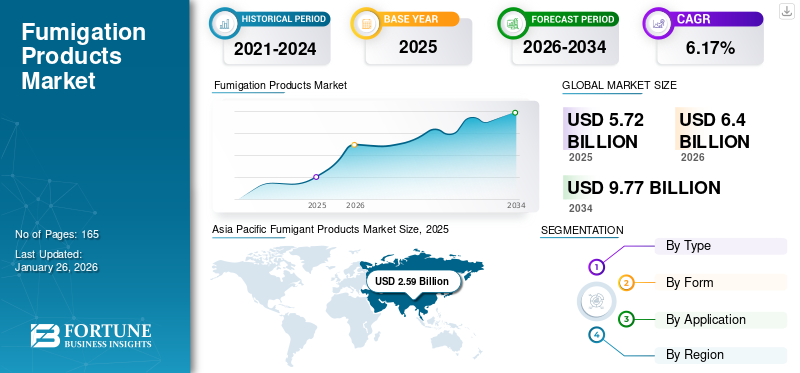
The global fumigant products market size was valued at USD 5.48 billion in 2025. The market is projected to grow from USD 5.76 billion in 2026 to USD 8.97 billion by 2034, exhibiting a CAGR of 5.68% during the forecast period. Asia Pacific dominated the fumigant products market with a market share of 39.05% in 2025.
Fumigants are toxic or volatile, poisonous substances that produce lethal gases when inhaled. Fumigants kill nematodes, insects, and pests that cause damage to seeds, stored foods, clothing, human dwellings, and nursery stock. Commercial fumigant products are applied under controlled conditions to treat agricultural soil, stored grains, warehouses, silos, food-processing facilities, shipping containers, vessels, wooden packaging, commercial buildings, and residential structures.
Global production, distribution, and technical development are supported by major companies such as UPL Limited, Detia Degesch Group, Douglas Products and Packaging Company LLC, Draslovka Holding a.s., and AMVAC Chemical Corporation. These companies maintain established portfolios across phosphine, sulfuryl fluoride, soil fumigants, and newer agricultural fumigation chemistries.
Download Free sample to learn more about this report.
Fumigant Products Market Trends
Technology-Enabled Pest Control Services are Emerging as a Key Market Trend
The use of technology for various industry verticals has been fueled in the last decade with the introduction of Internet of Things (IoT) platforms. IoT platforms are vital in changing how Pest Management Professionals (PMPs) do their business in the pest control industry. Rising service and product performance expectations are increasing customer demand for tech-enabled services. Considering the rising demand for tech-enabled services, manufacturers of fumigants and fumigation service providers are changing how they introduce products and services. The digital pest control system is a wireless network of high-tech trap sensors that provide 24/7 real-time capture alerts, monitoring, and up-to-the-minute rodent activity verification. This technique provides pest infestation data to consumers, which, in turn, helps them to take preventive actions.
The technology-enabled pest control system aids in providing valuable data. The system also enables consumers to receive instant information regarding the emergence of new pests and insects in the facility with real-time automated alerts sent on the smartphones or tablets of consumers. It also enables quick root-cause analysis.
- The Food and Agriculture Organization has also supported digital surveillance platforms such as eLocust, FAMEWS, and SusaHamra for monitoring plant pests across affected regions. Consequently, the fumigant-products industry is gradually moving from product-only sales toward integrated service packages combining monitoring, data analytics, treatment application, compliance documentation, and preventive maintenance.
MARKET DYNAMICS
Market Drivers
Download Free sample to learn more about this report.
Rising Crop-Pest Pressure and Changes in Pest Distribution to Support Product Adoption
Changes in temperature, rainfall, humidity, cropping cycles, and commodity movement can alter pest survival, reproduction, geographical distribution, and the number of generations completed during a season. Warmer storage environments can accelerate the development of beetles, moths, weevils, and other stored-product pests, while changing climatic conditions may expand the geographical range of soil-borne pathogens and nematodes.
The International Plant Protection Convention (IPPC) also notes that climate change is influencing the infectivity, severity, and distribution of plant pests and may alter international trade flows in plants and plant products. These conditions are expected to support demand for soil fumigation in high-value crops and post-harvest fumigation in regions experiencing longer warm periods, high humidity, or increased pest migration.
- The International Plant Protection Convention estimates that pests destroy up to 40% of crops annually, with associated global trade losses of approximately USD 220 billion. The scale of the economic exposure encourages farmers, grain handlers, processors, exporters, and warehouse fumigation operators to maintain preventive pest-management programs.
|
Rank |
Market Driver |
Expected Impact on Market Growth |
Estimated CAGR Contribution, 2026–2034 |
Impact: 2026-2028 |
Impact: 2029-2031 |
Impact: 2032-2034 |
|
1 |
Expansion of grain production, commercial storage capacity, strategic food reserves, and post-harvest protection requirements |
High |
2.10% |
High |
High |
High |
|
2 |
Increasing international agricultural trade, quarantine fumigation and pre-shipment treatments, port activity, and fumigation of containers, vessels, railcars, and export commodities |
High |
1.70% |
High |
High |
High |
|
3 |
Rising pest infestation associated with warmer temperatures, humidity, longer storage periods, and the wider distribution of insects, nematodes, and soil-borne pathogens |
Medium-High |
1.35% |
Medium |
High |
High |
|
4 |
Growing fumigant use across warehouses, food-processing plants, flour mills, grain terminals, silos, logistics facilities, and commercial buildings |
Medium |
1.05% |
Medium |
High |
High |
|
5 |
Product innovation involving sulfuryl fluoride, cylinderized phosphine, alternative gases, improved soil fumigants, digital monitoring, and recirculation systems |
Medium-Low |
0.80% |
Medium |
Medium |
High |
|
6 |
Others, including high-value crop cultivation, timber treatment, structural fumigation, applicator training, and food storage pest control modernization in emerging markets |
Low |
0.58% |
Low |
Medium |
Medium |
|
Total Gross Growth Contribution |
7.58% |
Market Restraints
Health, Environmental, and Regulatory Requirements Increase the Cost and Complexity of Fumigation
Fumigants require strict controls as they are designed to penetrate enclosed environments and kill pests through respiratory or cellular toxicity. Incorrect dosage, leakage, insufficient sealing, premature reentry, inadequate aeration, or untrained handling can expose applicators, nearby workers, residents, animals, and surrounding communities. As a result, fumigation operations frequently require certified personnel, respiratory protection, exclusion zones, warning signs, gas-monitoring instruments, treatment plans, aeration procedures, clearance testing, recordkeeping, and emergency-response protocols.
Regulatory restrictions are particularly influential in the methyl bromide segment. The Montreal Protocol established control schedules for non-quarantine and pre-shipment uses of methyl bromide, while quarantine and pre-shipment applications remain subject to reporting, licensing, emission-reduction measures, and continuing evaluation of alternatives.
- The United Nations Environment Programme (UNEP) reported that global consumption for controlled applications declined from approximately 64,420 metric tons in 1991 to around 40 metric tons in 2021, while alternatives have replaced more than 99% of baseline controlled uses.
|
Rank |
Market Restraint |
Expected Impact on Market Growth |
Estimated CAGR Contribution, 2026–2034 |
Impact: 2026-2028 |
Impact: 2029-2031 |
Impact: 2032-2034 |
|
1 |
Stringent regulations concerning worker exposure, toxic emissions, pesticide residues, re-entry periods, environmental impact, and restricted fumigant use |
High |
-0.72% |
High |
High |
High |
|
2 |
Increasing phosphine resistance due to repeated use, inadequate sealing, insufficient gas concentration, and shortened exposure periods |
Medium-High |
-0.51% |
Medium |
High |
High |
|
3 |
High application and compliance costs associated with certified operators, protective equipment, monitoring instruments, aeration, and clearance testing |
Medium |
-0.39% |
Medium |
Medium |
High |
|
4 |
Others, including hermetic storage, controlled atmospheres, heat treatment, biological pest control, limited applicator availability, and uneven approvals |
Low |
-0.28% |
Low |
Medium |
Medium |
|
Total Market Reduction |
-1.90% |
Market Opportunities
Development of Alternative Fumigants and Integrated Pest Management (IPM) to Create New Growth Potential
Regulatory pressure on methyl bromide and increasing resistance to phosphine are creating opportunities for alternative gases, improved formulations, agrochemical solutions, controlled-atmosphere systems, recirculation equipment, impermeable films, gas-recovery technology, and digitally verified application services. These solutions can be positioned according to specific requirements such as rapid treatment, lower residue potential, reduced ozone impact, suitability for organic commodities, efficacy against resistant insects, or compatibility with sensitive processing equipment.
Sulfuryl fluoride is gaining commercial relevance as it can treat food-processing plants, warehouses, mills, vehicles, stored commodities, and selected residential structures. The Environmental Protection Agency (EPA) confirms that products containing sulfuryl fluoride are registered for grains, dried fruits, dried beans, buildings, dwellings, furnishings, and vehicles, supporting its use as an alternative to methyl bromide in several enclosed applications.
- Newer products such as EDN and hydrogen-cyanide-based BlueFume are also being developed for soil, timber, structural, fresh-produce, and commodity applications. Draslovka positions EDN for soil disinfection and timber treatments and BlueFume for structural fumigation and commodity stored grain protection.
SEGMENTATION ANALYSIS
By Type
Phosphine Dominated the Market Due to Its Extensive Use in Stored-Grain and Commodity Protection
Based on type, the market is segmented into methyl bromide, phosphine, sulfuryl fluoride, and others.
The phosphine segment dominated the global market and was valued at USD 2.99 billion in 2025. Its leadership is supported by widespread use in wheat, rice, maize, pulses, oilseeds, animal feed, processed foods, tobacco, dried commodities, and non-food materials. Commercial products are supplied as aluminium-phosphide or magnesium-phosphide tablets, pellets, sachets, plates, strips, blankets, and cylinderized gas mixtures. These formats allow treatment across silos, warehouses, ships, railcars, containers, bag stacks, bunkers, and temporary covered enclosures.
Sulfuryl fluoride is projected to register the fastest CAGR of 6.63% over the forecast period. Growth will be supported by its expanding use in food-processing plants, warehouses, mills, transportation equipment, commodity chambers, and structural pest control.
To know how our report can help streamline your business, Speak to Analyst
By Form
Solid Fumigants Held the Largest Share Due to Their Established Use in Grain Storage
Based on form, the market is segmented into solid, liquid, and gas.
The solid segment dominated the global fumigant products market share and was valued at USD 3.00 billion in 2025. Solid products primarily include aluminium-phosphide and magnesium-phosphide tablets, pellets, sachets, plates, strips, and bag formulations that release phosphine when exposed to moisture. Their compact packaging, comparatively straightforward transportation, long storage life, controlled gas-release characteristics, and suitability for distributed grain-storage systems support broad adoption. Solid formulations can be introduced into silos, grain bulks, bag stacks, railcars, warehouses, containers, and ship holds without installing permanent gas-generation infrastructure.
The gas segment is projected to register the fastest CAGR of 6.30% over the forecast period. Cylinderized phosphine, sulfuryl fluoride, methyl bromide, and newer gases offer precise dosage control, rapid distribution, recirculation capability, and compatibility with automated concentration monitoring.
By Application
Agriculture Segment Dominated Due to Extensive Soil, Grain, and Post-Harvest Fumigation Requirements
Based on application, the market is segmented into commercial & industrial, agriculture, and residential.
The agriculture segment dominated the global market and was valued at USD 3.39 billion in 2025. The segment includes pre-plant soil fumigation, stored-grain treatment, seed and feed protection, orchard and nursery treatment, agricultural pesticides, greenhouse fumigation, and post-harvest protection of agricultural commodities. Soil fumigants are used to reduce populations of nematodes, weeds, fungi, bacteria, insects, and soil-borne pathogens before crop protection products. Post-harvest fumigants are applied to grains, pulses, oilseeds, feed ingredients, dried fruits, nuts, coffee, cocoa, tobacco, and other commodities during storage or transportation.
The commercial & industrial segment was valued at USD 1.83 billion in 2025 and is projected to register the fastest CAGR of 6.39% in the global fumigant products market forecast period. Commercial and industrial fumigation includes fumigation of ship-holds, railcars, sea containers, bins and silos, tarps and bunkers, trailers, elevators, chambers, vaults, trucks, warehouses, vans, transport vehicles, tarpaulin-covered commodities, and others.
Fumigant Products Market Regional Outlook
Regionally, the market is studied across North America, Europe, Asia Pacific, South America, and the Middle East & Africa.
Asia Pacific
Asia Pacific Fumigant Products Market Size, 2025 (USD Billion)
To get more information on the regional analysis of this market, Download Free sample
Asia Pacific dominated the global market and was valued at USD 2.14 billion in 2025, growing at the fastest regional CAGR of 6.68% over the forecast period. Its leadership is supported by large grain-production and consumption volumes, extensive use of phosphine, and a broad base of small and industrial storage facilities. Further, humid and warm climatic conditions, and expanding trade in rice, wheat, maize, pulses, oilseeds, spices, fresh produce, and timber also drive the region’s dominance.
China Fumigant Products Market
China dominated the Asia Pacific market and was valued at approximately USD 0.67 billion in 2025. Demand is supported by its extensive grain reserves, food-processing industry, commodity-import network, warehouses, port infrastructure, and domestic production of phosphide-based fumigants.
India Fumigant Products Market
India was valued at approximately USD 0.54 billion in 2025. The country has a substantial base of public and private grain storage, warehouses, flour mills, rice mills, pulse processors, exporters, and food-distribution facilities.
North America
North America was valued at USD 1.49 billion in 2025, expanding at a CAGR of 5.01% over the forecast period. Demand is supported by large-scale commercial grain storage, high-capacity food-processing plants, established structural pest-control services, regulated phytosanitary treatment, and extensive movement of agricultural commodities by truck, rail, vessel, and container. The region has strong demand for phosphine in stored commodities, sulfuryl fluoride in structural and food-facility applications, and liquid soil fumigants in high-value crop yield enhancement.
U.S. Fumigant Products Market
The U.S. dominates the North American market and was valued at approximately USD 1.23 billion in 2025. Demand comes from grain elevators, warehouses, mills, food factories, ports, rail operators, structural pest-control businesses, and growers of potatoes, berries, vegetables, orchard crops, and nursery plants.
Europe
Europe was valued at USD 0.97 billion in 2025 and is projected to grow at a CAGR of 4.58% over the forecast period. Regional demand is supported by grain storage, flour milling, food and beverage manufacturing, warehouses, museums, timber treatment, shipping, port activity, and professional structural pest management. Germany, France, Spain, Italy, the U.K., the Netherlands, and other major trading markets maintain established pest-control and commodity-treatment networks.
Germany Fumigant Products Market
Germany was valued at approximately USD 0.18 billion in 2025. Demand is supported by grain handling, food processing, flour milling, logistics facilities, stored-product protection, and trade with other European markets.
U.K. Fumigant Products Market
The U.K. market was valued at approximately USD 0.14 billion in 2025. Applications are concentrated in food-processing facilities, commercial warehouses, flour mills, grain storage, shipping, structural treatment, and imported commodities.
South America and Middle East & Africa
South America was valued at USD 0.55 billion in 2025, registering a CAGR of 6.31% over the forecast period. Growth is supported by large export-oriented grain and oilseed industries, longer storage durations, expansion of commercial silos, high port throughput, and warm climatic conditions. Further, rising treatment requirements for maize, soybeans, wheat, rice, coffee, cocoa, fruits, and animal feed also support fumigant products market growth.
The Middle East & Africa market was valued at USD 0.33 billion in 2025, witnessing a CAGR of 3.83% over the forecast period. Demand is supported by imported grain, strategic food reserves, flour mills, ports, warehouses, date processing, tobacco storage, food-manufacturing plants, and treatment of commodities entering through major trade corridors.
Brazil Fumigant Products Market
Brazil dominated the South American market and was valued at approximately USD 0.38 billion in 2025. Its position is supported by substantial soybean, maize, rice, wheat, coffee, and animal-feed supply chains, together with expanding inland storage and export-terminal capacity.
COMPETITIVE LANDSCAPE
Key Industry Players
Companies Focus on Regulatory Registration, Active-Ingredient Diversification, and Application Support to Strengthen Market Position
The global fumigant products market includes multinational crop-protection companies, specialist phosphide manufacturers, sulfuryl-fluoride suppliers, soil-fumigation companies, pest control chemical producers, product distributors, equipment suppliers, and professional application-service providers. Competition is based on active-ingredient access, product registration, geographic coverage, treatment efficacy, gas-release consistency, application safety, residue profile, exposure time, resistance management, technical training, and supply reliability.
Manufacturers, including UPL Limited, Detia Degesch Group, Draslovka Holding a.s., and AMVAC Chemical Corporation, are increasingly combining product sales with stewardship training, gas-monitoring guidance, dosage software, resistance-management advice, regulatory support, and application equipment. Registration expansion is particularly important due to the reason that a fumigant may be commercially available in one country but restricted or unapproved for the same commodity in another.
List of Key Fumigant Products Companies Profiled
- UPL Limited (India)
- Detia Degesch GmbH (Germany)
- Douglas Products and Packaging Company LLC (U.S.)
- Draslovka Holding a.s. (Czech Republic)
- AMVAC Chemical Corporation (U.S.)
- Intech Organics Limited (India)
- Teleos Ag Solutions, Inc. (U.S.)
- TriCal Group, Inc. (U.S.)
- Tessenderlo Kerley, Inc. (U.S.)
- Cardinal Professional Products (U.S.)
KEY INDUSTRY DEVELOPMENTS
- August 2026: Santa Cruz County launched a USD 175,000 pilot program to test high-temperature steam as a non-chemical alternative to conventional soil fumigants for berry farming in the Pajaro Valley. This follows recent regulatory pushes and studies exploring sustainable pest management.
- June 2026: Detia Degesch Group completed the acquisition of Draslovka’s eFUME business, including the employees responsible for developing the business. Detia stated that the acquisition would expand its international product and service portfolio, with a particular focus on preventing the movement of quarantine pests through the fresh-fruit trade.
- December 2025: Western Fumigation expanded into CO₂-based organic fumigation for nuts, dried fruits, cocoa beans, coffee, spices, grains, and other stored commodities. The system incorporates gas-introduction equipment, improved sealing and atmospheric monitoring, and digital treatment documentation.
- October 2025: Tessenderlo Kerley acquired Eastman’s U.S. and Canadian crop-protection product labels for CLR 42% metam sodium and KLR 54% metam potassium. The company described the transaction as an expansion of its soil-fumigation portfolio.
- May 2025: Teleos Ag Solutions acquired the TELONE soil-fumigation portfolio, effective May 1, 2025. Products including TELONE II, TELONE EC, and CURFEW were renamed under the “by Teleos” branding, while their formulations and performance specifications remained unchanged.
REPORT COVERAGE
The global fumigant products industry report analyzes the market in depth and highlights crucial aspects such as global market trends, market dynamics, supply chains, prominent companies, investment in research and development, and end-use. Besides this, the report also provides insights into the global market analysis and highlights significant industry developments.
Request for Customization to gain extensive market insights.
Report Scope & Segmentation
| ATTRIBUTE | DETAILS |
| Study Period | 2021-2034 |
| Base Year | 2025 |
| Estimated Year | 2026 |
| Forecast Period | 2026-2034 |
| Historical Period | 2021-2024 |
| Growth Rate | CAGR of 5.68% from 2026 to 2034 |
| Unit | Value (USD Billion) |
|
Segmentation |
By Type
|
|
By Form
|
|
|
By Application
|
|
|
By Region
|
Frequently Asked Questions
Fortune Business Insights says that the global market was valued at USD 5.48 billion in 2025 and is anticipated to reach USD 8.97 billion by 2034.
At a CAGR of 5.68%, the global market will exhibit steady growth over the forecast period.
By type, the phosphine segment led the market.
Asia Pacific held the largest market share in 2025.
Rising crop-pest pressure and changes in pest distribution are the crucial factors driving product adoption.
UPL Limited, Detia Degesch Group, Douglas Products and Packaging Company LLC, Draslovka Holding a.s., and AMVAC Chemical Corporation are the leading players in the market.
Technology-enabled pest control services is shaping industry trends.



- 2021-2034
- 2025
- 2021-2024
- 165
-
(Offer valid till 30th Sep 2026)
Get 30-60 hrs Free Customization
Expand Regional and Country Coverage, Segments Analysis, Company Profiles, Competitive Benchmarking, and End-user Insights.














Related Reports
-
US +1 833 909 2966 ( Toll Free )
-
Get In Touch With Us