Neurothrombectomy Devices Market Size, Share & Industry Analysis, By Product Type (Aspiration Devices [Aspiration Catheters, Aspiration Pumps/Aspiration Systems and Aspiration Tubing & Collection Canisters], Clot Retrievers [Stent Retrievers and Other Mechanical Clot Retrievers], Access Devices [Microcatheters, Guide Catheters, Balloon Guide Catheters, and Others), and Others], By Vascular Access Approach (Transfemoral Access, Transradial Access, Transbrachial Access, and Others), By End-user (Hospitals & ASCs, Specialty Clinics, and Others), and Regional Forecast, 2026-2034
 Download Free Sample
(Offer valid till 15th Aug 2026)
Neurothrombectomy Devices Market Size and Future Outlook
 Listen to Audio Version
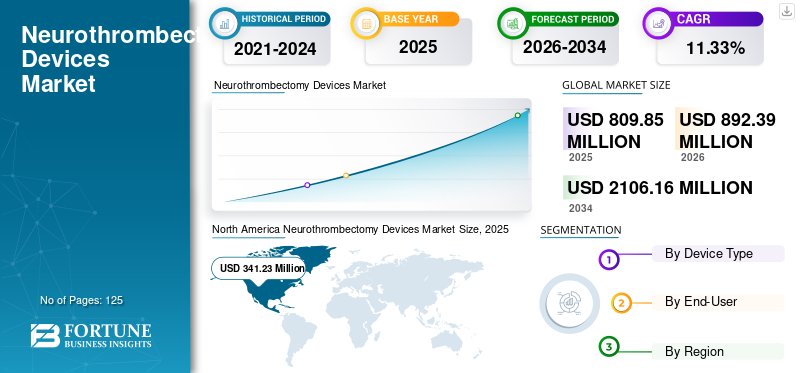
The global neurothrombectomy devices market size was USD 1.03 billion in 2025. The market is projected to grow from USD 1.16 billion in 2026 to USD 2.50 billion by 2034 at a CAGR of 10.1% during the forecast period. North America dominated the neurothrombectomy devices market with a market share of 37.86% in 2025.
Neurothrombectomy devices are clot removal products that are used to treat ischemic stroke, which occurs when a blood clot blocks blood flow to the brain, depriving it of oxygen and blood. The growing prevalence of stroke, rising demand for neurothrombectomy devices, and increasing investments in research and development activities are boosting the adoption of these devices in the market. In addition, government initiatives to improve access for thrombectomy procedures are further fueling market growth.
- For instance, according to the 2024 data published by the Centers for Disease Control & Prevention (CDC), around 795,000 people experienced a stroke in the U.S.
The growing integration of robotics and AI-enabled workflow optimization into neurothrombectomy systems by major companies, including Medtronic and Penumbra, Inc., is contributing to the global adoption of these devices.
Download Free sample to learn more about this report.
Neurothrombectomy Devices Market KEY TAKEAWAYS
 Global Market Size & Forecast
- 2025 Market Size: USD 1.03 Billion
- 2026 Market Size: USD 1.16 Billion
- 2034 Forecast Market Size: USD 2.50 Billion
- CAGR: 10.1% from 2026–2034
 Market Share
- North America held the dominant market share in 2025.
- Transfemoral Access accounted for the largest market share of 87.4% in 2025.
- Aspiration Devices emerged as a key product segment in the market.
 Key Regional Highlights
Asia Pacific
Asia Pacific is projected to reach USD 0.33 billion by 2026, driven by expanding healthcare infrastructure.
North America
North America reached USD 0.39 billion in 2025, supported by rising stroke cases and thrombectomy centers.
Europe
Europe is projected to reach USD 0.34 billion by 2026, driven by increasing neurovascular research.
U.S.
The U.S. market is projected to reach USD 0.39 billion by 2026, supported by advanced stroke treatment facilities.
Japan
The Japan market is projected to reach USD 0.08 billion by 2026, driven by the high prevalence of stroke.
Read More

Neurothrombectomy Devices Market Trends
Integration of AI-Enabled Stroke Workflow Optimization and Robotic Thrombectomy Platforms to Boost Market Growth
The integration of artificial intelligence-enabled stroke workflow optimization with robotic and remote thrombectomy solutions is emerging as a major trend in the global market. AI-enabled stroke solutions are increasingly being adopted to detect suspected large-vessel occlusion in CT/CTA imaging, which automatically notifies stroke professionals, helps in hub-and-spoke coordination, and reduces delays between imaging, specialist review, transfer decisions, and groin puncture. These capabilities improve workflow speed and accessibility among the patient population.
Additionally, key companies are focusing on the development of robotic neurointervention and remote thrombectomy platforms to address geographic and workforce-related access gaps. These robotic systems enable experienced physicians to support or perform procedures remotely in hospitals with limited on-site expertise, thereby expanding access to advanced stroke care.
- For instance, in September 2025, Stryker partnered with Siemens Healthineers to advance neurovascular robotics with the aim of developing a robotic system capable of performing a comprehensive range of elective and emergency neurovascular procedures, including treatment for strokes and aneurysms.
Market Dynamics
Market Drivers
Download Free sample to learn more about this report.
Increasing Prevalence of Acute Ischemic Strokes to Drive Market Growth
The rising prevalence of acute ischemic strokes is a key factor driving the market. Stroke remains one of the key causes of mortality and long-term disability globally, increasing the clinical demand for faster diagnosis, acute intervention, and improved revascularization outcomes. An increasing number of stroke patients is encouraging hospitals and stroke centers to adopt advanced neurothrombectomy devices, including next-generation stent retrievers, balloon guide catheters, microcatheters, aspiration catheters, guidewires, aspiration tubing, pumps, and vascular access products.
- For instance, according to data published by the American Heart Association in 2023, the global age-standardized incidence rate of ischemic stroke is projected to reach 89.32 per 100,000 population by 2030.
Furthermore, recent technological advancements, growing demand for minimally invasive procedures, and availability of adequate reimbursement policies are also boosting the adoption of neurothrombectomy devices globally.
|
Rank |
Market Drivers |
Overall Impact Rank |
CAGR Contribution (2026-2034) |
Impact 2026-2028 |
Impact 2029-2031 |
Impact 2032-2034 |
|
1 |
Rising incidence of acute ischemic stroke |
High |
+3.5% |
High |
High |
High |
|
2 |
Expansion of thrombectomy-capable stroke centers and hub-and-spoke stroke networks |
High |
+3.2% |
High |
High |
Medium |
|
3 |
Strong clinical guideline support and wider treatment-window adoption |
High |
+2.7% |
High |
Medium |
Medium |
|
4 |
Technology advancement in aspiration catheters, stent retrievers, balloon guide catheters, and AI-enabled triage |
Medium-High |
+2.4% |
Medium |
High |
High |
|
5 |
Improving reimbursement, public stroke programs, and hospital investment in neurointervention infrastructure |
Medium-High |
+2.2% |
Medium |
High |
Medium |
|
6 |
Others (growing clinician training, awareness campaigns, public-private stroke partnerships, product launches, and gradual adoption in secondary cities, etc.) |
Low-Medium |
+1.6% |
Low |
Medium |
Medium |
|
Total Positive Growth Contribution |
+15.6% |
Market Restraints
High Procedure Cost and Limited Access to Neurothrombectomy Centers to Hinder Market Growth
Among the treatment options available to treat ischemic stroke, mechanical thrombectomy is the main procedure where the blood clots are removed mechanically by a specialist. However, the procedure is highly specialized and requires advanced disposable devices, advanced imaging infrastructure, trained neurointerventional specialists, and 24/7 stroke-care readiness, which increases the upfront cost of treatment among the patient population.
- For instance, according to 2025 data published by the BMJ, stent retrievers and aspiration catheters often cost between USD 4,000.0 -5,000.0 per single-use procedure.
Limited awareness of thrombectomy, combined with the presence of a few thrombectomy centers in emerging countries, further restricts market growth by reducing patient access to timely treatment.
|
Rank |
Market Restraints |
Overall Impact Rank |
Negative CAGR Contribution (2026-2034) |
Impact 2026-2028 |
Impact 2029-2031 |
Impact 2032-2034 |
|
1 |
Limited access to trained neurointerventionalists and 24/7 thrombectomy services |
High |
-2.0% |
High |
Medium |
Medium |
|
2 |
High procedure cost and limited access to neurothrombectomy centers |
Medium-High |
-1.5% |
High |
Medium |
Medium |
|
3 |
Strict patient eligibility, time sensitivity, and procedural risks |
Medium |
-1.2% |
Medium |
Medium |
Medium |
|
4 |
Others (regulatory approval delays, procurement cycles, shortage of stroke awareness, limited EMS triage quality, and uneven reimbursement in smaller markets, etc.) |
Low |
-0.8% |
Low |
Low |
Low |
|
Total Negative Growth Impact |
-5.5% |
Market Opportunities
Expansion of Healthcare Infrastructure in Developing Nations Creates Growth Opportunities
The expansion of healthcare infrastructure in emerging countries presents a major growth opportunity for the market. The growing prevalence of stroke, combined with limited access to thrombectomy centers, is driving investments in healthcare infrastructure to improve stroke care services in emerging countries. Private healthcare providers and governmental organizations are investing in thrombectomy-capable centers, new hospitals, and AI-enabled devices. These investments, along with increasing healthcare expenditure, are improving access to healthcare settings, thereby driving the adoption of neurothrombectomy devices, including vascular access devices.
- For instance, according to 2023 data published by the National Center for Biotechnology Information (NCBI), China’s stroke care infrastructure expanded to 1,962 designated centers.
Market Challenges
Procedural Risks and Clinical Complications Hamper Market Growth
Neurothrombectomies are complex endovascular procedures that require catheter navigation through delicate cerebral vessels. Despite its proven clinical benefits, the procedure carries inherent risks that can influence physician decision-making, hospital adoption, patient selection, and device utilization.
Major risks associated with neurothrombectomy procedures include symptomatic intracranial hemorrhage, subarachnoid hemorrhage, vessel perforation, vasospasm, and arterial dissection. These complications can increase mortality risk, worsen functional outcomes, prolong ICU admission, and raise overall treatment costs, thereby hampering neurothrombectomy devices market growth.
- For instance, according to 2025 data published by MDPI, symptomatic intracranial hemorrhage (sICH) was reported to occur in around 2–14% of patients undergoing mechanical thrombectomy.
SEGMENTATION ANALYSIS
By Product Type
Rising Focus of Key Companies on Launching New Products Led to the Dominance of Clot Retrievers Segment
Based on product type, the market is classified into aspiration devices, clot retrievers, access devices, and others. Aspiration devices are further divided into aspiration catheters, aspiration pumps/ aspiration systems, and aspiration tubing & collection canisters. Clot retrievers are further bifurcated into stent retrievers and other mechanical clot retrievers. Access devices are further segmented into microcatheters, guide catheters, balloon guide catheters, and others.
The clot retrievers segment held the largest market share in 2025. The segment’s growth is owing to the increasing prevalence of acute ischemic stroke, resulting in a growing demand for neurothrombectomy devices, especially stent retrievers. This, along with the rising focus of key companies on launching novel devices, is further contributing to the segment’s growth.
- For instance, in August 2022, Wallaby Medical, a global innovative medical technology company specializing in neurovascular interventional products for stroke treatment, launched the pRESET thrombectomy device, a stent retriever, in Brazil.
To know how our report can help streamline your business, Speak to Analyst
The aspiration devices segment is expected to grow at a CAGR of 10.5% over the forecast period.
By Vascular Access Approach
Established Clinical Practice and Broad Device Compatibility Boosted the Transfemoral Access Segment Growth
Based on vascular access approach, the market is segmented into transfemoral access, transradial access, transbrachial access, and others.
The transfemoral access segment dominated the global market in 2025, accounting for 87.4% of the market share. The segment’s growth is driven by its widespread familiarity among interventional physicians, compatibility with most thrombectomy devices, and ease of standardization across public and private hospitals. This, along with a growing number of companies focusing on expanding their regional presence and introducing innovative neurovascular devices, is likely to fuel the segment’s growth.
- For instance, in August 2025, Balt Group opened its office in Bogotá, Colombia, with an aim to strengthen its presence in Latin America.
The transradial access segment is set to grow at a CAGR of 11.3% during the forecast period.
By End-user
Increasing Number of Hospitals & ASCs Led to the Segmental Dominance
Based on end user, the market is trifurcated into hospitals & ASCs, specialty clinics, and others.
The hospitals & ASCs segment dominated the market in 2025. The growing prevalence of chronic conditions, rising number of neurothrombectomy procedures performed in hospitals, and expanding hospital infrastructure are some of the major factors contributing to the growth of the segment in the market. Furthermore, the segment is set to hold a 96.4% share in 2026.
- For instance, according to 2023 data published by HealthcareAsia, Japan had around 8,300 hospitals.
The specialty clinics segment is projected to grow at a CAGR of 16.3% during the forecast period.
NEUROTHROMBECTOMY DEVICES MARKET REGIONAL Outlook
Based on region, the market has been studied across North America, Europe, Asia Pacific, Latin America, and the Middle East & Africa.
North America
North America Neurothrombectomy Devices Market Size, 2025 (USD Billion)
To get more information on the regional analysis of this market, Download Free sample
The North America market held the dominant share in 2024, valued at USD 0.35 billion, and also maintained its leading position in 2025 with USD 0.39 billion. The rising prevalence of acute ischemic stroke, developed healthcare infrastructure, growing product launches, and an increasing number of thrombectomy-capable centers are some of the factors contributing to the growth of the region in the market.
- For instance, according to 2020 statistics published by the Journal of Stroke & Cerebrovascular Diseases (JSCD), there were about 359 thrombectomy-capable centers in the U.S.
U.S. Neurothrombectomy Devices Market
Based on North America’s strong contribution and the U.S. dominance within the region, the U.S. market is expected to reach around USD 0.39 billion in 2026, accounting for roughly 33.9% of global sales.
Europe
Europe is projected to record a growth rate of 7.5% during the forecast period, which is the second highest among all regions. The market is likely to reach USD 0.34 billion in 2026. The growing research activities among key companies to introduce novel devices, including smart aspiration systems, are likely to support market growth.
U.K. Neurothrombectomy Devices Market
The U.K.’s market is estimated to reach around USD 0.05 billion in 2026, representing roughly 4.3% of global revenues.
Germany Neurothrombectomy Devices Market
Germany’s market is projected to reach approximately USD 0.09 billion in 2026, equivalent to around 8.0% of global sales.
Asia Pacific
Asia Pacific is estimated to reach USD 0.33 billion in 2026, securing the position of the third-largest region in the market, driven by expanding healthcare systems and growing demand for the product.
Japan Neurothrombectomy Devices Market
The Japanese market is estimated to reach around USD 0.08 billion in 2026, accounting for roughly 7.1% of global revenues. Japan has historically reported a high prevalence of stroke, supporting the growing adoption of endovascular thrombectomy systems in the industry.
China Neurothrombectomy Devices Market
China’s market is projected to be one of the largest worldwide. The market is expected to reach around USD 0.12 billion in 2026, representing roughly 10.5% of global sales.
India Neurothrombectomy Devices Market
The Indian market is estimated to reach around USD 0.04 billion in 2026, accounting for roughly 3.0% of global revenues.
Latin America and Middle East & Africa
The Latin America and Middle East & Africa regions are expected to witness moderate growth in this market during the forecast period. The Latin America market is set to reach a valuation of USD 0.04 billion in 2026. The growth is due to the growing number of neurological recovery programs and demand for advanced products, including clot retrieval devices. The Middle East & Africa is also expected to grow considerably during the forecast period, driven by rising demand for minimally invasive procedures and adoption of the product. In the Middle East & Africa, the GCC is set to reach USD 0.01 billion in 2026.
South Africa Neurothrombectomy Devices Market
The South Africa market is projected to reach around USD 0.004 billion in 2026, representing roughly 0.4% of global revenues.
Competitive Landscape
Key Industry Players
Key Players Focus on Acquisitions to Boost their Brand Presence
A robust and diversified neurothrombectomy devices portfolio, along with a significant focus on strategic initiatives, is one of the crucial factors contributing to the dominance of these companies in the market. Medtronic and Penumbra, Inc., are major companies in the market in 2025. Furthermore, the growing focus of key companies on acquisitions and mergers is further contributing to the global neurothrombectomy devices market share.
- For instance, in June 2026, Medtronic, a global company in healthcare technology, acquired Scientia Vascular, a privately-held medical device company in Salt Lake City. The acquisition is valued at USD 550 million and helped the company to increase its brand presence.
Other key players, including Stryker, are also growing in the market and strengthening their presence in the market through continued investments in research and development activities.
LIST OF KEY NEUROTHROMBECTOMY DEVICES COMPANIES PROFILED
- Stryker (U.S.)
- Medtronic (Ireland)
- Penumbra, Inc. (U.S.)
- Wallaby Medical (U.S.)
- Johnson & Johnson Services, Inc. (U.S.)
- Terumo Neuro (U.S.)
- ASAHI INTECC CO., LTD. (Japan)
- Balt Group (France)
- Imperative Care, Inc. (U.S.)
- RapidPulse, Inc. (U.S.)
KEY INDUSTRY DEVELOPMENTS
- June 2026: Penumbra, Inc., the thrombectomy company, received U.S. Food and Drug Administration (FDA) clearance for THUNDERBOLT, expanding its computer-assisted vacuum thrombectomy (CAVT) technology portfolio for the treatment of acute ischemic stroke.
- May 2026: ASAHI INTECC CO., LTD. received U.S. FDA 510(k) clearance for the SAYA 86 Radial Access Guide Catheter, a percutaneous neurovascular catheter designed to support neurovascular access procedures.
- May 2026: Balt Group established a new facility in Irvine to strengthen its product development capabilities in the U.S.
- February 2026: Johnson & Johnson Services, Inc., launched CEREGLIDE 42 and CEREGLIDE 57 aspiration catheters, along with the INNERGLIDE 7 delivery aid, expanding its aspiration-first stroke treatment portfolio.
- July 2025: Imperative Care, Inc., partnered with Proximie Partners to support physicians in the use of Imperative Care’s Telos robotic-assisted technology platform.
- March 2025: Medtronic partnered with Methinks AI, an AI-driven radiological triage and notification system provider, to enhance stroke treatment workflows across Central and Eastern Europe and other regions.
- August 2022: Wallaby Medical entered into a distribution collaboration with Japan Lifeline Co., Ltd., for 11 neurovascular treatment devices. This partnership strengthened the company's presence in the Japanese market.
REPORT COVERAGE
The report provides a detailed global neurothrombectomy devices market analysis and focuses on key aspects such as leading companies and market segmentation, including product type, vascular access approach, and end user. Besides this, the global report offers insights into the market growth trends and highlights key industry developments. In addition to the aforementioned factors, the report encompasses several factors that have contributed to the growth of the market in recent years.
Request for Customization to gain extensive market insights.
Report Scope & Segmentation
| ATTRIBUTE | DETAILS |
| Study Period | 2021-2034 |
| Base Year | 2025 |
| Estimated Year | 2026 |
| Forecast Period | 2026-2034 |
| Historical Period | 2021-2024 |
| Growth Rate | CAGR of 10.1% from 2026 to 2034 |
| Unit | Value (USD Billion) |
| Segmentation | By Product Type, Vascular Access Approach, End User, and Region |
| By Product Type |
|
| By Vascular Access Approach |
|
| By End User |
|
| By Region |
|
Frequently Asked Questions
Fortune Business Insights says that the global market stood at USD 1.03 billion in 2025 and is projected to reach USD 2.50 billion by 2034.
In 2025, the market value stood at USD 0.39 billion.
The market is expected to grow at a CAGR of 10.1% during the forecast period (2026-2034).
Based on product type, the clot retrievers segment led the market.
Increasing prevalence of acute ischemic stroke is the key factor driving the market.
Medtronic and Penumbra, Inc. are the top players in the market.
North America dominated the market share in 2025.
Growing prevalence of acute ischemic stroke is the key factor anticipated to drive the adoption of the product.



- 2021-2034
- 2025
- 2021-2024
- 125
-
(Offer valid till 15th Aug 2026)
Get 30-60 hrs Free Customization
Expand Regional and Country Coverage, Segments Analysis, Company Profiles, Competitive Benchmarking, and End-user Insights.













.webp)






Related Reports
-
US +1 833 909 2966 ( Toll Free )
-
Get In Touch With Us