Surgical Instrument Tracking Systems Market Size, Share & Industry Analysis, By Product (Hardware, Software, and Services), By Technology (Barcode and Radiofrequency Identification (RFID)), By Application (Private Hospitals and Public Hospitals), and Regional Forecast, 2026-2034
 Download Free Sample
KEY MARKET INSIGHTS
 Listen to Audio Version
The global surgical instrument tracking systems market size was valued at USD 316.3 million in 2025 and is projected to grow from USD 356.9 million in 2026 to USD 908.11 million by 2034, exhibiting a CAGR of 12.38% during the forecast period. North America dominated the surgical instrument tracking systems market with a market share of 47.80% in 2025.
Surgical instrument tracking systems are digital solutions especially designed for monitoring, tracking, and locating surgical instruments. These solutions provide visibility and traceability for surgical instruments, allowing them to maintain proper workflow in the supply chain. Moreover, tracking systems allow healthcare providers to optimize surgical operations, ensure patient safety, and achieve long-term cost efficiencies. As healthcare facilities continue to adopt more digitized and integrated systems, the role of tracking technologies in handling surgical assets is expected to grow considerably.
Market growth is expected to be driven by the growing need for intelligent inventory management solutions, technological advancements in asset tracking technologies, and substantial investments in healthcare infrastructure consolidation.
- For instance, in September 2024, Oracle announced a new RFID-based software to automate inventory management. This new solution is capable of tracking supplies and instruments within a minimal amount and improved patient experience. Moreover, the system uses cloud SCM to manage such exhaustive data.
Some of the key players in the market include Fortive, B. Braun SE, Getinge AB, Steris, and others. Key players are focused on implementing various organic and inorganic growth strategies to expand their market share globally.
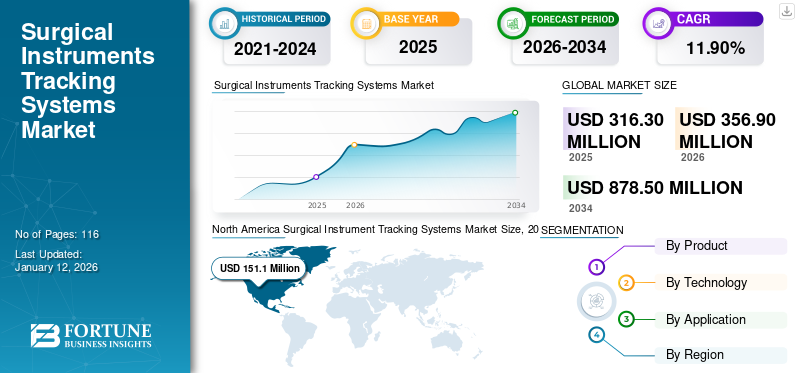
Download Free sample to learn more about this report.
Surgical Instrument Tracking Systems Market KEY TAKEAWAYS
 Market Size & Forecast
- 2025 Market Size: USD 316.3 million
- 2026 Market Size: USD 356.9 million
- 2034 Forecast Market Size: USD 908.11 million
- CAGR: 12.38% from 2026–2034
 Market Share
- North America dominated the surgical instrument tracking systems market with a 47.80% share in 2025.
- The hardware segment is projected to hold the largest market share of 42.08% in 2026.
- The private hospitals segment is expected to lead the market with a 75.04% share in 2026.
 Key Regional Highlights
North America
North America accounted for USD 151.1 million in 2025 and is projected to reach USD 170.9 million in 2026, supported by advanced healthcare infrastructure and technology adoption.
Europe
Europe generated USD 77.9 million in 2025 and is expected to reach USD 87.6 million in 2026, driven by growing emphasis on patient safety and regulatory compliance.
Asia Pacific
Asia Pacific contributed USD 58.4 million in 2025 and is projected to reach USD 66.8 million in 2026, fueled by healthcare modernization and increasing hospital investments.
U.S.
U.S. The market is projected to reach USD 158.9 million by 2026, supported by widespread adoption of automated tracking technologies in healthcare facilities.
Japan
Japan The market is projected to reach USD 18.9 million by 2026, driven by rising demand for efficient surgical asset management and healthcare digitization.
Read More

MARKET DYNAMICS
Market Drivers
Rapidly Expanding Healthcare Infrastructure Coupled with Growing Demand for Asset Management Solutions to Boost Market Growth
In recent years, there have been substantial developments in healthcare infrastructure in countries such as China, India, Brazil, Saudi Arabia, and UAE, among others. The rising emphasis of local government authorities on the development of healthcare facilities and expansion of hospitals is leading to huge investments from the public and private sectors across healthcare industry, which is further anticipated to drive the market growth in the near future.
- For instance, in May 2025, PB Healthcare raised USD 218 million through rounds of series funding to build hi-tech hospitals across Delhi. These hospitals will be incorporated with data-driven decision-making systems, along with predictive analytics tools and well-organized workflow modules.
Moreover, such significant expansion of healthcare infrastructure requires intelligent asset and inventory management solutions for better workflows. In addition, technological advancements are also offering favorable opportunities for the approval of such solutions.
- In November 2022, Sengkang General Hospital in Singapore announced its plan to expand its real-time tracking systems capabilities for asset tracking to improve its workflow.
Market Restraints
High Installation Cost of Surgical Instrument Tracking Workflow to Deter Market Growth
Though the number of benefits offered by surgical instrument tracking systems is large, the high initial cost of installation and setup is likely to hinder the market growth during the forecast period. Furthermore, beyond the initial capital outlay, there are also frequent costs tied to maintenance, system updates, and staff training. Successful implementation demands a shift in workflow, requiring time and effort to train surgical and sterilization staff in proper usage, which may lead to temporary inadequacies or resistance to change.
- The estimated average cost of surgical instrument tracking systems varies from USD 10,000 to USD 30,000 (first-year installation costs) for a small facility, which includes license and support, along with the cost of scanners, printers, and consumables. This cost is further amplified for a medium to large facility, which can range from USD 35,000 to USD 120,000 (first-year installation costs).
Market Opportunities
Rising Emphasis on Patient Safety and Operational Efficiency Offers Lucrative Market Opportunities
The rising emphasis on patient safety and operational efficiency within healthcare systems is offering a favorable opportunity for the adoption of surgical instrument tracking systems. Government guidelines are urging healthcare authorities to focus on better surgical outcomes and lowering medical errors, which further offers a favorable environment for the adoption of surgical instrument tracking systems.
Surgical instrument tracking systems play an important role in fulfilling these safety requirements by offering real-time visibility into the usage, sterilization, and storage of instruments used during medical procedures. This capability considerably reduces the risk of retained surgical items—an error that can lead to serious patient harm, infections, legal consequences, and reputational damage for healthcare institutions. Further, companies are focusing on the introduction of new solutions with progressive capabilities, enabling superior operational efficiencies.
- For instance, in October 2020, Braun SE’s part Aesculap announced a strategic partnership with Ascendco Health to combine unconventional sterile processing solutions with cutting-edge data analytics, aiming to modernize surgical operations and improve hospital efficiency. This collaboration surged the demand for Aesculap’s surgical instrument tracking solutions, as hospitals seek integrated, data-driven solutions to optimize inventory management, reduce waste, and improve patient safety.
Market Challenges
Lack of Standard Protocols to Offer Substantial Challenge for Market Growth
The lack of standardized protocol is one of the prominent challenges for the growth of the market. While the technology for tracking instruments has evolved rapidly—with advanced RFID and barcode systems offering real-time visibility—the absence of a unified framework for integration, data sharing, and interoperability among different departments or even across hospitals remains a challenge.
Each hospital or surgical center often uses its own method for cataloging, labeling, and sterilizing instruments. As a result, vendors must customize their solutions widely for each institution, which creates implementation delays and operational complexity.
Surgical Instrument Tracking Systems Market Trends
Rising Awareness among Healthcare Settings Leading to Higher Integration of Digital Technologies
The growing awareness about digital solutions and platforms among healthcare providers is encouraging the adoption of surgical instrument tracking systems in healthcare facilities. The healthcare sector in the majority of countries is witnessing digital transformation and adopting digital solutions due to the concerns related to patient safety, strict regulations connected to asset management, and rising focus on automation of workflow.
Furthermore, the adoption of digital solutions in the healthcare sector has significantly increased in developed countries such as the U.S., Germany, France, the U.K., and Japan. Different benefits associated with digital solutions are responsible for the higher adoption of these solutions. Digital solutions, such as digital health, EHR, EMR, mHealth, and Hospital management systems, are commonly used in developed regions.
- For instance, in May 2025, Latrobe Regional Health (LRH), Australia, announced the successful activation of its integrated operating theatre system, which Altera Digital Health designed. The newly activated theater holds capabilities such as theatre utilization tracking, improved scheduling, and superior resource allocation.
Download Free sample to learn more about this report.
Impact of COVID-19
Decreased Surgeries During Pandemic Restricted Market Expansion
The COVID-19 pandemic had a massive impact on the surgical instrument tracking systems market. During the pandemic, the focus of all healthcare facilities was on providing and accommodating the need for COVID-19 care, which impacted the adoption of surgical instrument tracking systems. Moreover, the less count of surgeries also impacted the utilization of tracking systems. However, the intensity of infection generated a promising environment for potentially superior solutions for sterilization management, which is projected to have a positive impact on the market.
- According to data published by the Australian Institute of Health and Welfare, Australia witnessed the lowest number of elective surgeries achieved during 2021-2022 since the past decade.
Segmentation Analysis
By Product
Rapid Adoption of Tracking Systems Boosted Hardware Segment Growth
Based on the product, the market is classified into hardware, software, and services.
The hardware segment dominated the market due to growing adoption of tracking systems, rising emphasis on improved inventory management, and expanding healthcare infrastructure. The hardware segment is projected to dominate the market with a share of 42.08% in 2026. In addition, technological advancements are also estimated to have a positive impact on the hardware segment.
- For instance, in June 2022, Fresenius Kabi expanded its RFID portfolio by adding +RFID, a radio frequency-tagged medication system. The company took this strategic step in collaboration with AmerisourceBergen.
On the other hand, the software segment is projected to exhibit the fastest CAGR during the forecast period. Various factors, such as rising demand for innovative solutions in developed countries and growing investments for the improvement of workflows, are major factors impacting the segment's growth.
- For instance, in December 2024, Synapsis Healthcare implemented the SYNAPSIS system at the Mazowiecki Specialist Hospital in Radom, Poland. This transformed the Central Sterilization Department into a fully digitalized and paperless environment, marking the company’s significant milestone.
To know how our report can help streamline your business, Speak to Analyst
By Application
Public Hospitals Take Lead Due to Increase in Surgical Procedures
Based on application, the market is divided into private hospitals and public hospitals.
The public hospitals segment holds the largest share of the market. The increasing number of surgical procedures, combined with the adoption of healthcare asset management systems in the public healthcare sector, are responsible for the growth of the segment. Many public hospitals are adopting barcode-based tracking systems initially due to lower implementation costs and ease of integration with existing processes.
In 2026, the private hospitals segment is projected to lead the market with a 75.04% share. Certain factors, such as a growing number of technologically advanced hospitals, a rising focus on asset management, and massive investments to drive the segment's growth. Moreover, private hospitals are highlighting provided world-class patient care, which is also expected to drive segment growth during the forecast period.
- For instance, in October 2022, Sengkang General Hospital in Singapore signed an agreement with Cadi Scientific to develop smart facilities incorporated with RTLS systems. The new facility will be equipped with asset tracking capability.
By Technology
Barcode Segment to Hold Major Share Due to Operational Efficiencies
Based on technology, the market is segmented into barcode and radiofrequency identification (RFID).
The barcode segment is expected to lead the market, contributing 66.41% globally in 2026. Barcodes offer reliable performance for tracking and managing surgical instruments. They can be rapidly scanned to record the movement, usage, and sterilization status of each instrument, reducing manual errors and ensuring accurate record-keeping. This traceability is crucial for patient safety, infection control, and compliance with hospital procedures.
The radiofrequency identification (RFID) segment is projected to register the fastest CAGR during the forecast period. The technology represents a significant advancement in surgical instrument tracking due to its capability to automate and streamline data collection without demanding line-of-sight.
SURGICAL INSTRUMENT TRACKING SYSTEMS MARKET REGIONAL OUTLOOK
By geography, the market is categorized into North America, Europe, Asia Pacific, Latin America, and Middle East & Africa.
North America
North America Surgical Instrument Tracking Systems Market Size, 2025 (USD Million)
To get more information on the regional analysis of this market, Download Free sample
In 2025, North America represented USD 151.1 million, accounting for 47.80% of the worldwide market, and is projected to grow to USD 170.9 million in 2026. This dominance is attributed to various factors, such as advanced healthcare infrastructure, strict government and U.S. Food and Drug Administration (FDA) regulations, a growing number of surgical procedures, and the introduction of new products. In addition, the financial capabilities of the region, along with emphasis on the adoption of new technologies, are estimated to drive the market.
- For instance, in January 2025, El Camino Health hospital in Mountain View announced the launch of its healthcare innovation fund to leverage improved patient care.
The U.S. observes rising emphasis on superior operational efficiency coupled with extensive surgical volumes. Moreover, the U.S. surgical instruments tracking market will be positively impacted with growing focus of healthcare facilities on long-term cost savings. Additionally, the healthcare authorities in Canada are also focusing on providing patient care, which is in turn estimated to boost market growth over the forecast period. The U.S. market is projected to reach USD 158.9 billion by 2026.
Europe
The Europe market generated USD 77.9 million in 2025, representing 24.60% of the global market landscape, and is expected to reach USD 87.6 million in 2026, owing to rising demand for the product due to growing regulatory pressures, increased focus on patient safety, growing number of surgical procedures, and hospital accreditation standards. Countries such as Germany, the U.K., and France have implemented national safety mandates that promote instrument traceability in operating rooms. The UK market is projected to reach USD 13.3 billion by 2026, while the Germany market is projected to reach USD 24.8 billion by 2026.
- For instance, in January 2024, Klinikverbund Sudwest, a German healthcare provider, along with Caverion, announced its plan to build a new and modernized hospital. The total investment for this healthcare facility is around USD 55 million.
Asia Pacific
Asia Pacific contributed 18.50% to the global market in 2025, with a valuation of USD 58.4 million, and is projected to reach USD 66.8 million in 2026. Asia Pacific is emerging as a high-growth region for surgical instrument tracking systems, supported by rapid expansion of healthcare infrastructure, increasing surgical volumes, and rising awareness of surgical safety standards. Countries including China, India, Japan, and South Korea are investing heavily in upgrading hospital technologies to match the international standards. Private healthcare chains in urban centers are aggressively deploying RFID and barcode systems to manage surgical tools and ensure regulatory compliance. Moreover, a strong focus on sterilization processes is also likely to boost the Asia Pacific surgical instrument tracking systems market growth. The Japan market is projected to reach USD 18.9 billion by 2026, the China market is projected to reach USD 16 billion by 2026, and the India market is projected to reach USD 12.2 billion by 2026.
- For instance, in July 2024, Getinge partnered with Medical Bear, a Japanese sterilization provider, to digitalize sterile supply workflows, integrating Getinge’s T-DOC system. This collaboration set a new benchmark for the company’s expansion in Japan.
Latin America
The market in Latin America reached USD 16.1 million in 2025, representing 5.10% of total market revenue, and is projected to reach USD 17.4 million in 2026. Latin America shows a moderate pace of adoption in the market, influenced by economic constraints and varying degrees of healthcare digitization. Countries such as Brazil, Mexico, and Argentina are investing in hospital infrastructure and seeking to align with global patient safety standards. However, fragmented healthcare systems, import dependency for advanced technologies, and a lack of uniform policy enforcement present hurdles to its widespread adoption.
- For instance, in February 2020, Avery Dennison installed a new RFID manufacturing plant in Brazil. The facility focuses on the production of RFID tags.
Middle East & Africa
The Middle East & Africa market was valued at USD 12.8 million in 2025, capturing 4.10% of global revenue, and is estimated to reach USD 14.1 million in 2026. The Middle East & Africa region is characterized by a dual scenario: advanced healthcare systems in Gulf countries and under-resourced hospitals in Africa. Countries such as UAE, Saudi Arabia, and Qatar are investing in smart hospital infrastructure and adopting advanced surgical tracking systems as part of broader digital health strategies. High-end private hospitals and government-funded facilities in these regions are leveraging RFID and integrated software to enhance surgical safety and performance.
- For instance, in February 2024, Synapsis Healthcare installed the SYNAPSIS system at Danat Al Emarat Hospital for Women & Children in Abu Dhabi, advancing the centralization and digitalization of sterilization services across the Mubadala Health network.
COMPETITIVE LANDSCAPE
Key Industry Players
Ongoing Focus on Development of Novel Technologies to Assist Companies Expanding Their Market Share
Various players, such as Fortive, STERIS, and Getinge AB, among a few others, are prominently operating in the market. Growing emphasis on providing cutting-edge tracking systems, along with massive investments by hospitals for the installation of novel technologies, is responsible for market growth. In addition, the emphasis of these players on partnerships and collaborations for geographical expansion is also estimated to have a positive impact on the market growth.
- In December 2020, Censis and Cantel Medical entered a long-term partnership to develop an integrated endoscope reprocessing software solution, combining Censis’ CensiTrac surgical asset management with Cantel’s CANEXIS workflow platform. This collaboration enhanced infection prevention, workflow efficiency, and patient safety for healthcare facilities.
Other companies operating in the global market include SpaTrack Medical Limited, Xerafy Singapore Pte Ltd, and Synapsis Healthcare, among other small & medium-sized players. These companies are focusing on various strategic initiatives such as partnerships, collaborations, and others to improve their market presence.
LIST OF KEY SURGICAL INSTRUMENT TRACKING SYSTEM COMPANIES PROFILED
- Fortive (U.S.)
- B Braun SE (Germany)
- SpaTrack Medical Limited (U.K.)
- Getinge (Sweden)
- Steris PLC (Ireland)
- Xerafy Singapore Pte Ltd. (Singapore)
- Synapsis Healthcare (Poland)
- RFID4U (U.S.)
KEY INDUSTRY DEVELOPMENTS
- April 2025: Xerafy Singapore Pte Ltd and ABL partnered to deliver an integrated RFID asset tracking solution, combining Xerafy’s rugged RFID tags with ABL’s AssetVoice software to streamline operations and boost asset visibility in energy, healthcare, and manufacturing sectors. This enhanced the company’s reputation in the global market.
- December 2024: Getinge completed the first North American installation of its full Surgical Workflows portfolio at UT Health San Antonio’s new Multispecialty and Research Hospital. This installation included digital health solutions, including the T-DOC instrument tracking system.
- March 2024: Synapsis Healthcare announced that Croatia’s Priora International Medical Center joined the SYNAPSIS family, pioneering the country’s first advanced surgical instrument management system to revolutionize CSSD operations and patient care.
- June 2023: STERIS signed a definitive agreement to purchase the surgical instrumentation from BD. This acquisition enhanced STERIS’s offerings and support for healthcare customers.
- June 2023: Braun SE’s part Aesculap Academy, received global accreditation from the Royal College of Surgeons of England, now recognized in 43 countries. This prestigious accreditation increased the demand for the company’s surgical instrument tracking solutions, as globally recognized, high-quality training increases the need for advanced, reliable solutions to ensure surgical safety and efficiency in accredited institutions.
REPORT COVERAGE
Request for Customization to gain extensive market insights.
Report Scope & Segmentation
|
ATTRIBUTE |
DETAILS |
|
Study Period |
2021-2034 |
|
Base Year |
2025 |
|
Estimated Year |
2026 |
|
Forecast Period |
2026-2034 |
|
Historical Period |
2021-2024 |
|
Growth Rate |
CAGR of 12.38% from 2026-2034 |
|
Unit |
Value (USD Million) |
|
Segmentation |
By Product
|
|
By Technology
|
|
|
By Application
|
|
|
By Region
|
Frequently Asked Questions
Fortune Business Insights says that the global market value stood at USD 356.9 million in 2026 and is projected to reach USD 878.5 million by 2034.
In 2025, the market value stood at USD 151.1 million.
The market is expected to exhibit a CAGR of 11.90% during the forecast period of 2026-2034.
The hardware segment led the market by product.
The key factors driving the market are the increasing emphasis on the adoption of inventory management and asset tracking solutions.
B Braun SE, SpaTrack Medical Limited, Getinge, and Steris PLC are the top players in the market.
North America dominated the surgical instrument tracking systems market with a market share of 47.80% in 2025.



- 2021-2034
- 2025
- 2021-2024
- 116
Get 30-60 hrs Free Customization
Expand Regional and Country Coverage, Segments Analysis, Company Profiles, Competitive Benchmarking, and End-user Insights.













.webp)






-
US +1 833 909 2966 ( Toll Free )
-
Get In Touch With Us