Airport Parking Management Market Size, Share & Industry Analysis, By Offering (Hardware, Software, and Services), By Parking Type (Short-Term, Long-Term, Valet, Reserved/Pre-Booked, and Employee Parking), By Technology (License Plate Recognition/ANPR, RFID & QR Code-Based Access, IoT-Based Parking Sensors, Parking Guidance Systems, AI-Based Dynamic Pricing, and Others), By Airport Category (Large International, Medium-Sized, and Regional/Domestic Airports), By Business Model (Airport-Owned & Operated, Third-Party Operated, and Concession-Based Parking), and Regional Forecast, 2026-2034
 Download Free Sample
Airport Parking Management Market Size and Future Outlook
 Listen to Audio Version
The global airport parking management market size was valued at USD 2.30 billion in 2025. The market is projected to grow from USD 2.48 billion in 2026 to USD 4.32 billion by 2034, exhibiting a CAGR of 7.17% during the forecast period. North America dominated the airport parking management market with a market share of 39.13% in 2025.
Airport parking management refers to the integrated systems, technologies, and services used to organize, monitor, control, and optimize vehicle parking operations within and around airport premises. It includes software platforms, hardware infrastructure, and managed services for automated access control, revenue management, parking reservation systems, parking guidance, real-time parking space monitoring, dynamic pricing, and digital payment processing. The market serves commercial, domestic, military, and international airports across short-term, long term, valet, employee, and covered parking facilities. Rising air passenger volumes, demand for frictionless travel, airport congestion management, and the need to improve non-aeronautical revenue are key factors driving adoption.
Major players include SKIDATA GmbH, Amano Corporation, Conduent Incorporated, T2 Systems, and TIBA Parking Systems, offering solutions for access control, enforcement, reservations, parking operations, and revenue optimization.
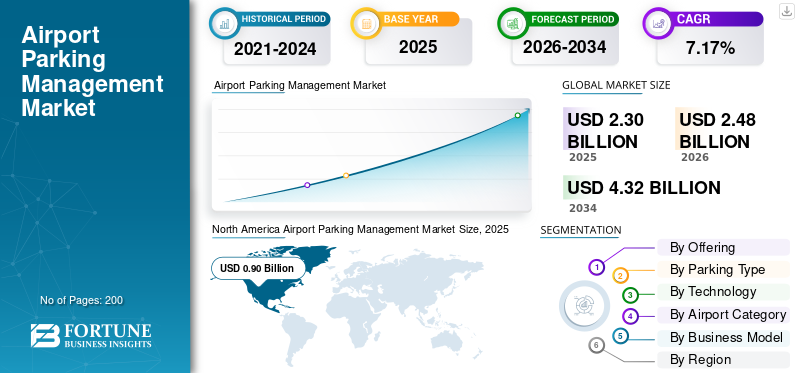
Download Free sample to learn more about this report.
AIRPORT PARKING MANAGEMENT MARKET KEY TAKEAWAYS
 Global Market Size & Forecast
- 2025 Market Size: USD 2.30 billion
- 2026 Market Size: USD 2.48 billion
- 2034 Forecast Market Size: USD 4.32 billion
- CAGR: 7.17% from 2026–2034
 Market Share
- North America dominated the market with a 39.13% share in 2025.
- The Large International Airports segment held the largest market share.
- The Airport-Owned & Operated Parking segment held the largest market share.
 Key Regional Highlights
North America
North America reached USD 0.90 billion in 2025, driven by high private-vehicle access to airports and increasing adoption of digital payment, pre-booking, and automated access systems.
Europe
Europe projected to reach USD 0.60 billion by 2026, growing at a 7.21% CAGR, supported by mature airport infrastructure and increasing adoption of digital parking platforms.
Asia Pacific
Asia Pacific projected to reach USD 0.55 billion by 2026, emerging as the fastest-growing region due to airport expansion, rising air travel demand, and smart parking investments.
U.S.
The market is projected to reach USD 0.60 billion by 2026, growing at a 7.40% CAGR, supported by large hub airports and mature adoption of automated parking technologies.
Japan
Japan growth is supported by airport modernization, rising adoption of smart parking systems, digital reservations, automated access control, and integrated mobility solutions.
Read More

AIRPORT PARKING MANAGEMENT MARKET TRENDS
Rising Demand for Smart Parking Technologies and Contactless Services is a Key Market Trend
Airport parking management is shifting quickly from basic space allocation to technology-and data-driven operations. Airports are using IoT sensors, AI-based demand forecasting, and cloud platforms to monitor occupancy in real-time, improve traffic flow, and adjust pricing based on demand. Since the pandemic, passengers have become more comfortable with contactless services, making mobile reservations, license plate recognition, and digital payments increasingly important. Many airports are also connecting parking with loyalty programs, pre-booking discounts, and wider mobility services to improve the passenger experience and increase non-aeronautical revenue. At the same time, the growing adoption of electric vehicles is encouraging airports to install EV charging stations, turning parking areas into more valuable service hubs that deliver both revenue and sustainability benefits.
MARKET DYNAMICS
MARKET DRIVERS
Download Free sample to learn more about this report.
Rising Air Passenger Traffic and Growing Preference for Private Vehicle to Reach Airports Drive Market Expansion
The recovery in global air travel, along with the growing preference for private vehicles to reach airports, is a major driver of the airport parking management market. As more passengers choose to drive instead of using public transport, especially for longer trips or early-morning flights, airports are facing greater pressure on parking capacity and traffic flow. Large airports handling millions of passengers each year need advanced systems to manage peak-hour demand, reduce congestion, improve security, and make parking easier for travelers. The growth of low-cost carriers has also widened the passenger base, bringing in more cost-conscious travelers who often prefer affordable self-drive parking options over premium ground transport.
MARKET RESTRAINTS
High Capital Investment and Integration Complexity Slow Adoption Across Smaller Airports
The high upfront cost of advanced parking management systems remains a major challenge, especially for smaller regional and domestic airports with limited budgets. Automated entry and exit systems, parking sensors, payment infrastructure, and software platforms require significant capital investment, along with ongoing spending on maintenance, upgrades, and staff training, thereby hindering airport parking management market growth. Many airports also face difficulties integrating new systems with older ticketing machines, outdated access controls, and disconnected databases. For operators managing multiple airports, different regulations across countries or regions can make implementation even more complex, increasing compliance requirements and slowing technology adoption.
MARKET OPPORTUNITIES
Expansion of Smart Airport Infrastructure Across Asia Pacific and the Middle East Creates Significant Growth Opportunities
The growing pipeline of new airport construction and expansion projects across Asia Pacific, the Middle East, and Africa is creating strong opportunities for parking management solution providers. Greenfield airports and terminal expansions in countries such as India, China, Saudi Arabia, and the UAE are increasingly being planned with smart parking systems built in from the start, making digital integration easier than retrofitting older facilities. At the same time, airports are placing greater focus on non-aeronautical revenue, with parking treated less as a support function and more as a commercial asset. By adopting dynamic pricing, online reservations, and pre-booking platforms, airport operators can improve space utilization and generate higher revenue from existing parking capacity.
MARKET CHALLENGES
Rising Cybersecurity and Data Privacy Risks to Hinder Market Growth
As airport parking solutions become more connected, cybersecurity risks are becoming harder to ignore. License plate readers, payment terminals, cloud platforms, and mobile apps improve operational efficiency, but they also create additional entry points for cyberattacks. A cybersecurity incident affecting access control systems or payment data at a busy airport could disrupt operations, delay passengers, and damage the airport’s reputation. At the same time, data privacy rules such as GDPR in Europe and similar regulations in other regions require airports to handle project vehicle, passenger, and payment data through strong security measures. Many airport operators do not have deep in-house cybersecurity capabilities, making vendor selection, system monitoring, and third-party risk management increasingly important.
Segmentation Analysis
By Offering
Services Segment to Dominate, Driven by Rising Demand for Managed Airport Parking Operations
Based on offering, the market is segmented into hardware, software, and services.
The services segment is anticipated to account for the largest market share. The segment is growing as airports are increasingly outsourcing parking operations to specialized third-party providers to manage complex digital infrastructure, reduce operational burden, and ensure continuous system performance. As parking platforms integrate AI, ANPR, and cloud-based technologies, many airport operators lack the in-house expertise to maintain them, making managed services the preferred deployment model.
The software segment is anticipated to grow at a CAGR of 7.76% over the forecast period.
By Parking Type
Long term Parking Segment Dominated, Backed by Rising Preference for Self-Drive Airport Travel
Based on parking type, the market is segmented into short-term parking, long term parking, valet parking, reserved/pre booked parking, and employee parking.
In 2025, the long term parking segment dominated the global market. The segment is growing as leisure and business travelers undertaking multi-day trips consistently prefer leaving their vehicles at the airport rather than arranging alternative transport, generating stable and high-volume revenue for operators. Pre-booking platforms, dynamic pricing, and EV charging upgrades are further strengthening occupancy rates and increasing revenue per parking space across long term facilities.
The reserved/pre-booked parking segment is projected to grow at a CAGR of 7.76% over the forecast period.
By Technology
License Plate Recognition/ANPR Segment to Lead as Airport Pursue Frictionless Entry and Exist
Based on technology, the market is segmented into license plate recognition/ANPR, RFID & QR code-based access, IoT-based parking sensors, parking guidance systems, AI-based analytics & dynamic pricing, and others.
The license plate recognition/ANPR segment is anticipated to hold a dominant airport parking management market share over the forecast period. The segment is growing as ANPR eliminates physical tickets and manual verification, significantly reducing lane processing times and peak-hour congestion at busy airport parking facilities. Real-time vehicle tracking, improved billing accuracy, and reduced revenue leakage are making ANPR the preferred technology investment across both greenfield and retrofit airport parking projects.
The AI-based analytics & dynamic pricing segment is projected to grow at a CAGR of 7.81% over the forecast period.
By Airport Category
Large International Airports Segment Accounted for Largest Market Share Owing to Scale, Volume, and Infrastructure Investment
Based on airport category, the market is segmented into large international airports, medium-sized airports, and regional/domestic airports.
The large international airports segment dominated the market. The segment is growing as major international airports manage heavy passenger traffic and large volumes of vehicle movement every day. These airports need automated, multi-zone parking systems that can reduce congestion, speed up entry and exit, and improve the overall passenger experience. Since parking is also a major source of non-aeronautical revenue, large airports have a strong incentive to invest in advanced parking management solutions. Their larger capital budgets and ongoing infrastructure upgrades make them among the earliest and most active adopters of smart parking technologies.
The regional/domestic airports segment is projected to grow at a CAGR of 8.14% during the forecast period.
To know how our report can help streamline your business, Speak to Analyst
By Business Model
Airport-Owned & Operated Parking Segment Led the Market Due to Greater Revenue Control
Based on business model, the market is segmented into airport-owned & operated parking, third-party operated parking, concession-based parking operations, public-private partnership parking, and aggregator/marketplace-based parking.
The airport-owned & operated parking segment dominated the market. The segment is growing as airport authorities are choosing to manage parking assets directly to capture full revenue margins, maintain pricing flexibility, and retain access to valuable passenger data for loyalty and mobility integration strategies. The owner-operator model also enables faster deployment of ancillary services such as EV charging and valet upgrades, delivering superior revenue-per-space performance compared to leased or concessionaire-managed arrangements.
The aggregator/marketplace-based parking segment is projected to grow at a CAGR of 7.99% during the forecast period.
Airport Parking Management Market Regional Outlook
By geography, the market is categorized into Europe, North America, Asia Pacific, and Rest of the World.
North America
North America Airport Parking Management Market Size, 2025 (USD Billion)
To get more information on the regional analysis of this market, Download Free sample
North America held the dominant market share in 2024, valued at USD 0.82 billion, and also maintained its leading position in 2025, with USD 0.90 billion. North America leads the market due to strong reliance on airport parking as a non-aeronautical revenue source and high private-vehicle access to airports. Airports are investing in digital payment, pre-booking, license plate recognition, and automated access systems to improve passenger flow and parking revenue generation.
U.S. Airport Parking Management Market
Based on North America’s strong contribution and the U.S. dominance within the region, the U.S. market is expected to reach around USD 0.60 billion in 2026, registering a CAGR of 7.40% during the forecast period. The U.S. remains the strongest country market, supported by large hub airports, high passenger volumes, and mature adoption of automated parking system technologies. Key demand is driven by ticketless entry, mobile reservations, revenue control systems, and parking guidance solutions across major airport networks.
Europe
Europe is projected to record a steady growth rate of 7.21% during the forecast period, which is the second-highest among all regions. The market is expected to reach a valuation of USD 0.60 billion in 2026. Europe is a mature market where airport parking management is driven by concession-based operations, high passenger traffic, and strong digital parking platforms adoption. Airports are upgrading parking and curbside systems to improve access control, reduce congestion, and strengthen commercial revenue.
U.K. Airport Parking Management Market
The U.K. market is estimated to reach around USD 0.19 billion in 2026, registering a CAGR of 7.66% during the forecast period. The U.K. market is supported by major airports such as Heathrow, Gatwick, Manchester, and Stansted, where parking and drop-off services are important revenue streams. Demand is growing for pre-booked parking, automated payments, License Plate Recognition, and app-based parking services.
Germany Airport Parking Management Market
Germany’s market is projected to reach approximately USD 0.17 billion in 2026. Germany has strong growth potential due to its dense airport network, major international hubs, and established parking operators. Airports are focusing on digital payment, automated entry and exit, parking guidance, and integrated mobility services to improve operational efficiency.
Asia Pacific
Asia Pacific region is poised to reach USD 0.55 billion in 2026, making it the third-largest regional market and the fastest-growing during the forecast period. Growth is driven by airport expansion, rising air travel demand, and smart airport parking investments across major economies. New and expanding airports are increasingly adopting parking automation, real-time occupancy monitoring, digital booking, and integrated passenger-access systems.
China Airport Parking Management Market
China’s market is projected to be one of the largest in Asia Pacific. The market is estimated to reach around USD 0.17 billion in 2026. China represents a major growth market due to its large airport base, expanding domestic aviation network, and strong focus on airport digitalization. Demand is supported by centralized parking control, Automatic Number Plate Recognition, digital payments, and smart parking systems at large airports.
India Airport Parking Management Market
The Indian market is estimated to reach around USD 0.15 billion in 2026. India is emerging as a high-growth market due to greenfield airport development, brownfield expansion, and rising use of digital airport services. Smart parking, online reservation, digital payment, and automated access solutions are gaining importance as airports modernize passenger-facing infrastructure.
Rest of the World
The rest of the world includes the Middle East & Africa and Latin America. Growth in the region is supported by airport concessions projects in Latin America, major airport hub expansion in the Middle East, and tourism-led airport development in Africa. Demand is increasing for outsourced parking operations, digital payments, pre-booking platforms, and automated access systems. The Middle East & Africa and Latin America market is set to reach USD 0.22 billion and USD 0.15 billion, respectively, in 2026.
COMPETITIVE LANDSCAPE
Key Industry Players
Key Players Focus on Innovation and Strategic Partnerships to Gain Competitive Edge
The airport parking management market is moderately fragmented, with competition spread across parking technology providers, access-control companies, payment systems solution vendors, mobility platforms, and outsourced parking operators. Key companies in the market include SKIDATA GmbH, Amano Corporation, Conduent Incorporated, T2 Systems, and TIBA Parking Systems.
From a company perspective, innovation and strategic partnerships are becoming the main growth drivers. Providers are investing in ticketless parking, cloud-based management platforms, AI-driven dynamic pricing, real-time occupancy monitoring, and mobile-first reservation systems to improve passenger convenience and airport revenue generation. At the same time, partnerships with airport operators, concessionaires, payment providers, mobility platforms, and infrastructure contractors help companies secure long-term contracts, support smart airport modernization, and expand their role from basic parking operations to integrated airport mobility management.
LIST OF KEY AIRPORT PARKING MANAGEMENT COMPANIES PROFILED
- SKIDATA GmbH (Austria)
- Amano Corporation (Japan)
- Conduent Incorporated (U.S.)
- T2 Systems (U.S.)
- TIBA Parking Systems (Israel)
- APCOA Parking Holdings GmbH (Germany)
- Indigo Group (France)
- ABM Industries Inc. (U.S.)
- SpotHero Inc. (U.S.)
- Metropolis Technologies Inc. (U.S.)
KEY INDUSTRY DEVELOPMENTS
- February 2026: Charlotte City Council awarded Ace Parking Management a five-year contract for airport parking operations at Charlotte Douglas International Airport, replacing the previous operator Reimagined Parking.
- May 2025: SP Plus, on behalf of Cincinnati/Northern Kentucky International Airport, invited vendors to provide a new Parking Access and Revenue Control System, including software, hardware, installation, configuration, maintenance, and servicing.
- February 2025: DESIGNA was selected to provide the parking management system for Western Sydney International Airport, including the delivery and maintenance of digital parking management solutions for the new airport.
- February 2025: Victoria Airport Authority issued a request for approval (RFP) for parking management services at Victoria International Airport. The project commenced in June 2025, with the scope requiring airport parking and curb management.
- January 2024: Tulsa Airports Improvement Trust issued an RFP for the management and operation of the airport parking system at Tulsa International Airport, covering covered long-term parking, shuttle lots, reserved parking, valet, overflow lots, employee parking, and shuttle bus operations.
REPORT COVERAGE
The global airport parking management industry analysis includes a comprehensive study of the market and forecast by all the market segments included in the report. It includes details on the market dynamics and market trends expected to drive the market over the forecast period. It provides information on key aspects, including an overview of technological advancements, the regulatory environment, Porter’s five forces analysis, company profiles, and a retrofitting program. Additionally, it details partnerships, mergers & acquisitions, and key aviation industry developments. The global market report also provides a detailed competitive landscape with information on the market share and profiles of key operating players.
Request for Customization to gain extensive market insights.
Report Scope & Segmentation
| ATTRIBUTE | DETAILS |
| Study Period | 2021-2034 |
| Base Year | 2025 |
| Estimated Year | 2026 |
| Forecast Period | 2026-2034 |
| Historical Period | 2021-2024 |
| Growth Rate | CAGR of 7.17% from 2026 to 2034 |
| Unit | Value (USD Billion) |
| Segmentation | By Offering, Parking Type, Technology, Airport Category, Business Model, and Region |
| By Offering |
|
| By Parking Type |
|
| By Technology |
|
| By Airport Category |
|
| By Business Model |
|
| By Region |
|
Frequently Asked Questions
According to Fortune Business Insights, the global market value stood at USD 2.30 billion in 2025 and is projected to reach USD 4.32 billion by 2034.
In 2025, the market value stood at USD 0.90 billion.
The market is expected to exhibit a CAGR of 7.17% during the forecast period.
By offering, the services segment is expected to dominate the market.
Rising air passenger traffic and growing preference for private vehicles are the key factors driving market expansion.
SKIDATA GmbH, Amano Corporation, Conduent Incorporated, T2 Systems, and TIBA Parking Systems are some of the key players in the market.
North America dominated the market in 2025.



- 2021-2034
- 2025
- 2021-2024
- 200
Get 30-60 hrs Free Customization
Expand Regional and Country Coverage, Segments Analysis, Company Profiles, Competitive Benchmarking, and End-user Insights.




















Related Reports
-
US +1 833 909 2966 ( Toll Free )
-
Get In Touch With Us