Airport Thermal Camera Market Size, Share & Industry Analysis, By Airport Type (Commercial Airports, Cargo Airports, Military & Dual-Use Airports, and Others), By End User (Airport Operators, Government & Aviation Security Agencies, Defense & Military Authorities, and Others), By Camera Type (Fixed Thermal Cameras, PTZ Thermal Cameras, Bi-Spectral Cameras, Handheld Thermal Cameras, Drone-Mounted Thermal Cameras, and Others), By Application (Perimeter Security & Intrusion Detection, Terminal Surveillance, Runway & Airside Monitoring, and Others), and Regional Forecast, 2026-2034
 Download Free Sample
Airport Thermal Camera Market Size and Future Outlook
 Listen to Audio Version
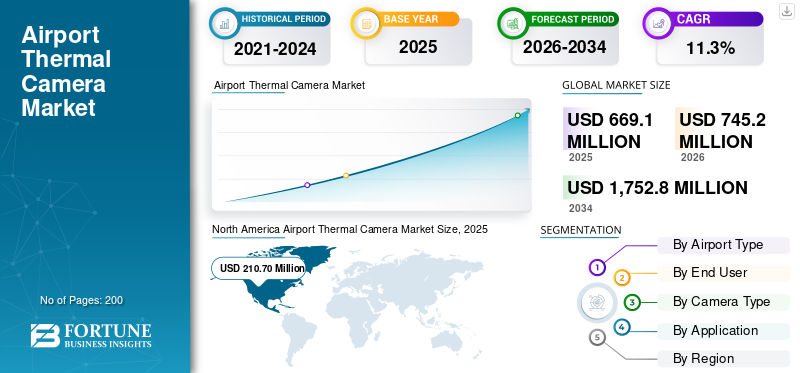
The global airport thermal camera market size was valued at USD 669.1 million in 2025. The market is projected to grow from USD 745.2 million in 2026 to USD 1,752.8 million by 2034, exhibiting a CAGR of 11.3% during the forecast period. North America dominated the airport thermal camera market with a market share of 31.49% in 2025.
The airport thermal camera market focuses on the deployment of non‑contact thermal imaging systems for perimeter security, passenger screening, baggage handling, and runway surveillance. These systems enhance situational awareness by detecting heat signatures in low‑visibility conditions, supporting early intrusion alerts, fire‑risk monitoring, and health‑related temperature screening. Growing investments in smart‑airport infrastructure and the need for reliable, all‑weather surveillance are driving steady adoption of thermal cameras across major international airports. The market is centered on integrating high‑resolution thermal sensors with existing video‑management and command‑control platforms to improve response times and operational efficiency without disrupting passenger flow.
Key players in the market include Teledyne FLIR, Axis Communications, Bosch Security Systems BV, Hikvision, Hanwha Vision, HGH Infrared Systems, Leonardo, Thales Group (France), Honeywell International, and Johnson Controls/Tyco Security Products These companies compete through advancements in thermal imaging resolution, wider field‑of‑view options, edge‑based analytics, ruggedized outdoor housings, and multi‑sensor fusion (visible + thermal) technologies for enhanced perimeter and terminal surveillance.
Download Free sample to learn more about this report.
AIRPORT THERMAL CAMERA MARKET Key Takeaways
 Global Market Size & Forecast
- 2025 Market Size: USD 669.1 million
- 2026 Market Size: USD 745.2 million
- 2034 Forecast Market Size: USD 1,752.8 million
- CAGR: 11.3% from 2026–2034
 Market Share
- North America dominated the airport thermal camera market with a market share of 31.49% in 2025.
- The military & dual-use airports segment is anticipated to grow at a CAGR of 12.3% over the forecast period.
- The government & aviation security agencies segment is projected to grow at a CAGR of 11.8% over the forecast period.
 Key Regional Highlights
North America
The regional market reached USD 210.70 million in 2025, driven by advanced airport infrastructure, strong aviation security standards, and continued investment in surveillance and airside monitoring.
Europe
The market is estimated to reach USD 205.0 million by 2026, driven by airport modernization, enhanced perimeter security, and investments in aviation infrastructure resilience.
Asia Pacific
Expected to reach USD 224.0 million by 2026, the region is projected to register the fastest growth at a 12.0% CAGR, supported by airport expansion and smart airport initiatives.
U.S.
The U.S. airport thermal camera market is projected to reach USD 201.7 million by 2026, supported by extensive airport infrastructure, increasing security modernization programs, and growing adoption of thermal surveillance technologies.
Japan
The Japanese market is expected to reach USD 41.2 million by 2026, with demand rising as airports invest in advanced monitoring systems to improve operational safety, perimeter security, and runway visibility.
Read More

AIRPORT THERMAL CAMERA MARKET TRENDS
Shift toward AI‑driven Thermal‑Video Surveillance is a Market Trend
The market is moving toward tightly integrated, AI‑enhanced thermal‑video surveillance rather than standalone devices. Operators are increasingly deploying thermal cameras that connect to centralized security platforms equipped with automated analytics for intrusion detection, loitering alerts, and thermal anomaly recognition. This trend is being supported by the rollout of smart‑airport initiatives, where thermal imaging is combined with visible‑spectrum cameras, radar, and access‑control systems to create layered, proactive security architectures across terminals, runways, and perimeter zones.
MARKET DYNAMICS
MARKET DRIVERS
Download Free sample to learn more about this report.
Rising Concerns Over Terrorism to Support Market Expansion
Heightened concerns over terrorism, unauthorized access, and on‑airfield incidents are driving airports to invest in advanced surveillance technologies. Thermal cameras address these concerns by enabling continuous, all‑weather monitoring of perimeters, runways, and terminal areas, even in complete darkness or fog, and other low-visibility conditions. Additional growth drivers include the need to detect overheating equipment, identify wildfire risk near airfields, and support health‑screening protocols, all of which reinforce the role of thermal camera systems as a critical component of modern airport security infrastructure.
MARKET RESTRAINTS
High Upfront Cost and Infrastructure Integration Complexity to Limit Product Adoption
The main restraint in the airport thermal camera market growth is the high initial investment required for thermal cameras, associated networking hardware, and integration with existing CCTV and access‑control systems. Many airports, especially smaller or regional hubs, face budget constraints and extended payback periods, slowing large‑scale deployment initiatives. Integration complexity, such as harmonizing data formats, video‑management‑system (VMS) compatibility, and maintaining installations with legacy can delay implementation and increase both deployment costs and operational risks.
MARKET OPPORTUNITIES
Expansion of Smart‑Airport to Create Strong Market Opportunity
The airport thermal camera market holds strong growth potential as airports worldwide continue upgrading to smart‑airport architectures and strengthening perimeter security amid rising cyber‑physical threats. Opportunities exist in retrofitting older terminals with thermal‑based intrusion‑detection systems, expanding surveillance coverage to remote parking areas, cargo zones, and airside areas, and deploying mobile or fixed‑mast thermal units for temporary or seasonal events. Moreover, increasing demand for non‑intrusive, 24/7 surveillance in low‑light and adverse‑weather conditions is creating opportunities for new thermal‑camera‑as‑a‑service models and managed‑security offerings.
MARKET CHALLENGES
Strict Data‑Retention Policies to Hinder Market Growth
A key challenge in the market is balancing high‑performance surveillance capabilities with passenger privacy expectations and evolving data‑protection regulations. Thermal systems capable of capturing biometric‑like data (e.g., facial‑temperature patterns) must comply with local and international privacy laws, often requiring anonymization measures and strict data‑retention policies. Additionally, airports must ensure that false alarms generated by thermal analytics do not overload security teams, making it critical to fine‑tune algorithms while maintaining regulatory‑approved surveillance standards across diverse jurisdictions.
Segmentation Analysis
By Airport Type
Commercial Airports Segment to Lead due to its Ability to Help Operators Maintain Visibility in Darkness
Based on airport type, the market is segmented into commercial airports, cargo airports, military & dual-use airports, and private & business aviation airports.
The commercial airports segment is anticipated to account for the largest airport thermal camera market share, as passenger hubs require continuous surveillance across terminals, runways, aprons, parking areas, and perimeter zones. Thermal cameras help operators maintain visibility in darkness, fog, rain, and smoke, making them valuable for security, safety, wildlife detection, and operational monitoring in high-traffic airport environments.
The military & dual-use airports segment is anticipated to grow at a CAGR of 12.3% over the forecast period.
By End User
Airport Operators Segment Led due to increasing Need for Passenger Safety
Based on end user, the market is segmented into airport operators, government & aviation security agencies, defense & military authorities, and others.
In 2025, the airport operators segment dominated the global market. Demand within this segment is increasing as operators remain responsible for day-to-day security, passenger safety, airside visibility, and infrastructure monitoring. Thermal cameras enable faster incident detection, reduced false alarm rates, and improved coordination with video management systems, helping operators enhance airport resilience while effectively managing large and complex facilities.
The government & aviation security agencies segment is projected to grow at a CAGR of 11.8% over the forecast period.
To know how our report can help streamline your business, Speak to Analyst
By Camera Type
Fixed Thermal Cameras Segment to Dominate due to its Ability to Provide Reliable 24/7 Detection
Based on camera type, the market is segmented into fixed thermal cameras, PTZ thermal cameras, bi-spectral cameras, handheld thermal cameras, drone-mounted thermal cameras, and others.
The fixed thermal cameras segment is anticipated to witness a dominant market share over the forecast period. Demand for fixed thermal cameras is rising as airports need permanent surveillance coverage across fences, gates, terminal entrances, cargo areas, and airside facilities. These cameras provide reliable 24/7 detection without depending on visible light, making them cost-effective for continuous monitoring and widely used in both new installations and security upgrades.
The bi-spectral cameras segment is projected to grow at a CAGR of 12.5% over the forecast period.
By Application
Perimeter Security & Intrusion Detection Segment Led Due to Its Ability to Operate Across Exposed Boundaries
Based on application, the market is segmented into perimeter security & intrusion detection, terminal surveillance, runway & airside monitoring, passenger & staff temperature screening, cargo & logistics area monitoring, and others.
The perimeter security & intrusion detection segment dominated the market. Demand for perimeter security and intrusion detection is rising as airports operate across vast, exposed boundaries that are difficult to monitor manually. Thermal cameras detect people, vehicles, wildlife, and suspicious movement in low-visibility conditions, helping security teams respond faster and reduce operational disruption caused by unauthorized access or runway-area incidents.
The terminal surveillance segment is projected to grow at a CAGR of 11.0% during the study period.
Airport Thermal Camera Market Regional Outlook
By geography, the market is categorized into North America, Europe, Asia Pacific, and the Rest of the World.
North America
North America Airport Thermal Camera Market Size, 2025 (USD Million)
To get more information on the regional analysis of this market, Download Free sample
North America held the dominant share in 2024, valued at USD 183.01 million, and maintained its leading share, reaching USD 210.70 million in 2025. Regional growth is supported by mature airport infrastructure, strict aviation security practices, and continued investment in perimeter surveillance, terminal safety, and airside monitoring. The U.S. remains the main contributor, supported by its large airport network and advanced security modernization programs.
U.S. Airport Thermal Camera Market
Based on North America’s strong market contribution and the U.S. dominance within the region, the U.S. market is expected to reach around USD 201.7 million by 2026, accounting for roughly 10.6% during the forecast period. Demand in the U.S. is rising due to the country’s extensive airport network, strong aviation security requirements, and continuous investment in perimeter protection, terminal surveillance, and airside safety. Thermal cameras are increasingly being deployed to improve night visibility, incident detection, and strengthen command-center response capabilities.
Europe
Europe is estimated to reach USD 205.0 million by 2026, securing its position as the third-largest regional market. Demand across Europe is increasing as airports strengthen perimeter protection, cargo-zone surveillance, and low-visibility monitoring. Germany, France, the U.K., and Russia are supporting steady demand through airport modernization projects, defense-linked aviation facilities, and heightened focus on infrastructure security and operational resilience.
U.K. Airport Thermal Camera Market
The U.K. market is estimated to reach around USD 37.9 million by 2026, representing a CAGR of 10.9% during the forecast period. Demand in the U.K. is increasing as airports focus on security upgrades, passenger safety, and infrastructure resilience. Thermal cameras support perimeter surveillance, terminal-area monitoring, and low-visibility detection, especially at major international airports handling high passenger and cargo traffic.
Germany Airport Thermal Camera Market
Germany’s market is projected to reach approximately USD 45.2 million by 2026. Demand in Germany is rising due to the country’s airport infrastructure, major air cargo operations, and strong emphasis on critical infrastructure protection. Thermal cameras are widely used for perimeter monitoring, cargo-area security, runway safety, and integration with advanced airport surveillance and video management systems.
Asia Pacific
Asia Pacific is projected to record a growth rate of 12.0% during the forecast period, which is the highest among all regions. The market is expected to reach a valuation of USD 224.0 million by 2026. Demand across the region is rising rapidly due to ongoing airport construction projects, terminal expansion programs, and smart airport modernization initiatives. China and India are the key growth drivers, while Japan continues to support market demand through advanced surveillance adoption, safety systems, and technology upgrades across major aviation hubs.
China Airport Thermal Camera Market
China’s market is projected to be one of the largest in Asia Pacific. The region is estimated to reach around USD 86.5 million by 2026. Demand in China is increasing due to the country’s extensive airport infrastructure, ongoing airport development, and rising investment in smart airport technologies. Thermal cameras support terminal surveillance, airside monitoring, cargo security, and perimeter protection as airports handle higher passenger volumes and expand operational capacity.
Japan Airport Thermal Camera Market
The Japanese market is estimated to reach around USD 41.2 million by 2026, representing a CAGR of roughly 11.3% during the forecast period. Demand in Japan is growing as airports prioritize safety, reliability, and advanced monitoring technologies. Thermal cameras support runway visibility, terminal security, perimeter monitoring, and infrastructure protection, especially in dense airport environments where operational efficiency and early incident detection are critical.
India Airport Thermal Camera Market
The Indian market is estimated to reach around USD 46.0 million by 2026. Demand in India is rising quickly as the country expands airport capacity, develops new airports, and modernizes existing facilities. Thermal cameras are gaining importance for perimeter security, terminal surveillance, cargo monitoring, and airside safety across both metro airports and emerging regional aviation hubs.
Rest of the World
The rest of the world includes the Middle East & Africa and Latin America. These regions are expected to witness moderate growth in this market during the forecast period. The Middle East & Africa and Latin America markets are set to reach a valuation of USD 51.8 million and USD 30.7 million, respectively, by 2026. Demand in the Rest of the World is growing as Middle Eastern airports invest in smart security, premium passenger infrastructure, and cargo-hub expansion. Latin America also contributes through gradual airport modernization, perimeter upgrades, and the rising need for reliable surveillance in large airport campuses.
COMPETITIVE LANDSCAPE
Key Industry Players
Key Players Focus on AI-Enabled Camera Portfolio to Boost Product Portfolio
The airport thermal camera market is being strengthened by key players that are moving airport surveillance beyond conventional CCTV and standalone thermal devices toward integrated, analytics-led security ecosystems. Companies such as Teledyne FLIR, Axis Communications, Bosch Security Systems BV, and Hikvision are focusing on high-sensitivity thermal imaging, AI-based object classification, radiometric temperature monitoring, bi-spectral cameras, long-range PTZ surveillance, and video management system integration. Teledyne FLIR and HGH Infrared Systems are supporting demand through advanced thermal detection and wide-area monitoring solutions, while Axis, Hanwha Vision, Hikvision, and Bosch are expanding AI-enabled camera portfolios that help reduce false alarms and improve real-time threat verification. Large infrastructure and security integrators such as Honeywell, Johnson Controls, Thales, and Leonardo further contribute by connecting thermal cameras with command centers, access control, perimeter intrusion detection, and airport operations platforms. These strategies are helping airports improve 24/7 visibility across perimeters, runways, terminals, cargo zones, and airside facilities, thereby supporting long-term market growth.
LIST OF KEY AIRPORT THERMAL CAMERA COMPANIES PROFILED
- Teledyne FLIR (U.S.)
- Axis Communications (Sweden)
- Bosch Security Systems BV (Germany)
- Hikvision (China)
- Hanwha Vision (South Korea)
- HGH Infrared Systems (France)
- Leonardo (Italy)
- Thales Group (France)
- Honeywell International (U.S.)
- Johnson Controls (Ireland)
KEY INDUSTRY DEVELOPMENTS
- January 2026: FLIR unveiled next-generation iXX-Series app-enabled thermal cameras at CES 2026 to automate maintenance and condition monitoring, including for critical infrastructure.
- January 2026: Teledyne FLIR launched the SCION Family of SWIR cameras and Tura™, an automotive-qualified thermal longwave infrared camera.
- July 2025: Guide Sensmart was awarded a USD 38 million contract to supply 12,000 thermal cameras for substation automation.
- January 2025: SightLogix enhanced its SightSensor Infrared system with stronger detection capability, advanced Thermal AI to reduce false alarms, and easier-to-use features. The upgrade is designed to deliver reliable 24/7 outdoor security performance across challenging conditions, reinforcing the company’s focus on intelligent thermal surveillance solutions.
- January 2024: Hanwha Vision launched advanced AI-enabled radiometric thermal cameras to improve safety, monitoring accuracy, and operational efficiency across critical environments. The cameras offer high-quality thermal imaging, temperature detection from -40°C to 550°C, and AI-based object classification, helping users strengthen security, reduce downtime, and support flexible industrial and commercial monitoring needs.
REPORT COVERAGE
This research offers a detailed analysis of emerging trends and rapidly adopted technologies across key regions. The report outlines the key drivers supporting market growth and challenges limiting expansion, delivering a detailed overview of the industry landscape. The study also highlights recent advancements to boost industry insights and support stakeholders in making well-informed decisions.
Request for Customization to gain extensive market insights.
Report Scope & Segmentation
| ATTRIBUTE | DETAILS |
| Study Period | 2021-2034 |
| Base Year | 2025 |
| Estimated Year | 2026 |
| Forecast Period | 2026-2034 |
| Historical Period | 2021-2024 |
| Growth Rate | CAGR of 11.3% from 2026-2034 |
| Unit | Value (USD Million) |
| Segmentation | By Airport Type, By End User, By Camera Type, By Application, and Region |
| By Airport Type |
|
| By End User |
|
| By Camera Type |
|
| By Application |
|
| By Region |
|
Frequently Asked Questions
According to Fortune Business Insights, the global market value stood at USD 669.1 million in 2025 and is projected to reach USD 1,752.8 million by 2034.
In 2025, the market value stood at USD 210.70 million.
The market is expected to exhibit a CAGR of 11.3% during the forecast period.
By end user, the airport operators segment dominated the market.
Rising concerns over terrorism are the key factor driving market expansion.
Teledyne FLIR, Axis Communications, Bosch Security Systems BV, Hikvision, Hanwha Vision, HGH Infrared Systems, and Leonardo are a few top players in the global market.
North America dominated the market in 2025



- 2021-2034
- 2025
- 2021-2024
- 200
Get 30-60 hrs Free Customization
Expand Regional and Country Coverage, Segments Analysis, Company Profiles, Competitive Benchmarking, and End-user Insights.




















Related Reports
-
US +1 833 909 2966 ( Toll Free )
-
Get In Touch With Us