Ambient Intelligence Market Size, Share & Industry Analysis, By Component (Bluetooth Low Energy, RFID, Ambient Light Sensors, Biometrics, and Others), By End-User (Residential, Retail & E-commerce, Healthcare, Office Building, Automotive, and Others), and Regional Forecast, 2026–2034
 Download Free Sample
KEY MARKET INSIGHTS
 Listen to Audio Version
The global ambient intelligence market size was valued at USD 36.29 billion in 2025. The market is projected to grow from USD 45.2 billion in 2026 to USD 233.38 billion by 2034, exhibiting a CAGR of 22.8% during the forecast period. North America dominated the ambient intelligence market with a market share of 35% in 2025.
Ambient Intelligence (AmI) is a digital environment where smart devices and systems work together seamlessly and interact with people to improve their experiences and surroundings. This concept envisions technology that is embedded, context-aware, personalized, and adaptive, creating an intelligent environment that anticipates and responds to the needs of individuals in a natural and unobtrusive way. As consumers become more familiar with smart technologies, there is a growing acceptance of and trust in the AmI system. People are becoming more comfortable with the idea of AmI technologies that can learn and adapt to their behaviors, particularly when it offers tangible benefits, such as convenience, security, and energy savings.
The COVID-19 pandemic had a significant impact on the adoption of ambient intelligence technologies across various sectors, including healthcare, retail, and others. In retail and public spaces, AmI technologies were deployed to monitor occupancy levels and ensure compliance with social distancing guidelines. Sensors and cameras equipped with AI were used to track the number of people in a store, thereby automatically controlling entry when maximum capacity is reached. They were even used to monitor customer influx to avoid congestion.
This market research report has included solutions offered by companies, such as Infosys Limited, Ambient, Eyeris Technologies, Inc., care.ai, Nuance Communications, Inc., BioIntelliSense, Inc., Zippin, and others.
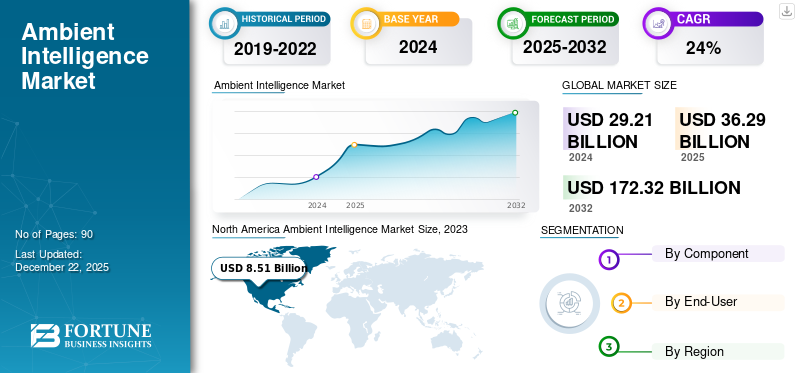
Download Free sample to learn more about this report.
Ambient Intelligence Market Key Takeaways
 Global Market Size & Forecast
- 2025 Market Size: USD 36.29 billion
- 2026 Market Size: USD 45.20 billion
- 2034 Forecast Market Size: USD 233.38 billion
- CAGR: 22.80% (2026–2034)
 Market Share
- North America dominated the market with a 35.00% share in 2025.
- The Healthcare segment is projected to lead the market with a 24.45% share in 2026.
- The Bluetooth Low Energy (BLE) segment captured the largest market share in 2026.
 Key Regional Highlights
Asia Pacific
Asia Pacific recorded USD 9.09 billion in 2025 and is projected to reach USD 11.53 billion in 2026.
North America
North America accounted for USD 12.86 billion in 2025 and is projected to reach USD 15.85 billion in 2026.
Europe
Europe generated USD 10.39 billion in 2025 and is expected to grow to USD 12.91 billion in 2026.
U.S.
U.S. market is projected to reach USD 11.33 billion by 2026.
Japan
Japan market is projected to reach USD 2.36 billion by 2026.
Read More

Impact of Generative AI
Growing Demand for Enhanced Personalization and Adaptation to Boost Market Growth
Generative AI can help create highly personalized environments by continuously learning from user interactions and behaviors. It can generate adaptive responses, such as personalized lighting, music, or temperature settings, thereby enhancing user comfort and satisfaction in smart homes, offices, and public spaces. By using generative AI models, AmI systems can better understand the context and nuances of user behavior, leading to more intuitive interactions. For example, generative AI can help smart environments recognize and predict user needs more accurately, thereby providing proactive solutions without explicit commands. Thus, as generative AI technologies continue to evolve, they are likely to play an increasingly central role in shaping the future of AmI systems, making them more adaptive, intuitive, and user-centric while addressing these challenges effectively. These factors will fuel the market outlook during the forecast period.
Ambient Intelligence Market Trends
Increasing Demand for Smart Homes and Buildings among Consumers to Fuel Market Growth
There is a growing consumer demand for smart homes that offer greater convenience, efficiency, and comfort. Ambient intelligence enhances these smart environments by making them more intuitive and responsive, automatically adjusting settings, such as lighting, temperature, and security based on the presence and behavior of the occupants. Smart buildings equipped with ambient intelligence can optimize energy usage by automating various systems based on occupancy and usage patterns. This reduces energy costs and supports sustainability efforts, making it attractive to both consumers and businesses.
In addition to this, many governments and municipalities are investing in smart city initiatives that leverage AmI to improve urban living. This includes smart transportation systems, intelligent public services, and energy efficient buildings that contribute to more sustainable and livable cities. These factors are expected to fuel the ambient intelligence market growth during the forecast period.
Download Free sample to learn more about this report.
Ambient Intelligence Market Growth Factors
Growing Adoption of Internet of Things (IoT)-Enabled Devices to Drive Market Growth
The rapid growth of IoT has resulted in an increasing number of connected devices that can communicate with each other and share data. This connectivity is a cornerstone of ambient intelligence, allowing for the creation of intelligent environments that are aware of and responsive to the presence and needs of individuals. The development of common protocols and standards for Internet of things (IoT) devices has enhanced interoperability, allowing different devices and systems to work together seamlessly. This is crucial for the integration of multiple devices into a cohesive AmI ecosystem.
Moreover, the continuous miniaturization of sensors and their decreasing costs have made it easier to integrate a wide range of sensors into various environments. This includes everything, from temperature to motion sensors, which are essential for creating context-aware environments that can adapt to users’ needs in real time. Adoption of high-precision sensors enables better detection of environmental changes and user activities, which is crucial for the effectiveness of an ambient intelligence system. These factors are set to drive the ambient intelligence market share in the coming years. For instance,
- May 2022: Identiv, Inc., a provider of digital security and identification solutions, announced that it will receive a 25-million-unit order from Wiliot, an IoT software company. The company’s IoT Pixel tags will power the Ambient ecosystem developed for the global supply chain.
RESTRAINING FACTORS
High Implementation Costs and Privacy Concerns May Hinder Market Growth
Ambient intelligence systems rely heavily on continuous data collection from sensors, cameras, microphones, and other devices. This raises significant privacy concerns among users as they may feel uncomfortable with being constantly monitored and having their data collected and analyzed. There is a risk of the data being used without user consent or for purposes beyond the original intent, such as targeted advertising or even more invasive surveillance. This potential misuse of personal data can deter users from adopting AmI technologies.
Moreover, setting up an AmI system can require substantial initial investments in hardware, software, and infrastructure. This includes the cost of purchasing and installing sensors, IoT devices, and advanced computing systems, which may be quite expensive for some consumers and organizations. The need for frequent software updates to keep systems secure and functional can also be a financial burden for consumers.
Ambient Intelligence Market Segmentation Analysis
By Component Analysis
Rise in Demand for Providing Seamless Connectivity and Energy Efficiency Aided Adoption of Bluetooth Low Energy
Based on component, the market is divided into Bluetooth low energy, RFID, ambient light sensors, biometrics, and others (nanotechnology).
The Bluetooth Low Energy (BLE) segment captured the maximum share of the market in 2026. BLE enables seamless connectivity between devices, which is crucial for creating interconnected environments. In smart homes, offices, and public spaces, BLE can facilitate communication between various sensors, wearables, and control systems, allowing for real-time data exchange and environmental adjustments. Furthermore, this component is specifically designed to consume minimal power, making it suitable for devices that require long battery life. The bluetooth Low Energy (BLE) segment dominated the market accounting for 26.41% market share in 2026.
The RFID segment is expected to register the highest CAGR in the coming years as this technology enables automatic identification and tracking of objects and individuals without the need for direct line-of-sight or manual intervention. This capability is essential for AmI systems that require real-time monitoring and control of assets, inventory, or personnel. Also, RFID can be used for secure access control in smart environments, allowing only authorized individuals to enter restricted areas. Owing to this, it is being increasingly adopted in smart buildings and offices to provide enhanced security.
By End-User Analysis
To know how our report can help streamline your business, Speak to Analyst
Growing Emphasis on Health and Wellbeing of Patients Boosted AmI Use in Healthcare
Based on end user, the market is classified into residential, retail & e-commerce, healthcare, office building, automotive, and others (manufacturing, education, etc.).
The healthcare segment captured the highest market share in 2026 as ambient intelligence is being increasingly adopted in healthcare settings to enhance patient care and monitoring. AmI systems can monitor a patient’s vital signs, detect falls, remind patients to take medications, and even predict potential health issues. These features can improve patient outcomes and reduce healthcare costs. The healthcare segment is projected to dominate the market with a share of 24.45% in 2026.
The residential segment is expected to record the highest CAGR of 26.50% during the forecast period (2024-2032), as AmI systems can monitor and manage energy consumption of various home devices, shutting off appliances and lights when not in use. This reduces unnecessary energy consumption and contributes to more sustainable living practices. Furthermore, AmI in residential settings can also integrate with renewable energy sources, such as solar panels, thereby optimizing energy usage based on real-time production and storage capabilities. This can enhance sustainability and reduce reliance on non-renewable energy sources.
REGIONAL INSIGHTS
By region, the market has been studied across five key regions: North America, Europe, Asia Pacific, South America, and the Middle East & Africa.
North America
North America Ambient Intelligence Market Size, 2025 (USD Billion)
To get more information on the regional analysis of this market, Download Free sample
North America maintained a strong presence in the global market, reaching USD 12.86 billion in 2025, accounting for 35.00% share, and is expected to reach USD 15.85 billion in 2026. In North America, the adoption of smart home technologies is relatively high, with many households incorporating devices, such as smart thermostats, lighting systems, security cameras, and voice-activated assistants in their homes. AmI enhances these systems by integrating various devices to create a more seamless, automated, and context-aware home environment. The regional market is also witnessing increased adoption of AmI for health and wellness purposes. Smart homes equipped with sensors and monitoring systems can track air quality, detect allergens, and provide alerts about unusual activities or potential health risks, catering to the needs of elderly residents and those with chronic health conditions. The U.S. market is projected to reach USD 11.328 billion by 2026. For instance,
- In April 2024, Eleos Health engaged in a partnership with the National Council for Mental Wellbeing, a U.S. based organization. Through this collaboration, Eleos aims to increase customers’ accessibility to AI education, research, and provider-centric tools.
Asia Pacific
The Asia Pacific market accounted for USD 9.09 billion in 2025, representing 25.00% of the global industry, and is expected to reach USD 11.53 billion in 2026. The region is experiencing rapid urbanization, leading to the development of smart cities. China, Japan, South Korea, and Singapore are at the forefront, incorporating AmI technologies to manage urban environments more efficiently. These technologies are used for traffic management, public safety, energy management, waste management, and pollution monitoring. AmI systems are being integrated into urban infrastructure to enhance efficiency and sustainability. The Chinese market is anticipated to be worth USD 2.06 billion in 2025.This includes smart street lighting systems that adjust their brightness based on pedestrian movement, intelligent traffic systems that optimize flow and reduce congestion, and sensors that monitor environmental conditions and infrastructure health. Thus, the adoption of AmI in Asia Pacific is expected to accelerate, transforming industries and daily life with intelligent, responsive environments. The Japan market is projected to reach USD 2.364 billion by 2026, the China market is projected to reach USD 2.567 billion by 2026, and the India market is projected to reach USD 1.781 billion by 2026. For instance,
- In May 2024, LifeSmart, a provider of smart home solutions, opened its new facility in Tokyo, Japan. Through this new facility, the company aims to collaborate with local partners to offer smart home products and services to customers.
Europe
In 2025, Europe generated USD 10.39 billion, contributing 29.00% to global market revenue, and is projected to grow to USD 12.91 billion in 2026. The region has been at the forefront of smart city initiatives, with Amsterdam, Barcelona, and Copenhagen implementing AmI technologies to enhance urban management. These systems help in monitoring and controlling traffic, managing waste, optimizing public transportation, and improving environmental sustainability. Moreover, European hospitals are integrating AmI to streamline operations, improve patient care, and enhance overall efficiency. This includes the use of RFID and Bluetooth Low Energy (BLE) for equipment tracking, automated environmental controls for patient rooms, and data-driven decision support systems. The UK market is projected to reach USD 2.53 billion by 2026, while the Germany market is projected to reach USD 2.37 billion by 2026. while France is estimated to be value at USD 1.69 billion in the 2025.
Middle East & Africa
In 2025, Middle East & Africa represented USD 2.37 billion, accounting for 7.00% of the worldwide market, and is projected to grow to USD 2.95 billion in 2026. The Middle East & Africa (MEA) is expected to showcase noteworthy growth during the forecast period. Owing to security concerns and the need for public safety, many countries in the Middle East are adopting AmI technologies, such as AI-powered surveillance systems, facial recognition, and smart street lighting that respond to real-time conditions. These technologies help monitor public spaces, detect potential threats, and respond swiftly to emergencies. The GCC market is foreseen to be valued at USD 0.80 billion in 2025.
Latin America
Latin America contributed 4.00% to the global market in 2025, with a valuation of USD 1.59 billion, and is projected to reach USD 1.95 billion in 2026.
South America
Moreover, many South American countries are focusing on sustainability and energy efficiency as part of their smart city strategies. AmI technologies are being used to manage energy consumption in public buildings, street lighting, and water systems. Owing to these factors, the market is expected to grow steadily in the region.
KEY INDUSTRY PLAYERS
Key Market Players to Engage in Partnerships, Collaborations, and Acquisitions to Expand Their Business Operations
Key players in the market are trying to increase their geographical footprint by developing and launching industry-specific services. They are entering merger, partnership, and acquisition deals with other players to remain dominant. They are also introducing new solutions to expand their current consumer base. These market players are also increasing their R&D investments to facilitate product innovations. Hence, these leading organizations are rapidly implementing these strategic initiatives to gain a strong competitive edge.
List of Top Ambient Intelligence Companies:
- Infosys Limited (India)
- Ambient (U.S.)
- Elos Health, Inc. (U.S.)
- Eyeris Technologies, Inc. (U.S.)
- Care.ai (U.S.)
- BioIntelliSense, Inc. (U.S.)
- Nuance Communications, Inc. (U.S.)
- Johnson Controls (U.S.)
- Honeywell International (U.S.)
- Zippin (U.S.)
KEY INDUSTRY DEVELOPMENTS:
- June 2023: Nuance Communications, Inc. partnered with Epic to develop the Nuance Dragon Ambient eXperience Express (DAX Express) solution. This solution will act as a copilot for medical users and help them manage administrative workloads, provide access for patient care, and improve healthcare outcomes.
- April 2023: care.ai collaborated with Google Cloud. With this collaboration, healthcare organizations and care facilities will be able to access care.ai’s Virtual Nursing solution through the Google Cloud Marketplace.
- January 2023: BioIntelliSense, Inc. entered a partnership with care.ai. Through this collaboration, the company aims to enhance the delivery of patient care by enabling continuous ambient intelligence tracking and biometric data.
- July 2022: Logicalis engaged in a partnership with Zippin. Through this partnership, Logicalis will develop and implement checkout-free stores in Brazil. Also, the company will offer its customers AI-powered technology to provide them with real-world consumer actions and digitize them.
- January 2022: Andreessen Horowitz offered USD 52 million to Ambient.ai to launch a novel computer vision intelligence platform. This platform is capable of handling multiple physical security incidents and dangers.
REPORT COVERAGE
The report provides a detailed analysis of the market and focuses on key aspects, such as leading companies, product/service types, and prominent applications of the product. Besides, it offers insights into the market trends and highlights key industry developments. In addition to the factors mentioned above, the report encompasses several factors that have contributed to the growth of the market in recent years.
Request for Customization to gain extensive market insights.
Report Scope & Segmentation
|
ATTRIBUTE |
DETAILS |
|
Study Period |
2021-2034 |
|
Base Year |
2025 |
|
Estimated Year |
2026 |
|
Forecast Period |
2026-2034 |
|
Historical Period |
2021-2024 |
|
Growth Rate |
CAGR of 22.8% from 2026 to 2034 |
|
Unit |
Value (USD Billion) |
|
Segmentation |
By Component
By End-User
By Region
|
Frequently Asked Questions
The market is projected to reach a valuation of USD 233.38 billion by 2034.
In 2025, the market was valued at USD 36.29 billion.
The market is projected to record a CAGR of 22.8% during the forecast period.
By component, the Bluetooth low energy segment is expected to lead the market.
Growing adoption of Internet of Things (IoT)-enabled devices is driving the market growth.
Infosys Limited, Ambient, Eyeris Technologies, Inc., care.ai, Nuance Communications, Inc., BioIntelliSense, Inc., and Zippin are the top players in the market.
North America is expected to hold the highest market share.
By end-user, the residential segment is expected to record the highest CAGR during the forecast period.



- 2021-2034
- 2025
- 2021-2024
- 90
Get 30-60 hrs Free Customization
Expand Regional and Country Coverage, Segments Analysis, Company Profiles, Competitive Benchmarking, and End-user Insights.




















Related Reports
-
US +1 833 909 2966 ( Toll Free )
-
Get In Touch With Us