Ambulance Services Market Size, Share & Industry Analysis, By Service Type (Emergency Ambulance Services and Non-Emergency Ambulance Services), By Transport Mode (Ground Ambulance Services, Air Ambulance Services, and Water Ambulance Services), By Ownership (Public Ambulance Services, Private Ambulance Services, & Hospital-based Ambulance Services), By Application (Trauma & Accident Cases, Cardiac Emergencies, Respiratory Emergencies, Obstetric & Neonatal Transport, & Others), By End-user (Hospitals & Clinics, Nursing Homes & Assisted Living Centers, & Others), & Regional Forecast, 2026-2034
 Download Free Sample
Ambulance Services Market Size and Future Outlook
 Listen to Audio Version
The global ambulance services market size was valued at USD 60.05 billion in 2025 and is projected to grow from USD 63.76 billion in 2026 to USD 108.34 billion by 2034, exhibiting a CAGR of 6.9% during the forecast period. North America dominated the ambulance services market with a market share of 37.81% in 2025.
Ambulance services refer to the emergency and non-emergency medical transportation systems that provide pre-hospital care, patient stabilization, and rapid transport to healthcare facilities. In addition, these services include ground, air, and water ambulance operations, staffed by trained emergency medical technicians (EMTs) and paramedics. The market growth is attributed to the rising prevalence of trauma and accident cases, the growing geriatric population, increasing incidence of cardiovascular and chronic conditions, and continuous investments in emergency healthcare infrastructure. In addition, technological advancements, including GPS-based dispatch systems, telemedicine integration, and AI-driven fleet management, are projected to have a significant positive impact on the market.
- For instance, in February 2026, Acadian Health announced the expansion of its ambulance services in Jacksonville, Florida. The implementation of this plan is carried out in collaboration with Baptist Health.
Many key industry players, such as Global Medical Response, Falck, Acadian Ambulance Service, Air Methods, and PHI Air Medical, operating in the market, are focusing on developing innovative technologies to offer better services and superior patient convenience.
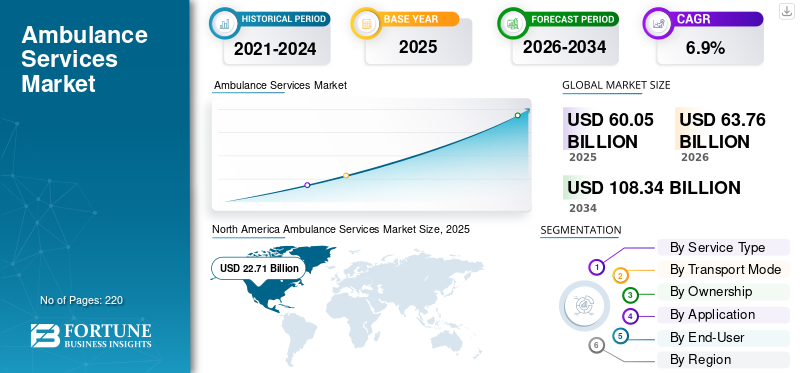
Download Free sample to learn more about this report.
AMBULANCE SERVICES MARKET KEY TAKEAWAYS
 Global Market Size & Forecast
- 2025 Market Size: USD 60.05 billion
- 2026 Market Size: USD 63.76 billion
- 2034 Forecast Market Size: USD 108.34 billion
- CAGR: 6.90% from 2026–2034
 Market Share
- North America dominated the market with a 37.81% share in 2025.
- The Emergency Ambulance Services segment is expected to dominate the market in 2026.
- Hospitals & Clinics are expected to hold the largest market share of 61.10% in 2026.
 Key Regional Highlights
North America
The market reached USD 22.71 billion in 2025 and is projected to grow to USD 24.04 billion in 2026.
Europe
The market is projected to reach USD 17.41 billion by 2026, supported by rising investments in ambulance services, expanding healthcare infrastructure, and the growing prevalence of chronic diseases.
Asia Pacific
The market is projected to reach USD 17.06 billion by 2026, driven by increasing healthcare investments, expanding emergency medical services, and rising demand for rapid patient transportation.
U.S.
The market is projected to reach USD 22.04 billion by 2026.
Japan
The market is projected to reach USD 2.93 billion by 2026.
Read More

AMBULANCE SERVICES MARKET TRENDS
Integration of Telemedicine and AI Dispatch Systems is Emerging as a Key Trend in the Market
The market is witnessing a rapid shift toward technology-enabled emergency response, with ambulance service providers increasingly integrating telemedicine platforms, AI-based dispatch algorithms, and real-time GPS tracking into their operations. These technologies are enabling faster triage decisions, optimized routing, and remote physician consultations during transport, which are significantly improving patient outcomes. Additionally, the growing adoption of electronic patient care reporting (ePCR) systems is also streamlining documentation and improving handover efficiency at emergency departments.
- For instance, in September 2025, the London Ambulance Service announced the deployment of AI-assisted dispatch technology capable of predicting call volumes and pre-positioning ambulance crews, resulting in measurable improvements in Category 1 response times across dense urban zones.
MARKET DYNAMICS
MARKET DRIVERS
Download Free sample to learn more about this report.
Rising Incidence of Road Accidents and Trauma Cases is Driving Demand for Emergency Ambulance Services
The escalating frequency of road traffic accidents, workplace injuries, and mass casualty incidents is directly fueling the demand for rapid-response ambulance services globally. As urbanization and vehicle ownership continue to increase, emergency medical service (EMS) systems are under increasing strain to respond quickly and effectively. Governments in emerging economies are investing heavily in expanding EMS infrastructure, including procurement of advanced life support vehicles, trained paramedic teams, and centralized dispatch centers, all of which are contributing to sustained global ambulance services market growth.
MARKET RESTRAINTS
High Operational Costs and Funding Constraints are Limiting Service Expansion
High costs associated with maintaining and upgrading ambulance fleets, retaining trained paramedics, and operating 24/7 dispatch systems are posing significant challenges to market expansion, particularly in low- and middle-income countries. Public ambulance systems, which predominate in most regions, are heavily dependent on government budgets that are often constrained by competing healthcare priorities. Staffing shortages and high attrition among EMTs and paramedics are further exacerbating operational bottlenecks, resulting in delayed response times and reduced service coverage in rural and remote areas.
MARKET OPPORTUNITIES
Expansion into Underserved Rural Regions is Offering Significant Market Growth Opportunities
Large, underserved rural and semi-urban populations across Asia Pacific, Latin America, and Sub-Saharan Africa present substantial untapped opportunities for ambulance service providers. Governments and international health agencies are increasingly deploying mobile EMS models, including motorcycle ambulances, boat ambulances, and air evacuation services, to bridge geographic gaps in emergency response coverage. The growing penetration of mobile-based ambulance booking platforms and app-driven EMS dispatch services is also creating new revenue streams and democratizing access to emergency care in areas previously lacking formal medical transport infrastructure.
MARKET CHALLENGES
Ensuring Consistent Response Times across Geographically Diverse Regions is Posing a Critical Challenge
Maintaining standardized response time targets across urban, suburban, and rural regions is emerging as a persistent and complex challenge for ambulance service operators. Traffic congestion in metropolitan areas, long distances in rural areas, and inadequate road infrastructure in developing regions collectively hamper the ability to meet clinical response benchmarks. Additionally, the uneven distribution of hospital infrastructure further complicates patient handover processes, leading to ambulance offload delays that reduce fleet availability and degrade overall system performance.
Segmentation Analysis
By Service Type
High Volume of Life-Threatening Medical Events to Drive Emergency Ambulance Services Segment Growth
Based on the service type, the market is divided into emergency ambulance services and non-emergency ambulance services.
The emergency ambulance services segment is anticipated to account for the largest market share. Emergency response operations are experiencing consistently high demand, owing to the growing global burden of cardiovascular emergencies, road traffic accidents, traumatic injuries, and acute medical episodes such as strokes and respiratory failures. Emergency ambulance fleets are being equipped with advanced cardiac life support (ACLS) systems, automated external defibrillators (AEDs), and portable diagnostic tools, enabling life-saving interventions during transport. The critical and time-sensitive nature of emergency calls is making this segment the operational and revenue cornerstone of the global ambulance services industry.
The non-emergency ambulance services segment is anticipated to rise with a CAGR of 7.3% over the forecast period.
To know how our report can help streamline your business, Speak to Analyst
By Transport Mode
Wide Accessibility and Cost-Effectiveness of Ground Ambulance Service Accelerated Segment Growth
Based on transport mode, the market is segmented into ground ambulance services, air ambulance services, and water ambulance services.
In 2025, the ground ambulance services segment dominated the global market. Ground ambulances are the primary mode of emergency medical transport in virtually all healthcare systems across the globe due to their cost-effectiveness, operational flexibility, and ability to navigate urban and suburban road networks efficiently. The segment is benefiting from ongoing fleet modernization programs, including the introduction of electric ambulance vehicles, advanced in-vehicle medical systems, and telematics-enabled fleet management platforms. The sheer scale of ground ambulance infrastructure, comprising hundreds of thousands of vehicles globally, is underpinning its commanding revenue share.
- For instance, in May 2025, the collaboration between DCAS and FDNY announced the launch of 30 all-electric vehicles, including the first-ever EV paramedic response units.
The air ambulance services segment is anticipated to rise with a CAGR of 7.8% over the forecast period.
By Ownership
Government Funding and Universal Coverage Mandates Boosted Public Ambulance Services Segment Growth
Based on ownership, the market is segmented into public ambulance services, private ambulance services, and hospital-based ambulance services.
In 2025, the public ambulance services segment dominated the global market. Government-operated and publicly funded EMS systems account for the majority of ambulance operations globally, particularly across North America, Europe, and Asia Pacific, where universal healthcare access is a policy priority. Public systems are benefiting from large-scale government procurement programs, centralized dispatch infrastructure, and guaranteed demand from publicly insured patient populations.
The private ambulance services segment is anticipated to rise with a CAGR of 7.3% over the forecast period.
By Application
High Global Incidence of Road Traffic Injuries Boosted Trauma & Accident Cases Segment Growth
Based on application, the market is segmented into trauma & accident cases, cardiac emergencies, respiratory emergencies, obstetric & neonatal transport, and others.
In 2025, the trauma & accident cases segment dominated the global market. Road traffic accidents, fall injuries, workplace incidents, and other trauma events are generating the highest volume of emergency ambulance dispatches across the globe. According to the World Health Organization, approximately 1.19 million people are dying annually from road traffic crashes, with tens of millions more sustaining non-fatal injuries requiring emergency medical transport.
The respiratory emergencies segment is anticipated to grow at a CAGR of 7.4% over the forecast period.
By End-User
Primary Destination for Emergency Medical Transport Accelerated Hospitals & Clinics Segment Growth
Based on end-user, the market is segmented into hospitals & clinics, nursing homes & assisted living centers, and others.
In 2025, hospitals & clinics held the highest market share. Hospitals serve as the principal receiving facilities for ambulance-transported patients, making them the central end users in the emergency medical services value chain. The growing number of hospital-based EMS partnerships, whereby ambulance services are entering into Service Level Agreements (SLAs) with hospital networks for guaranteed patient transport, is strengthening the integration between prehospital care and in-hospital emergency departments. Furthermore, the segment is set to hold 61.1% share in 2026.
The nursing homes & assisted living centers segment is projected to grow at a 7.3% CAGR during the study period.
Ambulance Services Market Regional Outlook
By geography, the market is categorized into Europe, North America, Asia Pacific, Latin America, and the Middle East & Africa.
North America
North America Ambulance Services Market Size, 2025 (USD Billion)
To get more information on the regional analysis of this market, Download Free sample
North America held the dominant share in 2024, at USD 21.47 billion, and maintained the leading share in 2025, at USD 22.71 billion. The market in North America is expected to increase due to highly developed EMS infrastructure, favorable reimbursement frameworks under Medicare and Medicaid, and significant private investment in air medical transport operations.
U.S. Ambulance Services Market
Based on North America’s strong contribution and the U.S. dominance within the region, the U.S. market can be analytically approximated at around USD 22.04 billion in 2026, accounting for roughly 34.6% of global sales.
Europe
Europe is projected to record a growth rate of 6.3% in the coming years, which is the second highest among all regions, and reach a valuation of USD 17.41 billion by 2026. The region is estimated to witness considerable market growth due to rising investments in new ambulance services and rising prevalence of chronic conditions.
U.K. Ambulance Services Market
The U.K. market in 2026 is estimated at around USD 3.11 billion, representing roughly 4.9% of global revenues.
Germany Ambulance Services Market
The market in Germany is projected to reach approximately USD 4.26 billion in 2026, equivalent to around 6.7% of global sales.
Asia Pacific
Asia Pacific is estimated to reach USD 17.06 billion in 2026 and secure the position of the third-largest region in the market.
Japan Ambulance Services Market
The Japanese market in 2026 is estimated at around USD 2.93 billion, accounting for roughly 4.6% of global revenues.
China Ambulance Services Market
China’s market is projected to be one of the largest across the globe, with 2026 revenues estimated at around USD 5.64 billion, representing roughly 8.8% of global sales.
India Ambulance Services Market
The Indian market in 2026 is estimated at around USD 3.76 billion, accounting for roughly 5.9% of global revenues.
Latin America and Middle East & Africa
The Latin America and Middle East & Africa regions are expected to witness moderate growth in this market space during the forecast period. The Latin America market is set to reach a valuation of USD 2.77 billion in 2026. In the Middle East & Africa, the GCC is set to reach USD 0.50 billion in 2026.
South Africa Ambulance Services Market
The South African market is projected to reach around USD 0.20 billion in 2026, representing roughly 0.31% of global revenues.
COMPETITIVE LANDSCAPE
Key Industry Players
Growing Number of Fleet Expansions and Strategic Partnerships, Coupled with Technology Integration by Key Players, are Boosting Market Progress
The global ambulance services market holds a semi-consolidated market structure, constituting prominent players such as Global Medical Response, Falck, Acadian Ambulance Service, Air Methods, and PHI Air Medical. The significant global market share of these companies is due to numerous strategic activities, including distribution collaborations and the implementation of new programs.
- For instance, in March 2025, Global Medical Response (GMR) and Airbus Helicopters signed a strategic agreement for up to 15 H140 helicopters for use in the emergency medical services.
Other notable players in the global market include Ziqitza Healthcare, Medivic Aviation, Metro West Ambulance, London Ambulance Service NHS Trust, and Ambulance Victoria. These companies are expected to prioritize collaborations to increase their global market share during the forecast period.
LIST OF KEY AMBULANCE SERVICE COMPANIES PROFILED
- Global Medical Response (U.S.)
- Falck (Denmark)
- Acadian Ambulance Service (U.S.)
- Air Methods (U.S.)
- PHI Air Medical (U.S.)
- Ziqitza Healthcare (India)
- Medivic Aviation (India)
- Metro West Ambulance (U.S.)
- London Ambulance Service NHS Trust (U.K.)
- Ambulance Victoria (Australia)
KEY INDUSTRY DEVELOPMENTS
- January 2026: Grant Avenue Capital announced the acquisition of PatientCare EMS Solutions to accelerate PatientCare's geographic expansion and strengthen its partnerships with municipalities, hospitals, and healthcare systems.
- February 2025: AmeriPro Health announced the acquisition of Priority Medical Transport, a Nebraska-based emergency medical services provider. The strategic step was taken to expand AmeriPro's suite of 911 emergency response, interfacility medical transportation, and critical care transport services across Nebraska.
- February 2025: Falck was awarded a new ambulance contract in Catalonia, Spain, by the Catalan Prehospital Authority (SEM), securing three of the maximum allowable lots covering the metropolitan area of Barcelonès Sud, Girona, and Penedès.
- January 2025: Priority Ambulance announced the acquisition of LifeCare EMS, an emergency medical services provider serving seven counties in central Mississippi, under the new brand Magnolia Ambulance.
- January 2024: Acadian Ambulance Service announced the acquisition of SouthernCross Ambulance.
REPORT COVERAGE
The global ambulance services market analysis includes a comprehensive study of the market size & forecast across all market segments covered in the report. It includes details on the market dynamics and market trends expected to drive the market over the forecast period. It provides information on key aspects, including technological advancements, the regulatory environment, and product launches. Additionally, it details partnerships, mergers & acquisitions, key industry developments, and investments by key regions. The global market research report also provides a detailed competitive landscape, including market share and profiles of key operating players.
Request for Customization to gain extensive market insights.
Report Scope & Segmentation
| ATTRIBUTE | DETAILS |
| Study Period | 2021-2034 |
| Base Year | 2025 |
| Estimated Year | 2026 |
| Forecast Period | 2026-2034 |
| Historical Period | 2021-2024 |
| Growth Rate | CAGR of 6.9% from 2026 to 2034 |
| Unit | Value (USD Billion) |
| Segmentation | By Service Type, Transport Mode, Ownership, Application, End-User, and Region |
| By Service Type |
|
| By Transport Mode |
|
| By Ownership |
|
| By Application |
|
| By End-User |
|
| By Region |
|
Frequently Asked Questions
According to Fortune Business Insights, the global market value stood at USD 60.05 billion in 2025 and is projected to reach USD 108.34 billion by 2034.
In 2025, the market value in North America stood at USD 22.71 billion.
The market is expected to exhibit a CAGR of 6.9% during the forecast period of 2026-2034.
By service type, the emergency ambulance services segment is expected to lead the market.
Rising emphasis on better emergency care and rising prevalence of accidents & trauma are driving market expansion.
Global Medical Response, Falck, Acadian Ambulance Service, Air Methods, and PHI Air Medical are the major players in the global market.
North America dominated the market in 2025.



- 2021-2034
- 2025
- 2021-2024
- 220
Get 30-60 hrs Free Customization
Expand Regional and Country Coverage, Segments Analysis, Company Profiles, Competitive Benchmarking, and End-user Insights.













.webp)






Related Reports
-
US +1 833 909 2966 ( Toll Free )
-
Get In Touch With Us