Artificial Intelligence (AI) in Retail Market Size, Share & Industry Analysis, By Offerings (Solutions and Services), By Function (Operation-Focused, and Customer-Facing), By Type (Online and Offline), By Application (Predictive Analytics, In-Store Visual Monitoring & Surveillance, Customer Relationship Management, Market Forecasting, Inventory Management, and Others), By Technology (Computer Vision, Machine Learning, Natural Language Processing, and Others), and Regional Forecast, 2026-2034
 Download Free Sample
 KEY MARKET INSIGHTS
 Listen to Audio Version
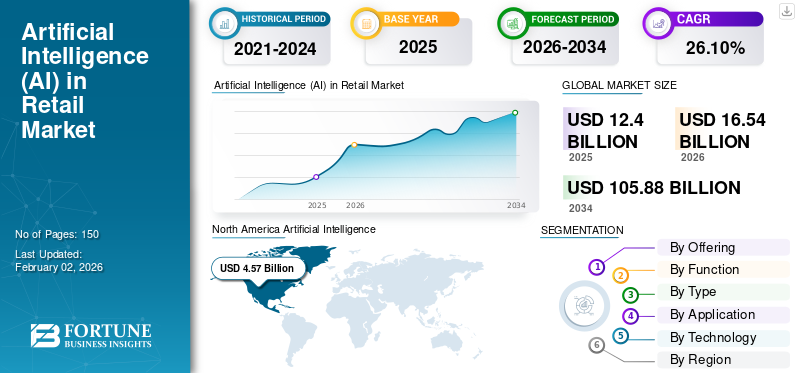
The global artificial intelligence (AI) in retail market size was valued at USD 12.40 billion in 2025 and is projected to grow from USD 16.54 billion in 2026 to USD 105.88 billion by 2034, exhibiting a CAGR of 26.10% during the forecast period. North America dominated the global market with a share of 36.90% in 2025. Additionally, the U.S. artificial intelligence in retail market is predicted to grow significantly, reaching an estimated value of USD 17.76 billion by 2032.
Rising demand for personalized shopping experiences, automation in operations, AI-powered chatbots, predictive analytics, and visual/voice search technologies are fueling market growth. Increased cloud adoption, digital transformation in retail, and strategic partnerships among tech giants are accelerating the deployment of AI solutions across global retail ecosystems.
North America dominated the global market with a share of 39.08% in 2023. The Artificial Intelligence in Retail Market in the U.S. is projected to grow significantly, reaching an estimated value of USD 17.76 billion by 2032, driven by Rising Use of AI-powered Chatbots for Improved Customer Experience.
Retail businesses need to prioritize productivity to remain competitive in the market. Artificial Intelligence (AI) supports retailers in automating their operations, thus increasing profits and optimizing business processes. The report covers solutions, such as automated inventory management, demand forecasting, customer assistance, predictive analytics, and more to enhance retail operations.
The digital transformation in the retail industry is driving the adoption of artificial intelligence in the retail sector. Retailers and brands across the world are rapidly implementing AI technology for optimizing automation in retail stores. AI in retail technology is helping retailers introduce automation in both online and offline services and customer-facing solutions.
Moreover, companies are rapidly incorporating the cloud in these advanced technologies to provide better customer experiences. For instance, in February 2023, Google, along with Accenture, launched new tools to help retailers innovate their businesses and benefit from cloud technology. With this partnership, Accenture ai.RETAIL Platform was integrated with Google Cloud to build on joint customer successes.
The COVID-19 pandemic severely impacted the retail industry across the globe. The imposition of lockdowns during this period significantly changed customers’ purchasing patterns & behavior. Therefore, the implementation of AI helped retailers realign their supply chains, recognize dynamic demand, understand new market trends, and boost their efficiency.
Download Free sample to learn more about this report.
Artificial Intelligence (AI) in Retail Market Trends
AI-driven Visual and Voice Search to Propel Market Opportunities
E-commerce platforms and virtual shops are growing rapidly. Today, consumers can use new techniques, such as product images, videos, and voice to search for new products. Artificial Intelligence (AI) in visual search optimizes its functionalities by processing inquiries and mining the metadata. The visual search engine utilizes AI features to analyze, track, and predict growing shopping trends, thereby enhancing shoppers’ experience and engagement.
For instance, in January 2024, Google Cloud launched various new-gen AI-powered technologies to allow retailers to modernize operations, personalize online shopping, and transform in-store technology rollouts. To help customers find and buy products more quickly, Google Cloud's search technology for retailers has been improved with the ability to use large language models. The increasing use of such digital tools can make Artificial Intelligence in retail experience more seamless and spontaneous.
Thus, it has become essential for retailers to implement AI-based search engines to enhance customer service and boost revenue growth. In addition, retailers gain valuable insights into consumer trends and make better business decisions through AI powered searches. A rich data base and potential growth opportunities for retailers are expected to be provided by AI driven search engines over the coming years.
Download Free sample to learn more about this report.
Artificial Intelligence (AI) in Retail Market Growth Factors
Rising Use of AI-powered Chatbots for Improved Customer Experience to Drive Market Growth
AI-powered chatbot assistance is gaining vast popularity across the retail industry owing to its highly efficient customer service. A chatbot offers dedicated and personalized responses to customers to boost their experience. For instance, in May 2023, smart appliances brand upliance.ai integrated ChatGPT into its products. DelishUp, a smart cooking assistant, simplified cooking by automating the process. Moreover, the company plans to launch products in the home appliances category, thus setting a strong footprint in Artificial Intelligence in the retail industry.
The AI chatbots are equipped with Natural Language Processing (NLP) and Machine Learning (ML) technologies. These technologies offer real-time insights regarding customer preferences. Also, they help the chatbot understand customers’ sentiments and behavior patterns, which assist it in responding to customer queries and building relations.
For instance, Levi’s has implemented a chatbot platform, Levi’s Virtual Stylist, to provide recommendations to its customers. The bot asks users for basic details, such as size, fit, material, and even preferred brands to offer quick suggestions. Thus, the AI-driven chatbot is expected to drive artificial intelligence in retail market growth.
RESTRAINING FACTORS
Lack of Infrastructure and Higher Implementation Costs to Limit Adoption of AI in the Retail Sector
Well-established retail brands continuously invest in innovative technologies to enhance customer engagement; however, different factors are likely to limit the market growth. Large enterprises and global-level retailers, such as Walmart have already implemented AI technology for in-shop operations and to manage online portals.
However, today, new start-ups and small & medium-sized enterprises face challenges in adopting the technology due to a lack of infrastructure and technical expertise. As per IBM's cloud-data service insights, 37% of respondents stated that lack of AI expertise was an obstacle in implementing such technology. The high implementation cost associated with AI in retail solutions is also a major barrier for small retailers, which is limiting its implementation. These factors are expected to hamper Artificial Intelligence in retail market expansion.
Artificial Intelligence (AI) in Retail Market Segmentation Analysis
By Offering Analysis
Increasing Automation in Retail Industry to Fuel AI-based Solution Adoption
Based on offering, Artificial Intelligence in the retail market is segmented into solutions and services. The solutions segment is anticipated to hold a dominant market share of 63.73% in 2026. Some of the popular AI solutions include smart stores, e-commerce, intelligent customer insights, smart delivery, intelligent supply chain, and more. The growing challenges in managing various retail operations are likely to drive the development of new & innovative automation solutions in the retail industry. AI-based retail solutions help retailers manage logistics, supply chain operations, and warehouse management, and improve customer experience. This is expected to fuel the implementation of AI in the retail sector.
The services segment is likely to showcase highest growth rate during the forecast period. Retailers need additional support from vendors in specific services, such as installation, management, maintenance, and more. Thus, the rapid implementation of AI solutions is driving the demand for services.
By Function Analysis
Growing Demand for Efficient Operations to Boost Usage of Operations-focused Functions
Based on function, the market is bifurcated into operations-focused and customer-facing. The operation-focused segment is anticipated to hold a dominant market share of 64.81% in 2026. Some of the popular operation-focused solutions include Intel Movidius VPUs, Taskdesk Virtual Agents, RetailNext Store Layout, and ViSenze merchandising planning. Retailers are implementing AI to boost the efficiency of their operations, such as merchandising, logistics, supply chain, on-time delivery, and more. Proper management of backend functions helps retailers focus on revenue expansion and new growth strategies.
The customer-facing segment is likely to showcase the highest growth during the forecast period owing to the increasing demand for a solution to improve customer experience. To reduce customer complaints and enhance brand loyalty, retailers are adopting AI-driven solutions. In addition, due to its highly efficient customer service, AI-based chatbot assistance is becoming more and more popular in the consumer sector. To increase consumer satisfaction, these chatbots provide personalized and dedicated customer responses.
By Type Analysis
Efficient Management of In-Store Operations to Boost Product Adoption in Offline Stores
Based on type, the market is bifurcated into online and offline. The offline segment is anticipated to hold a dominant market share of 63.29% in 2026 and is also expected to record the highest CAGR during the forecast period. The demand for AI technology is growing due to its capabilities, such as managing in-store operations, enhancing merchandising & assortment, and automating personalized product recommendations, among others, to enhance customer shopping experiences.
In addition, the implementation of AI technologies that can help retailers improve their business growth is also improving online customer service capabilities. For instance, ViSenze offers a wide range of intelligent e-commerce solutions, such as cross-device experience, smart recommendations, discovery, and inspiring SEO marketing.
By Application Analysis
Rapidly Changing Customer Behavior to Drive Use of AI in Retail Technology in Predictive Analytics
Based on applications, the market is categorized into predictive analytics, in-store visual monitoring and surveillance, Customer Relationship Management (CRM), market forecasting, inventory management, and others. The predictive analytics segment is anticipated to hold a dominant market share of 26.57% in 2026. Some of its key solutions are demographic segmentation, store operations, shelf management, inventory management, labor optimization, and more. Retailers are implementing AI-based predictive analytics to understand future market opportunities and customer behavior. The AI is also used to gain real-time analysis of different locations, countries, cultures, gender, age, and other demographics.
The customer relationship management segment is likely to record the highest growth during the forecast period, owing to increasing demand for better customer engagement. AI-driven virtual assistance, chatbots, search engines, and more help retailers maintain strong customer relationships and loyalty. The demand for AI in market forecasting is also gaining traction owing to the uncertain and rapid changes in customer buying behavior. Similarly, the use of AI in in-store visual monitoring and surveillance is likely to showcase steady growth. The continuous surveillance offers high security and captures customer insights, shelf replenishment alerts, control fraud & shrinkage, face recognition, and more.
By Technology Analysis
To know how our report can help streamline your business, Speak to Analyst
Highly Accurate Customer Insights to Boost Adoption of Machine Learning
Based on technology, the market is divided into computer vision, machine learning, natural language processing, and others.
Machine learning holds the largest share and is expected to continue its dominance in the market during the forecast period. Retailers are keen on understanding their customers’ behavior, emotions, personality type, and more to provide customized services. Machine Learning (ML) offers quick deep insights from the collected information and is useful in providing personalized experiences to customers. To boost inventory productivity, it helps retailers optimize their supply chain plans and demand forecasts.
For instance, Amazon SageMaker is a fully managed service that deploys machine learning models for any application, right from predictive analytics to customer experience. Similarly, the implementation of computer vision is expanding significantly in the retail industry. AI-based computer vision is being adopted to gain insights from facial recognition and video searches.
REGIONAL INSIGHTS
Geographically, the market is fragmented into five major regions, such as North America, Europe, Asia Pacific, the Middle East & Africa, and South America. They are further categorized into countries.
North America
North America Artificial Intelligence (AI) in Retail Market Size, 2025 (USD Billion)
To get more information on the regional analysis of this market, Download Free sample
North America maintained a strong presence in the global market, reaching USD 4.57 billion in 2025, accounting for 36.90% share, and is expected to reach USD 5.9 billion in 2026. The retailers in this region are focusing on extracting data based on customers’ preferences to boost customer service efficiency. The U.S. is an early adopter of AI technology and is witnessing technology investment in AI. The country is also witnessing notable growth in the network of new startups and small enterprises due to the rising demand for this technology. This factor is expected to boost Artificial Intelligence (AI) in retail market growth. The U.S. market is projected to reach USD 4.01 billion by 2026.
To know how our report can help streamline your business, Speak to Analyst
Asia Pacific
The Asia Pacific market accounted for USD 3.37 billion in 2025, representing 27.20% of the global industry, and is expected to reach USD 4.62 billion in 2026. The region’s retail industry is going through a rapid transition phase. This is driving the demand for advanced AI technologies to improve operations and customer experience. For instance, as per SAP SE’s analysis, 2020, China has secured a 23.4% share of AI investments for its commerce & retail industry. Moreover, investments in this technology are expected to reach USD 18.8 billion by 2027. India is anticipated to register the highest CAGR due to the high demand for automation tools to improve decision-making capabilities and operations. The Japan market is projected to reach USD 1.29 billion by 2026, the China market is projected to reach USD 2.07 billion by 2026, and the India market is projected to reach USD 0.57 billion by 2026.
Europe
Europe will likely capture the second largest market share. The current large-scale retailers across the region in cosmetics, fashion, and apparels sectors are actively investing in advanced technologies to boost customer experience. This is expected to surge the demand for artificial intelligence in the retail industry. The UK market is projected to reach USD 1.69 billion by 2026, and the Germany market is projected to reach USD 1.48 billion by 2026.
Middle East & Africa
The Middle East & Africa region will showcase prominent growth opportunities for the market in the coming years due to the increasing shift toward implementing innovative solutions to boost customer engagement. Similarly, Latin America is set to witness steady growth owing to the rise in investment in AI in the retail industry. In 2025, Middle East & Africa represented USD 0.16 billion, accounting for 1.30% of the worldwide market, and is projected to grow to USD 0.21 billion in 2026.
Latin America
Latin America contributed 2.50% to the global market in 2025, with a valuation of USD 0.31 billion, and is projected to reach USD 0.4 billion in 2026.
List of Key Companies in Artificial Intelligence (AI) in Retail Market
New and Innovative Product Launches to Boost Market Positions of Key Players
The key players in the market are continuously investing in innovative solutions. These solutions help retailers quickly adapt to new services in companies. The growing data volume in the retail industry is further driving the implementation of AI. Thus, the market players are launching tailored and customer-targeting solutions. By leveraging advanced technologies, companies are strengthening their product portfolios to stay ahead in the market competition. Further, the key players are implementing partnership, merger, and acquisition strategies to expand their market share.
- January 2024 – Salesforce launched AI-powered tools and new data to transform all shopping experiences. Retailers and marketing companies can use generative tools with a real-time understanding of customer preferences and behavior to optimize every interaction with customers by integrating AI into the marketing cloud and commerce cloud.
- January 2024 – Lenovo launched its AI-powered and end-to-end retail solutions designed for retailers and consumers in every category to help reduce loss, grow business opportunities, and enhance customer experience.
List of the Key Companies Profiled:
- Amazon.com, Inc. (U.S.)
- Google LLC (U.S.)
- IBM Corporation (U.S.)
- Intel Corporation (U.S.)
- Microsoft Corporation (U.S.)
- Nvidia Corporation (U.S.)
- Oracle Corporation (U.S.)
- SAP SE (Germany)
- Salesforce.com, Inc. (U.S.)
- Talkdesk, Inc. (U.S.)
KEY INDUSTRY DEVELOPMENTS:
- April 2023 – Siam Makro Public Company Limited, a leading retailer, collaborated with Oracle to accelerate its digital transformation. The company implemented Oracle Cloud Infrastructure to drive efficiency in Makro Retail management.
- January 2023 – Microsoft collaborated with AiFi, a tech start-up, to launch Smart Store Analytics. It is a cloud-tracking service for smart and cashier-less outlets that aids retailers with shopper and operational analytics.
- January 2023 – EY, a Fintech company, launched the EY Retail Intelligence solution built on Microsoft Cloud to provide clients with a time-saving and secure shopping experience. This solution uses Microsoft Cloud for Retail and its technologies including Artificial Intelligence (AI), analytics, and image recognition to provide valuable insights.
- January 2023 – Perfect partnered with Valmont, a luxury cosmetics brand, for its latest AI-focused beauty partnership. The collaboration brings Valmont’s background in skincare with Perfect’s artificial intelligence solution to offer consumers a detailed skin analysis.
- November 2022 – Fractal launched Asper.ai, an AI product for manufacturing, consumer goods, and retail sectors. The solution brings an end-to-end AI product, unifying inventory optimization, demand planning, strategic pricing, and positioning.
REPORT COVERAGE
Request for Customization to gain extensive market insights.
The artificial intelligence in retail market report highlights leading regions across the world to offer a better understanding of the market. Furthermore, the report provides insights into the latest industry trends and analyzes technologies deployed at the global level. It further highlights some of the growth-stimulating factors and restraints, helping the reader gain in-depth knowledge about the market.
REPORT SCOPE & SEGMENTATION
|
ATTRIBUTE |
DETAILS |
|
Study Period |
2021-2034 |
|
Base Year |
2025 |
|
Estimated Year |
2026 |
|
Forecast Period |
2026-2034 |
|
Historical Period |
2021-2024 |
|
Growth Rate |
CAGR of 26.10% from 2026 to 2034 |
|
Unit |
Value (USD billion) |
|
Segmentation |
By Offering
By Function
By Type
By Application
By Technology
By Region
|
Frequently Asked Questions
According to Fortune Business Insights, the market is projected to reach USD 105.88 billion by 2034.
In 2025, the market size stood at USD 12.40 billion.
The market is projected to record a CAGR of 26.10% during the forecast period of 2026-2034.
In 2026, Predictive analytics led the market.
The rising usage of automation to enhance customer experience is likely to drive market growth.
Amazon.com, Inc., Google LLC, IBM Corporation, Intel Corporation, Microsoft Corporation, Nvidia Corporation, Oracle Corporation, and SAP SE are the top players in the market.
North America dominated the global market with a share of 36.90% in 2025.
Asia Pacific is expected to record a remarkable CAGR.



- 2021-2034
- 2025
- 2021-2024
- 150
Get 20% Free Customization
Expand Regional and Country Coverage, Segments Analysis, Company Profiles, Competitive Benchmarking, and End-user Insights.




















Related Reports
-
US +1 833 909 2966 ( Toll Free )
-
Get In Touch With Us