Biochar Market Size, Share & Industry Analysis, By Technology (Pyrolysis and Gasification), By Application (Farming, Livestock, Power Generation, and Others), and Regional Forecast, 2026-2034
 Download Free Sample
Biochar Industry Outlook Analysis 2026-2034
 Listen to Audio Version
The global biochar market size was valued at USD 859.04 million in 2025 and is projected to grow from USD 969.29 million in 2026 to USD 2,731.94 million by 2034, exhibiting a CAGR of 13.83% during the forecast period. Asia Pacific dominated the biochar market with 82.97% maket share in 2025. The industry growth is driven by carbon sequestration initiatives, sustainable agriculture, waste valorization, circular economy practices, and expanding climate-focused investments worldwide.
The global biomarketchar market is transitioning from a niche agricultural input toward a strategically important carbon management and resource efficiency industry. Demand is gaining traction as governments, agricultural producers, and industrial organizations pursue solutions that simultaneously support carbon sequestration, improve resource utilization, and strengthen climate resilience. The convergence of environmental policy, sustainable farming practices, and voluntary carbon markets is creating favorable conditions for long-term biochar adoption across multiple end-use sectors.
Commercial expansion is increasingly supported by the conversion of agricultural waste and other biomass feedstocks into carbon-rich materials capable of delivering measurable environmental and economic benefits. Biochar applications extend beyond traditional soil amendment uses into livestock management, water treatment, industrial processes, and renewable energy systems. This diversification is reducing dependence on a single demand source while strengthening the industry's long-term commercial outlook.
Agricultural applications remain the largest contributor to the biochar market size because improving soil fertility, enhancing water retention, and improving soil health directly influence farm productivity and climate adaptation strategies. Farmers are increasingly evaluating high-quality biochar products as part of integrated soil management programs designed to improve crop yield while reducing nutrient losses. These operational advantages complement the material's ability to sequester carbon over extended periods, supporting participation in emerging carbon removal credit markets.
Investment activity is expanding from pilot-scale facilities toward large-scale commercial biochar production supported by infrastructure investors, climate technology funds, and strategic partnerships. Capital allocation increasingly favors projects capable of integrating biomass utilization, renewable energy recovery, and carbon management within circular economy business models. Growing alignment with corporate net zero targets is also strengthening long-term demand from industrial buyers seeking verified carbon removal solutions. The biochar market in the U.S. is projected to grow significantly, reaching an estimated value of USD 43.61 million by 2032, driven by federal and state renewable energy mandates and the push to combat GHG emissions.
Biochar is a charcoal-like material produced from plant materials, such as grass and agricultural and forest residues, that decompose at high temperatures, often during renewable energy production. During the process, the physical and chemical properties of the plant material change into a highly porous, stable, and carbon-rich material.
Pyrolysis is widely known as the manufacturing process of producing charcoal from wood. Gasification is a basic process in which organic carbonaceous materials are converted into carbon monoxide and carbon dioxide at high temperatures with oxygen and steam. The demand for biochar is rising owing to growing trends of carbon credits and rising adoption of sustainable agriculture practices across farming activities, which are the driving factors for the market growth.
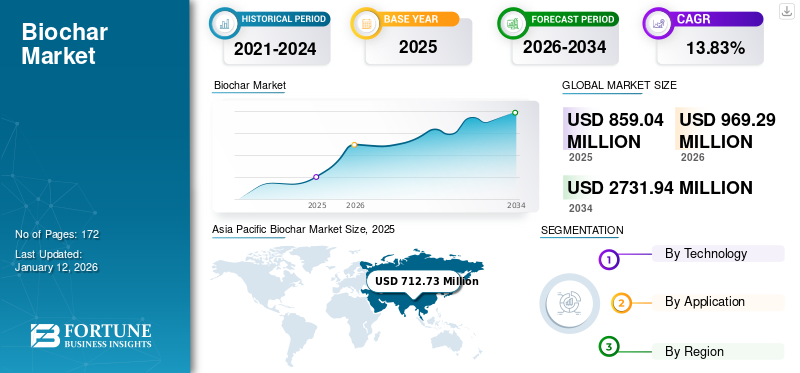
Download Free sample to learn more about this report.
Biochar Market Key Takeaways
 Global Market Size & Forecast
- 2025 Market Size: USD 859.04 million
- 2026 Market Size: USD 969.29 million
- 2034 Forecast Market Size: USD 2,731.94 million
- CAGR: 13.83% from 2026–2034
 Market Share
- Asia Pacific dominated the biochar market with an 82.97% share in 2025.
- The pyrolysis segment is projected to account for an 86.71% market share in 2026.
- The farming segment is projected to hold a 40.91% market share in 2026.
 Key Regional Highlights
Asia Pacific
Asia Pacific led the global market with USD 712.73 million in 2025 and is projected to reach USD 808.64 million in 2026.
North America
North America accounted for USD 95.39 million in 2025 and is projected to grow to USD 105.48 million in 2026.
Europe
Europe generated USD 41.47 million in 2025 and is expected to reach USD 44.97 million in 2026.
U.S.
The market is projected to reach USD 99.21 million by 2026.
Japan
The market is supported by biomass conversion technologies, sustainable agriculture policies, and carbon neutrality initiatives.
Read More

Biochar Industry Trends
Rising Trend of Carbon Credits is Propelling the Market Growth
Biochar carbon credits are credits that constitute persistent carbon sequestration. This permanent sequestration, also referred to as drawdown or removal, varies from reduction credits or avoidance as it physically traps carbon in a stable form for a longer time.
For instance, in March 2024, Microsoft buys 95,000 tons of carbon capture credits from a Mexican biochar plant. It has agreed to a six-year purchasing deal with The Next 150 and its General Biochar Systems business unit, which runs the biochar plant near the city of Guanajuato.
Climate mitigation priorities are reshaping biochar market trends beyond conventional agricultural applications. Biochar is increasingly recognized as a carbon-negative material because it stabilizes biomass-derived carbon for extended periods while creating measurable environmental value. This characteristic is encouraging wider commercial acceptance among agricultural producers, industrial operators, and institutional investors pursuing sustainable decarbonization strategies.
Carbon markets are becoming an important commercial driver. Organizations seeking verified carbon removal credits are investing in certified biochar projects capable of demonstrating transparent carbon accounting and permanent carbon storage. As voluntary and compliance-based carbon mechanisms mature, biochar producers are expanding business models beyond product sales to include environmental attribute monetization.
In addition, in July 2023, North America’s largest plant was announced along the north shore of the Saint Lawrence River in Port-Cartier, Quebec, Canada. A group of Canadian and French companies, including Groupe Rémabec, SUEZ, and Airex Energy, is investing USD 59 to 60 million to construct North America’s biggest biochar production plant. This initiative underlines the rising worldwide acknowledgment of biochar’s ability to enhance soil and sequester carbon.
By sequestering carbon, biochar will generate guaranteed, certified carbon credits. Moreover, biochar production can generate Carbon Dioxide Removal (CDR) carbon credits. These credits can be traded or sold, generating a second revenue stream for biochar manufacturers and motivating further carbon sequestration attempts.
Download Free sample to learn more about this report.
Biochar Market Growth Factors
Surging Adoption of Sustainable Agriculture Practices to Lead the Market Growth
The adoption of sustainable agriculture practices across farming activities is expected to drive the global market. Sustainable agriculture practices include a wide range of methods and techniques for meeting the current and future demand for food while ensuring a healthy environment and ecosystem. The integration of biochar as a sustainable farming method for promoting crop yield has resulted in the expansion of the global biochar market.
In addition, biochar enhances soil structure, water retention, and nutrient availability, promoting optimal conditions for plant growth. Moreover, the rising initiatives, schemes, and subsidies by the government and different organizations for the promotion of sustainable practices in agriculture would also support market growth. For instance;
- In December 2023, a task force of companies including Mars, McCain Foods, McDonald's, Mondelez International, PepsiCo, and Waitrose announced a plan to make regenerative farming financially viable and scalable, exploring implementation projects in India, the U.K., and the U.S.
- In March 2024, the Agriculture Department and Nuziveedu Seeds gave 200 metric tons of Biochar to farmers of Erravelli village in Markook Mandal. Nuziveedu’s Biochar, a carbon-rich soil amendment produced from cow dung and maize stalks. Its innovative production process imbues the Biochar with unusual characteristics, comprising enhanced soil aeration, nutrient capacity, and improved moisture retention.
Rising Waste Management is Driving the Market Growth
In recent years, pyrolysis of biochar has gained significant traction as a sustainable method for waste management and soil enhancement. This innovative technology provides numerous advantages that extend beyond conventional waste disposal methods. As an option for rapid incineration or slow decomposition, converting biomass waste into biochar results in a product that is extremely valuable for enhancing the soil.
Biochar is mainly produced from biomass waste materials, which are suitable for production. It includes crop residues, such as field and processing residues, food and forest waste, and animal manure. Abundant agricultural, municipal, and forest biomass is burned, due to which a large amount of CO2 and methane is released, which pollutes the surface and local groundwater.
If solid waste is not treated properly, it could negatively impact the environment, as the global accumulation of agricultural waste is around 2 billion tons in a year, whereas forest waste accounts for about 0.2 billion tons, municipal waste for about 1.7 billion tons, and industrial waste for 9.1 billion tons.
The usage of biomass-related solutions globally is increasing, owing to the increasing prices of primary fuel for energy production. The global demand for biochar as a fuel is increasing significantly due to the high industrial and commercial demand. Moreover, the easy availability of biomass sources and low production cost have led to its higher consumption in the industrial sector.
Restraining Factors
Lack of Knowledge Concerning the Manufacturing Process of Products to Hamper Market Growth
Biomass is used as the feedstock in the pyrolysis reactor, which has a set heating and gas flow rate, residence duration, and temperature. Following that, the biomass-residue product can be created. There are certain by-products of this process, such as gas and bio-oil. However, when the product is applied to agricultural land, several prior research identified the following drawbacks: loss of land due to erosion, soil compaction during the application, risk of contamination, removal of crop residues, and reduction in worm life rates; these factors are creating a negative impact on the environment and could affect the market.
Many farmers and industries in regions such as South America, Africa, and some parts of the Asia-Pacific region have limited awareness regarding the useful application and production of biochar. Due to the lack of education and outreach efforts by government organizations, the potential of biochar hasn’t reached the core users and manufacturers, which has further led to the limited production and application of biochar in the global market.
Commercial scalability remains one of the principal challenges affecting the biochar market. Although demand is expanding, widespread biochar adoption depends on reliable feedstock availability, consistent product quality, and economically viable production systems. Feedstock composition varies according to biomass source, influencing physical and chemical characteristics that directly affect application performance. Consequently, manufacturers must implement rigorous quality assurance processes to produce standardized, high-quality materials suitable for commercial use.
Economic considerations also influence investment decisions. Establishing large-scale biochar production facilities requires substantial capital expenditure for feedstock processing, pyrolysis equipment, emissions control systems, and logistics infrastructure. Smaller producers often encounter financing constraints, particularly where carbon markets remain underdeveloped or government incentives are limited. These conditions can slow commercialization despite favorable long-term market fundamentals.
Regulatory fragmentation creates additional uncertainty. Certification standards governing carbon sequestration, environmental performance, and carbon removal credits continue evolving across different jurisdictions. Inconsistent verification methodologies may delay project approvals and complicate participation in voluntary carbon markets, affecting investor confidence and revenue predictability.
Market Opportunities
Carbon management is emerging as the most compelling opportunity within the biochar market. Growing corporate commitments toward net-zero targets and increasing participation in voluntary carbon markets are expanding demand for durable carbon sequestration solutions. Because biochar sequesters carbon over extended periods while creating productive end uses, it occupies a distinctive position among engineered carbon removal technologies. This dual environmental and economic value proposition is strengthening commercial interest from both institutional investors and industrial organizations.
Agricultural modernization presents another significant growth avenue. Farmers increasingly seek sustainable inputs capable of improving soil fertility, strengthening water retention, and enhancing crop yield under changing climatic conditions. Biochar applications are becoming integrated into regenerative farming systems where soil productivity, nutrient efficiency, and climate resilience are strategic priorities rather than isolated agronomic objectives.
Industrial decarbonization is creating additional investment potential. Biochar is gaining traction across construction materials, wastewater treatment, environmental remediation, and specialty filtration because its carbon-rich structure offers functional performance beyond traditional agricultural use. These diversified applications reduce dependence on a single customer segment while expanding addressable market opportunities.
Technological innovation continues to improve commercial scalability. Advanced pyrolysis systems, integrated renewable energy recovery, and digital process optimization enable more efficient biochar production with greater consistency and lower operating costs. These improvements strengthen project economics while supporting expansion into new regional markets.
Biochar Market Segmentation Analysis
By Technology Analysis
Pyrolysis Segment Holds the Dominant Market Share Owing to its Inexpensive and Convenient Aspects
Based on the technology, the market has been bifurcated into gasification and pyrolysis.
Pyrolysis
Pyrolysis will dominate the market due to its widespread adoption, as it is cost-effective, convenient, and capable of processing a wide range of feedstocks, accounting for an 86.71% market share in 2026. This technology helps to avoid greenhouse gas emissions. This drives the growth in the pyrolysis technology segment over the forecast period.
Pyrolysis represents the dominant technology within the biochar market because it provides high conversion efficiency, stable product characteristics, and flexibility across diverse biomass feedstocks. Agricultural waste, forestry residues, and organic by-products can be converted into carbon-rich biochar under oxygen-limited conditions while simultaneously generating renewable heat and bio-oil. This integrated resource utilization model improves overall plant economics and supports circular economy objectives.
Commercial producers increasingly favor advanced pyrolysis systems because they deliver greater process consistency and enable the production of high-quality biochar tailored to specific end-user requirements. Controlled operating temperatures and optimized residence times allow manufacturers to customize physical and chemical properties according to agricultural, environmental, or industrial applications. These capabilities improve product differentiation while supporting premium market positioning.
Gasification
The gasification segment is expected to show significant growth during the forecast period. This technology produces smaller quantities of such char in a directly heated, air-introduced reaction vessel. Market demand and acceptance of this technology are increasing as it produces lower levels of air pollutants. However, this method is slightly less efficient than others.
Gasification occupies a strategically important position within the biochar market by combining renewable energy generation with biochar recovery. Unlike conventional pyrolysis systems, gasification emphasizes synthesis gas production while generating biochar as a valuable co-product. This dual-output configuration enables operators to diversify revenue streams and improve overall project economics, particularly where renewable energy demand is increasing.
Industrial users increasingly evaluate gasification because electricity generation, thermal energy recovery, and waste management objectives can be addressed within a single integrated facility. Agricultural waste and forestry biomass remain common feedstocks, supporting resource efficiency while reducing environmental impacts associated with biomass disposal. Such integrated operations align closely with circular economy principles and sustainable infrastructure development.
Commercial adoption depends on project scale and regional energy markets. Facilities located near biomass sources and industrial energy consumers often achieve stronger financial performance because feedstock transportation costs remain comparatively low while energy utilization improves operational efficiency. These advantages enhance investment attractiveness across selected industrial clusters.
By Application Analysis
To know how our report can help streamline your business, Speak to Analyst
The farming segment holds the Dominant Share due to its Extensive Use in Agriculture for Fertilizer.
Based on application, this market is segmented into farming, livestock, power generation, and others.
Farming
The farming segment will account for 40.91% of the market share in 2026. Such charcoal is used extensively in agriculture for fertilizer, as it helps to increase the natural rates of carbon in the soil and improves the quality of the soil. It also helps reduce agricultural waste and lowers greenhouse gas emissions from the soil. Farmers are increasingly using such char globally, driving the growth in the agriculture segment during the forecast period.
Agriculture remains the largest application segment within the biochar market because soil productivity directly influences food security, farm profitability, and climate resilience. Farmers increasingly incorporate biochar as a soil amendment to improve soil fertility while strengthening long-term agricultural sustainability. The material's porous structure enhances water retention, supports microbial activity, and improves nutrient availability under diverse cultivation conditions.
Crop performance remains a primary purchasing consideration. Biochar applications are gaining traction because field studies increasingly demonstrate improvements in crop yield, nutrient efficiency, and drought resilience across selected soil types. These agronomic benefits become particularly valuable in regions experiencing declining soil quality or increasing climate variability.
Power Generation
The power generation segment is expected to grow significantly over the forecast period. Governments in different parts of the world have encouraged the generation of energy from coal as it reduces carbon emissions from different sectors, such as agriculture, forestry, and others.
Energy recovery is the defining characteristic supporting biochar utilization within power generation applications. Biomass conversion facilities increasingly integrate biochar production with renewable electricity and thermal energy generation to maximize resource utilization and improve project economics. Such integrated operations enhance financial resilience by creating multiple revenue streams from a single feedstock source.
Carbon management is becoming an important commercial consideration. Facilities capable of combining renewable energy generation with permanent carbon sequestration are attracting growing interest from infrastructure investors and climate-focused funds. This integrated value proposition strengthens competitiveness as carbon markets mature.
Feedstock flexibility further enhances commercial viability. Forestry residues, agricultural waste, and industrial biomass by-products can support continuous energy production while generating marketable biochar. Efficient resource utilization reduces disposal costs and strengthens environmental performance across biomass supply chains.
Livestock
Livestock production is emerging as an increasingly important application area because biochar delivers benefits extending beyond traditional agricultural use. Producers incorporate biochar into feed supplements, manure management systems, and bedding materials to improve operational efficiency while reducing environmental impacts. These diversified applications strengthen commercial demand and broaden the industry's addressable market.
Nutrient recovery has become a key investment driver. Biochar enhances manure stabilization and supports improved nutrient recycling, enabling livestock operations to convert organic waste into valuable agricultural inputs. This integrated approach aligns with circular economy strategies while reducing disposal costs.
Environmental performance is also influencing adoption. Biochar-based manure treatment systems can contribute to lower greenhouse gas emissions and improved waste handling practices, supporting compliance with increasingly stringent environmental regulations. These operational improvements strengthen long-term economic returns for commercial livestock producers.
Others
Diversification across environmental and industrial applications is expanding the commercial potential of the biochar market. Water treatment, environmental remediation, construction materials, mining rehabilitation, and specialty filtration increasingly utilize biochar because of its adsorption capacity, chemical stability, and carbon-rich composition. These sectors reduce dependence on agricultural demand while creating higher-value market opportunities.
Industrial sustainability initiatives are encouraging broader product adoption. Manufacturers increasingly evaluate biochar as a functional material capable of supporting resource efficiency and emissions reduction across production processes. Such applications complement broader corporate environmental objectives while expanding commercial demand.
Regional Analysis of Biochar Industry
By geography, the market is studied across North America, Europe, Asia Pacific, and the Rest of the World.
Asia-Pacific Biochar Market Analysis
Asia Pacific contributed approximately USD 712.73 million to the global market in 2025, accounting for an 82.97% share, and is expected to reach USD 808.64 million in 2026. The region's potential for soil improvement and carbon sequestration is the main driver behind this sector. In addition, the region's tremendous economic and agricultural development has contributed to the market expansion.
Rapid agricultural activity, abundant biomass resources, and expanding environmental awareness position Asia-Pacific as a high-growth biochar market. Governments increasingly encourage agricultural waste utilization to reduce emissions and improve resource efficiency. Commercial investment in sustainable farming practices and renewable energy supports industry expansion. Rising food production requirements continue to strengthen long-term biochar market growth throughout the region.
According to Nature Communications, the widespread application of zero-emission technologies (NETs) is essential to achieve CO2 reduction and renewable energy goals to meet the Paris Agreement goals of cost-effectively reducing global temperature rise to 2°C or possibly limiting 1.5°C. Reductions in total GHG emissions could reach up to 8620 MtCO2eq by 2050 if a “moderate” scenario calls for charcoal processing 73% of crop residues with BIPP in the short term (2020-2030) and then coordinating deployment with BECCS beyond 2030.
Japan Biochar Market
Japan's biochar market is supported by resource efficiency initiatives, advanced biomass conversion technologies, and sustainable agricultural policies. Limited land availability encourages greater emphasis on improving soil health and maximizing agricultural productivity. Research institutions continue advancing innovative biochar applications across environmental and industrial sectors. Carbon neutrality objectives strengthen long-term investment prospects within the domestic biochar industry.
China Biochar Market
China occupies a leading position within the Asia-Pacific biochar market owing to substantial agricultural waste availability and strong government support for low-carbon development. Expanding biomass utilization programs and rural sustainability initiatives encourage commercial biochar adoption. Growing interest in soil restoration and carbon sequestration supports continued investment. Large-scale agricultural activities reinforce China's long-term market potential.
China is the leading producer of such char. The China market is projected to reach USD 552.37 million by 2026. The region addresses crop residue disposal, soil pollution, quality degradation, slash-and-burn, and greenhouse gas emissions. As a result, agricultural waste from this product and the use of this product as a soil conditioner in farmland are driving growth in this region to overcome these problems.
North America Biochar Market Analysis
In 2025, North America held 11.10% of the global market share, reaching a valuation of USD 95.39 million, and is projected to grow to USD 105.48 million in 2026. The sector's growth has been supported by many local and large manufacturers operating on a national and global basis. The U.S. market is projected to reach USD 99.21 million by 2026. According to the U.S. Biochar Initiative (USBI), the domestic char production represented by the survey participants ranges from 35,000 to 70,000 tons annually.
Strong climate policies, advanced carbon markets, and sustainable agricultural practices support North America's leadership within the biochar market. Commercial investment increasingly targets carbon sequestration projects, regenerative farming, and biomass utilization. Expanding participation in carbon removal credits strengthens project economics. Technological innovation, abundant agricultural waste resources, and institutional financing continue to support long-term biochar market growth across the region.
United States Biochar Market
The United States represents the largest contributor to the biochar market size in North America through expanding commercial biochar production and growing adoption across agriculture and carbon management initiatives. Corporate net-zero targets and voluntary carbon markets encourage investment in large-scale production facilities. Research partnerships and abundant biomass availability reinforce long-term biochar market growth and industry competitiveness.
Europe Biochar Market Analysis
The market in Europe reached USD 41.47 million in 2025, representing 4.83% of total market revenue, and is projected to reach USD 44.97 million in 2026. European countries, particularly those with strong commitments to sustainable agriculture and environmental conservation, have implemented policies and incentives encouraging the use of biochar, further enhancing the market growth.
For instance, as of January 2024, the Irish BioEnergy Association (IrBEA) hails the recognition of Bioenergy with Carbon Capture and Storage (BECCS) and Biochar in Ireland’s Biochar Climate Action Plan 2024.
Europe's biochar market benefits from ambitious climate policies, circular economy initiatives, and increasing investment in sustainable agriculture. Regulatory support for carbon sequestration and biomass valorization encourages commercial deployment across multiple industries. Growing interest in improving soil fertility and reducing agricultural emissions supports demand. Strong environmental governance continues to strengthen regional biochar market share and investment confidence.
Germany Biochar Market
The German market is projected to reach USD 17.01 million by 2026. Germany maintains a prominent position within the biochar market through advanced biomass utilization technologies and strong environmental policy implementation. Commercial projects increasingly integrate biochar production with renewable energy recovery and carbon management strategies. Agricultural modernization and industrial sustainability programs encourage broader biochar adoption. Engineering expertise and research capabilities continue to support Germany's long-term market development.
United Kingdom Biochar Market
The United Kingdom biochar market is expanding through increasing emphasis on carbon removal technologies, regenerative agriculture, and sustainable land management. Public and private investment supports the commercialization of advanced biochar applications across farming and environmental restoration projects. Growing participation in voluntary carbon markets enhances investment attractiveness. Policy alignment with net zero targets reinforces future market expansion.
Rest of the World, Middle East & Africa, and Latin America
The rest of the world, consisting of the Middle East & Africa and Latin America, will grow in the coming years owing to the prevalence of the region's vast agricultural landscapes in South America and the African regions, including large-scale crop cultivation and livestock farming, which creates an opportunity for the utilization of biochar. For instance, in November 2023, BIOSORRA launched one of the largest biochar manufacturing sites, Thika, in Kiambu County, Kenya. Thus, the companies have become one of the first scalable biochar alliances in the East Africa region with a shared goal of agriculture and sustainability, among others.
Agricultural expansion and abundant biomass resources provide favorable conditions for biochar market development across Latin America. Commercial interest is increasing as producers seek solutions for improving soil fertility, water retention, and climate resilience. Sustainable farming initiatives and biomass valorization projects strengthen regional demand. Growing environmental awareness supports gradual biochar market growth throughout key agricultural economies.
The Middle East & Africa biochar market is gaining momentum through sustainable agriculture initiatives and increasing biomass utilization. Water scarcity and declining soil quality encourage the adoption of biochar as a soil amendment to improve resource efficiency. Government sustainability programs and climate adaptation strategies support investment, creating favorable long-term conditions for biochar market growth.
Asia Pacific Biochar Market Size, 2025 (USD Million)
To get more information on the regional analysis of this market, Download Free sample
Competitive Landscape
Key Participants are Focusing on Enhancing Their Product Capacities to Gain a Competitive Edge
The biochar market is highly fragmented, with the presence of numerous players. Chardust Ltd, Aries Clean Energy, Airex Energy, and Farm2Energy are the leading players with a strong presence across different countries. Their operational plants' success will help them acquire contracts and gain a market share in the coming years. In June 2022, Airex Energy became a technology group partner in the BDO Zone Strategic Alliance, which comprises some of the top companies in the bioenergy sector. This alliance plays a crucial role in mitigating risks associated with the development of biobased projects in BDO Zones.
Competitive dynamics within the biochar market are increasingly defined by feedstock integration, carbon certification capabilities, production technology, and downstream application expertise rather than manufacturing capacity alone. Market participants compete by delivering consistent product quality, scalable production systems, and verified environmental outcomes. As carbon markets mature and sustainability regulations strengthen, organizations capable of combining commercial biochar production with measurable carbon sequestration benefits are improving their competitive positioning.
Leading participants, including Airex Energy, Carbon Gold Ltd., and Oregon Biochar Solutions, maintain meaningful biochar market share through diversified feedstock strategies, proprietary conversion technologies, and expanding application portfolios. These companies are strengthening market presence by serving agriculture, environmental remediation, livestock, and industrial customers while increasingly participating in carbon removal markets.
Technology differentiation has become a major source of competitive advantage. Manufacturers continue investing in advanced pyrolysis systems, process automation, emissions control technologies, and digital production monitoring to improve operational efficiency and produce high-quality biochar with consistent physical and chemical characteristics. Product certification and traceable carbon accounting are also becoming essential capabilities as institutional buyers increasingly prioritize verified environmental performance. The competition among top players in the market is very high as they are targeting to expand across regions. The one with unique offerings in technology, portfolio, design, efficiency, and more will capture the maximum end-user attention.
Top Biochar Companies Analyzed
- Airex Energy (Canada)
- Carbonis GmbH & Co. KG (Germany)
- Carbon Gold Ltd (U.K.)
- Farm2Energy (India)
- Oregon Biochar Solutions (U.S.)
- CharGrow LLC (U.S.)
- Chardust Ltd (Kenya)
- Safi Organics (Kenya)
- Charline GmbH (Austria)
- Cookswell Jikos (Kenya)
- Aries Clean Energy (U.S.)
Recent Biochar Industry Key Developments
- December 2023: Carbonfuture, in partnership with the Bolivia-based Exomad Green Concepción project, announced an agreement with Microsoft to deliver more than 32,000 tonnes of carbon dioxide removal credits. This agreement is a part of Microsoft’s ongoing efforts to achieve carbon negativity by 2030 and eliminate all past emissions by 2050.
- January 2025: Charm Industrial signed a long-term carbon removal agreement with Google, representing one of the largest carbon dioxide removal purchases announced to date. The strategic purpose was to accelerate the commercialization of permanent biomass-based carbon removal while supporting large-scale deployment of carbon-negative technologies. Technologies and capabilities involved included biomass pyrolysis, bio-oil carbon sequestration, sustainable agricultural residue utilization, and long-duration carbon removal infrastructure.
- May 2025: Airex Energy, Groupe Rémabec, and SUEZ inaugurated Carbonity, Canada's first industrial-scale biochar production facility in Port-Cartier, Québec. The strategic purpose was to commercialize large-scale biochar production, expand carbon sequestration capacity, and create high-value products from forestry biomass. Technologies and capabilities involved included CarbonFX continuous pyrolysis technology, industrial biomass conversion, renewable thermal energy integration, and certified biochar production.
- October 2025: The International Biochar Initiative (IBI), the U.S. Biochar Initiative (USBI), and the State of Carbon Dioxide Removal launched the Second Global Biochar Market Survey. The strategic purpose was to establish an updated global benchmark for biochar production, market development, investment activity, and carbon removal deployment. Technologies and capabilities involved included market intelligence frameworks, carbon dioxide removal assessment methodologies, and global biochar industry benchmarking.
- January 2026: The International Biochar Initiative (IBI) published a comprehensive research and technology integration update highlighting the rapid commercialization of biochar as a diversified carbon dioxide removal pathway. The strategic purpose was to support broader industrial deployment by consolidating advances in production technologies, certification frameworks, and commercial applications. Technologies and capabilities involved included advanced pyrolysis systems, engineered biochar, carbon accounting methodologies, and multi-sector biochar deployment strategies.
- June 2026: Vow ASA and Stiesdal presented large-scale industrial biochar deployment experience at the 2026 Biochar Summit Europe, highlighting operational scaling of commercial production facilities. The strategic purpose was to accelerate industrial adoption by demonstrating scalable manufacturing approaches and integrated energy solutions for biochar production. Technologies and capabilities involved included industrial-scale pyrolysis, energy integration systems, commercial biochar manufacturing, and verified carbon removal production processes.
Investment Analysis and Opportunities
Institutional investment in the biochar market is accelerating as carbon management, sustainable agriculture, and resource efficiency become integral components of long-term climate strategies. Investors increasingly view biochar projects as infrastructure-like assets capable of generating diversified revenue streams through product sales, renewable energy recovery, waste valorization, and environmental credits. Unlike conventional agricultural inputs, commercial biochar facilities can create value across multiple markets, improving investment resilience while reducing dependence on a single demand source.
Carbon finance has become one of the most influential investment catalysts. Growing participation in voluntary carbon markets and increasing demand for verified carbon removal credits are improving the commercial attractiveness of biochar production. Since biochar sequesters carbon in stable forms for extended periods, certified projects can generate recurring environmental revenue alongside conventional product sales. Institutional investors are therefore evaluating biochar as a scalable carbon removal solution aligned with corporate decarbonization strategies and net-zero targets.
Technology selection significantly influences project economics. Advanced pyrolysis facilities generally attract greater investment because they produce high-quality biochar while simultaneously generating renewable heat, bio-oil, or syngas that improve overall asset utilization. Integrated production models capable of processing agricultural waste, forestry residues, and other biomass feedstocks strengthen circular economy outcomes and diversify operational cash flows. Digital process monitoring and automated quality control further enhance commercial scalability by improving production consistency and reducing operating costs.
The strongest investment opportunities are expected to emerge from organizations integrating scalable biochar production with certified carbon sequestration, diversified biochar applications, and disciplined operational execution. Companies combining renewable energy recovery, robust carbon accounting, and sustainable biomass supply chains are likely to strengthen biochar market share while delivering durable long-term value creation in an increasingly climate-focused investment landscape.
REPORT COVERAGE
The market report provides a detailed analysis of the biochar market share and focuses on key aspects such as leading companies, types, and system applications. Besides this, the report offers insights into market trends and highlights key industry developments. In addition to the abovementioned factors, the report encompasses several factors that have contributed to the market growth over recent years.
Request for Customization to gain extensive market insights.
REPORT SCOPE & SEGMENTATION
|
ATTRIBUTE |
DETAILS |
|
Study Period |
2021-2034 |
|
Base Year |
2025 |
|
Forecast Period |
2026-2034 |
|
Historical Period |
2021-2024 |
|
Growth Rate |
CAGR of 13.83% from 2026 to 2034 |
|
Unit |
Value (USD Million) and Volume (Tons) |
|
Segmentation |
By Technology, By Application, and By Region |
|
Segmentation |
By Technology
|
|
By Application
|
|
|
By Region
|
Frequently Asked Questions
The Fortune Business Insights study shows that the global market was USD 859.04 million in 2025.
The global market is projected to grow at a CAGR of 13.83% during the forecast period.
The Asia Pacific market size stood at USD 712.73 million in 2025.
Based on the application, the farming segment holds the dominating share in the global market.
The global market size is expected to reach USD 2,731.94 million by 2034.
Surging adoption of sustainable agriculture practices to drive market growth
The top players in the market are Chardust Ltd, Aries Clean Energy, and Airex Energy, among others.



- 2021-2034
- 2025
- 2021-2024
- 172
Get 30-60 hrs Free Customization
Expand Regional and Country Coverage, Segments Analysis, Company Profiles, Competitive Benchmarking, and End-user Insights.



















Related Reports
-
US +1 833 909 2966 ( Toll Free )
-
Get In Touch With Us