Dermatitis Drugs Market Size, Share and Industry Analysis by Drug Class (Calcineurin Inhibitors, PDE4 Inhibitors, Corticosteroids, Biologics & Others), By Disease Indication (Atopic Dermatitis, Contact Dermatitis & Others), By Distribution Channel (Hospital Pharmacy, Retail Pharmacy & Online Pharmacy), and Regional Forecast 2026-2034
 Download Free Sample
 KEY MARKET INSIGHTS
 Listen to Audio Version
The global dermatitis drugs market size was valued at USD 12.37 billion in 2025. The market is projected to grow from USD 13.63 billion in 2026 to USD 28.67 billion by the end of 2034, exhibiting a CAGR of 9.74% during the forecast period (2026-2034). North America dominated the global market with a share of 52.06% in 2025. Growing use of monoclonal antibodies to treat dermatitis and increasing rate of drug approvals in Asia Pacific will accelerate the market’s growth.
Dermatitis is a chronic inflammatory condition posing a significant burden on healthcare resources. A major type of dermatitis with significantly high prevalence is atopic dermatitis (AD) which affects around 20% of children & 3% adults worldwide. Dermatitis is described as an allergic skin disease, usually having genetically determined risk factors, and it results from the interaction between environmental, immune and genetic factors.
Atopic dermatitis is also called as eczema and is characterized as pruritic lesions over the dry skin. The disease affects all age groups but it usually begins in early childhood. The management of dermatitis varies depending on the severity of the disease. A better understanding of the root causes of dermatitis helps in the prevention and management of the disease.
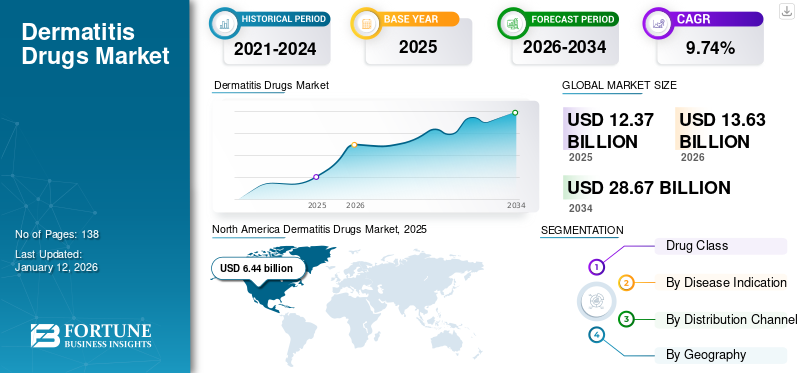
Global Dermatitis Drugs Market Overview
Market Size:
- 2025 Value: USD 12.37 billion
- 2026 Estimate: USD 13.63 billion
- 2034 Forecast: USD 28.67 billion
- CAGR (2026–2034): 9.74%
Market Share:
- Regional Leader: North America led the global market with a 52.06% share in 2025, driven by strong drug distribution networks and high prevalence of atopic dermatitis in the U.S. and Canada.
- Fastest-Growing Region: Asia Pacific is anticipated to grow at the highest CAGR, supported by rising drug approvals, government initiatives, and growing diagnosis-treatment gaps.
- Top Drug Class: Corticosteroids held the highest value share in 2024, continuing as the first-line therapy in many countries.
Industry Trends
- Rise of Biologics and Monoclonal Antibodies: Products like Dupixent (dupilumab) have revolutionized the treatment landscape, driving significant market momentum.
- Shifting Preferences to Non-Steroidal Treatments: Developed nations are seeing a preference shift toward non-steroid, targeted therapies, including PDE4 inhibitors and calcineurin inhibitors.
- Digital Health & Online Pharmacies: Growth in pharmaceutical e-commerce is fueling the rise of online pharmacy channels, especially in urban regions.
- Increasing Pediatric Focus: With ~20% of children affected by atopic dermatitis globally, pediatric formulations and treatments are gaining R&D attention.
- Regulatory Greenlights: Accelerated FDA approvals and supportive regulatory environments are encouraging new entrants and pipeline expansions.
Driving Factors
- High Global Disease Burden: Atopic dermatitis alone impacts ~18 million adults in the U.S. and a significant global pediatric population, increasing demand for effective treatments.
- R&D Innovation: Active clinical trials and drug pipelines are leading to new molecule launches, especially in biologics.
- Brand Impact: Drugs like Dupixent (Regeneron/Sanofi) and Eucrisa (Anacor Pharmaceuticals) are setting new benchmarks in sales and clinical efficacy.
- Strategic Partnerships & M&A: Industry consolidation and strategic collaborations are fueling global expansion and innovation.
- Expanding Treatment Access in Asia Pacific: Increased focus on healthcare accessibility and government support in APAC are bridging diagnosis and treatment gaps.
Market Segmentation
Download Free sample to learn more about this report.
"Corticosteroids Dominated the Market in terms of Value Share in 2024"
Various drug classes in the management of dermatitis are corticosteroids, calcineurin Inhibitors, biologics, PDE4 inhibitors, and others. Corticosteroids accounted for highest market with a share of 39.57% in 2026, and is projected to continue to lead the dermatitis drugs market throughout the forecast period. Corticosteroids is termed as a first line of therapy in several countries for atopic dermatitis, which accounts for majority of the prevalent cases of dermatitis.
However, numerous researches being conducted by key pharmaceutical companies on biologics and PDE4 inhibitors and strong market sale of monoclonal antibodies such as dupilumab for the management of atopic dermatitis are key factors associated with the estimated expansion of biologics and PDE4 inhibitors with relatively higher CAGR by the end of 2032.
To know how our report can help streamline your business, Speak to Analyst
In terms of disease indication, the global dermatitis drugs market is segmented into atopic dermatitis, contact dermatitis, and others. Atopic dermatitis is anticipated to lead the market contributing 74.58% globally in 2026, owing to its rising prevalence across the globe.
Various distribution channels in global market are hospital pharmacy, retail pharmacy, and online pharmacy. The improved adoption for pharmaceutical e-commerce purchase is expected to propel the growth of online pharmacy segment contributing 41.62% globally in 2026. This factor will further enhance the global dermatitis drugs market revenue.
Regional Analysis
North America Dermatitis Drugs Market, 2025 (USD Billion)
To get more information on the regional analysis of this market, Download Free sample
"Green Signal by Regulatory Authorities for the Approval of Novel Therapies is Augmenting the Market Growth in Asia Pacific with Highest CAGR"
North America
In terms of revenue, North America accounted for USD 6.44 billion in 2025 and is estimated to remain dominant in the global dermatitis drugs market during the forecast period. Market strength is supported by the improved distribution of dermatitis drugs and the high prevalence of atopic dermatitis, particularly in United States and Canada. Strong reimbursement frameworks, early adoption of biologics and topical innovations, and high dermatology visit rates further sustain regional leadership. The U.S. market is valued at USD 7.07 billion by 2026.
Asia Pacific
Asia Pacific is projected to register a relatively significant CAGR during 2026–2034, driven by proactive government initiatives introducing innovative dermatitis therapies and a rising gap between diagnosed and treated cases across several countries. Expanding regulatory approvals, improving access to care, and a large untreated patient pool are expected to accelerate market growth.The Japan market is valued at USD 0.52 billion by 2026, the China market is valued at USD 0.75 billion by 2026, and the India market is valued at USD 0.74 billion by 2026.
Europe
Europe’s dermatitis drugs market growth is underpinned by high disease awareness and widespread adoption of advanced topical and systemic therapies, including biologics and JAK inhibitors. Supportive clinical guidelines and strong public healthcare systems enhance treatment uptake and adherence. The UK market is valued at USD 0.67 billion by 2026, while the Germany market is valued at USD 0.68 billion by 2026.
Latin America
Latin America currently represents a smaller share of the global market; however, growth is supported by improving diagnosis rates and greater access to dermatology treatments, including biosimilars. Public health programs and rising private-sector participation are gradually expanding patient access.
Middle East & Africa
The Middle East & Africa market holds a limited share but is expected to grow with increasing awareness of dermatitis and ongoing investments in healthcare infrastructure. Gradual expansion of specialty care and availability of advanced therapies are improving treatment penetration.
Key Market Drivers
"Regeneron Pharmaceuticals, Inc. and Anacor Pharmaceuticals, Inc. leading the global Dermatitis Drugs market"
The current vendor landscape of the global dermatitis drugs market is fragmented with numerous manufacturers actively involved in the production & marketing of generic drugs. Dupilumab, sold under the brand name Dupixent by Regeneron Pharmaceuticals and Sanofi has changed a face of dermatitis treatment with its rising acceptance and effective & potent action against the symptoms of dermatitis. The drug is interleukin-4 inhibitor that generated a revenue of around US$ 922 Mn by the end of 2024.
Eucrisa by Anacor Pharmaceuticals, Inc. is another key product in the dermatitis drugs industry that has shown a promising growth over last 3 years. The ongoing clinical trials on new molecules and green signal by USFDA for approval of dermatitis drugs in the U.S. are anticipated to propel the number of emerging players in the market by 2032. Some of the other prominent players operating in the global dermatitis drugs market are Valeant Pharmaceuticals, Astellas Pharma US, Inc., Pfizer, Inc., Mylan, Bayer AG, Allergan, LEO Pharma, and others.
Key companies covered in the report
- Valeant Pharmaceuticals
- Astellas Pharma US, Inc.
- Pfizer, Inc.
- Mylan
- Bayer AG
- Allergan
- LEO Pharma
- Regeneron Pharmaceuticals, Inc.
- Anacor Pharmaceuticals, Inc.
Report Coverage
Atopic Dermatitis is the most common form of dermatitis, affecting around 18 million adults in the U.S. every year. The dermatitis drugs market is expected to progress with a rapid pace in the forecast duration, owing to the introduction of effective therapies at a premium price structure, improved diagnosis of the disease, and rising incidence rate of atopic dermatitis. Although the first line of treatment is usually steroids administration in emerging nations, the patients and physicians are now preferring more specific non-steroid treatment for specific dermatitis type in the developed countries.
The report provides qualitative and quantitative insights on the dermatitis drugs industry and detailed analysis of dermatitis drugs market size and growth rate for all possible segments in the market. The market is segmented on the basis of drug class, disease indication and distribution channel. Based on drug class, the dermatitis market is categorized into corticosteroids, calcineurin Inhibitors, biologics, PDE4 inhibitors, and others.
On the basis of disease indication, the market is classified into atopic dermatitis, contact dermatitis, and others, while various distribution channels covered in the report are hospital pharmacy, retail pharmacy, and online pharmacy. Geographically, the dermatitis drugs market is segmented into four major regions, which are North America, Europe, Asia Pacific, and rest of world. The regions are further categorized into countries.
Along with this, the report provides elaborative analysis of the dermatitis drugs market dynamics and competitive landscape. Various key insights provided in the report are the prevalence of major dermatitis types by key countries, recent industry developments such as partnerships, mergers & acquisitions, pipeline analysis, patent landscape, reimbursement scenario by key countries, and regulatory scenario.
Request for Customization to gain extensive market insights.
SEGMENTATION
|
ATTRIBUTE |
DETAILS |
|
Study Period |
2021-2034 |
|
Base Year |
2025 |
|
Estimated Year |
2026 |
|
Forecast Period |
2026-2034 |
|
Historical Period |
2021-2024 |
|
Unit |
Value (USD Billion) |
|
Growth Rate |
CAGR of 9.74% from 2026 to 2034 |
|
Segmentation |
Drug Class
|
|
By Disease Indication
|
|
|
By Distribution Channel
|
|
|
By Geography
|
Frequently Asked Questions
Fortune Business Insights says that the Dermatitis Drugs Market was valued at USD 12.37 billion in 2025 and is projected to reach USD 28.67 billion by 2034.
In 2025, the Dermatitis Drugs Market was valued at USD 12.37 billion.
Growing at a CAGR of 10.6%, the Dermatitis Drugs Market will exhibit steady growth in the forecast period (2026-2034)
Corticosteroids segment is expected to be the leading segment in Dermatitis Drugs Market during the forecast period.
Significant prevalence of dermatitis is a key driving factor of the Dermatitis Drugs Market.
Regeneron Pharmaceuticals, Inc. and Anacor Pharmaceuticals, Inc. are the leading market players in Dermatitis Drugs Market.
North America is expected to hold the highest market share in the Dermatitis Drugs Market.
Increasing adoption of monoclonal antibodies in the treatment of dermatitis and rising number of drug approvals in Asia Pacific are few of the trends of Dermatitis Drugs Market.



- 2021-2034
- 2025
- 2021-2024
- 138













.webp)






Related Reports
-
US +1 833 909 2966 ( Toll Free )
-
Get In Touch With Us