Anaerobic Adhesives Market Size, Share & Industry Analysis, By Product Type (Threadlockers, Retaining Compound, Thread Sealants, Gasket Sealant, and Others), By End-Use Industry (Automotive, Industrial Machinery, Electrical & Electronics, Aerospace, and Others), and Regional Forecast, 2026-2034
 Download Free Sample
Anaerobic Adhesives Market Size and Future Outlook
 Listen to Audio Version
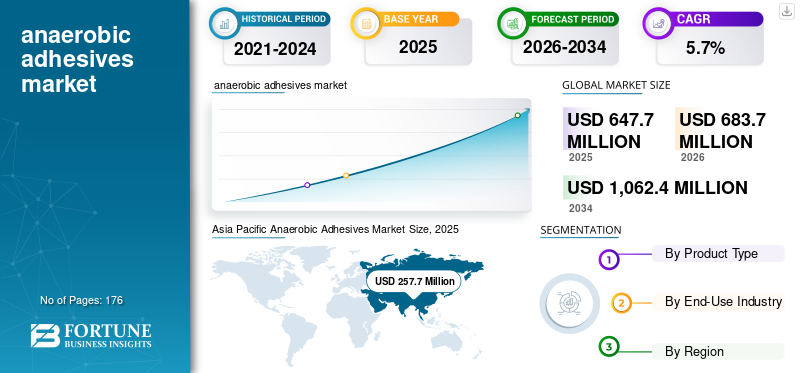
The global anaerobic adhesives market size was valued at USD 647.7 million in 2025 and is projected to grow from USD 683.7 million in 2026 to USD 1,062.4 million by 2034, exhibiting a CAGR of 5.7% during the forecast period. Asia Pacific dominated the anaerobic adhesives market with a market share of 39.79% in 2025.
Anaerobic adhesives are specialty bonding materials mainly used for thread locking, retaining, sealing, and gasketing in metal parts and assemblies. Their demand is closely linked to their use in automotive, industrial machinery, electronics, and repair work, where strong fastening, leak prevention, vibration resistance, and long service life are important. The market is supported by steady demand from manufacturing and maintenance across industries. Globally, the market growth remains moderate and application-based, as these adhesives are mainly chosen for critical uses that improve assembly reliability, reduce maintenance needs, and support durable performance rather than for high-volume consumption.
The market is dominated by a small group of established manufacturers with strong product portfolios, proven formulation technologies, and broad industrial reach. Major players such as Henkel Jebel Ali FZCO., 3M, Permabond, ITW LLC & Co. KG, and WEICON GmbH & Co. KG, and regional suppliers focus on product performance, application reliability, and technical service support, resulting in a moderately consolidated market characterized by steady demand, high customer retention, and controlled competition across key industrial and automotive applications.
Download Free sample to learn more about this report.
Anaerobic Adhesives Market KEY TAKEAWAYS
 Market Size & Forecast
- 2025 Market Size: USD 647.7 million
- 2026 Market Size: USD 683.7 million
- 2034 Forecast Market Size: USD 1,062.4 million
- CAGR: 5.7% from 2026–2034
 Market Share
- Asia Pacific dominated the anaerobic adhesives market with a 39.79% share in 2025.
- The thread sealants segment is projected to grow at a CAGR of 5.8% during the forecast period.
- The electrical & electronics segment is projected to grow at a CAGR of 6.4% during the forecast period.
 Key Regional Highlights
Asia Pacific
Asia Pacific USD 273.9 million in 2026. Strong automotive production and industrial manufacturing across China, India, Japan, and South Korea driving demand.
Europe
Europe USD 163.2 million in 2025. Strong automotive and industrial manufacturing with strict quality standards supporting steady adhesive consumption.
North America
North America USD 150.6 million in 2025. Mature industrial base with steady demand from automotive, machinery, and maintenance applications.
U.S.
U.S. USD 130.7 million in 2025. High demand from automotive manufacturing and industrial equipment maintenance applications.
Japan
Japan Strong automotive and electronics manufacturing base supporting steady anaerobic adhesive demand.
Read More

ANAEROBIC ADHESIVES MARKET TRENDS
Shift Toward Faster-Curing and Easy-to-Use Formulations is an Emerging Trend in the Market
A key trend in the market is the growing focus on faster-curing and easy-to-use formulations that improve convenience for industrial users. Manufacturers are increasingly seeking adhesive solutions that help reduce assembly time, support cleaner application, and improve handling during production and maintenance. This trend is becoming increasingly important in automotive, machinery, and repair applications, where efficiency and ease of use matter alongside product performance. From a business perspective, suppliers are giving more attention to formulation improvements to increase product appeal and meet changing customer expectations.
- According to the U.S. Bureau of Labor Statistics, manufacturing sector labor productivity increased by 4.5% in the first quarter of 2025, indicating a stronger focus on faster, more efficient production processes that support demand for easy-to-use formulations.
MARKET DYNAMICS
MARKET DRIVERS
Download Free sample to learn more about this report.
Rising Demand from Automotive and Industrial Assembly Supports Market Expansion
The demand in the market is mainly driven by its increasing use in automotive and industrial assembly applications, where secure locking, sealing, and retaining of metal parts are essential. These adhesives are widely used in engines, transmissions, pumps, gearboxes, and threaded components to prevent loosening, leakage, and vibration-related failure. As manufacturers continue to focus on product durability, assembly efficiency, and reduced maintenance needs, demand for anaerobic adhesives remains steady. Their ability to improve joint reliability and support long-term equipment performance creates a strong demand-side pull across key end-use industries.
- According to the U.S. Census Bureau, U.S. distributive trade sales and manufacturers’ shipments totaled USD 1,965.9 billion in December 2025, up by 3.2% from December 2024, supporting steady demand for industrial assembly materials such as anaerobic adhesives.
MARKET RESTRAINTS
Strong Dependence on Cyclical Industries Creates Product Demand Uncertainty
The anaerobic adhesives market growth is limited by its strong dependency on cyclical industries such as automotive, industrial equipment, and general manufacturing. When vehicle production slows, machinery investment declines, or factory activity weakens, demand for these adhesives can fall quickly. They are mainly used in the assembly and maintenance of metal parts, so their consumption is closely linked to overall industrial activity. Unlike some essential chemicals with more stable demand, anaerobic adhesives are more affected by changes in production levels, business confidence, and broader economic conditions in major end-use sectors.
- According to the U.S. Census Bureau, new orders for manufactured durable goods in January 2026 were down in three of the last four months and virtually unchanged at USD 321.2 billion, showing softer industrial activity that can limit demand in assembly applications.
MARKET OPPORTUNITIES
Rising Use of Lightweight and Precision Components Creates Growth Opportunities for the Market
The market is expected to see new growth opportunities as the use of lightweight, compact, and precision-engineered components in automotive, electronics, and industrial equipment increases. As product designs become more advanced, manufacturers need reliable locking, sealing, and retaining solutions that improve joint strength, prevent leakage, and reduce the risk of parts’ failure. This supports the use of these adhesives in such applications where accuracy, durability, and long-term performance are important. Their growing use in more specialized metal assembly applications can create additional demand beyond traditional industrial fastening uses.
- According to the U.S. Census Bureau’s Annual Capital Expenditures Survey, robotic equipment expenditures in the U.S. totaled up to USD 12.96 billion in 2022, showing rising investment in automation and precision manufacturing that can support future demand in the market.
MARKET CHALLENGES
Application Sensitivity and Proper Surface Preparation are Key Challenges for the Market Expansion
Anaerobic adhesives face an ongoing challenge because their performance depends heavily on proper application, thorough surface cleaning, and the use of close-fitting metal parts. If the gap is too wide, the surface is contaminated, or if the material is not suitable, bonding strength and curing performance can be reduced. This can create reliability issues in industrial applications where consistent assembly quality is important. As a result, users need careful product selection, proper handling, and controlled application conditions to achieve the required performance and ensure dependable results in critical uses.
- According to NIST, defects in discrete manufacturing cost an estimated USD 32.0 billion to USD 58.6 billion, highlighting the importance of correct application and process control in assembly materials.
Segmentation Analysis
By Product Type
Wide Usage in Securing Threaded Metal Fasteners Drives Dominance Of Threadlockers Segment
Based on product type, the market is segmented into threadlockers, retaining compounds, thread sealants, gasket sealants, and others.
The threadlockers segment accounted for a largest anaerobic adhesives market share in 2025 as they are widely used to secure threaded metal fasteners in automotive, industrial machinery, electronics, and maintenance applications where vibration resistance, leak prevention, and assembly reliability are important. Their use is functionally essential in preventing loosening and reducing equipment failure, especially in critical assemblies exposed to movement and stress. As industries continue to focus on durability, safety, and lower maintenance requirements, threadlockers remain the most established and structurally important product type in the market.
Thread sealants segment is expected to grow at a 5.8% CAGR over the forecast period.
To know how our report can help streamline your business, Speak to Analyst
By End-Use Industry
High Use in Critical Fastening Applications Positions Automotive as the Primary Demand Anchor
By end-use industry, the market is segmented into automotive, industrial machinery, electrical & electronics, aerospace, and others.
The automotive segment accounted for the largest share in 2025 as these adhesives are widely used for threadlocking, sealing, retaining, and gasketing in engines, transmissions, braking systems, and other metal assemblies where vibration resistance and reliability are essential. Vehicles contain numerous threaded and fitted components that require secure bonding to prevent long-term loosening, leakage, and part failure. As manufacturers continue to focus on durability, safety, and maintenance reduction, automotive remains the most stable and structurally important end-use industry in the market.
The electrical & electronics segment is expected to grow at a 6.4% CAGR over the forecast period.
Anaerobic Adhesives Market Regional Outlook
By geography, the market is categorized into North America, Europe, Asia Pacific, Latin America, and the Middle East & Africa.
Asia Pacific
Asia Pacific Anaerobic Adhesives Market Size, 2025 (USD Million)
To get more information on the regional analysis of this market, Download Free sample
Asia Pacific held the dominant position in 2025, valued at USD 257.7 million, and is expected to retain its leading position in 2026, reaching USD 273.9 million. The region’s leadership is driven by its large manufacturing base, strong automotive production, and high level of industrial activity across key economies such as China, Japan, India, and South Korea. Robust demand from automotive assembly, industrial machinery, electronics manufacturing, and maintenance applications supports sustained consumption of anaerobic adhesives, particularly in metal bonding and sealing uses where cost efficiency, reliability, and large-volume production are important.
China Anaerobic Adhesives Market
Based on Asia Pacific’s strong contribution and China’s large-scale manufacturing footprint, the China market is analytically reached USD 117.2 million in 2025, accounting for approximately 45.5% of global revenues. The demand is supported by the country’s extensive automotive production, a broad industrial machinery base, strong electronics manufacturing activity, and a well-established metalworking and assembly ecosystem. These factors create steady consumption across threadlocking, sealing, retaining, and gasketing applications where reliability, production efficiency, and cost-effective performance are important.
India Anaerobic Adhesives Market
The India market in 2025 was valued at around USD 44.1 million. Growth is supported by rising automotive production, expanding demand for industrial machinery, increasing electrical and electronics manufacturing, and gradual improvements in domestic assembly, repair, and maintenance across industrial and commercial end-use sectors.
North America
North America remains a significant regional market, was valued at USD 150.6 million in 2025. Demand is supported by automotive, industrial machinery, electrical equipment, and maintenance applications. The region benefits from well-established manufacturing capabilities, strong aftermarket demand, and steady use of high-performance assembly materials across key industries. However, growth remains moderate due to market maturity, stable replacement demand, and limited scope for rapid volume expansion.
U.S. Anaerobic Adhesives Market
The U.S. market in 2025 was valued at USD 130.7 million, representing approximately 86.8% of global revenues. Consumption is driven by strong demand from automotive manufacturing, industrial machinery, electrical equipment, and maintenance applications requiring reliable threadlocking, sealing, retaining, and gasketing solutions for durable metal assemblies.
Europe
Europe is projected to record modest growth over the forecast period, reaching a valuation of USD 163.2 million by 2025. Strict quality standards, high production costs, and a strong focus on reliable assembly processes shape the region’s growth. Despite these constraints, steady demand from automotive components, industrial machinery, electrical equipment, and maintenance applications continues to support the consumption across major manufacturing industries in the region.
Germany Anaerobic Adhesives Market
Germany’s market reached a valuation of approximately USD 60.2 million by 2025, equivalent to around 36.9% of the global market. Demand is supported by strong automotive production, advanced industrial manufacturing, and widespread product use in reliable metal assembly and sealing applications.
U.K. Anaerobic Adhesives Market
The U.K. market in 2025 reached a valuation of 24.5 million, accounting for roughly 15.0% of global revenues. Consumption is concentrated in automotive maintenance, industrial machinery, electrical equipment, and selected metal-assembly applications, where these adhesives are used for threadlocking, sealing, retaining, and gasketing.
Latin America and the Middle East & Africa
The Latin America and Middle East & Africa regions are expected to witness moderate growth during the forecast period. The Latin America market reached a valuation of USD 44.2 million in 2025, supported by rising automotive production, expanding industrial activity, and increasing use of adhesives in machinery repair, equipment maintenance, and metal assembly applications. In the Middle East & Africa, demand is driven by industrial maintenance needs, equipment assembly, oilfield and mechanical applications, and gradual expansion of manufacturing capabilities across key countries. The MEA market reached a valuation of USD 32.0 million in 2025, supported by growing industrial and commercial activity.
GCC Anaerobic Adhesives Market
The GCC market accounted for around USD 15.3 million in 2025, representing approximately 47.7% of regional revenues. Demand is supported by industrial maintenance needs, infrastructure development, expanding equipment use, and the region’s growing role in manufacturing, assembly, and downstream industrial distribution activities.
COMPETITIVE LANDSCAPE
Key Industry Players
High Capital Intensity and Strategic Asset Management are Shaping the Competition in the Market
The anaerobic adhesives market is shaped by a relatively small group of established manufacturers competing through formulation expertise, product reliability, and technical support. Competition depends on consistent performance, application-focused solutions, and strong customer relationships across automotive, machinery, electronics, and maintenance applications.
Leading players such as Henkel Jebel Ali FZCO., 3M, Permabond, ITW LLC & Co. KG, and WEICON GmbH & Co. KG, as well as other specialized suppliers, focus primarily on application-focused innovation, technical support, and long-term customer engagement rather than relying on aggressive volume-based competition. Recent activities across these companies highlight a strategic emphasis on application reliability, product innovation, and gradual development of more user-friendly formulations to support long-term market positioning.
LIST OF KEY ANAEROBIC ADHESIVE COMPANIES PROFILED
- Henkel Jebel Ali FZCO. (Germany)
- 3M (U.S.)
- Anabond (India)
- Permabond (U.K.)
- Loxeal S.r.l. (Italy)
- Parson Adhesives, Inc. (U.S.)
- ITW LLC & Co. KG (Germany)
- WEICON GmbH & Co. KG (Germany)
- B. Fuller Company (U.S.)
- THREEBOND INTERNATIONAL, INC (U.S.)
REPORT COVERAGE
The global anaerobic adhesives market analysis provides an in-depth study of market size & forecast by all the market segments included in the report. It includes details on market dynamics and trends expected to drive the market during the forecast period. It offers information on technological advancements, new product launches, key industry developments, and partnerships, mergers & acquisitions. The market research report also includes a detailed competitive landscape, including market share and profiles of key players.
Request for Customization to gain extensive market insights.
Report Scope & Segmentation
| ATTRIBUTE | DETAILS |
| Study Period | 2021-2034 |
| Base Year | 2025 |
| Estimated Year | 2026 |
| Forecast Period | 2026-2034 |
| Historical Period | 2021-2024 |
| Growth Rate | CAGR of 5.7% from 2026-2034 |
| Unit | Value (USD Million), Volume (Kiloton) |
| Segmentation | By Product Type, End-Use Industry, and Region |
| By Product Type |
|
| By End-Use Industry |
|
| By Region |
|
Frequently Asked Questions
Fortune Business Insights says that the global market size was valued at USD 647.7 million in 2025 and is projected to reach USD 1,062.4 million by 2034.
Recording a CAGR of 5.7%, the market is slated to exhibit steady growth during the forecast period.
The automotive segment led in 2025.
Asia Pacific held the highest market share in 2025.
The growing use in automotive and machinery assembly is driving market growth.



- 2021-2034
- 2025
- 2021-2024
- 176
Get 30-60 hrs Free Customization
Expand Regional and Country Coverage, Segments Analysis, Company Profiles, Competitive Benchmarking, and End-user Insights.


















Related Reports
-
US +1 833 909 2966 ( Toll Free )
-
Get In Touch With Us