Antifreeze Market Size, Share & Industry Analysis, By Product (Ethylene Glycol, Propylene Glycol & Glycerin), By Application and Regional Forecast, 2026-2034
 Download Free Sample

Antifreeze Market Overview
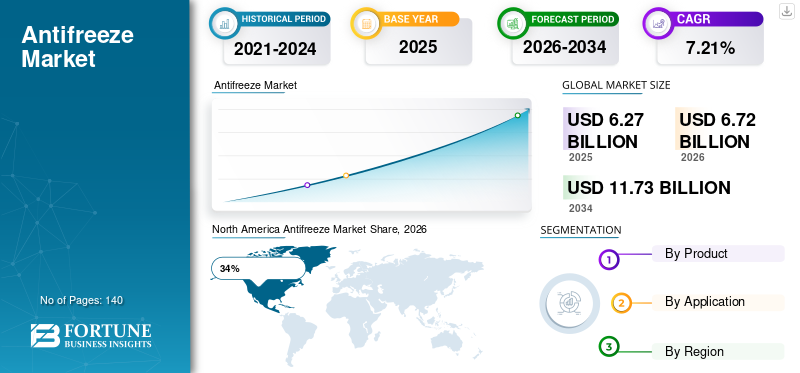
The antifreeze market size was valued at USD 6.27 Billion in 2025. The market is projected to grow from USD 6.72 Billion in 2026 to USD 11.73 Billion by 2034, exhibiting a CAGR of 7.21% during the forecast period.

The antifreeze market plays a critical role in the global automotive, industrial, marine, and heavy-equipment sectors by ensuring temperature regulation and corrosion protection in cooling systems. Antifreeze formulations are primarily based on glycol compounds and are designed to prevent freezing in low temperatures and overheating in high-temperature operating environments. Growing vehicle ownership, expanding transportation fleets, and increasing industrial activity continue to support demand for advanced coolant technologies. Manufacturers are focusing on long-life antifreeze solutions, environmentally friendly formulations, and improved thermal performance products. The antifreeze market report highlights increasing adoption across passenger vehicles, commercial vehicles, power generation systems, and industrial machinery, strengthening long-term market demand worldwide.
Download Free sample to learn more about this report.
USA Antifreeze Market Overview
The United States remains one of the largest consumers of antifreeze products due to its extensive automotive fleet, large logistics industry, and significant industrial infrastructure. Seasonal temperature variations across northern and central states create consistent demand for high-performance antifreeze solutions. The presence of a mature automotive aftermarket, widespread vehicle maintenance practices, and strong commercial transportation activity support market expansion. Electric vehicle manufacturers are also adopting specialized thermal management fluids, creating additional opportunities for suppliers. The USA antifreeze market Analysis indicates strong demand for extended-life coolants, low-toxicity formulations, and advanced heat-transfer fluids used in passenger cars, trucks, construction equipment, agricultural machinery, and industrial cooling applications.
Antifreeze Market Key Takeaways
 Global Market Size & Forecast
- 2025 Market Size: USD 6.27 Billion
- 2026 Market Size: USD 6.72 Billion
- 2034 Forecast Market Size: USD 11.73 Billion
- CAGR: 7.21% from 2026-2034
 Market Share
- The market in North America dominated with a revenue share of 34% in 2025.
- Ethylene glycol dominated by product with a market share of approximately 62%
- Automotive applications dominated with a market share of approximately 71%.
 Key Regional Highlights
North America
North America led the market with a 34% share, supported by strong automotive production and demand for engine cooling solutions.
Asia-Pacific
Asia-Pacific accounted for 30% of the market, driven by expanding vehicle production, growing automotive fleets, and industrial development.
Europe
Europe held a 27% share, supported by established automotive industries and increasing demand for advanced coolant technologies.
U.S
The U.S. remains a key market, supported by a large vehicle fleet and strong demand for automotive cooling and thermal management solutions.
Japan
Japan accounted for approximately 22% of the Asia-Pacific market, supported by its established automotive manufacturing industry and demand for advanced coolant technologies.
Read More

Antifreeze Market Latest Trends
The antifreeze market trends indicate a growing shift toward long-life coolant formulations capable of extending replacement intervals and reducing maintenance costs. Automotive manufacturers increasingly recommend organic acid technology coolants due to superior corrosion protection and enhanced durability. These products are becoming standard in new-generation passenger vehicles and commercial fleets.
Download Free sample to learn more about this report.
Another important trend is the development of environmentally responsible antifreeze solutions. Propylene glycol-based products are gaining acceptance because of their lower toxicity compared with traditional ethylene glycol formulations. Manufacturers are also investing in recyclable coolant technologies and sustainable production methods to align with environmental regulations.
The rise of electric mobility is influencing product innovation. Battery electric vehicles require advanced thermal management systems to maintain battery performance and safety. As a result, coolant suppliers are introducing specialized antifreeze products designed specifically for electric drivetrains and battery cooling systems.
Digital fleet management and predictive maintenance programs are also supporting demand for premium coolant solutions. Fleet operators increasingly prioritize products that offer longer service life, improved engine protection, and reduced downtime. These developments continue to shape the antifreeze market research report and contribute to changing customer preferences across multiple industries.
Antifreeze Market Dynamics
Driver
Rising Demand for Automotive and Industrial Cooling Systems
The increasing global vehicle population remains the primary growth driver for the antifreeze market. Passenger vehicles, commercial trucks, agricultural equipment, and construction machinery all require efficient cooling systems to maintain operating temperatures and prevent engine damage. As transportation networks continue expanding, demand for reliable antifreeze products rises accordingly.
Industrial applications also contribute significantly to market growth. Manufacturing facilities, power plants, compressors, and process cooling systems utilize antifreeze fluids to ensure uninterrupted operations under varying temperature conditions. Growing industrialization in developing economies has increased installation of cooling systems requiring specialized antifreeze formulations.
In addition, advancements in engine technology have created greater demand for premium coolants capable of providing enhanced corrosion resistance and heat-transfer performance. Vehicle manufacturers increasingly specify advanced antifreeze products to improve fuel efficiency and component longevity. These factors collectively strengthen antifreeze market Growth and support ongoing expansion across automotive and industrial sectors.
Restraint
Environmental Concerns Associated with Glycol-Based Products
Environmental regulations regarding chemical disposal and coolant management represent a major restraint for the antifreeze market. Traditional ethylene glycol formulations can pose environmental risks if improperly handled or disposed of, leading regulatory authorities to implement stricter standards governing production, transportation, and recycling.
Compliance requirements increase operational costs for manufacturers and distributors. Companies must invest in sustainable manufacturing practices, waste management systems, and product reformulation efforts to meet evolving environmental expectations. These additional expenditures can impact profitability and pricing strategies.
Consumer awareness regarding environmental sustainability has also increased scrutiny of chemical products used in automotive and industrial applications. End users are increasingly seeking eco-friendly alternatives, forcing manufacturers to accelerate innovation while maintaining performance standards. Such pressures create challenges for market participants attempting to balance regulatory compliance, environmental responsibility, and competitive pricing.
Opportunity
Expansion of Electric Vehicle Thermal Management Systems
The rapid adoption of electric vehicles presents a significant opportunity for the antifreeze market. Unlike conventional engines, electric vehicles rely heavily on thermal management systems to regulate battery temperatures and ensure optimal operating performance. Specialized coolants are essential for maintaining battery efficiency and extending operational lifespan.
Automotive manufacturers are investing heavily in advanced battery technologies and liquid-cooling systems. This transition is generating demand for next-generation antifreeze formulations with improved dielectric properties, thermal conductivity, and compatibility with electric powertrain components.
Beyond passenger vehicles, electric buses, delivery vans, and industrial equipment are increasingly incorporating sophisticated cooling architectures. Antifreeze suppliers capable of developing innovative thermal management fluids can capitalize on these emerging opportunities. The antifreeze market Outlook remains favorable as electrification continues transforming the global transportation industry.
Challenge
Volatility in Raw material Supply and Pricing
Raw material fluctuations represent one of the most significant challenges facing the antifreeze industry analysis. Key ingredients such as ethylene glycol, propylene glycol, additives, and corrosion inhibitors are influenced by petrochemical market conditions and supply-chain disruptions.
Changes in feedstock availability can create pricing uncertainty for manufacturers. Rising production costs often affect profitability and may lead to increased product prices, influencing purchasing decisions among fleet operators and industrial customers.
Global supply chain disruptions have further highlighted vulnerabilities in sourcing critical chemical inputs. Transportation delays, geopolitical tensions, and manufacturing interruptions can affect product availability and inventory management. Companies must therefore develop resilient procurement strategies while maintaining consistent product quality and competitive pricing in an increasingly complex marketplace.
Antifreeze Market Segmentation
By Product
Ethylene glycol remains the dominant segment of the antifreeze market, accounting for approximately 62% market share. Its superior heat-transfer capabilities, freeze protection performance, and cost-effectiveness make it the preferred choice across automotive and industrial applications. Passenger vehicles, heavy-duty trucks, agricultural machinery, and industrial equipment extensively utilize ethylene glycol-based coolants.
The segment benefits from widespread availability and established manufacturing infrastructure. Long-life ethylene glycol formulations incorporating advanced corrosion inhibitors continue gaining popularity among fleet operators seeking reduced maintenance requirements. Despite environmental concerns, the segment maintains strong demand because of its proven performance and compatibility with existing cooling systems. antifreeze market share analysis consistently identifies ethylene glycol as the leading product category due to its broad application base and established customer acceptance.
Propylene glycol represents approximately 28% of the antifreeze market. Growing emphasis on environmental safety and reduced toxicity has increased adoption of propylene glycol-based formulations in applications where environmental exposure risks are higher. Food processing facilities, recreational vehicles, marine systems, and environmentally sensitive industrial operations frequently utilize these products.
Manufacturers continue enhancing performance characteristics to narrow the gap between propylene glycol and traditional ethylene glycol formulations. Regulatory support for environmentally friendly chemicals further strengthens market prospects. Increasing sustainability initiatives across industrial sectors contribute to growing demand for propylene glycol-based antifreeze products. The antifreeze market Forecast indicates continued expansion of this segment as environmental considerations become increasingly important.
Glycerin-based antifreeze products account for approximately 10% market share. These formulations are attracting interest due to their renewable origins and lower environmental impact. Glycerin is often derived from biodiesel production processes, making it an attractive option for organizations pursuing sustainability objectives.
Although glycerin products currently represent a smaller portion of the market, technological improvements continue enhancing their thermal performance and operational reliability. Demand is increasing in specialty industrial applications and environmentally conscious markets. As sustainability initiatives expand globally, glycerin-based products may gain broader commercial acceptance and contribute to future antifreeze market opportunities.
To know how our report can help streamline your business, Speak to Analyst
By Application
The automotive segment dominates the antifreeze market with approximately 71% market share. Passenger vehicles, commercial trucks, buses, and specialty transportation equipment require antifreeze solutions for engine cooling, corrosion protection, and thermal management. Increasing vehicle production and expanding vehicle fleets continue supporting segment growth.
The emergence of hybrid and electric vehicles is driving innovation in coolant technology. Manufacturers are developing specialized formulations tailored to modern powertrain requirements. Extended service intervals and improved thermal efficiency remain key purchasing considerations among automotive customers. antifreeze market research report findings consistently identify automotive applications as the largest contributor to industry demand.
Antifreeze Market Regional Outlook
North America
North America Antifreeze Market Share, 2026 (%)
To get more information on the regional analysis of this market, Download Free sample
North America remains a leading regional market due to extensive vehicle ownership, advanced industrial infrastructure, and strong aftermarket demand. Harsh winter conditions across Canada and northern US states create sustained demand for high-performance antifreeze products. Commercial transportation, agriculture, mining, and construction industries further contribute to consumption levels. Manufacturers continue introducing extended-life coolants and environmentally responsible formulations to meet changing customer preferences. The region benefits from well-established distribution networks and strong maintenance practices. North America accounts for 34% of the global antifreeze market share.
Europe
Europe maintains a significant position within the antifreeze market owing to strict vehicle maintenance standards, strong automotive manufacturing activity, and advanced environmental regulations. Demand for premium coolants remains high across passenger vehicles, commercial fleets, and industrial equipment. Sustainable product development and recycling initiatives influence purchasing decisions throughout the region. Automotive innovation and increasing adoption of electric mobility continue creating opportunities for specialized thermal management fluids. Europe represents 27% of the global market share.
Germany Antifreeze Market
Germany serves as Europe's largest antifreeze market due to its extensive automotive manufacturing base and advanced engineering sector. The country hosts major vehicle production facilities and a substantial automotive supplier network that supports continuous demand for coolant technologies. Premium vehicle manufacturers prioritize advanced thermal management systems, creating opportunities for high-performance antifreeze products.
Industrial applications also contribute significantly to market demand. Manufacturing plants, energy facilities, and logistics operations require reliable cooling solutions for operational efficiency. Environmental regulations encourage adoption of sustainable coolant formulations and recycling practices. Germany accounts for 31% of Europe's antifreeze market, supported by technological innovation and strong industrial activity.
United Kingdom Antifreeze Market
The United Kingdom maintains a well-established antifreeze market supported by automotive servicing activities, commercial transportation networks, and industrial operations. Vehicle maintenance remains a significant driver, particularly during colder seasons when cooling system protection becomes essential.
Growing interest in electric mobility has encouraged demand for advanced thermal management fluids designed for battery cooling systems. Fleet operators increasingly prioritize long-life coolant products to reduce maintenance costs and improve operational efficiency. Environmental compliance requirements further support adoption of advanced formulations. The United Kingdom represents 19% of Europe's antifreeze market.
Asia-Pacific
Asia-Pacific represents the fastest-expanding regional market, driven by vehicle production, industrialization, infrastructure development, and rising transportation activity. Countries across the region continue expanding manufacturing capacity and vehicle ownership levels, generating significant demand for antifreeze products. The presence of major automotive manufacturing hubs strengthens regional consumption. Increasing investment in logistics, construction, and industrial facilities supports additional growth opportunities. Asia-Pacific accounts for 30% of the global market share.
Japan Antifreeze Market
Japan remains a technologically advanced market characterized by high-quality automotive manufacturing and sophisticated thermal management requirements. Vehicle producers emphasize durability, fuel efficiency, and reliability, driving demand for premium coolant solutions.
The country's focus on hybrid and electric vehicle technologies creates opportunities for specialized antifreeze formulations. Industrial machinery and manufacturing applications also contribute to steady demand. Product innovation remains a key competitive factor among suppliers. Japan accounts for 22% of the Asia-Pacific antifreeze market.
China Antifreeze Market
China represents the largest antifreeze market within Asia-Pacific due to extensive vehicle production, industrial expansion, and infrastructure development. Growing automotive ownership and increasing commercial transportation activity continue driving coolant consumption.
The country's electric vehicle industry creates significant demand for next-generation thermal management fluids. Manufacturing facilities, logistics operations, and construction projects further support market expansion. Domestic and international suppliers actively invest in production capacity and product innovation to address rising demand. China accounts for 45% of the Asia-Pacific antifreeze market.
Rest of World
The Rest of World region includes Latin America, the Middle East, and Africa, where demand is supported by transportation growth, mining activities, industrial development, and infrastructure projects. Commercial vehicle fleets and heavy equipment applications remain major consumption areas. Extreme operating conditions in many regions increase the importance of reliable cooling solutions.
Manufacturers are expanding distribution networks and strengthening local partnerships to improve market access. Economic development initiatives and industrial investment continue creating opportunities for market expansion. The Rest of World region accounts for 9% of the global antifreeze market share.
List of Top Antifreeze Companies
- Royal Dutch Shell
- CCI Corporation
- BASF SE
- Old World Industries Inc
- KMCO
- SONAX GmbH
- KOST USA, Inc
- Recochem Inc
- Amsoil
- MITAN
- PARAS Lubricants
- TOTAL
- Gulf Oil International
- PENTOSIN
- Millers Oils
Top Two Companies by Market Share
- Royal Dutch Shell – 12%
- BASF SE – 9%
Investment Analysis and Opportunities
Investment activity within the antifreeze market continues focusing on production expansion, sustainable chemistry, and advanced coolant technologies. Manufacturers are allocating capital toward research and development programs aimed at improving thermal performance, extending service intervals, and reducing environmental impact. Production facility modernization remains a priority as companies seek operational efficiency and product quality improvements.
Opportunities are particularly strong in electric vehicle thermal management, industrial cooling systems, and environmentally friendly formulations. Strategic partnerships between automotive manufacturers and coolant suppliers are becoming increasingly common. Emerging markets present additional investment potential due to rising vehicle ownership and industrialization. Companies capable of developing specialized solutions for next-generation mobility and industrial applications are expected to benefit from growing demand and changing customer requirements.
New Product Development
Product innovation remains a defining feature of the antifreeze market. Manufacturers are introducing long-life coolant technologies capable of delivering extended protection against corrosion, cavitation, and scale formation. New additive packages are improving compatibility with modern engine materials and enhancing thermal efficiency.
Significant development efforts are targeting electric vehicle applications. Advanced battery cooling fluids with enhanced dielectric properties are entering commercial markets. Sustainable formulations utilizing renewable feedstocks and biodegradable components are also gaining attention. Smart coolant monitoring technologies are emerging as an additional innovation area, allowing operators to track fluid condition and optimize maintenance schedules. These developments continue shaping future antifreeze market trends and competitive strategies.
Five Recent Developments (2023-2025)
- BASF expanded production capabilities for glycol-based cooling solutions to support growing automotive demand.
- Shell introduced advanced long-life coolant formulations designed for extended maintenance intervals.
- Recochem enhanced its coolant portfolio with products targeting electric vehicle thermal management systems.
- KOST USA expanded distribution operations across North America to strengthen aftermarket presence.
- Gulf Oil International launched new high-performance antifreeze products for commercial fleet applications.
Report Coverage
The antifreeze market report provides comprehensive analysis of product categories, application sectors, regional demand patterns, competitive positioning, and emerging technology developments. The report evaluates market drivers, restraints, opportunities, and challenges influencing industry performance. Detailed segmentation analysis covers ethylene glycol, propylene glycol, and glycerin-based products, along with automotive and industrial applications.
Request for Customization to gain extensive market insights.
Regional assessment includes North America, Europe, Asia-Pacific, and Rest of World markets, highlighting country-level developments and competitive dynamics. The study also examines investment trends, innovation activities, manufacturing strategies, supply-chain developments, and regulatory influences affecting market participants. antifreeze market insights presented in the report assist stakeholders in understanding industry developments, identifying growth opportunities, and supporting strategic decision-making across the value chain.
Frequently Asked Questions
Fortune Business Insights says that the global market value stood at USD 6.27 billion in 2025 and is projected to reach USD 11.73 billion by 2034.
The market is expected to exhibit a CAGR of 7.21% during the forecast period of 2026-2034.
Ethylene glycol led the product segment with approximately 62% market share, owing to its strong heat-transfer capabilities, freeze protection, cost-effectiveness, and broad use in automotive and industrial applications.
Key players include Royal Dutch Shell, CCI Corporation, BASF SE, Old World Industries Inc., KMCO, and SONAX GmbH.
Major trends include rising demand for long-life and environmentally responsible coolants and the development of specialized thermal-management fluids for electric vehicles. North America led with approximately 34% market share.


- 2021-2034
- 2025
- 2021-2024
- 140
-

(Offer valid till 15th Nov 2026)
Get 30-60 hrs Free Customization
Expand Regional and Country Coverage, Segments Analysis, Company Profiles, Competitive Benchmarking, and End-user Insights.










-
US +1 833 909 2966 ( Toll Free )
-
Get In Touch With Us