 Download Free Sample



Get a Quote
Receive a tailored pricing based on your needs.
- Choose license type
- Multiple user options
- Custom scope & coverage
- Fast turnaround
"Designing Growth Strategies is in our DNA"
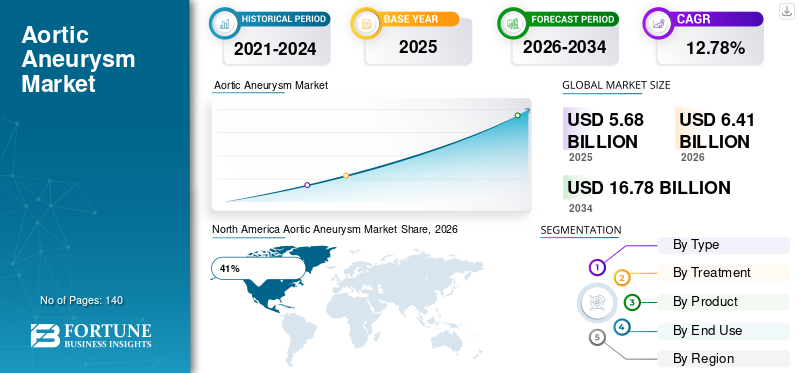
The global aortic aneurysm market size was valued at USD 5.68 billion in 2025. The market is projected to grow from USD 6.41 billion in 2026 to USD 16.78 billion by 2034, exhibiting a CAGR of 12.78% during the forecast period.

The aortic aneurysm market is expanding steadily due to the growing burden of cardiovascular disorders, rising elderly population, and increasing adoption of minimally invasive vascular procedures. The market is witnessing strong demand for advanced aortic stent grafts, endovascular aneurysm repair systems, and hybrid surgical technologies across hospitals and specialty cardiac centers. Increasing awareness regarding early diagnosis of thoracic and abdominal aneurysms is also improving treatment rates globally. The aortic aneurysm market Report highlights growing investments in imaging technologies, vascular screening programs, and patient-specific treatment planning. Technological advancements in graft durability, catheter navigation, and post-operative monitoring are further strengthening aortic aneurysm market Growth and creating long-term opportunities for manufacturers.
The USA aortic aneurysm market continues to dominate global demand because of high cardiovascular disease prevalence, strong reimbursement systems, and advanced vascular surgery infrastructure. Increasing screening initiatives for abdominal aortic aneurysm among older adults are supporting early diagnosis and timely intervention. Demand for minimally invasive aneurysm repair procedures has grown significantly in major healthcare institutions. The country also benefits from extensive clinical research activities and rapid adoption of next-generation endovascular devices. Aortic Aneurysm Industry Analysis indicates that the USA remains a major innovation hub for stent graft technologies, robotic-assisted vascular surgery, and AI-supported diagnostic imaging, strengthening the country’s leadership in the Aortic Aneurysm Industry Report landscape.
Download Free sample to learn more about this report.
 Global Market Size & Forecast
 Market Share
 Key Regional Highlights
North America
North America led the market with a 41% share.
Europe
Europe accounted for 29% of the global market.
Asia-Pacific
Asia-Pacific held a 22% market share.
U.S.
The U.S. is a major market supported by advanced cardiovascular care and aneurysm treatment infrastructure.
Japan
Japan accounted for 31% of the Asia-Pacific market, supported by advanced vascular treatment capabilities.
Read More

The aortic aneurysm market Trends are evolving rapidly with the transition from conventional open surgery toward minimally invasive endovascular aneurysm repair procedures. Hospitals and vascular specialists increasingly prefer endovascular approaches because of shorter recovery periods, lower procedural complications, and reduced hospitalization time. Manufacturers are focusing on low-profile delivery systems and flexible stent graft platforms to improve procedural success in complex anatomies. Advanced imaging integration during surgery is also becoming a standard trend across modern vascular centers. The aortic aneurysm market Research Report shows growing demand for customized graft solutions designed specifically for patient anatomy.
Download Free sample to learn more about this report.
Another important trend shaping the aortic aneurysm market Outlook is the integration of artificial intelligence and predictive analytics into aneurysm screening and treatment planning. Healthcare providers are using advanced imaging software for accurate aneurysm measurement and rupture-risk prediction. Remote patient monitoring and digital follow-up systems are becoming more common after aneurysm repair procedures. Companies are also investing in bioengineered graft materials with improved durability and reduced leakage risks. Increased partnerships between medical device companies and research institutes are accelerating innovation across thoracic and abdominal aneurysm therapies, contributing significantly to aortic aneurysm market Opportunities and long-term industry expansion.
Rising Prevalence of Cardiovascular Disorders and Aging Population
The increasing incidence of hypertension, atherosclerosis, obesity, and smoking-related vascular diseases is one of the strongest growth drivers for the aortic aneurysm market. Aging populations across developed and emerging economies are particularly vulnerable to thoracic and abdominal aortic aneurysms, creating substantial demand for early diagnosis and intervention. Healthcare systems are expanding screening programs for high-risk patients, especially older adults with cardiovascular complications. This trend is supporting the demand for advanced imaging technologies and minimally invasive repair procedures. The aortic aneurysm market Analysis indicates that improved awareness among physicians and patients regarding aneurysm rupture risks has accelerated treatment adoption.
In addition, technological improvements in endovascular repair systems are encouraging hospitals to expand aneurysm treatment capabilities. Patients increasingly prefer minimally invasive procedures because they involve shorter recovery times and lower post-operative complications. Government support for cardiovascular disease management programs and improved reimbursement policies are also strengthening market expansion. Continuous innovation in stent graft design and catheter-based technologies further contributes to aortic aneurysm market Growth globally.
High Procedural Costs and Limited Access In Developing Regions
One of the major restraints affecting the aortic aneurysm market is the high cost associated with advanced aneurysm repair procedures and premium stent graft systems. Endovascular aneurysm repair requires sophisticated imaging infrastructure, highly trained vascular specialists, and specialized operating facilities, making treatment expensive in many healthcare systems. In low-income and middle-income regions, limited healthcare budgets and inadequate reimbursement policies restrict access to advanced aneurysm therapies. This challenge reduces treatment penetration despite rising disease prevalence.
Another limiting factor is the shortage of skilled vascular surgeons and interventional radiologists in several developing countries. Rural healthcare facilities often lack advanced imaging equipment needed for accurate aneurysm diagnosis and surgical planning. Many patients remain undiagnosed until aneurysm rupture occurs, increasing mortality rates and reducing opportunities for planned intervention. Regulatory complexities and lengthy approval timelines for innovative graft systems can also delay product commercialization. These factors collectively slow down the pace of aortic aneurysm market Forecast expansion in underserved healthcare markets.
Expansion of Minimally Invasive and Personalized Vascular Therapies
The growing shift toward minimally invasive vascular interventions presents a major opportunity for the aortic aneurysm market. Healthcare providers are increasingly adopting endovascular aneurysm repair procedures because they reduce surgical trauma and improve patient outcomes. Companies investing in patient-specific graft systems and customized repair technologies are expected to gain a competitive advantage. Advanced 3D imaging and personalized procedural planning are enabling physicians to treat highly complex aneurysm anatomies with greater precision.
Emerging economies are also creating strong opportunities for the Aortic Aneurysm Industry Report due to rising healthcare expenditure and expansion of cardiac specialty centers. Increasing adoption of hybrid operating rooms and digital surgical navigation systems is improving access to advanced aneurysm treatment procedures. The market is further benefiting from rising research activities focused on bioresorbable materials, AI-driven diagnostics, and next-generation vascular implants. Collaborations between hospitals, academic institutions, and medical device manufacturers are accelerating innovation, strengthening aortic aneurysm market Insights and long-term business potential.
Post-Surgical Complications and Long-Term Monitoring Requirements
Despite technological advancements, post-operative complications remain a major challenge in the aortic aneurysm market. Patients undergoing aneurysm repair procedures often require long-term imaging surveillance to detect graft migration, endoleaks, or secondary aneurysm formation. These follow-up requirements increase healthcare costs and create additional burdens for both patients and healthcare systems. Concerns regarding device durability and late procedural complications continue to influence physician decision-making and treatment selection.
Another challenge is the complexity associated with treating aneurysms involving difficult anatomical structures. Some patients are not suitable candidates for standard endovascular repair procedures because of vessel shape, calcification, or aneurysm location. In such cases, open surgery or hybrid procedures become necessary, increasing procedural risk and hospitalization time. Regulatory compliance standards for vascular devices are also becoming more stringent, increasing research and manufacturing costs for companies. These factors continue to shape competitive dynamics within the aortic aneurysm market Research Report environment.
Thoracic Aortic Aneurysm accounts for nearly 42% of the global aortic aneurysm market Share due to the increasing incidence of hypertension-related thoracic vascular disorders and genetic connective tissue diseases. The segment is witnessing rising adoption of thoracic endovascular aneurysm repair procedures because of improved clinical outcomes and reduced recovery periods compared to open surgical repair. Healthcare providers are increasingly utilizing advanced imaging systems for early detection of thoracic aneurysms before rupture occurs. The demand for branched and fenestrated stent grafts has increased significantly in this segment because they allow physicians to manage complex thoracic anatomies more effectively.
The aortic aneurysm market Analysis for thoracic aneurysms also reflects strong investment in hybrid surgical technologies and robotic-assisted vascular procedures. Hospitals are prioritizing minimally invasive thoracic interventions to reduce intensive care stays and improve post-operative recovery. Growing clinical research related to connective tissue disorders and hereditary aneurysm syndromes is supporting innovation in graft durability and surgical precision. The segment is expected to maintain strong momentum because of increasing physician awareness regarding thoracic aneurysm screening among high-risk cardiovascular patients.
Abdominal Aortic Aneurysm represents approximately 58% of the global aortic aneurysm market Share owing to the higher prevalence of abdominal aneurysms among elderly smokers and patients with cardiovascular disease history. Screening programs targeting adults above sixty-five years of age have significantly improved diagnosis rates in developed healthcare systems. Endovascular aneurysm repair procedures are increasingly replacing open surgery for abdominal aneurysm treatment because of reduced surgical trauma and shorter hospitalization periods. This transition is supporting strong demand for advanced abdominal stent graft systems.
Manufacturers are focusing on developing flexible graft technologies that improve compatibility with varying abdominal anatomies. The aortic aneurysm market Research Report indicates growing adoption of low-profile delivery systems that simplify procedural access and reduce complications. Hospitals are also integrating AI-assisted imaging platforms to improve aneurysm sizing accuracy and surgical planning efficiency. Increasing awareness campaigns regarding aneurysm rupture prevention are contributing to long-term segment expansion. Rising healthcare investments in emerging economies are expected to further increase abdominal aneurysm treatment accessibility in the coming years.
To know how our report can help streamline your business, Speak to Analyst
Open Surgical Repair continues to hold nearly 36% of the aortic aneurysm market Share because it remains an essential treatment option for patients with highly complex aneurysm anatomy or unsuitable vascular access for endovascular procedures. This surgical method is often preferred in cases involving extensive aneurysm rupture risk or severe calcification where minimally invasive interventions may not provide long-term stability. Major cardiac hospitals continue investing in advanced surgical infrastructure and specialized vascular operating units to support open repair procedures.
The Aortic Aneurysm Industry Analysis highlights ongoing improvements in surgical techniques, anesthesia management, and intensive post-operative care, which are reducing mortality risks associated with open aneurysm repair. Surgeons are increasingly using hybrid operating environments that combine imaging guidance with traditional vascular surgery. Although minimally invasive therapies are gaining popularity, open repair remains clinically significant for younger patients requiring durable long-term treatment outcomes. Continuous physician training and rising investments in cardiovascular surgery programs are maintaining demand for this segment.
Hybrid procedures account for nearly 24% of the aortic aneurysm market Share and are gaining popularity due to their ability to manage anatomically challenging aneurysms using a combination of surgical and endovascular approaches. These procedures are particularly valuable for patients with complex thoracoabdominal aneurysms where conventional treatment methods may not be sufficient. Hybrid techniques reduce procedural invasiveness while maintaining treatment precision, making them increasingly attractive in advanced vascular centers.
The aortic aneurysm market Outlook for hybrid procedures is supported by technological advancements in intraoperative imaging and surgical navigation systems. Healthcare institutions are investing in hybrid operating rooms equipped with integrated fluoroscopy and digital imaging technologies to improve procedural accuracy. Physicians are also increasingly adopting personalized treatment planning methods for complex aneurysm repair. Growing demand for reduced recovery times and improved surgical outcomes continues to strengthen this segment within the broader Aortic Aneurysm Industry Report landscape.
Aortic Stent Grafts dominate the product category with nearly 68% market share because they are the foundation of most endovascular aneurysm repair procedures. Demand for thoracic and abdominal stent graft systems has increased significantly due to rising physician preference for minimally invasive vascular interventions. Manufacturers are continuously improving graft flexibility, sealing capability, and long-term durability to minimize endoleaks and procedural complications. Advanced delivery systems are also improving access to difficult vascular anatomies.
The aortic aneurysm market Trends indicate strong innovation activity related to branched grafts, fenestrated designs, and patient-specific implants. Companies are investing heavily in research to develop low-profile stent systems compatible with smaller access vessels. Integration of bioengineered materials and anti-thrombotic coatings is further improving clinical outcomes. Increasing adoption of endovascular therapies across emerging healthcare systems is expected to maintain strong demand for advanced aortic stent graft technologies.
Hospitals and specialty cardiac centers represent nearly 72% of the aortic aneurysm market Share because they perform the majority of aneurysm diagnosis, intervention, and post-operative monitoring procedures. Large healthcare institutions possess advanced imaging systems, hybrid operating rooms, and experienced vascular specialists required for complex aneurysm treatment. Increasing patient preference for specialized cardiovascular centers is also contributing to segment expansion.
The aortic aneurysm market Forecast indicates rising investment in ambulatory vascular care centers and minimally invasive surgical facilities. Outpatient aneurysm repair procedures are becoming more common for selected patient groups, especially in developed healthcare systems. Academic medical centers are also driving innovation through clinical research, physician training, and advanced procedural trials. Growing healthcare infrastructure development in emerging economies is expected to expand the availability of aneurysm treatment services across multiple end-use environments.
North America Aortic Aneurysm Market Share, 2025 (%)
To get more information on the regional analysis of this market, Download Free sample
North America accounts for approximately 41% of the global aortic aneurysm market Share due to the presence of advanced cardiovascular treatment infrastructure, high awareness regarding aneurysm screening, and strong adoption of minimally invasive vascular procedures. The region benefits from a large elderly population and increasing prevalence of hypertension, obesity, and smoking-related vascular diseases. Hospitals across the United States and Canada are extensively adopting endovascular aneurysm repair technologies because they reduce hospitalization periods and improve recovery outcomes. Continuous investments in hybrid operating rooms and AI-assisted imaging systems are further strengthening regional market expansion.
The aortic aneurysm market Research Report highlights strong clinical research activity and rapid commercialization of innovative graft technologies across North America. Regulatory approvals for next-generation thoracic and abdominal stent graft systems continue to support product adoption. Academic medical institutions are actively involved in vascular research programs focused on aneurysm rupture prediction and personalized treatment planning. Rising healthcare expenditure and favorable reimbursement structures remain critical growth drivers across the regional market.
Europe holds nearly 29% of the global aortic aneurysm market Share supported by established healthcare systems, growing cardiovascular screening programs, and increasing adoption of minimally invasive vascular procedures. Countries across Western Europe are expanding public health initiatives focused on early aneurysm detection among aging populations. The region also demonstrates strong demand for technologically advanced stent graft systems and hybrid vascular surgery techniques. Hospitals are increasingly integrating digital imaging solutions and robotic-assisted surgical technologies into aneurysm treatment pathways.
The Aortic Aneurysm Industry Analysis indicates that Europe remains a major center for vascular research and device innovation. Collaborative partnerships between healthcare institutions and medical device manufacturers are accelerating the development of advanced endovascular repair technologies. Increasing physician awareness regarding complex aneurysm management and favorable patient outcomes from minimally invasive procedures continue to support regional market growth. Expansion of specialized vascular centers across Southern and Eastern Europe is also contributing to increased treatment accessibility.
Germany represents nearly 26% of the European aortic aneurysm market Share because of its advanced cardiovascular healthcare infrastructure and strong adoption of minimally invasive vascular procedures. The country has a well-established network of specialized cardiac hospitals and vascular surgery centers equipped with modern imaging technologies and hybrid operating rooms. Growing prevalence of hypertension and smoking-related vascular diseases among older adults is supporting demand for thoracic and abdominal aneurysm repair procedures. Healthcare providers in Germany are increasingly utilizing AI-assisted diagnostic systems for precise aneurysm evaluation and procedural planning.
The German aortic aneurysm market Outlook is further strengthened by ongoing investments in medical research and advanced stent graft technologies. Domestic and international manufacturers actively collaborate with hospitals and research institutions to conduct clinical studies related to graft durability and post-operative monitoring. The country also benefits from favorable reimbursement systems for minimally invasive aneurysm repair procedures. Rising physician preference for customized graft solutions and advanced endovascular devices continues to expand Germany’s role in the European vascular treatment industry.
The United Kingdom accounts for around 19% of the European aortic aneurysm market Share driven by strong public healthcare screening initiatives and growing awareness regarding aneurysm rupture prevention. National screening programs targeting older men have improved early diagnosis rates for abdominal aortic aneurysms across the country. Hospitals are increasingly shifting toward minimally invasive endovascular aneurysm repair procedures to reduce patient recovery times and improve surgical outcomes. The growing use of advanced imaging technologies is also improving treatment precision in major healthcare institutions.
The Aortic Aneurysm Industry Report for the United Kingdom highlights rising investment in vascular research and clinical training programs. Healthcare providers are expanding access to hybrid operating environments and digital surgical navigation systems. Demand for low-profile stent graft technologies is increasing as physicians manage more complex aneurysm anatomies. The country’s focus on evidence-based cardiovascular treatment strategies and post-operative monitoring programs continues to support stable market development across public and private healthcare sectors.
Asia-Pacific captures approximately 22% of the global aortic aneurysm market Share due to rapidly improving healthcare infrastructure and increasing prevalence of cardiovascular diseases. Countries across the region are investing heavily in cardiac specialty hospitals, advanced diagnostic imaging systems, and minimally invasive surgical capabilities. Rising urbanization, aging populations, and lifestyle-related vascular disorders are contributing significantly to aneurysm incidence. Demand for endovascular aneurysm repair procedures is growing rapidly in metropolitan healthcare centers because of increasing patient awareness and physician adoption.
The aortic aneurysm market Trends within Asia-Pacific indicate strong potential for long-term expansion driven by healthcare modernization and rising medical tourism activities. Governments are supporting investments in advanced cardiovascular treatment programs and specialist physician training. International medical device manufacturers are expanding regional distribution networks and local manufacturing capabilities to meet growing demand for affordable stent graft systems. Increased access to vascular screening and diagnostic imaging technologies is expected to further strengthen regional market penetration.
Japan represents approximately 31% of the Asia-Pacific aortic aneurysm market Share because of its large elderly population and sophisticated cardiovascular healthcare system. The country has one of the highest rates of age-related vascular disorders, increasing demand for thoracic and abdominal aneurysm interventions. Hospitals in Japan are highly advanced in robotic-assisted vascular surgery, hybrid procedures, and precision imaging technologies. Endovascular aneurysm repair has become widely adopted due to its effectiveness in reducing recovery time for elderly patients.
The aortic aneurysm market Analysis for Japan highlights strong research activity related to graft biocompatibility and minimally invasive treatment innovation. Domestic healthcare providers emphasize long-term patient monitoring and preventive cardiovascular care. Increasing investments in AI-driven imaging and surgical planning software are improving procedural accuracy across major hospitals. The country’s strong focus on technological advancement and specialized vascular care continues to position Japan as a leading market within the Asia-Pacific region.
China accounts for nearly 37% of the Asia-Pacific aortic aneurysm market Share due to rapid healthcare infrastructure development and the growing burden of cardiovascular diseases. Urban hospitals are increasingly adopting advanced endovascular aneurysm repair technologies as patient awareness regarding minimally invasive treatment options rises. The expansion of cardiac specialty centers and improved access to diagnostic imaging are supporting higher aneurysm detection rates across the country. Government healthcare reforms are also improving access to vascular treatment services in several provinces.
The China aortic aneurysm market Outlook is supported by strong domestic manufacturing capabilities and increasing investment in medical technology innovation. Local companies are focusing on affordable stent graft production to meet growing clinical demand. Partnerships between hospitals and medical device manufacturers are accelerating research related to customized aneurysm repair systems and digital surgical planning. Rising healthcare expenditure and expansion of insurance coverage continue to strengthen the country’s role in the global Aortic Aneurysm Industry Analysis landscape.
The Rest of World region holds nearly 8% of the global aortic aneurysm market Share, supported by gradual improvements in cardiovascular healthcare infrastructure and rising awareness regarding aneurysm diagnosis. Countries in Latin America, the Middle East, and Africa are increasingly investing in advanced medical imaging systems and specialized vascular surgery facilities. Growing urbanization and rising incidence of hypertension and smoking-related diseases are contributing to increasing aneurysm cases across these regions. Demand for minimally invasive aneurysm repair procedures is slowly expanding in major metropolitan hospitals.
The aortic aneurysm market Opportunities within the Rest of World region are strongly linked to healthcare modernization initiatives and international medical collaborations. Governments and private healthcare providers are investing in physician training programs and advanced surgical technologies to improve cardiovascular treatment capabilities. International manufacturers are also expanding distribution partnerships to improve access to affordable stent graft systems. Although market penetration remains lower than in developed regions, long-term growth potential continues to increase steadily.
The aortic aneurysm market is attracting strong investment activity due to increasing demand for minimally invasive vascular procedures and advanced aneurysm management technologies. Medical device manufacturers are investing heavily in research and development focused on low-profile stent graft systems, branched endovascular devices, and personalized vascular implants. Venture capital funding and strategic partnerships between healthcare institutions and technology companies are accelerating innovation in AI-assisted aneurysm diagnosis and digital surgical planning. Investments in hybrid operating rooms and robotic-assisted vascular surgery infrastructure are also increasing globally.
Emerging markets present significant aortic aneurysm market Opportunities because healthcare providers are modernizing cardiovascular treatment capabilities and expanding access to advanced imaging systems. Companies are increasingly establishing regional manufacturing facilities to improve affordability and strengthen supply chain efficiency. Demand for customized graft systems and long-term post-operative monitoring technologies is creating additional commercial opportunities. Growing physician training programs and expansion of specialty vascular centers are expected to further increase adoption of advanced aneurysm repair solutions across both developed and emerging economies.
Innovation within the aortic aneurysm market is increasingly focused on advanced endovascular technologies designed to improve procedural safety and long-term clinical outcomes. Manufacturers are developing branched and fenestrated stent graft systems capable of treating highly complex aneurysm anatomies with greater precision. Low-profile delivery systems are becoming more common because they reduce vascular access complications and simplify minimally invasive procedures. Companies are also integrating bioengineered graft materials that enhance durability and reduce the risk of endoleaks after aneurysm repair.
The aortic aneurysm market Research Report also highlights growing innovation in imaging-guided surgical navigation and AI-powered aneurysm assessment tools. Several companies are investing in patient-specific graft modeling technologies using 3D imaging and digital simulation platforms. Remote patient monitoring systems are being developed to improve long-term follow-up care after endovascular repair procedures. Hybrid surgical technologies combining traditional vascular surgery with advanced catheter-based interventions are also gaining momentum. These developments continue to strengthen product differentiation and competitive positioning within the global aneurysm treatment industry.
The aortic aneurysm market Report provides detailed analysis of industry trends, treatment technologies, competitive dynamics, and regional demand patterns across major healthcare markets. The report covers thoracic and abdominal aneurysm segments, highlighting advancements in endovascular repair systems, open surgical procedures, and hybrid treatment approaches. It also evaluates market drivers including aging populations, cardiovascular disease prevalence, and increasing adoption of minimally invasive interventions. The report includes extensive segmentation by type, treatment, product category, and end-use applications.
Request for Customization to gain extensive market insights.
The Aortic Aneurysm Industry Report further analyzes regional healthcare infrastructure development, regulatory environments, and investment activities influencing market expansion. Detailed company profiling and competitive benchmarking provide insights into product innovation strategies, manufacturing expansion, and strategic partnerships among leading market participants. The report also examines future opportunities related to AI-assisted diagnostics, personalized graft systems, and digital surgical planning technologies. Comprehensive evaluation of clinical trends and technological innovation supports long-term aortic aneurysm market Forecast assessment for stakeholders across the vascular healthcare industry.
Fortune Business Insights says that the global market value stood at USD 5.68 billion in 2025 and is projected to reach USD 16.78 billion by 2034.
The market is expected to exhibit a CAGR of 12.78% during the forecast period of 2026-2034.
Abdominal Aortic Aneurysm was the leading type segment, accounting for approximately 58% of the market, supported by its higher prevalence among elderly individuals and patients with cardiovascular disease.
Key players include Medtronic, W.L. Gore & Associates, Inc., Cook, MicroPort Scientific Corporation, Boston Scientific Corporation, and Artivion Inc.
Major trends include the shift toward minimally invasive endovascular aneurysm repair and growing integration of AI and advanced imaging for screening and treatment planning. North America led the market with a 41% share.


(Offer valid till 31st Oct 2026)
Get 30-60 hrs Free Customization
Expand Regional and Country Coverage, Segments Analysis, Company Profiles, Competitive Benchmarking, and End-user Insights.













.webp)






Get In Touch With Us
US +1 833 909 2966 ( Toll Free )
Receive a tailored pricing based on your needs.
Discuss your questions with our industry experts.
Have questions? Get quick answers before you purchase.

