Arterial Cannula Market Size, Share & Industry Analysis, By Application (ECMO, Cardiopulmonary Bypass Surgery), By Size (20-22 Fr, 35-36 Fr), By End-use (Hospitals, ASCs) and Regional Forecast, 2026-2034
 Download Free Sample
Arterial Cannula Market Overview
The arterial cannula market size was valued at USD 23.8 Million in 2025. The market is projected to grow from USD 25.61 Million in 2026 to USD 46.03 Million by 2034, exhibiting a CAGR of 7.61% during the forecast period.

The arterial cannula market is an essential segment of the cardiovascular and extracorporeal life support device industry. Arterial cannulas are widely utilized in cardiopulmonary bypass procedures, extracorporeal membrane oxygenation (ECMO), and advanced cardiac surgeries where controlled blood circulation is required. The increasing prevalence of cardiovascular disorders, rising surgical volumes, and growing demand for critical care support systems continue to drive adoption. Healthcare providers are emphasizing improved patient outcomes, procedural efficiency, and reduced complications, encouraging the use of advanced arterial cannula designs. The arterial cannula market report highlights growing technological innovation, enhanced biocompatibility, and expanding utilization across specialized healthcare settings.
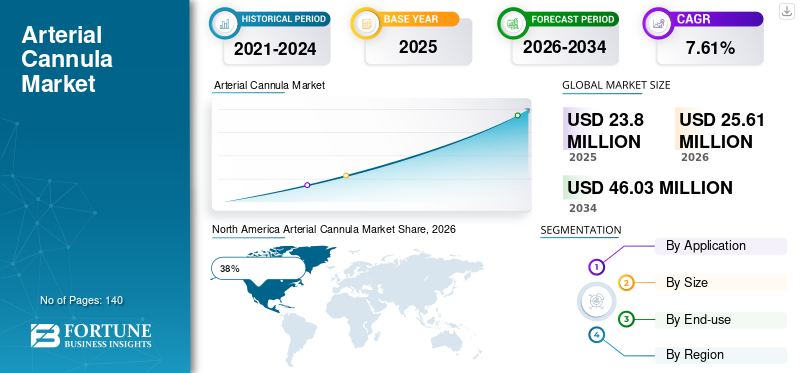
Download Free sample to learn more about this report.
Arterial Cannula Market Key Takeaways
 Global Market Size & Forecast
- 2025 Market Size: USD 23.8 Million
- 2026 Market Size: USD 25.61 Million
- 2034 Forecast Market Size: USD 46.03 Million
- CAGR: 7.61% from 2026-2034
 Market Share
- North America dominated with a revenue share of 39% in 2025.
- Cardiopulmonary bypass surgery dominated by application with 58% market share.
- Hospitals dominated by end use with 81% market share.
 Key Regional Highlights
North America
North America held the largest regional share at 39% in 2025, supported by advanced cardiovascular care infrastructure.
Europe
Europe accounted for 28% of the global market, driven by established cardiac surgery networks.
Asia-Pacific
Asia-Pacific represented 25% of the market, supported by expanding healthcare infrastructure and rising cardiovascular procedures.
U.S
The U.S. remains a major market, supported by high volumes of cardiac surgeries and ECMO procedures.
Japan
Japan accounted for 22% of the Asia-Pacific market, supported by advanced cardiovascular care facilities and surgical technologies
Read More

USA Arterial Cannula Market Overview
The United States represents one of the largest markets for arterial cannulas due to its advanced healthcare infrastructure, high volume of cardiac surgeries, and increasing adoption of ECMO therapies. Hospitals and specialized cardiac centers continue investing in advanced perfusion technologies to improve treatment outcomes and support complex cardiovascular procedures.
The USA arterial cannula market analysis indicates strong demand driven by an aging population and increasing incidence of heart-related conditions. Continuous innovation in surgical devices, growing awareness regarding minimally invasive procedures, and expanding critical care capabilities contribute to market development. Healthcare institutions increasingly prioritize high-performance cannulas that enhance blood flow management while reducing procedural risks.
Arterial Cannula Market Latest Trends
The arterial cannula market trends reveal increasing demand for technologically advanced devices designed to improve safety and procedural efficiency during cardiovascular interventions. Manufacturers are focusing on developing cannulas with enhanced flow dynamics, improved flexibility, and superior biocompatibility. These innovations help reduce complications associated with blood circulation management and improve clinical outcomes.
Download Free sample to learn more about this report.
Another important trend involves the growing utilization of arterial cannulas in ECMO procedures. Rising awareness of advanced life support therapies and expanding critical care infrastructure have increased demand for reliable cannulation systems. The arterial cannula market research report highlights growing adoption of specialized cannulas designed for long-duration extracorporeal support.
Hospitals are increasingly seeking devices that support minimally invasive surgical techniques while improving ease of insertion and patient safety. Product customization based on procedural requirements is also becoming more common. The arterial cannula industry analysis suggests that investments in material science, precision engineering, and infection prevention technologies will continue shaping future product development and market expansion.
Arterial Cannula Market Dynamics
DRIVER
Rising Number of Cardiovascular and ECMO Procedures
The primary driver supporting arterial cannula market growth is the increasing number of cardiovascular surgeries and ECMO procedures performed worldwide. Cardiovascular diseases remain among the leading causes of hospitalization, resulting in growing demand for cardiac bypass procedures and circulatory support systems. Arterial cannulas are indispensable during these interventions because they facilitate efficient blood flow between the patient and extracorporeal circulation systems.
The expansion of specialized cardiac care centers and advanced intensive care units has increased the utilization of ECMO technologies. As healthcare providers seek improved survival outcomes for critically ill patients, ECMO adoption continues to rise. This trend directly supports the demand for high-performance arterial cannulas capable of maintaining stable blood circulation during prolonged support periods.
Additionally, aging populations and rising prevalence of lifestyle-related cardiovascular disorders contribute to growing procedural volumes. Healthcare institutions are increasingly investing in advanced cannulation technologies to improve treatment quality, making cardiovascular procedure growth a major factor in the arterial cannula market forecast.
RESTRAINT
Risk of Procedure-Related Complications
Despite strong demand, procedure-related complications remain a significant restraint for the arterial cannula market. Arterial cannulation procedures carry risks including bleeding, infection, vascular injury, thrombosis, embolism, and limb ischemia. Such complications can increase hospitalization duration and treatment costs while affecting patient outcomes.
Healthcare providers must adhere to strict procedural guidelines and extensive training requirements to minimize adverse events. In certain healthcare facilities, concerns regarding procedural complexity may limit adoption of advanced cannulation systems. Regulatory requirements for safety validation further increase development timelines and compliance costs for manufacturers.
Additionally, the need for highly skilled surgeons and perfusionists can create operational barriers in regions experiencing shortages of specialized healthcare professionals. These factors can restrict procedural expansion in some healthcare settings, influencing overall arterial cannula market Share growth and limiting adoption rates in developing healthcare systems.
OPPORTUNITY
Expansion of Minimally Invasive Cardiac Surgery
The growing popularity of minimally invasive cardiac surgery presents substantial opportunities for the arterial cannula market. Patients increasingly prefer procedures associated with reduced trauma, shorter hospital stays, and faster recovery periods. As a result, healthcare providers are adopting minimally invasive surgical techniques for various cardiac interventions.
These procedures require specialized arterial cannulas designed for smaller access points and enhanced maneuverability. Manufacturers have significant opportunities to develop innovative products tailored specifically for minimally invasive applications. Demand for flexible, wire-reinforced, and low-profile cannulas continues to increase among cardiovascular surgeons.
Emerging healthcare markets are also investing heavily in modern cardiac care infrastructure. As advanced surgical procedures become more accessible in developing economies, demand for specialized cannulation devices is expected to expand. Product innovation, combined with increasing healthcare investments, creates strong opportunities highlighted throughout arterial cannula market research report studies and arterial cannula market Insights evaluations.
CHALLENGE
Increasing Regulatory and Quality Compliance Requirements
One of the major challenges facing the arterial cannula industry report landscape is the growing complexity of regulatory compliance. Medical device manufacturers must meet stringent quality standards, safety requirements, and clinical validation protocols before introducing new products into the market.
Obtaining approvals for advanced arterial cannulation systems often requires extensive testing and documentation. Compliance costs continue to rise as regulators emphasize patient safety, product traceability, and post-market surveillance. These requirements can extend product development cycles and increase commercialization expenses.
Additionally, manufacturers face pressure to maintain competitive pricing while investing heavily in research and innovation. Supply chain disruptions and raw material quality requirements further complicate manufacturing operations. Balancing regulatory compliance, innovation, and affordability remains a significant challenge for participants seeking to strengthen their position in the arterial cannula market Opportunities landscape.
Arterial Cannula Market Segmentation
By Application
The ECMO segment accounts for approximately 42% of the global arterial cannula market Share and continues to be one of the most significant application categories within the market. Extracorporeal Membrane Oxygenation (ECMO) is increasingly used for patients suffering from severe cardiac failure, respiratory failure, and critical circulatory disorders that cannot be managed effectively through conventional treatment methods. Arterial cannulas play a vital role in ECMO systems by facilitating blood circulation between the patient and the extracorporeal circuit. As healthcare providers increasingly rely on ECMO support for critically ill patients, the demand for advanced arterial cannulation solutions continues to rise. The arterial cannula market report identifies ECMO as a major contributor to product demand due to the growing number of specialized critical care units worldwide.
The expansion of ECMO programs across hospitals and tertiary care centers has accelerated the adoption of technologically advanced arterial cannulas. Healthcare professionals prioritize products that offer high flow efficiency, superior biocompatibility, and reduced risk of thrombosis or vessel injury. Manufacturers are investing in innovations such as wire-reinforced structures, anti-kink technologies, and atraumatic tip designs to improve procedural safety and long-term performance. Increasing awareness of ECMO therapy among clinicians and expanding treatment availability in emerging healthcare markets are expected to support sustained growth in this segment. The ECMO segment remains a crucial focus area in the arterial cannula market analysis and arterial cannula industry report due to its increasing utilization in life-support procedures.
Cardiopulmonary bypass surgery represents approximately 58% of the global arterial cannula market Share, making it the dominant application segment. During open-heart procedures, arterial cannulas are used to direct oxygenated blood from the heart-lung machine back into the patient's arterial system. These devices are indispensable in maintaining systemic circulation while surgeons perform complex cardiovascular operations. The increasing prevalence of coronary artery disease, valvular disorders, congenital heart defects, and aortic pathologies continues to generate substantial demand for cardiopulmonary bypass procedures globally. As a result, hospitals consistently procure arterial cannulas to support routine and advanced cardiac surgeries.
Technological advancements in cardiac surgery have encouraged the use of arterial cannulas with optimized flow dynamics and enhanced safety features. Manufacturers focus on reducing turbulence, minimizing hemolysis, and improving arterial perfusion efficiency during bypass procedures. The growing number of cardiac surgery centers, coupled with expanding healthcare infrastructure in developing economies, further supports segment growth. Demand is particularly strong in regions with advanced cardiac care networks where high surgical volumes require reliable and efficient cannulation products. The cardiopulmonary bypass surgery segment continues to influence arterial cannula market growth, arterial cannula market Size, and long-term arterial cannula market Outlook due to its fundamental role in cardiovascular surgery.
To know how our report can help streamline your business, Speak to Analyst
By Size
The 20-22 Fr arterial cannula segment accounts for approximately 46% of the total arterial cannula market Share. These medium-sized cannulas are widely utilized in adult cardiac surgeries and ECMO procedures where moderate blood flow rates are required. Their versatility and compatibility with a broad range of patient anatomies make them highly preferred among cardiovascular surgeons and perfusionists. The segment benefits from increasing procedural volumes across hospitals and specialized cardiac centers, where balanced flow performance and vessel preservation are critical considerations. The arterial cannula market research report highlights this category as a preferred choice for routine cardiovascular interventions.
One of the key factors driving adoption of 20-22 Fr cannulas is their ability to provide adequate perfusion while minimizing vascular trauma. Healthcare providers frequently select these devices for standard cardiopulmonary bypass surgeries because they offer a favorable balance between blood flow efficiency and arterial access safety. Manufacturers continue to enhance product designs through improved flexibility, reinforced structures, and advanced tip configurations that facilitate easier insertion and positioning. The increasing use of minimally invasive cardiac procedures further supports demand for these cannulas, as surgeons seek solutions that deliver reliable performance through smaller access points. This segment remains a vital component of the arterial cannula industry analysis and arterial cannula market forecast.
The 35-36 Fr segment holds approximately 54% of the arterial cannula market Share and serves as the leading size category. These larger-diameter cannulas are specifically designed for high-flow cardiovascular applications, including complex cardiac surgeries and advanced ECMO support procedures. Their ability to accommodate greater blood flow volumes makes them particularly valuable in patients requiring extensive circulatory assistance. The growing complexity of cardiovascular interventions and increasing demand for prolonged extracorporeal support continue to drive utilization of larger arterial cannulas across healthcare settings.
Healthcare providers often choose 35-36 Fr cannulas for cases involving significant hemodynamic support requirements. Their larger lumen facilitates efficient blood circulation, helping maintain stable perfusion during extended surgical procedures and critical care treatments. Manufacturers are actively developing advanced products within this category, incorporating enhanced flexibility and improved biocompatible materials to reduce complications despite larger dimensions. Product innovations have also focused on minimizing insertion trauma while preserving structural integrity under demanding clinical conditions. As healthcare systems expand capabilities related to advanced cardiac care and ECMO therapy, the 35-36 Fr segment is expected to maintain its leading position within the arterial cannula market Opportunities landscape.
By End-use
Hospitals account for approximately 81% of the global arterial cannula market Share and remain the dominant end-user segment. The majority of cardiopulmonary bypass surgeries, ECMO procedures, and advanced circulatory support treatments are performed in hospital environments equipped with specialized cardiovascular departments and intensive care units. These institutions represent the primary purchasing channel for arterial cannulas due to their extensive procedural volumes and need for consistent product availability. The arterial cannula market Insights indicate that hospitals continue to invest heavily in advanced cardiovascular technologies, creating substantial demand for high-quality cannulation products.
Large healthcare systems are expanding cardiac surgery programs and establishing specialized ECMO centers to meet rising patient demand. These developments directly increase procurement of arterial cannulas designed for a wide range of cardiovascular applications. Hospitals prioritize products that enhance procedural efficiency, improve patient safety, and reduce the risk of vascular complications. Manufacturers frequently collaborate with healthcare institutions to develop cannulation solutions tailored to evolving clinical requirements. The hospital segment is expected to remain the largest contributor to arterial cannula market growth due to ongoing investments in cardiovascular infrastructure and increasing adoption of advanced circulatory support technologies.
Ambulatory Surgical Centers (ASCs) account for approximately 19% of the arterial cannula market Share and represent an emerging end-user segment. Although most complex cardiac procedures continue to be performed in hospitals, advancements in minimally invasive techniques have enabled select cardiovascular interventions to move into outpatient settings. ASCs offer cost-effective treatment environments, shorter patient recovery times, and streamlined procedural workflows, making them increasingly attractive for certain surgical applications.
The growth of ASCs is creating new opportunities for arterial cannula manufacturers seeking to diversify their customer base. Healthcare systems are increasingly emphasizing operational efficiency and patient convenience, leading to greater utilization of outpatient facilities for eligible cardiovascular procedures. As technological innovations continue to improve procedural safety and reduce recovery requirements, demand for arterial cannulas within ASCs is expected to increase steadily. Manufacturers are responding by developing products that support minimally invasive approaches and outpatient procedural environments. The ASC segment represents an important area of future expansion highlighted in the arterial cannula market forecast, arterial cannula industry report, and arterial cannula market Opportunities analysis.
Arterial Cannula Market Regional Outlook
North America Arterial Cannula Market Share, 2026 (%)
To get more information on the regional analysis of this market, Download Free sample
North America
North America holds approximately 38% of the global arterial cannula market. The region benefits from advanced healthcare infrastructure, high procedural volumes, and widespread adoption of innovative cardiovascular technologies. Hospitals and cardiac specialty centers continue investing in advanced perfusion equipment and extracorporeal support systems to improve patient outcomes. Strong clinical expertise, favorable reimbursement frameworks, and growing demand for ECMO therapies contribute to market expansion. Increasing prevalence of cardiovascular disease and continuous innovation in surgical technologies further strengthen regional growth prospects.
Europe
Europe accounts for approximately 29% of the global arterial cannula market Share. The region demonstrates strong demand driven by established healthcare systems, increasing cardiovascular treatment volumes, and ongoing investments in medical technology. Hospitals across Europe continue adopting advanced arterial cannulation systems designed to improve procedural safety and efficiency. research initiatives and collaborations between healthcare institutions and manufacturers support innovation and product development. Expanding critical care capabilities also contribute to sustained market demand.
Germany Arterial Cannula Market
Germany represents approximately 24% of the European arterial cannula market. The country's highly developed healthcare system and strong cardiovascular treatment infrastructure support significant demand for arterial cannulation devices. Hospitals and specialized cardiac centers continue investing in advanced surgical technologies and extracorporeal support systems. Growing emphasis on patient safety, procedural precision, and clinical excellence strengthens market development. Germany remains an important hub for medical technology innovation and cardiovascular research.
United Kingdom Arterial Cannula Market
The United Kingdom accounts for approximately 18% of the European arterial cannula market. Increasing demand for cardiac surgeries, critical care services, and advanced perfusion technologies supports market expansion. Healthcare providers focus on improving treatment outcomes through adoption of innovative surgical devices and enhanced clinical protocols. Investments in healthcare modernization and specialized cardiac treatment centers continue strengthening market opportunities.
Asia-Pacific
Asia-Pacific holds approximately 25% of the global arterial cannula market. Rapid healthcare infrastructure development, growing awareness of cardiovascular diseases, and increasing access to advanced surgical procedures are driving regional growth. Hospitals across major economies continue expanding cardiac care capabilities and adopting modern perfusion technologies. Rising healthcare expenditure and improvements in critical care services support long-term market potential.
Japan Arterial Cannula Market
Japan represents approximately 22% of the Asia-Pacific arterial cannula market. The country's aging population and advanced healthcare system contribute significantly to demand for cardiovascular treatment solutions. Hospitals prioritize high-quality medical devices and advanced surgical technologies to improve patient outcomes. Strong clinical expertise and continued investment in healthcare innovation support market growth.
China Arterial Cannula Market
China accounts for approximately 39% of the Asia-Pacific arterial cannula market Share. Expanding healthcare infrastructure, increasing cardiovascular disease prevalence, and growing access to advanced medical treatments continue driving demand. Hospitals are investing heavily in cardiac care facilities and critical care capabilities. Government healthcare initiatives and medical technology adoption further strengthen market prospects.
Rest of World
The Rest of World region accounts for approximately 8% of the global arterial cannula market. Emerging healthcare systems across Latin America, the Middle East, and Africa are gradually increasing adoption of advanced cardiovascular treatment technologies. Investments in hospital infrastructure, specialized surgical centers, and critical care services continue creating growth opportunities for market participants.
List of Top Arterial Cannula Companies
- Medtronic, plc.
- LivaNova plc
- Edward Lifesciences
- Getinge AB
- Fresenius Medical Care
- BD
- Nipro Corp.
- Andocor
- Freelife Medical GmbH
- Surgical Holdings
- Kangxin Medical
Top Two Companies with Highest Market Share
- Medtronic, plc. – 21%
- Getinge AB – 16%
Investment analysis and Opportunities
The arterial cannula market continues attracting investment due to increasing demand for advanced cardiovascular treatment technologies. Healthcare providers are expanding cardiac surgery capabilities and critical care infrastructure, creating favorable conditions for device manufacturers. Investment activity focuses on product innovation, material science advancements, and development of next-generation cannulation systems capable of improving procedural outcomes.
arterial cannula market Opportunities are particularly strong within ECMO applications, emerging healthcare markets, and minimally invasive cardiovascular procedures. Manufacturers are investing in research and development to enhance biocompatibility, flow performance, and ease of insertion. Strategic partnerships, acquisitions, and facility expansions remain common approaches for strengthening market presence and addressing growing global demand.
New Product Development
Innovation remains central to competition within the arterial cannula industry. Manufacturers are developing advanced cannulas featuring improved tip designs, enhanced flexibility, and optimized flow dynamics. These innovations help reduce vascular trauma and support safer blood circulation management during complex procedures.
Recent product development efforts focus on coatings that improve biocompatibility and reduce thrombosis risk. Companies are also exploring smart monitoring technologies capable of providing real-time procedural feedback. Enhanced manufacturing techniques and precision engineering continue improving device consistency and performance. These advancements support broader adoption across cardiac surgery and critical care applications.
Five Recent Developments (2023-2025)
- Introduction of advanced arterial cannulas designed specifically for long-duration ECMO support.
- Expansion of manufacturing facilities to meet growing global demand for cardiovascular devices.
- Development of biocompatible surface technologies aimed at reducing thrombosis risks.
- Strategic partnerships between device manufacturers and healthcare institutions for clinical evaluation programs.
- Launch of next-generation cannulas featuring enhanced flow performance and insertion control.
report Coverage
The arterial cannula market report provides detailed analysis of market dynamics, competitive landscape, technological developments, and emerging opportunities across the cardiovascular device sector. The report evaluates key growth drivers, restraints, opportunities, and challenges influencing market performance.
Request for Customization to gain extensive market insights.
Coverage includes segmentation by application, size, end-use, and region. The arterial cannula market research report further examines product innovation trends, investment activities, and strategic developments among leading manufacturers. Regional analysis covers North America, Europe, Asia-Pacific, and Rest of World markets while highlighting country-level insights and competitive positioning. The report serves as a comprehensive resource for stakeholders seeking actionable intelligence regarding market trends, growth opportunities, and future industry direction.
Frequently Asked Questions
Fortune Business Insights says that the global market value stood at USD 23.8 million in 2025 and is projected to reach USD 46.03 million by 2034.
The market is expected to exhibit a CAGR of 7.61% during the forecast period of 2026-2034.
Cardiopulmonary bypass surgery was the leading application segment, accounting for approximately 58% of the market, driven by its essential role in maintaining systemic circulation during complex cardiac procedures.
Key players include Medtronic plc, LivaNova plc, Edwards Lifesciences, Getinge AB, Fresenius Medical Care, and BD.
Major trends include growing demand for advanced cannulas with improved flow dynamics, flexibility, and biocompatibility, along with increasing utilization in ECMO and minimally invasive cardiac procedures. North America led the market with approximately 38% share.



- 2021-2034
- 2025
- 2021-2024
- 140
-

(Offer valid till 30th Sep 2026)
Get 30-60 hrs Free Customization
Expand Regional and Country Coverage, Segments Analysis, Company Profiles, Competitive Benchmarking, and End-user Insights.













.webp)






-
US +1 833 909 2966 ( Toll Free )
-
Get In Touch With Us