 Download Free Sample



Get a Quote
Receive a tailored pricing based on your needs.
- Choose license type
- Multiple user options
- Custom scope & coverage
- Fast turnaround
"Designing Growth Strategies is in our DNA"
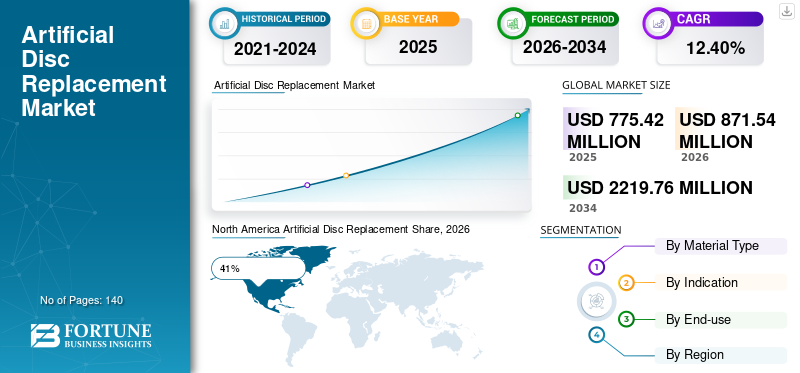
The global artificial disc replacement market size was valued at USD 775.42 million in 2025. The market is projected to grow from USD 871.54 million in 2026 to USD 2219.76 million by 2034, exhibiting a CAGR of 12.40% during the forecast period.

The artificial disc replacement market is gaining strong momentum as healthcare systems increasingly focus on motion-preserving spinal treatment solutions. Artificial disc replacement procedures are designed to maintain spinal flexibility while reducing pain caused by degenerative disc disease. The market is benefiting from technological progress in implant materials, surgical navigation systems, and minimally invasive techniques. Increasing incidences of cervical and lumbar spinal disorders among aging and working populations are contributing to demand. The artificial disc replacement market report highlights growing physician preference for disc replacement over fusion in selected cases. Rising patient awareness, improved clinical outcomes, and expanding availability of specialized spine centers continue to strengthen artificial disc replacement market growth globally.
The United States remains the leading contributor to the artificial disc replacement market due to advanced spinal care infrastructure and high adoption of innovative surgical technologies. Increasing prevalence of chronic back pain, degenerative disc disease, and spinal injuries supports procedure volumes throughout the country. Cervical disc replacement procedures are widely accepted among spine surgeons due to favorable long-term outcomes. The artificial disc replacement market analysis indicates that specialized orthopedic and neurosurgical centers are expanding treatment offerings to meet growing patient demand. Strong reimbursement support for approved procedures, increased surgeon expertise, and continuous product innovation make the United States a critical market within the global Artificial Disc Replacement industry report landscape.
Download Free sample to learn more about this report.
 Global Market Size & Forecast
 Market Share
 Key Regional Highlights
North America
North America held the largest regional share at 41% in 2025, supported by advanced spine care infrastructure.
Europe
Europe accounted for 29% of the global market, driven by established orthopedic healthcare systems.
Asia-Pacific
Asia-Pacific represented 22% of the market, supported by rising demand for advanced spinal procedures.
U.S
The U.S. remains a major market, supported by advanced spine care facilities and increasing adoption of motion-preserving procedures.
Japan
Japan accounted for 34% of the Asia-Pacific market, supported by advanced orthopedic care and growing adoption of spinal implants.
Read More

The artificial disc replacement market trends are increasingly shaped by technological advancements and evolving patient treatment preferences. Motion-preserving spine therapies continue gaining popularity as patients seek alternatives to traditional fusion surgeries. Advanced implant designs featuring enhanced wear resistance and biomechanical compatibility are becoming standard across major healthcare facilities. The artificial disc replacement market research report identifies increasing use of titanium alloys, cobalt-chromium materials, and advanced polymers that improve implant longevity and functional performance. Personalized spinal implants are emerging as a significant trend, allowing physicians to tailor procedures according to individual anatomical requirements.
Robotic-assisted surgery is gaining traction within specialized spine centers, improving implant placement accuracy and reducing recovery times. Artificial intelligence is also being incorporated into preoperative planning and postoperative monitoring systems. The expansion of outpatient spinal surgery programs is another notable trend supporting market development. The artificial disc replacement market outlook further reflects rising investment in research focused on next-generation implants capable of mimicking natural spinal movement. Increasing regulatory approvals for innovative products and growing physician training programs are expected to accelerate adoption. These developments continue to strengthen artificial disc replacement market opportunities across developed and emerging healthcare systems.
Growing Prevalence of Degenerative Disc Disease and Chronic Back Pain
The primary driver supporting artificial disc replacement market growth is the increasing prevalence of degenerative disc disease and chronic spinal disorders. Global aging populations, sedentary lifestyles, obesity, and occupational injuries are contributing to higher rates of cervical and lumbar degeneration. Artificial disc replacement procedures provide motion preservation while reducing limitations associated with spinal fusion. Patients increasingly seek solutions that enable faster recovery and maintain mobility. Healthcare providers are recognizing the long-term benefits of artificial discs in eligible patients. The artificial disc replacement market analysis indicates that growing awareness among physicians and patients regarding advanced spinal treatment options is driving procedure adoption. Continuous improvements in implant durability and surgical techniques further strengthen market expansion across healthcare facilities.
High Procedure Costs and Reimbursement Limitations
Despite strong demand, the artificial disc replacement market faces restraints related to procedure costs and reimbursement challenges. Artificial disc implants require advanced manufacturing processes and specialized surgical expertise, increasing treatment expenses. In many regions, healthcare reimbursement policies remain inconsistent, limiting patient access to these procedures. Some healthcare providers prioritize conventional spinal fusion because of established reimbursement structures and lower initial costs. The Artificial Disc Replacement industry analysis also highlights financial barriers in developing economies where advanced spinal procedures are less accessible. Limited insurance coverage for certain disc replacement indications further restricts procedural growth. These factors continue influencing adoption rates despite the recognized clinical benefits associated with artificial disc replacement technologies.
Expansion of Minimally Invasive Spinal Surgery
Market opportunities within the artificial disc replacement market are closely linked to the growth of minimally invasive spinal surgery. Hospitals and outpatient facilities are increasingly adopting procedures that reduce hospitalization periods and accelerate rehabilitation. Artificial disc replacement aligns with these objectives by preserving spinal movement while minimizing tissue disruption. Rising investments in spine surgery centers, advanced imaging technologies, and surgeon training programs are creating favorable conditions for market expansion. Emerging economies are improving access to specialized orthopedic care, opening new avenues for manufacturers. The artificial disc replacement market forecast suggests increasing demand from younger patient populations seeking active lifestyles after surgery. These developments continue generating substantial opportunities for industry participants.
Limited Patient Eligibility and Clinical Complexity
A significant challenge affecting the artificial disc replacement market involves patient eligibility limitations and procedural complexity. Not all individuals suffering from spinal degeneration qualify for artificial disc replacement procedures. Factors such as severe osteoporosis, spinal instability, multiple-level degeneration, and certain anatomical conditions can restrict treatment suitability. Successful outcomes depend heavily on precise patient selection and surgeon expertise. The artificial disc replacement market Insights reveal that specialized training remains essential for achieving optimal implant placement and long-term functionality. Additionally, regulatory requirements and extensive clinical evaluation processes can delay product launches. These challenges require ongoing education, research, and technological innovation to support broader market adoption.
Metal artificial discs account for approximately 67% of the artificial disc replacement market share. These implants are widely utilized because of their durability, load-bearing capacity, and proven long-term clinical performance. Common materials include titanium and cobalt-chromium alloys that provide excellent structural stability while supporting natural spinal movement. Metal-based implants are preferred for active patients requiring long-lasting solutions. Advances in surface engineering have improved wear resistance and reduced complications associated with implant friction. Healthcare providers frequently select metal artificial discs for both cervical and lumbar procedures due to strong clinical evidence.
Plastic artificial discs hold approximately 33% of the artificial disc replacement market share. These implants utilize advanced polymer materials designed to improve flexibility and shock absorption. Plastic components are commonly integrated into hybrid implant systems that replicate natural disc biomechanics. Continuous innovation in polymer technology has enhanced durability and reduced wear-related concerns, increasing physician confidence. The artificial disc replacement market trends indicate growing demand for biomimetic solutions that closely mimic natural spinal motion. Plastic artificial discs offer advantages in specific patient populations where flexibility and reduced mechanical stress are priorities.
To know how our report can help streamline your business, Speak to Analyst
Cervical applications represent approximately 56% of the artificial disc replacement market share. Cervical disc replacement has gained widespread acceptance due to strong clinical outcomes and extensive long-term performance data. Patients suffering from neck pain, cervical disc degeneration, and nerve compression increasingly undergo artificial disc replacement procedures to preserve mobility. The artificial disc replacement market analysis highlights growing surgeon confidence in cervical implants because of lower adjacent segment degeneration risks compared with fusion surgery. Continuous product improvements and favorable regulatory approvals have further expanded adoption.
Lumbar applications account for approximately 44% of the artificial disc replacement market share. Lumbar disc replacement procedures are gaining attention as evidence supporting long-term effectiveness continues to expand. Patients experiencing lower back pain associated with degenerative disc disease increasingly consider motion-preserving alternatives to spinal fusion. Advanced lumbar implant designs are improving stability, durability, and patient outcomes. The artificial disc replacement market research report indicates growing adoption among specialized spine centers and orthopedic facilities. Although patient selection criteria remain more restrictive than cervical procedures, ongoing clinical research and technological innovation continue supporting segment growth across developed and emerging healthcare markets.
Hospitals hold approximately 72% of the artificial disc replacement market share by end-use. Large hospitals possess advanced imaging systems, surgical infrastructure, and multidisciplinary spine care teams necessary for complex procedures. Most artificial disc replacement surgeries are performed in hospital environments due to the availability of specialized operating rooms and postoperative monitoring resources. Increasing investments in spine centers and orthopedic departments continue supporting procedural volumes. The Artificial Disc Replacement industry analysis identifies hospitals as the primary treatment setting because of established surgeon networks and comprehensive patient care capabilities.
Outpatient facilities account for approximately 28% of the artificial disc replacement market share. Advancements in minimally invasive surgical techniques and enhanced recovery protocols are driving growth within this segment. Patients increasingly prefer outpatient procedures because of shorter stays, faster recovery, and reduced healthcare costs. Specialized ambulatory surgical centers are expanding spinal treatment offerings to accommodate rising demand. The artificial disc replacement market opportunities associated with outpatient facilities are expected to increase as technology continues improving procedural efficiency and safety.
North America Artificial Disc Replacement Share, 2026 (%)
To get more information on the regional analysis of this market, Download Free sample
North America dominates the artificial disc replacement market with an estimated 41% market share. The region benefits from advanced healthcare infrastructure, high awareness regarding motion-preserving spinal procedures, and strong adoption of innovative medical technologies. The United States contributes the majority of regional demand due to increasing incidences of degenerative disc disease, chronic back pain, and spinal injuries. Artificial disc replacement procedures are increasingly preferred among eligible patients because they maintain spinal mobility while reducing adjacent segment degeneration risks. The artificial disc replacement market report indicates that specialized spine centers and orthopedic hospitals across North America continue expanding procedural capabilities. Continuous product innovation, favorable reimbursement environments, and growing surgeon expertise support market expansion. The region also benefits from a strong clinical research ecosystem that facilitates the introduction of advanced implant technologies.
Europe accounts for approximately 29% of the artificial disc replacement market share and remains a major contributor to global procedure volumes. The region benefits from comprehensive healthcare systems, growing elderly populations, and increasing acceptance of artificial disc replacement technologies among orthopedic and neurosurgical specialists. Countries such as Germany, France, Italy, and the United Kingdom are actively adopting motion-preserving spinal treatments to address rising incidences of degenerative disc disorders. The Artificial Disc Replacement industry analysis identifies strong demand for cervical and lumbar artificial disc replacement procedures across European healthcare facilities. Healthcare providers increasingly favor technologies that improve patient outcomes while reducing long-term disability associated with spinal fusion procedures. Continuous advancements in implant materials and surgical techniques are supporting wider adoption across the region.
Germany represents approximately 30% of the global artificial disc replacement market share and is the largest market within Europe. The country possesses a highly developed healthcare infrastructure and strong expertise in orthopedic and spinal surgery. German hospitals and specialty spine centers frequently adopt advanced technologies aimed at improving patient outcomes and preserving mobility. The artificial disc replacement market research report indicates that increasing incidences of degenerative spinal disorders and an aging population continue driving procedure demand. Germany's focus on evidence-based healthcare supports adoption of clinically proven artificial disc technologies. Surgeons increasingly recommend motion-preserving procedures for eligible patients seeking alternatives to spinal fusion. Investments in advanced surgical equipment and rehabilitation services further strengthen Germany's position as a leading European market for artificial disc replacement solutions.
The United Kingdom accounts for approximately 25% of the global artificial disc replacement market share. Demand is increasing due to growing prevalence of chronic neck and lower back pain among aging and working populations. Healthcare providers are increasingly evaluating artificial disc replacement as a treatment option that preserves spinal motion and improves long-term patient outcomes. The artificial disc replacement market Insights indicate rising awareness among clinicians regarding the advantages of motion-preserving spinal implants. Specialist spinal centers are expanding treatment capabilities and incorporating advanced surgical technologies. Government healthcare modernization initiatives and growing investments in orthopedic care continue supporting market development. The United Kingdom remains an important market within Europe due to its established healthcare infrastructure and increasing adoption of innovative spinal treatment approaches.
Asia-Pacific holds approximately 22% of the artificial disc replacement market share and represents one of the fastest-growing regional markets. Rapid healthcare infrastructure development, increasing healthcare expenditure, and rising awareness of advanced spinal treatments are supporting market expansion. Countries such as China, Japan, South Korea, India, and Australia are increasingly investing in orthopedic and neurosurgical capabilities. The artificial disc replacement market growth in Asia-Pacific is driven by large patient populations affected by degenerative disc disease, spinal injuries, and age-related musculoskeletal conditions. Increasing urbanization and sedentary lifestyles are contributing to higher incidences of chronic back pain across the region. Healthcare providers are expanding access to specialized spinal procedures, creating favorable conditions for artificial disc replacement adoption.
Japan accounts for approximately 34% of the global artificial disc replacement market share. The country's aging population creates significant demand for advanced spinal treatment solutions designed to improve mobility and quality of life. Japanese healthcare providers emphasize precision, safety, and long-term clinical outcomes when adopting new medical technologies. The artificial disc replacement market analysis highlights increasing use of innovative implant systems and minimally invasive surgical techniques across Japanese hospitals. Rising incidences of degenerative spinal conditions among elderly populations continue supporting market growth. Strong physician expertise and advanced healthcare infrastructure contribute to the adoption of motion-preserving spinal procedures. Japan remains a key market for premium artificial disc replacement technologies within the Asia-Pacific region.
China represents approximately 11% of the global artificial disc replacement market share and is one of the most promising growth markets worldwide. Rapid expansion of healthcare infrastructure, increasing access to specialized orthopedic services, and rising awareness of advanced spinal treatments are driving demand. Urban hospitals are investing heavily in modern surgical technologies and spine care programs. The artificial disc replacement market opportunities in China continue expanding as aging demographics and lifestyle-related spinal disorders increase procedure demand. Government initiatives supporting healthcare modernization and domestic medical device development further strengthen market growth. Growing patient preference for mobility-preserving treatments and expanding surgeon expertise contribute to rising adoption of artificial disc replacement procedures across major healthcare centers.
Rest of World accounts for approximately 8% of the artificial disc replacement market share and includes Latin America, the Middle East, and Africa. These regions are experiencing gradual market expansion due to improving healthcare infrastructure and increasing access to specialized spinal care services. Growing awareness regarding artificial disc replacement procedures is supporting adoption among healthcare providers and patients. The Artificial Disc Replacement industry report identifies increasing investments in orthopedic hospitals, neurosurgical centers, and rehabilitation facilities across these regions. Several countries are expanding healthcare spending to improve access to advanced medical technologies. Rising incidences of spinal disorders associated with aging populations and occupational injuries are creating additional demand for motion-preserving treatment options. Medical tourism is also contributing to market growth in selected countries with advanced healthcare capabilities. The artificial disc replacement market outlook for Rest of World remains positive as healthcare modernization initiatives continue and physician training programs improve procedural expertise.
The artificial disc replacement market continues attracting investment from medical device manufacturers, healthcare providers, and institutional investors. Capital allocation is increasingly focused on research programs aimed at improving implant durability, motion preservation, and surgical outcomes. Companies are investing in advanced biomaterials, robotic-assisted surgical systems, and patient-specific implant technologies. Strategic acquisitions and partnerships remain common as organizations seek to strengthen product portfolios and expand geographic reach.
artificial disc replacement market opportunities are particularly strong in emerging healthcare economies where access to advanced spinal treatments is expanding. Hospitals are increasing investments in specialized spine centers equipped with modern imaging and navigation technologies. Outpatient surgical facilities also represent a growing investment area due to increasing demand for minimally invasive procedures.
Innovation remains a defining characteristic of the artificial disc replacement market. Manufacturers are developing next-generation implants that more closely replicate natural spinal movement while improving long-term durability. Advanced materials including highly wear-resistant polymers, titanium alloys, and hybrid composites are being incorporated into modern artificial disc systems. Three-dimensional printing technologies are supporting the development of customized implants tailored to individual patient anatomy. Artificial intelligence is increasingly utilized during product design and surgical planning processes. These advancements help optimize implant positioning and improve postoperative outcomes.
The Artificial Disc Replacement industry analysis highlights significant progress in surface engineering technologies that reduce friction and enhance implant longevity. Companies are also introducing modular implant systems that provide greater flexibility during surgical procedures. Motion-preserving designs capable of supporting physiological spinal movement continue attracting attention across the healthcare sector. Robotic-assisted implantation systems and digital navigation platforms are further enhancing procedural precision. These innovations contribute to improved patient satisfaction, reduced recovery times, and broader acceptance of artificial disc replacement procedures worldwide.
The artificial disc replacement market report provides comprehensive analysis of industry developments, market dynamics, technological innovation, competitive positioning, and regional performance. The report evaluates key factors influencing demand, including degenerative disc disease prevalence, healthcare infrastructure development, surgeon adoption trends, and patient treatment preferences. The artificial disc replacement market research report includes detailed segmentation analysis by type, indication, end-use, and geography. Market share assessments identify leading product categories and application areas contributing to overall industry expansion.
Request for Customization to gain extensive market insights.
The report also examines investment activity, product development initiatives, and strategic growth opportunities across major healthcare markets. Regional analysis covers North America, Europe, Asia-Pacific, and Rest of World markets while highlighting country-level developments in major healthcare economies. Competitive landscape evaluation reviews leading manufacturers, market positioning, innovation strategies, and expansion initiatives. artificial disc replacement market Insights included within the report support decision-making for manufacturers, distributors, healthcare providers, investors, and other stakeholders seeking opportunities within the global artificial disc replacement industry.
Fortune Business Insights says that the global market value stood at USD 2.73 billion in 2025 and is projected to reach USD 5.19 billion by 2034.
The market is expected to exhibit a CAGR of 7.67% during the forecast period of 2026-2034.
Lumbar artificial disc replacement was the leading segment, supported by the high prevalence of lumbar degenerative disc disease and growing demand for motion-preserving treatments.
Key players include DePuy Synthes, Zimmer Biomet, Globus Medical, Stryker, Centinel Spine, and Orthofix Medical Inc.
Major trends include increasing adoption of motion-preserving spinal implants and minimally invasive procedures, along with advancements in implant materials and surgical technologies. North America held the leading market position.


(Offer valid till 31st Oct 2026)
Get 30-60 hrs Free Customization
Expand Regional and Country Coverage, Segments Analysis, Company Profiles, Competitive Benchmarking, and End-user Insights.













.webp)






Get In Touch With Us
US +1 833 909 2966 ( Toll Free )
Receive a tailored pricing based on your needs.
Discuss your questions with our industry experts.
Have questions? Get quick answers before you purchase.

