Artificial Turf Market Size, Share & Industry Analysis, By Material (Polyethylene, Polypropylene, Nylon), By Application (Residential, Commercial, Sports), By Region (North America, Europe, Asia Pacific, Latin America, MEA), and Regional Forecast, 2026-2034
 Download Free Sample
Artificial Turf Market Overview
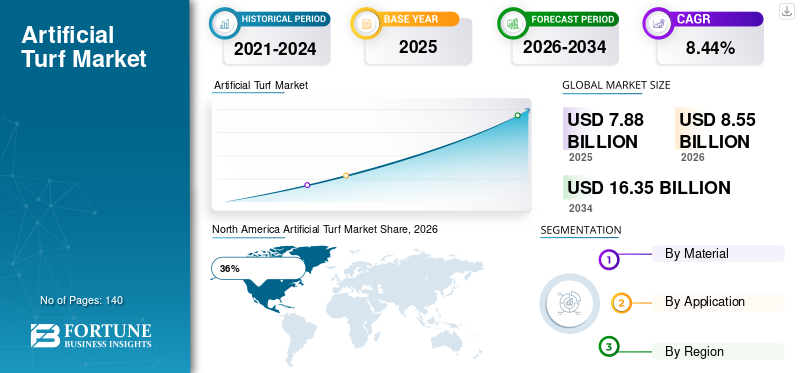
The global artificial turf market size was valued at USD 7.88 billion in 2025. The market is projected to grow from USD 8.55 billion in 2026 to USD 16.35 billion by 2034, exhibiting a CAGR of 8.44% during the forecast period.

The artificial turf market is expanding steadily due to rising demand for low-maintenance landscaping solutions, growing sports infrastructure projects, and increasing water conservation initiatives worldwide. Artificial turf products are widely used in sports stadiums, residential lawns, commercial landscapes, playgrounds, and recreational facilities because they provide year-round durability and visual consistency. The Artificial Turf Market Report highlights growing adoption of synthetic grass systems in urban areas where natural grass maintenance becomes expensive and resource-intensive. Manufacturers are focusing on advanced fiber technologies, UV-resistant materials, and recyclable turf systems to improve sustainability and product lifespan. Artificial Turf Market Analysis also shows rising investments in eco-friendly infill materials and high-performance sports surfaces.
The United States Artificial Turf Market is witnessing strong growth due to extensive sports facility development, commercial landscaping demand, and increasing homeowner preference for water-efficient lawn solutions. Schools, universities, and professional sports organizations continue investing in synthetic turf systems because of reduced maintenance costs and improved field durability. Artificial Turf Industry Analysis indicates growing adoption of artificial grass in residential backyards, rooftop gardens, pet areas, and public parks across major metropolitan regions. Commercial real estate projects increasingly integrate synthetic landscaping to reduce irrigation and operational expenses. Advancements in shock absorption, drainage technology, and heat-resistant fibers are further strengthening Artificial Turf Market Growth throughout the USA market.
Download Free sample to learn more about this report.
Artificial Turf Market Key Takeaways
 Global Market Size & Forecast
- 2025 Market Size: USD 7.88 Billion
- 2026 Market Size: USD 8.55 Billion
- 2034 Forecast Market Size: USD 16.35 Billion
- CAGR: 8.44% from 2026-2034
 Market Share
- North America dominated with a 36% market share in 2025.
- Polyethylene held the largest material share at 47%.
- Sports applications held the largest application share at 42%.
 Key Regional Highlights
Europe
Europe accounted for 29% of the global market.
Asia-Pacific
Asia-Pacific held a 27% share, supported by rapid urbanization and sports infrastructure development.
Rest of World
Rest of World accounted for 8% of the global market.
U.S.
The U.S. is a major market driven by strong adoption in sports facilities and residential landscaping.
Japan
Japan accounted for 15% of the Asia-Pacific market.
Read More

Artificial Turf Market Latest Trends
The Artificial Turf Market Trends are strongly influenced by sustainability, sports modernization, and technological innovation. One major trend is the increasing demand for recyclable and environmentally friendly turf systems made from bio-based materials and non-toxic infill products. Manufacturers are introducing artificial grass solutions with improved drainage, cooling properties, and enhanced durability to meet growing customer expectations. Smart turf systems integrated with moisture control and temperature management technologies are also gaining traction in sports infrastructure projects. Artificial Turf Market Insights indicate rising preference for turf surfaces that closely replicate the appearance and playing characteristics of natural grass.
Download Free sample to learn more about this report.
Another key trend shaping the Artificial Turf Industry Report is the growing use of artificial turf in commercial landscaping and urban development projects. Hotels, airports, office complexes, and shopping centers increasingly adopt synthetic grass to reduce landscaping maintenance and water consumption. Sports organizations are investing in premium turf systems with advanced shock absorption and athlete safety features. Residential consumers are also driving market demand by installing pet-friendly and child-safe turf surfaces. Artificial Turf Market Forecast suggests continued innovation in antimicrobial coatings, recyclable backing materials, and heat reduction technologies to support long-term market expansion across residential and commercial sectors.
Artificial Turf Market Dynamics
DRIVER
Rising Demand for Low-Maintenance and Water-Efficient Landscaping Solutions
The increasing need for low-maintenance landscaping and water conservation is a major factor driving the Artificial Turf Market Growth globally. Urban regions facing water scarcity are increasingly adopting synthetic turf solutions as an alternative to natural grass lawns that require regular irrigation and maintenance. Residential homeowners, sports facilities, educational institutions, and commercial property developers are investing in artificial turf to reduce landscaping costs and improve long-term durability. Artificial Turf Market Research Report findings show that synthetic grass systems significantly reduce mowing, fertilization, and pesticide usage, making them attractive for sustainable landscaping initiatives.
Sports infrastructure development is also contributing substantially to market expansion. Stadiums, training facilities, and recreational complexes require durable playing surfaces capable of supporting continuous use under varying weather conditions. Artificial turf provides consistent performance, rapid drainage, and extended operational life compared to natural grass fields. Government investments in urban beautification and public recreational facilities further strengthen Artificial Turf Market Opportunities across developed and emerging economies.
RESTRAINT
Environmental Concerns Related to Synthetic Materials
Environmental concerns associated with plastic-based turf materials remain a major restraint in the Artificial Turf Market Outlook. Many artificial turf products are manufactured using petroleum-derived polymers that raise sustainability concerns regarding disposal and recyclability. Used turf systems often generate landfill waste because recycling infrastructure remains limited in several regions. Environmental groups and regulatory authorities are increasingly scrutinizing infill materials such as crumb rubber due to concerns regarding microplastic pollution and chemical exposure.
High installation costs also limit adoption among cost-sensitive residential and commercial buyers. While artificial turf reduces long-term maintenance expenses, initial project investments remain significantly higher than natural grass landscaping. Temperature retention is another challenge, especially in hot climate regions where synthetic surfaces may become excessively warm during summer conditions. Artificial Turf Industry Analysis also indicates that some sports organizations continue preferring natural grass because of athlete comfort and traditional playing characteristics. These factors may restrict faster adoption across certain applications and regional markets.
OPPORTUNITY
Expansion of sports infrastructure and urban landscaping projects
The rapid development of sports infrastructure and urban landscaping projects presents significant opportunities for the Artificial Turf Market. Governments and private organizations are investing heavily in sports academies, stadiums, schools, and recreational parks that require durable and low-maintenance playing surfaces. Artificial turf systems are increasingly preferred because they support year-round usability and reduce maintenance downtime. Emerging economies are witnessing rising demand for synthetic sports fields due to growing interest in football, hockey, rugby, and multi-sport recreational facilities.
Urban landscaping projects also offer substantial business opportunities for manufacturers and installers. Commercial buildings, airports, hotels, and residential communities increasingly use artificial turf to enhance visual appeal while minimizing water consumption. Artificial Turf Market Analysis highlights growing opportunities for pet-friendly and rooftop landscaping solutions in densely populated cities. Technological innovation in recyclable materials, antimicrobial coatings, and cooling systems is expected to create additional growth potential for companies operating in the artificial turf industry.
CHALLENGE
Managing heat retention and long-term sustainability concerns
One of the biggest challenges in the Artificial Turf Market is managing heat retention and sustainability issues associated with synthetic surfaces. Artificial turf can become significantly hotter than natural grass in direct sunlight, particularly in warm climate regions. This creates concerns for athlete safety and residential comfort, encouraging manufacturers to invest in cooling technologies and heat-resistant fibers. Developing affordable solutions that reduce surface temperature while maintaining durability remains a key industry challenge.
Long-term sustainability is another critical issue affecting market growth. Disposal and recycling of used artificial turf systems remain complex due to the combination of multiple materials such as plastics, rubber, and backing compounds. Regulatory pressure regarding environmental impact is increasing across Europe and North America. Artificial Turf Market Forecast reports indicate that manufacturers must focus on recyclable turf systems and eco-friendly infill solutions to maintain market competitiveness. Intense competition among regional suppliers and pricing pressure in commercial projects further complicate profitability for market participants.
Artificial Turf Market Segmentation
By Material
Polyethylene artificial turf dominates the market with nearly 47% market share due to its soft texture, durability, and natural grass-like appearance. This material is widely used in residential lawns, sports fields, and commercial landscaping because it provides excellent flexibility and UV resistance. Polyethylene turf systems are highly preferred for football, soccer, and playground applications because they offer improved athlete comfort and reduced abrasion risk. Artificial Turf Market Report findings indicate strong demand for polyethylene turf in regions experiencing water conservation initiatives and urban landscaping expansion.
Manufacturers continue improving polyethylene fiber technology to enhance resilience, drainage performance, and heat resistance. Multi-tone polyethylene fibers are increasingly used to replicate the appearance of natural grass and improve visual aesthetics. Commercial property developers prefer polyethylene turf because of its long operational lifespan and low maintenance requirements. Sports organizations are also investing in polyethylene-based turf systems equipped with advanced shock absorption layers and sustainable infill materials. Growing demand for premium landscaping solutions continues strengthening this segment globally.
Polypropylene artificial turf accounts for approximately 28% market share because of its affordability and lightweight properties. This type of turf is commonly used in decorative landscaping, indoor sports facilities, balconies, and temporary installations. Polypropylene fibers provide moderate durability and are considered suitable for low-traffic areas where cost efficiency is a primary consideration. Artificial Turf Industry Analysis highlights growing adoption of polypropylene turf in commercial events, exhibition spaces, and small recreational facilities.
Manufacturers are focusing on improving the tensile strength and UV stability of polypropylene turf systems to expand their application range. Residential consumers increasingly utilize polypropylene turf for rooftop gardens, patios, and pet areas because it requires minimal upkeep. The material’s cost advantage makes it particularly attractive in emerging economies where budget-conscious landscaping projects dominate market demand. However, polypropylene turf is generally less durable than polyethylene and nylon alternatives, limiting its use in high-impact sports environments and heavy commercial applications.
Nylon artificial turf holds around 25% market share due to its superior strength, resilience, and ability to withstand extreme temperatures. Nylon fibers are commonly used in professional sports facilities and high-traffic commercial areas where durability is essential. This type of turf maintains its shape under heavy use and performs effectively in harsh weather conditions. Artificial Turf Market Insights indicate increasing demand for nylon turf in sports training facilities, golf practice areas, and athletic complexes.
The high-performance characteristics of nylon make it ideal for environments requiring consistent surface quality and extended lifespan. Manufacturers are developing hybrid nylon turf systems that combine softness with enhanced durability for multi-purpose sports applications. Nylon turf also demonstrates excellent resistance to wear, making it suitable for intensive usage in educational institutions and stadiums. Although nylon products generally involve higher installation costs, commercial buyers often prefer them because of long-term operational benefits and reduced replacement frequency.
To know how our report can help streamline your business, Speak to Analyst
By Application
The residential segment contributes approximately 31% market share in the Artificial Turf Market due to growing homeowner interest in low-maintenance landscaping solutions. Artificial turf is increasingly installed in gardens, terraces, balconies, pet zones, and children’s play areas because it eliminates the need for regular watering and lawn care. Urban homeowners facing water restrictions and high landscaping costs are adopting synthetic grass systems as practical alternatives to natural lawns. Artificial Turf Market Analysis indicates rising demand for aesthetically appealing turf products with natural textures and improved softness.
Manufacturers are introducing residential turf systems with antimicrobial coatings, enhanced drainage capabilities, and pet-friendly materials. Smart landscaping trends and rooftop gardening projects are also contributing to market expansion in urban environments. Homeowners increasingly prefer artificial turf because it remains visually attractive throughout the year and withstands varying weather conditions. Growing awareness regarding water conservation and sustainable residential landscaping continues supporting long-term demand in this application segment.
Commercial applications account for nearly 27% market share because businesses increasingly use artificial turf to enhance landscape aesthetics while minimizing maintenance expenses. Hotels, office complexes, airports, restaurants, and retail centers are adopting synthetic grass systems to improve outdoor visual appeal and reduce irrigation requirements. Artificial Turf Market Research Report findings show growing use of artificial landscaping in hospitality and entertainment venues seeking sustainable property management solutions.
Commercial developers are investing in high-quality turf systems capable of handling moderate foot traffic and harsh environmental exposure. Rooftop landscaping, event spaces, and urban beautification projects are also driving demand in this segment. Artificial turf offers commercial property owners operational advantages including reduced maintenance labor, lower water consumption, and year-round greenery. Manufacturers continue developing customizable turf products with enhanced UV protection and realistic aesthetics to meet evolving commercial landscaping requirements.
The sports segment dominates with approximately 42% market share due to extensive installation of artificial turf in stadiums, training grounds, schools, and recreational facilities. Sports organizations prefer synthetic surfaces because they provide consistent playing conditions, rapid drainage, and high durability under intensive use. Football, rugby, hockey, tennis, and multi-sport complexes increasingly utilize advanced turf systems designed for athlete safety and performance optimization. Artificial Turf Industry Report findings indicate strong investments in sports infrastructure across North America, Europe, and Asia-Pacific.
Manufacturers are focusing on shock absorption technologies, cooling systems, and recyclable infill materials to improve sports turf performance. Educational institutions and municipal recreational facilities are also adopting artificial turf because of reduced maintenance downtime and longer operational life compared to natural grass fields. Increasing global interest in professional and community sports activities continues driving demand for high-performance synthetic turf systems worldwide.
By Region
North America dominates the Artificial Turf Market with nearly 36% market share due to high adoption across sports facilities, commercial landscapes, and residential applications. The region benefits from extensive investments in stadium modernization, school sports infrastructure, and urban landscaping projects. Artificial Turf Market Analysis indicates that the United States remains the largest contributor because of rising demand for synthetic turf in football, baseball, soccer, and recreational fields. Commercial real estate developers increasingly use artificial turf in hotels, office complexes, and entertainment venues to reduce water usage and landscaping expenses.
Residential consumers across North America are also driving Artificial Turf Market Growth through increased installation of synthetic lawns, rooftop gardens, and pet-friendly outdoor spaces. Municipal authorities are investing in sustainable public parks and playgrounds using recyclable turf materials. Technological advancements in cooling systems, drainage layers, and UV-resistant fibers continue improving product performance. The presence of major turf manufacturers and strong awareness regarding water conservation further strengthen regional market expansion.
Europe accounts for approximately 29% market share in the Artificial Turf Market because of growing environmental awareness, advanced sports infrastructure, and increasing demand for sustainable landscaping solutions. Countries such as Germany, the United Kingdom, France, and the Netherlands are investing heavily in football grounds, educational sports complexes, and public recreational facilities. Artificial Turf Industry Analysis highlights increasing use of synthetic turf in urban commercial landscapes where maintenance efficiency and year-round greenery are important priorities.
The region is witnessing rising adoption of eco-friendly turf systems with recyclable backing materials and non-toxic infill solutions. Commercial developers increasingly integrate artificial grass into hospitality projects, airports, rooftop gardens, and shopping centers to improve outdoor aesthetics while minimizing maintenance requirements. Sports organizations continue replacing traditional grass fields with durable synthetic surfaces capable of handling intensive usage under varying weather conditions. Government regulations supporting sustainable construction and water conservation are also creating long-term Artificial Turf Market Opportunities across Europe.
Asia Pacific holds nearly 27% market share in the Artificial Turf Market due to rapid urbanization, expanding sports participation, and increasing infrastructure development activities. China, Japan, India, Australia, and South Korea are major contributors to regional demand for artificial turf systems across sports, residential, and commercial applications. Artificial Turf Market Research Report findings indicate growing investment in football academies, school playgrounds, and public parks throughout emerging economies.
Commercial landscaping demand is rising significantly in urban centers where property developers seek visually attractive and low-maintenance outdoor solutions. Residential consumers are increasingly adopting artificial grass for balconies, terraces, and home gardens because of water conservation concerns and reduced maintenance requirements. Governments across the region are supporting smart city projects and sports infrastructure modernization, creating additional growth opportunities for turf manufacturers. Regional production expansion and technological innovation in heat-resistant turf materials continue strengthening Asia Pacific’s position in the global market.
Latin America represents nearly 5% market share in the Artificial Turf Market because of increasing investments in sports facilities and urban recreational infrastructure. Football remains the strongest demand driver, with schools, sports clubs, and municipal authorities installing synthetic turf systems to improve field durability and reduce maintenance costs. Artificial Turf Market Outlook in the region is supported by growing awareness regarding water-efficient landscaping solutions and rising urbanization trends.
Commercial applications are also expanding as hotels, entertainment centers, and tourism projects adopt artificial turf to enhance property aesthetics. Residential landscaping demand is increasing in metropolitan areas where homeowners seek practical alternatives to natural grass lawns. Governments are investing in public parks and multi-purpose recreational spaces to improve community sports participation and urban development. Manufacturers are introducing affordable and climate-resistant turf systems tailored to regional environmental conditions, further supporting market penetration across Latin America.
The Middle East and Africa region accounts for nearly 3% market share in the Artificial Turf Market due to extreme climate conditions, water scarcity, and rising sports infrastructure development. Countries in the Middle East are heavily adopting artificial turf for stadiums, commercial landscapes, golf facilities, and public recreational projects because maintaining natural grass is costly and resource-intensive. Artificial Turf Market Insights show increasing demand for heat-resistant synthetic turf systems designed for desert environments.
In Africa, artificial turf adoption is growing across schools, sports academies, and municipal recreational grounds due to lower maintenance requirements and improved field durability. Commercial sectors including hospitality, retail, and tourism are also contributing to regional demand for synthetic landscaping products. Governments and private investors continue supporting football infrastructure projects and urban beautification initiatives, creating additional opportunities for manufacturers and installation providers. Technological advancements in UV protection and drainage systems are further improving product suitability across the MEA region.
Artificial Turf Market Regional Outlook
North America
North America Artificial Turf Market Share, 2026 (%)
To get more information on the regional analysis of this market, Download Free sample
North America holds nearly 36% market share in the Artificial Turf Market due to strong sports infrastructure development, commercial landscaping demand, and widespread adoption of water conservation practices. The United States remains the largest regional contributor because of heavy investments in stadiums, schools, universities, and recreational facilities. Artificial Turf Market Trends in North America indicate growing use of synthetic grass in residential properties, pet facilities, and urban landscaping projects.
Commercial real estate developers increasingly integrate artificial turf into hospitality and office landscaping to reduce operational maintenance costs. Canada also contributes significantly through sports facility modernization and recreational infrastructure investments. Technological advancements in recyclable turf systems and cooling technologies are strengthening market competitiveness in the region. Sports organizations continue replacing aging natural grass fields with durable synthetic alternatives capable of supporting year-round activities and extreme weather conditions.
Europe
Europe accounts for around 29% market share because of increasing investments in sustainable landscaping, sports infrastructure, and urban redevelopment initiatives. Countries across the region are emphasizing water-efficient landscaping solutions and environmentally responsible construction practices. Artificial turf is widely used in football grounds, educational institutions, commercial landscapes, and public recreational spaces. Artificial Turf Market Outlook in Europe is strongly influenced by innovation in recyclable materials and eco-friendly infill technologies.
Stringent environmental regulations are encouraging manufacturers to develop sustainable turf systems with reduced plastic waste and improved recyclability. Sports clubs and municipal authorities increasingly invest in premium artificial turf fields capable of supporting continuous use throughout the year. Urban population growth and limited green space availability are also driving demand for synthetic landscaping solutions across European cities.
Germany Artificial Turf Market
Germany represents nearly 24% share within the European Artificial Turf Market due to advanced sports infrastructure, urban landscaping projects, and strong environmental awareness. Football training facilities, schools, and municipal sports complexes extensively utilize artificial turf systems because of their durability and year-round usability. Commercial property developers increasingly integrate synthetic landscaping into office buildings, hospitality projects, and rooftop gardens.
Artificial Turf Market Growth in Germany is supported by rising investment in sustainable construction and water conservation initiatives. Manufacturers operating in the country focus heavily on recyclable turf systems and environmentally friendly infill materials. Public recreational areas and playgrounds also contribute to growing demand for safe and low-maintenance synthetic surfaces. Germany’s focus on innovation and environmental compliance continues shaping the development of advanced artificial turf technologies across residential and sports applications.
United Kingdom Artificial Turf Market
The United Kingdom holds nearly 19% share within the European Artificial Turf Market due to strong demand from football facilities, schools, and residential landscaping projects. Sports clubs increasingly install synthetic turf to maintain playable surfaces throughout varying weather conditions. Educational institutions and local councils are also investing in multi-purpose artificial sports fields capable of supporting high-frequency usage.
Artificial Turf Industry Analysis in the United Kingdom highlights growing residential adoption of artificial grass for urban gardens, pet zones, and decorative landscaping. Commercial hospitality venues and rooftop entertainment spaces are further contributing to market expansion. Manufacturers are focusing on developing durable and environmentally sustainable turf systems to align with changing consumer preferences and regulatory expectations. Growing emphasis on reducing water consumption and landscaping maintenance costs continues driving long-term market demand in the UK.
Asia-Pacific
Asia-Pacific dominates infrastructure expansion and holds approximately 27% market share in the Artificial Turf Market due to rapid urbanization, sports development, and commercial construction activities. Countries such as China, Japan, India, and Australia are heavily investing in sports academies, schools, recreational parks, and urban beautification projects. Artificial Turf Market Forecast for the region indicates increasing demand for low-maintenance landscaping solutions in densely populated urban centers.
Commercial real estate projects and tourism infrastructure development are also contributing significantly to regional growth. Manufacturers are expanding production capabilities in Asia-Pacific to meet rising domestic demand and strengthen export competitiveness. Artificial turf adoption is accelerating in residential landscapes, educational institutions, and sports complexes because of water scarcity concerns and operational efficiency benefits. Government initiatives supporting sports participation and smart city development continue supporting long-term market expansion.
Japan Artificial Turf Market
Japan accounts for nearly 15% share within the Asia-Pacific Artificial Turf Market because of advanced sports infrastructure, urban landscaping demand, and strong focus on technological innovation. Educational institutions, recreational facilities, and sports clubs increasingly utilize synthetic turf surfaces due to limited land availability and high maintenance costs associated with natural grass. Artificial Turf Market Insights indicate rising demand for premium turf systems with enhanced shock absorption and heat reduction properties.
Commercial landscaping and rooftop garden projects are also driving market growth in urban regions across Japan. Manufacturers focus on developing environmentally sustainable turf systems compatible with strict environmental standards. Increasing interest in multi-purpose recreational spaces and sports participation continues supporting installation of artificial turf in schools and municipal facilities. Technological advancements in drainage systems and recyclable backing materials are strengthening Japan’s competitive position in the regional market.
China Artificial Turf Market
China represents nearly 43% share within the Asia-Pacific Artificial Turf Market because of massive urban development, expanding sports infrastructure, and growing commercial landscaping activities. Government investments in public sports facilities, educational institutions, and recreational parks continue accelerating market growth. Artificial turf is increasingly preferred for football grounds, playgrounds, and commercial outdoor spaces due to its durability and low maintenance requirements.
Artificial Turf Market Research Report findings indicate rapid expansion of domestic manufacturing capabilities and export activities in China. Residential communities and commercial developers are adopting synthetic landscaping to improve aesthetics and reduce water consumption. Sports modernization initiatives and rising participation in recreational activities are further increasing demand for high-performance turf systems. Manufacturers are also focusing on advanced cooling technologies and recyclable materials to improve sustainability and product quality.
Rest of World
The Rest of World region holds nearly 8% market share in the Artificial Turf Market due to growing infrastructure investments across Latin America, the Middle East, and Africa. Sports facility development and urban beautification projects remain primary growth drivers in these regions. Countries in the Middle East increasingly utilize artificial turf because of harsh climatic conditions and water scarcity issues that limit natural grass maintenance.
Mining camps, hospitality projects, and public recreational facilities in Africa and Latin America are also contributing to rising demand for synthetic landscaping solutions. Artificial Turf Market Opportunities in emerging economies are supported by increasing urbanization and growing investments in tourism infrastructure. Manufacturers are expanding distribution networks and introducing affordable turf systems tailored to regional climate conditions. Demand for durable and low-maintenance landscaping products is expected to strengthen market penetration across developing countries.
List of Top Artificial Turf Companies
- Synthetic Turf International
- Shaw Industries Group, Inc.
- Sport Court Carolina
- Tarkett S.A.
- Synlawn Artificial Grass
- Act Global
- CONDOR Group
- TIGERTURF
- European Turf Group
- CC Grass
- ForeverLawn, Inc.
- Challenger Turf, Inc.
- Limonta Sport S.p.A.
- AstroTurf
Top two companies with the highest market share
- Shaw Industries Group, Inc. – 13%
- Tarkett S.A. – 11%
Investment Analysis and Opportunities
The Artificial Turf Market continues attracting significant investments due to growing sports infrastructure projects, commercial landscaping expansion, and increasing adoption of sustainable outdoor solutions. Manufacturers are investing heavily in recyclable turf systems, advanced fiber technologies, and eco-friendly infill materials to address environmental concerns and evolving customer preferences. Artificial Turf Market Opportunities are particularly strong in emerging economies where governments are developing sports facilities, recreational parks, and urban infrastructure projects.
Private equity firms and construction companies are increasingly partnering with turf manufacturers to support large-scale commercial and sports installations. Investments in research and development are focused on heat-resistant turf systems, antimicrobial coatings, and improved drainage technologies. The residential landscaping sector also presents strong opportunities because homeowners increasingly seek water-efficient and low-maintenance lawn alternatives. Artificial Turf Market Forecast indicates growing demand for premium synthetic grass systems in hospitality, education, and entertainment sectors. Expansion of e-commerce distribution and customized landscaping solutions is further improving business opportunities for manufacturers and installers globally.
New Product Development
Innovation in the Artificial Turf Market is centered on sustainability, performance enhancement, and realistic aesthetics. Manufacturers are developing artificial turf systems with recyclable backings, biodegradable infill materials, and reduced environmental impact. Advanced polyethylene and nylon fibers are being engineered to mimic the appearance and feel of natural grass while improving durability and UV resistance. Artificial Turf Market Trends show increasing introduction of cooling technologies designed to reduce surface temperatures in high-heat environments.
Sports turf manufacturers are focusing on shock absorption systems that improve athlete safety and reduce injury risks. Residential landscaping products now feature antimicrobial properties, pet-friendly drainage layers, and odor-control technologies. Commercial buyers increasingly demand customizable turf solutions suitable for rooftop gardens, event spaces, and hospitality environments. Artificial Turf Industry Report findings also indicate rising investment in hybrid turf systems combining synthetic and natural elements for enhanced sports performance. Smart turf technologies integrated with moisture management and temperature monitoring capabilities are expected to influence future product development strategies.
Five Recent Developments (2023-2025)
- Tarkett S.A. launched recyclable artificial turf systems designed for sustainable sports facilities.
- CC Grass expanded production capacity to support rising global sports infrastructure demand.
- Act Global introduced advanced cooling turf technology for high-temperature sports environments.
- Shaw Industries Group, Inc. developed eco-friendly artificial grass products using renewable materials.
- AstroTurf partnered with sports organizations to install next-generation synthetic playing fields with improved shock absorption.
Report Coverage of Artificial Turf Market
The Artificial Turf Market Report provides detailed analysis of market trends, product innovations, competitive developments, and application growth across residential, commercial, and sports sectors. The report evaluates demand patterns for polyethylene, polypropylene, and nylon turf systems while examining technological advancements in recyclable materials, drainage systems, and athlete safety features. Artificial Turf Market Analysis also covers changing consumer preferences related to sustainable landscaping and water conservation solutions.
Request for Customization to gain extensive market insights.
Regional analysis within the report includes North America, Europe, Asia-Pacific, and Rest of World markets, highlighting infrastructure investments, sports development projects, and urban landscaping trends. Competitive profiling of leading manufacturers provides insights into expansion strategies, product launches, partnerships, and technological innovation initiatives. Artificial Turf Market Insights additionally assess regulatory developments, environmental challenges, and opportunities linked to smart landscaping and eco-friendly turf systems. The report coverage supports manufacturers, investors, contractors, and commercial developers in identifying future business opportunities and emerging demand trends across the global artificial turf industry.
Frequently Asked Questions
Fortune Business Insights says that the global market value stood at USD 7.88 billion in 2025 and is projected to reach USD 16.34 billion by 2034.
The market is expected to exhibit a CAGR of 8.44% during the forecast period of 2026-2034.
Polyethylene was the leading material segment, holding nearly 47% market share.
Key players include Shaw Industries Group, Inc., Tarkett S.A., Synthetic Turf International, Sport Court Carolina, Synlawn Artificial Grass, and Act Global.
Major trends include growing demand for recyclable, eco-friendly turf systems and adoption of smart turf, cooling, and advanced drainage technologies. North America led the market with nearly 36% share, supported by sports infrastructure and water-efficient landscaping demand.



- 2021-2034
- 2025
- 2021-2024
- 140
-

(Offer valid till 15th Sep 2026)
Get 30-60 hrs Free Customization
Expand Regional and Country Coverage, Segments Analysis, Company Profiles, Competitive Benchmarking, and End-user Insights.







-
US +1 833 909 2966 ( Toll Free )
-
Get In Touch With Us