Air Quality Monitoring System Market Size, Share & Industry Analysis, By Type (Indoor Monitors and Outdoor Monitors), By Pollutant (Chemical, Physical, and Biological), By End-User (Commercial & Residential, Public Infrastructure, Power Generation Plants, Pharmaceutical Industry, and Others), and Regional Forecast, 2026-2034
 Download Free Sample
Air Quality Monitoring System Market Size and Future Outlook
 Listen to Audio Version
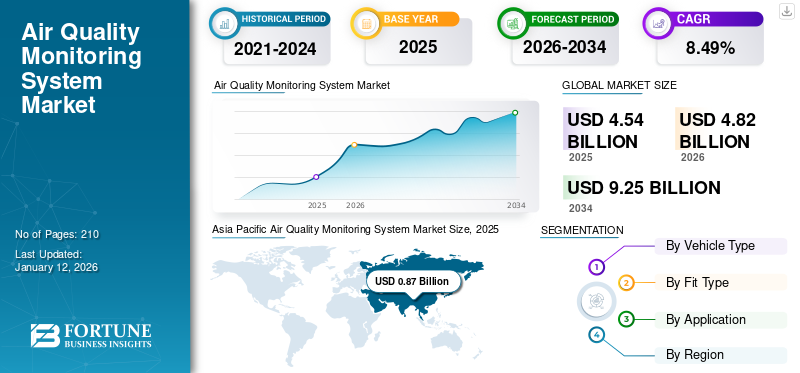
The global air quality monitoring system market size was valued at USD 4.54 billion in 2025 and is projected to grow from USD 4.82 billion by 2026 to USD 9.24 billion by 2034, exhibiting a CAGR of 8.48% during the forecast period. Asia Pacific dominated the air quality monitoring system market with a market share of 32.81% in 2025. North America is expected to dominate the market due to high adoption of outdoor and indoor air quality monitors in the region.
Air quality monitoring systems are utilized for repeated measurement of ‘air pollutants’ or ‘criteria air pollutants’. The contaminated air contains harmful contaminants that are responsible for various health issues. They identify different pollutants such as particulate matter, sulfur dioxide, Volatile Organic Compounds (VOC), carbon monoxide, and nitrous oxide. Air pollution monitoring and controlling data are crucial for assessing air pollution and environmental pollution policies by national and local authorities, public and private companies, and national organizations.
- In Europe, the Ambient Air Quality Directive (2008/50/EC) enforces strict pollutant limits and requires member states to maintain extensive monitoring networks and publicly report air quality data. Similarly, in India, the National Clean Air Programme (NCAP) aims to reduce particulate pollution by 20–30% by 2024 (extended beyond) across more than 130 non-attainment cities, significantly boosting the deployment of Continuous Ambient Air Quality Monitoring Stations (CAAQMS).
The market is expected to witness significant growth owing increasing demand for improving air quality, which has led to growing demand in the market. Rising global pollution levels and government air quality mandates across the globe also propel the market growth.
HORIBA, Ltd. is one of the prominent players in the market. The company is a manufacturer and distributor of environmental measuring instruments, automotive emission measurement systems, and a wide range of scientific analyzers.
Download Free sample to learn more about this report.
Air Quality Monitoring System Market KEY TAKEAWAYS
 Global Market Size & Forecast
- 2025 Market Size: USD 4.54 Billion
- 2026 Market Size: USD 4.82 Billion
- 2034 Forecast Market Size: USD 9.24 Billion
- CAGR: 8.48% from 2026–2034
 Market Share
- Region Asia Pacific dominated the market with a 32.81% share in 2025.
- By Product Indoor monitors are expected to lead with a 50.71% share in 2025.
- By End-use Industry Chemicals segment accounted for the largest share of 53.44% in 2025.
 Key Regional Highlights
Asia Pacific
Asia Pacific USD 0.87 billion in 2025, driven by rapid industrialization and urbanization.
North America
North America USD 1.49 billion in 2025, supported by strict environmental regulations.
Europe
Europe USD 1.14 billion in 2025, driven by advanced monitoring infrastructure.
U.S.
U.S. USD 1.12 billion in 2025, fueled by strong regulatory support and technology adoption.
Japan
Japan USD 0.10 billion in 2025, supported by advanced monitoring technologies and government initiatives.
Read More

AIR QUALITY MONITORING SYSTEM MARKET TRENDS
Technological Advancements Has Emerged As A Notable Trend In The Market
Key players in the market are heavily investing in research and development to create systems that cater to various regions by integrating IoT into these systems. For instance, in November 2024, Google launched a real-time air quality monitoring system named Air View + on Google Maps across India. The system provides region-wise real time air quality data by utilizing a network of sensors and AI. This system provides data on pollutants such as ozone and PM2.5 through Google Maps. Such technological advancements play a major role in driving trends in the market.
MARKET DYNAMICS
MARKET DRIVERS
Download Free sample to learn more about this report.
Favorable Government Initiatives to Boost Market Growth
Governments across the globe are undertaking various regulatory initiatives to cut down and reduce air pollution from multiple sectors by utilizing awareness programs and campaigns. Rising awareness of the severe effects of contaminated air on health has propelled the growth of the global air quality monitoring market.
For instance, in September 2024, the Climate & Clean Air Coalition (CCAC) launched the Air Quality Management Exchange Platform following the UNEA-6 resolution to boost regional cooperation among various governments and improve air quality globally. This platform has been developed to guide national air quality management in meeting World Health Organization (WHO) guidelines and air quality targets. Furthermore, the favorable government regulations related to the control and monitoring of air pollution and the rise in public-private partnerships for AQM solutions have boosted the demand for air quality monitors.
MARKET RESTRAINTS
High Cost of the Systems to Restrain Market Growth
The high installation cost of these systems is expected to restrain the market growth. The high maintenance cost of various pollution monitoring stations also hinders the market development. For instance, Aeroqual provides an outdoor air quality monitoring system at the price of approx. USD 230,000 to USD 250,000/unit, which makes it expensive for general buyers from end-use industries. High costs associated with the maintenance, establishment, and purchase of AQM sensors, as well as the establishment of air quality monitoring stations, coupled with stringent pollution control policies, further restricting the market growth.
MARKET OPPORTUNITIES
Growing Focus on Environmental and Climate Change Initiatives Offers Huge Growth Opportunities for Market Players
Rising environmental and climate change across the globe is expected to create lucrative opportunities for market players in the coming years, propelled by technological advancements and environmental regulations. Moreover, the introduction of carbon neutrality goals will also create opportunities for AQM systems manufacturers. For instance, in December 2024, the U.S. government announced a new carbon emissions target to achieve 61% to 66% below 2005 carbon levels by 2035, which is a part of the updated national contribution to the Paris Agreement. Such targets are announced by various governments across the world and are expected to foster the air quality monitoring systems market growth in the near future.
- India’s Smart Cities Mission alone covers over a hundred cities, each designed to deploy integrated digital solutions, including high-resolution, neighborhood-level air quality monitoring networks. In April 2022, Oizom installed 129 smart air quality monitors across 9 Indian smart cities, including Bhagalpur, Kakinada, and Varanasi, using its Polludrone technology to track PM2.5, gases, and weather. This supports urban air quality goals, saving costs up to 50% in Kakinada.
MARKET CHALLENGES
Lack of Technological Standardization in Product Development to Challenge Market Growth
The industry faces challenges in developing standard products for each country due to variances in environmental policies, levels of pollution, and emission targets. Furthermore, the development of specialized products to cater to the regional markets poses technological and financial challenges to the manufacturers. Hence, different countries and regions varying air quality monitoring processes and management, which poses a significant challenge for market players in developing a standardized product.
Segmentation Analysis
By Type
Indoor Air Quality Monitors Held the Largest Share Due to Increasing Health Implications of Indoor Air Pollution
Based on type, the market is classified into indoor monitors and outdoor monitors.
Indoor monitors held the major share of 50.71% of the market in 2025, owing to the increasing installation of AQM stations and several smart city initiatives undertaken to enhance public awareness of the health implications of indoor air pollution. Furthermore, the growing adaptation of green-building and smart home technologies and increasing preference for pollution-free indoor environments is estimated to drive segmental growth.
Furthermore, outdoor monitors are estimated to grow at the highest CAGR of 8.99% during the projected period. This is due to public-private investments in producing novel and affordable ambient monitoring products, growing industrial use of air pollution monitoring systems, and increasing end-user base.
By Pollutant
Significant Spike In Carbon Emissions Levels To Drive Growth For Chemical Pollutant Segment
Based on pollutant, the market is classified into chemical, physical, and biological.
The chemicals segment accounted for the largest market major share of 53.44% in market in 2025. Owing to the growth in industrialization and car registration, there has been a significant spike in carbon emissions, which fueled the demand for air quality monitoring systems across the globe. Hence, the large volume of industrial activities and cars fosters the growth of the chemical segment and is expected to influence the market growth over the forecast period.
The physical segment is experiencing the highest growth with a CAGR of 9.61% due to intense urbanization and rising health concerns as demand for physical particle sensors is surging for both Indoor Air Quality (IAQ) and outdoor ambient tracking.
By End-User
To know how our report can help streamline your business, Speak to Analyst
Public Infrastructure Dominated Owing To Their High Spending Capacity For AQM Solutions
By end-user, the market is segmented into commercial & residential, public infrastructure, power generation plants, pharmaceutical industry, and others.
In 2025, public infrastructure accounted for the largest air quality monitoring system market share accounting for 34.11% of the market owing to high spending capacity, as various government agencies are using AQM solutions and establishing national AQM networks. Also, air quality monitors play an important role in academic institutes to avoid the health impact and monitor air pollution.
Commercial & residential is expected to grow at CAGR of 8.75% due to growing demand for a high-quality life and rising awareness for protection from severe pollutants that cause health problems.
Air Quality Monitoring System Market Regional Outlook
By geography, the market is studied across North America, Europe, Asia Pacific, Latin America, and the Middle East & Africa.
North America
North America Air Quality Monitoring System Market Size, 2025 (USD Billion)
To get more information on the regional analysis of this market, Download Free sample
North America market emerged as dominating region with valuation of USD 1.49 billion in 2025. The regional market is driven by stringent environmental regulations, technological advancements, and increasing public health awareness. The U.S. dominates the regional market due to strict enforcement of the Clean Air Act and EPA’s National Ambient Air Quality Standards, supported by an extensive network of over 4,000 monitoring stations.
U.S. Air Quality Monitoring System Market
With North America's strong contribution and the U.S. dominance in the region, the U.S. market is having been estimated around USD 1.12 billion in 2025, accounting for roughly 24.70% of the global market. The country dominated the market and also emerged as the fastest-growing country market because it combines the region’s largest installed monitoring base with the strongest regulatory and technology adoption environment.
Europe
Europe emerged as one of the prominent regions with valuation of USD 1.14 billion by 2025. The Europe market is a highly regulated and technologically advanced segment, driven primarily by stringent environmental policies, cross-border air quality directives, and strong public health awareness.
Germany Air Quality Monitoring System Market
Germany’s market in 2025 was around USD 0.18 billion. It is projected to reach USD 0.19 billion by 2026, representing approximately 3.89% of the global market revenues
Asia Pacific
Asia Pacific held the significant share in 2025, valued at USD 0.87 billion, and in 2026 it is estimated to reach USD 0.93 billion.
The Asia Pacific market emerged as fastest-growing regional market globally. Growth is primarily driven by rapid urbanization, industrialization, and severe air pollution levels across countries such as China, India, and Southeast Asia. Governments are increasingly implementing strict air quality regulations and expanding national monitoring networks.
China Air Quality Monitoring System Market
The China market in 2025 was around USD 0.38 billion, accounting for roughly 8.35% of the global market revenues.
China dominated the Asia Pacific market because it combines the region’s largest industrial base with the world’s largest environmental monitoring architecture.
India Air Quality Monitoring System Market
India's market is projected to be one of the largest globally, with 2025 revenues reaching USD 0.18 billion, representing approximately 3.99% of the global market.
Japan Air Quality Monitoring System Market
The Japan market in 2025 is was around USD 0.10 billion, accounting for approximately 2.31% of global revenues.
Latin America
Latin America is expected to witness moderate growth during the forecast period and is set to reach a valuation of USD 0.50 billion in 2026.
The Latin America market is an emerging but steadily expanding one. Growth is primarily driven by increasing urbanization, rising industrial emissions, and growing awareness of air pollution impacts on public health across major economies such as Brazil, Mexico, and rest of Latin America.
Brazil Air Quality Monitoring System Market
Brazil's market is reached approximately USD 0.23 billion by 2025, accounting for a very minor share of the global market.
Middle East & Africa
The Middle East & Africa accounted for market share of 12.16% in 2025 and is expected to witness significant growth during the forecast period. The regional market is set to reach a valuation of USD 0.58 billion in 2026. The market is an emerging but increasingly strategic segment. Growth is primarily driven by rising urbanization, industrial expansion, and increasing awareness of air pollution impacts on public health, particularly in GCC countries, South Africa, and parts of North Africa.
GCC Air Quality Monitoring System Market
The GCC market reached approximately USD 0.24 billion by 2025, accounting for around 5.23% of the global market.
COMPETITIVE LANDSCAPE
Key Industry Players
Vendors Are Actively Expanding Their Market Share Through Partnerships, Business Expansion, And Technological Advancements
The competitive landscape of the global market is dominated by Thermo Fisher Scientific and 3M Company. These companies are some of the major market players. The presence of other major players such as Horiba, PerkinElmer, Testo, Merck, and others makes the market highly competitive. Extensive customer reach and higher brand value, as opposed to other companies, has allowed companies such as Thermo Fisher Scientific and 3M to gain a solid foothold in the global market. For instance, In January 2026, Innovaer Technologies, LLC has launched CM1106UL ultra-low power CO2 sensor which is a new generation of NDIR sensor with a solid-state design and LED light source. These features create a very robust sensor that is resistant to vibration (out-of-box drift) while maintaining measurement accuracy throughout the entire sensing range and installed lifetime of the product.
LIST OF KEY AIR QUALITY MONITORING SYSTEM MARKET COMPANIES PROFILED
- Tisch Environmental (U.S.)
- Thermo Fisher Scientific (U.S.)
- Emerson Electric (U.S.)
- 3M Company (U.S.)
- Horiba, Ltd. (Japan)
- Siemens AG (Germany)
- RXI Instruments (U.S.)
- Testo (Germany)
- Innovaer Technologies (U.S.)
- Chemtrols (India)
- Honeywell (U.S.)
- Aeroqual (New Zealand)
- TSI Incorporated (U.S.)
- Tisch Environmental (U.S.)
KEY INDUSTRY DEVELOPMENTS
- March 2026: Mumbai’s civic body announced plans to deploy 75 hyperlocal air‑quality sensors across pollution‑prone areas such as Deonar and Andheri under the MANAS network, developed with IIT Kanpur. The low‑cost, AI‑enabled system will capture real‑time, neighbourhood‑level data to pinpoint hotspots and guide targeted pollution‑control actions.
- October 2025: Siemens launched redesigned air quality sensors A, redesign of the Siemens ranges of room sensors has Indoor Air Quality Monitoring (IAQ) as a central focus, with the introduction of a traffic light system.
- May 2025: Emerson announced the launch of a new solution for Dust Collector Monitoring and Control which is used in wide range of industries including cement, mining and metals, chemicals and plastics, food and dairy, power, utilities, and more handle materials that generate significant amounts of dust and particulate emissions.
- August 2024: Beijing unveiled an advanced Supervision-Monitoring-Inspection (SMI) mechanism for air pollution control, leveraging IoT, sensors, satellite sensing, and AI-driven large-scale models. This upgrade enables real-time VOC monitoring, 90% accurate target identification, and intelligent emission tracking, reducing PM2.5 from 38 µg/m³ in 2020 to 32 µg/m³ in 2023.
- May 2024: Thermo Fisher Scientific launched 'Make in India' AQMS analyzers, manufactured at its Nashik facility in Maharashtra. Previously imported from the US and China, these are now locally engineered to monitor pollutants and gases precisely, aiding industrial emission regulation in sectors like cement, mining, and power. They assemble into Class 1 CAAQMS in Pune, supporting India's air pollution control efforts.
REPORT COVERAGE
The global air quality monitoring system market research report delivers a detailed insight into the market. It focuses on key aspects, such as leading companies in the market. Besides, the report offers insights into the global market trends & technology and highlights key industry developments. In addition to the factors above, the report encompasses several factors and challenges that contributed to the growth and downfall of the market in recent years.
Request for Customization to gain extensive market insights.
Report Scope & Segmentation
| ATTRIBUTE | DETAILS |
| Study Period | 2021-2034 |
| Base Year | 2025 |
| Estimated Year | 2026 |
| Forecast Period | 2026-2034 |
| Historical Period | 2021-2024 |
| Growth Rate | CAGR of 8.48% from 2026 to 2034 |
| Unit | Value (USD Billion) |
|
Segmentation |
By Type
|
|
By Pollutant
|
|
|
By End-User
|
|
|
By Region
|
Frequently Asked Questions
As per the Fortune Business Insights study, the market size was USD 4.54 billion in 2025 and is and is projected to reach USD 9.24 billion by 2034.
The market is likely to grow at a CAGR of 8.48% over the forecast period.
The public infrastructure end-user segment leads the market
The market size of North America stood at USD 1.49 billion in 2025.
Increased awareness regarding the harmful effects of pollution is the key factor driving market growth.
Some of the top players in the market are Aeroqual, Honeywell, Emerson Electric, and Thermo Fisher Scientific.



- 2021-2034
- 2025
- 2021-2024
- 210
Get 30-60 hrs Free Customization
Expand Regional and Country Coverage, Segments Analysis, Company Profiles, Competitive Benchmarking, and End-user Insights.



















-
US +1 833 909 2966 ( Toll Free )
-
Get In Touch With Us