 Download Free Sample



Get a Quote
Receive a tailored pricing based on your needs.
- Choose license type
- Multiple user options
- Custom scope & coverage
- Fast turnaround
"Designing Growth Strategies is in our DNA"
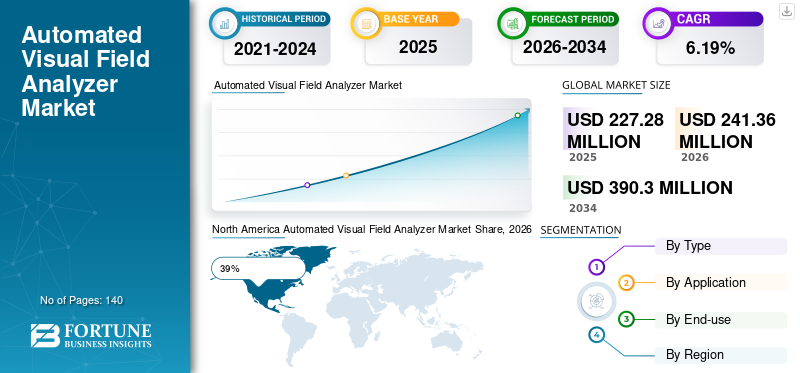
The global automated visual field analyzer market size was valued at USD 227.28 Million in 2025. The market is projected to grow from USD 241.36 Million in 2026 to USD 390.3 Million by 2034, exhibiting a CAGR of 6.19% during the forecast period.

The automated visual field analyzer market is witnessing steady expansion due to the increasing prevalence of ophthalmic disorders, growing elderly populations, and rising awareness regarding preventive eye diagnostics. Automated visual field analyzers are widely used in hospitals, specialty eye clinics, and diagnostic centers for detecting glaucoma, retinal diseases, neurological abnormalities, and optic nerve damage. Technological advancements in perimeter testing systems, touchscreen integration, AI-assisted diagnosis, and compact ophthalmic imaging platforms are accelerating market penetration across developed and emerging economies. The automated visual field analyzer market report highlights increasing investments in precision ophthalmology equipment and digital healthcare infrastructure, strengthening demand for advanced diagnostic systems in clinical environments.
The United States automated visual field analyzer market remains highly developed due to the strong presence of ophthalmology device manufacturers, advanced reimbursement frameworks, and widespread screening programs for glaucoma and retinal disorders. Large hospital networks and specialized ophthalmology clinics continue to adopt automated perimetry systems integrated with electronic medical records and cloud-based patient management solutions. Rising diabetic eye disease cases and increased focus on early vision impairment diagnosis are further driving demand across the country. The Automated Visual Field Analyzer Industry Analysis for the U.S. also indicates increasing deployment of portable and AI-supported devices in ambulatory surgical centers and outpatient eye care facilities.
Download Free sample to learn more about this report.
 Global Market Size & Forecast
 Market Share
 Key Regional Highlights
North America
North America led the market with a 39% share, supported by advanced ophthalmic infrastructure and growing demand for glaucoma diagnosis and monitoring.
Europe
Europe accounted for 28% of the market, driven by established healthcare systems and increasing adoption of advanced ophthalmic diagnostic technologies.
Asia-Pacific
Asia-Pacific held a 15% share, supported by expanding healthcare infrastructure and rising demand for eye-care diagnostics.
U.S
The U.S. remains a key market, supported by advanced ophthalmic care facilities and strong adoption of automated visual field testing technologies.
Japan
Japan accounted for approximately 29% of the Asia-Pacific market, supported by advanced healthcare infrastructure and growing demand for ophthalmic diagnostic solutions.
Read More

The automated visual field analyzer market trends indicate rapid integration of artificial intelligence and machine learning algorithms into ophthalmic diagnostics. Manufacturers are focusing on smart visual field analyzers capable of generating faster and more accurate results while minimizing patient discomfort during testing procedures. AI-enabled progression analysis tools are becoming increasingly popular in glaucoma management, allowing clinicians to monitor disease development with enhanced precision. Digital connectivity features and cloud-based reporting platforms are also improving workflow efficiency in hospitals and specialty eye care centers.
Download Free sample to learn more about this report.
Another significant trend in the automated visual field analyzer market forecast is the growing demand for portable and compact diagnostic devices. Mobile ophthalmology clinics and teleophthalmology services are expanding across rural and underserved regions, increasing the adoption of lightweight visual field analyzers. Touchscreen interfaces, wireless data transfer capabilities, and automated patient guidance systems are improving operational efficiency and reducing examination time. In addition, manufacturers are developing multimodal ophthalmic diagnostic systems that combine visual field testing with retinal imaging and optic nerve analysis, creating integrated diagnostic ecosystems for comprehensive eye care management.
Rising Prevalence of Glaucoma and Retinal Disorders
The increasing incidence of glaucoma, diabetic retinopathy, optic neuropathy, and age-related visual impairments is one of the primary drivers fueling the automated visual field analyzer market growth. Healthcare providers are emphasizing early-stage disease detection to reduce blindness risks and improve long-term treatment outcomes. Automated visual field analyzers play a critical role in identifying functional vision loss before permanent damage occurs, making them essential tools in ophthalmology practices and hospitals.
The growing aging population worldwide is further accelerating demand for ophthalmic diagnostic equipment. Elderly individuals are more vulnerable to visual impairment disorders, increasing the need for routine visual field examinations. The automated visual field analyzer market analysis also highlights expanding government eye health programs and preventive screening campaigns supporting equipment procurement across healthcare facilities. Advancements in perimetry technologies, automated patient monitoring systems, and AI-supported interpretation software are additionally improving diagnostic efficiency and clinician confidence, encouraging wider adoption of these systems in developed and emerging healthcare markets.
High Equipment Costs and Maintenance Requirements
The high acquisition and maintenance costs associated with automated visual field analyzers remain significant barriers for small healthcare providers and clinics. Advanced perimetry systems equipped with AI analytics, digital imaging integration, and cloud connectivity require substantial capital investment. Many small ophthalmology practices in developing regions face budget limitations that restrict adoption of premium diagnostic systems.
Maintenance expenses, calibration requirements, and the need for skilled operators also increase operational costs for healthcare facilities. In addition, healthcare institutions in price-sensitive markets often prefer refurbished ophthalmic equipment instead of purchasing new automated visual field analyzers. The Automated Visual Field Analyzer Industry Report indicates that reimbursement limitations in several countries further affect equipment purchasing decisions. Training requirements for technicians and clinicians can also delay implementation, particularly in regions with limited ophthalmic infrastructure and workforce shortages. These factors collectively create challenges for manufacturers seeking deeper penetration into cost-sensitive healthcare markets.
Expansion of Teleophthalmology and Portable Diagnostics
The rapid growth of teleophthalmology services is creating major opportunities within the automated visual field analyzer market opportunities landscape. Remote eye screening programs are gaining popularity due to increasing healthcare digitization and rising demand for accessible ophthalmic care in rural regions. Portable and compact visual field analyzers are enabling eye specialists to conduct remote diagnostic assessments and improve patient access to preventive eye examinations.
Healthcare providers are increasingly investing in mobile diagnostic units and digital ophthalmology platforms that support real-time patient monitoring and cloud-based result sharing. The automated visual field analyzer market Insights suggest that emerging economies are witnessing substantial opportunities for affordable portable devices that can operate in low-resource settings. AI-powered interpretation software and automated patient guidance systems are further supporting telemedicine integration by reducing dependency on highly specialized ophthalmic personnel. Manufacturers focusing on lightweight, battery-operated, and smartphone-compatible visual field analyzers are expected to gain significant competitive advantages in the evolving global ophthalmology diagnostics sector.
Shortage of Trained Ophthalmic Professionals
A major challenge affecting the automated visual field analyzer market outlook is the shortage of skilled ophthalmologists and trained ophthalmic technicians in many regions. Automated visual field testing requires proper patient positioning, accurate calibration, and careful interpretation of diagnostic reports. Inadequate training can lead to inconsistent test results and reduced clinical reliability.
Emerging healthcare systems often face workforce limitations that hinder the efficient use of advanced ophthalmic diagnostic devices. The lack of specialized training programs and uneven distribution of eye care professionals across rural and urban areas continue to restrict market expansion. In addition, elderly patients may experience difficulty completing visual field examinations due to fatigue, cognitive limitations, or poor test comprehension, increasing the risk of unreliable results. The automated visual field analyzer market Research Report also highlights that integrating advanced AI-driven diagnostic systems into existing clinical workflows can create implementation challenges for healthcare facilities with outdated infrastructure and limited digital capabilities.
Static automated visual field analyzers dominate the automated visual field analyzer market share with approximately 64%. These systems are widely preferred for glaucoma diagnosis and monitoring because they provide highly accurate measurements of retinal sensitivity at fixed points within the visual field. Static perimetry devices are extensively utilized in hospitals, ophthalmology clinics, and specialty diagnostic centers due to their precision and reproducibility in long-term disease tracking.
Manufacturers are integrating advanced software algorithms, touchscreen interfaces, and AI-assisted progression analysis tools into static visual field analyzers to improve diagnostic efficiency. The automated visual field analyzer market report indicates increasing adoption of static analyzers in developed healthcare systems where routine glaucoma screening programs are expanding. Static systems also support integration with electronic medical records and cloud-based patient databases, enhancing workflow management for clinicians. Rising demand for early-stage glaucoma detection and growing awareness regarding preventive ophthalmic examinations continue to strengthen the market position of static automated visual field analyzers globally.
Kinetic automated visual field analyzers account for nearly 36% of the automated visual field analyzer market Size. These devices are commonly used for evaluating neurological visual field defects, advanced retinal diseases, and peripheral vision abnormalities. Kinetic perimetry enables dynamic assessment by moving visual stimuli from non-seeing areas toward visible zones, making it valuable for diagnosing complex neuro-ophthalmic conditions.
The automated visual field analyzer industry analysis shows growing interest in kinetic analyzers for specialized diagnostic applications, particularly in tertiary hospitals and neurological care centers. Manufacturers are improving device portability and automation capabilities to reduce examination complexity and improve patient comfort. Kinetic visual field analyzers are increasingly being used in research institutions and academic medical centers due to their ability to provide detailed mapping of peripheral vision loss. Growing awareness of neurological disorders associated with visual impairment and increasing demand for comprehensive ophthalmic evaluations are supporting the expansion of this segment across multiple healthcare markets.
To know how our report can help streamline your business, Speak to Analyst
Glaucoma remains the leading application segment in the automated visual field analyzer market with approximately 58% share. Automated visual field analyzers are essential tools for glaucoma diagnosis, progression monitoring, and treatment planning. Healthcare providers rely heavily on automated perimetry systems to detect early functional vision loss before irreversible optic nerve damage occurs. The increasing global burden of glaucoma, particularly among aging populations, continues to drive strong demand for automated visual field testing systems. The automated visual field analyzer market analysis highlights growing implementation of glaucoma screening programs across hospitals and specialty ophthalmology clinics. AI-supported progression analysis software and advanced patient tracking capabilities are further enhancing the role of automated visual field analyzers in long-term glaucoma management.
Age-related macular degeneration applications represent around 42% of the automated visual field analyzer market Share. Automated visual field analyzers are increasingly utilized to evaluate central vision defects and monitor disease progression in patients with macular degeneration. Growing elderly populations and rising incidence of retinal degenerative disorders are supporting demand for advanced ophthalmic diagnostic systems in this segment. The automated visual field analyzer market forecast indicates expanding use of visual field analyzers alongside retinal imaging technologies for comprehensive assessment of macular health. Eye care providers are emphasizing early diagnosis and continuous monitoring to improve treatment outcomes and preserve visual function among elderly patients. Technological advancements in visual sensitivity mapping and digital reporting systems are improving diagnostic precision in age-related macular degeneration management.
The automated visual field analyzer market by end-use is expanding steadily due to the increasing adoption of advanced ophthalmic diagnostic technologies across hospitals, specialty eye clinics, ambulatory care centers, and diagnostic laboratories. Healthcare providers are focusing on early detection of glaucoma, retinal disorders, and neurological vision abnormalities, increasing demand for automated perimetry systems in routine ophthalmic examinations. The automated visual field analyzer market analysis indicates that hospitals remain the leading end-use contributors because of their ability to manage large patient volumes and integrate comprehensive ophthalmic diagnostic platforms within centralized healthcare systems. Specialty ophthalmology clinics are also emerging as significant end users due to rising demand for outpatient eye care services and preventive vision screening programs. Increasing investments in digital healthcare infrastructure and AI-enabled ophthalmic devices are supporting adoption across both public and private healthcare facilities
North America Automated Visual Field Analyzer Market Share, 2025 (%)
To get more information on the regional analysis of this market, Download Free sample
North America holds approximately 39% of the automated visual field analyzer market due to advanced healthcare infrastructure, strong ophthalmology research capabilities, and high adoption of digital diagnostic technologies. The region benefits from widespread availability of specialized eye care centers and favorable reimbursement systems supporting ophthalmic diagnostic procedures. Hospitals and ambulatory surgical centers are increasingly investing in AI-enabled visual field analyzers to improve clinical efficiency and patient management.
The automated visual field analyzer market Insights indicate growing demand for integrated ophthalmic platforms that combine visual field analysis with retinal imaging and optic nerve assessment. Increasing prevalence of diabetes-related eye diseases and glaucoma among aging populations is driving equipment adoption across the United States and Canada. Major market participants are focusing on product innovation, cloud-based reporting solutions, and advanced patient monitoring systems to strengthen their regional presence. Teleophthalmology expansion and remote diagnostic programs are also supporting the increasing use of portable visual field analyzers across underserved communities.
Europe accounts for nearly 28% of the automated visual field analyzer market share, supported by well-established healthcare systems and strong awareness regarding preventive eye care. Countries across the region are implementing national screening initiatives for glaucoma and retinal diseases, increasing demand for advanced ophthalmic diagnostic equipment. Hospitals and specialized eye clinics are investing in automated perimetry technologies to improve diagnostic precision and workflow optimization.
The Automated Visual Field Analyzer Industry Report highlights rising adoption of AI-assisted diagnostic systems and digital ophthalmology platforms across European healthcare institutions. Aging demographics and increasing prevalence of visual impairment disorders continue to stimulate market growth. Research collaborations between universities, hospitals, and medical device manufacturers are also accelerating innovation in ophthalmic diagnostics. Portable visual field analyzers are gaining popularity in community healthcare programs and mobile eye examination services, particularly in regions focusing on rural healthcare accessibility.
Germany represents nearly 11% of the European automated visual field analyzer market due to its strong medical technology sector and advanced ophthalmology infrastructure. The country maintains a high concentration of specialized eye hospitals, research institutions, and diagnostic centers utilizing automated ophthalmic equipment for glaucoma and retinal disease management. Increasing healthcare digitization and adoption of AI-based diagnostic solutions are strengthening demand for sophisticated visual field analyzers.
German healthcare providers emphasize preventive ophthalmology and early disease detection, supporting widespread use of automated perimetry systems. The automated visual field analyzer market Research Report indicates growing investments in integrated ophthalmic diagnostic platforms capable of combining retinal imaging, visual field testing, and patient data management. Universities and research laboratories in Germany are also collaborating with medical device manufacturers to develop next-generation visual field analyzers with enhanced diagnostic accuracy and faster testing capabilities.
The United Kingdom contributes approximately 24% of the European automated visual field analyzer market Share. Rising glaucoma prevalence and increasing demand for early-stage ophthalmic diagnostics are driving equipment adoption across hospitals and community eye care clinics. The National Health Service continues to support vision screening programs aimed at reducing preventable blindness and improving access to specialized eye care services.
The automated visual field analyzer market outlook for the United Kingdom highlights increasing use of portable diagnostic systems in outpatient and community healthcare environments. Teleophthalmology services are also expanding, enabling remote visual field assessments and digital patient monitoring. Eye care providers are focusing on reducing diagnostic waiting times by integrating automated perimetry systems with digital workflow management platforms. In addition, growing awareness regarding diabetic eye complications and age-related vision disorders is supporting long-term demand for advanced ophthalmic diagnostic technologies throughout the country.
Asia-Pacific holds around 15% of the automated visual field analyzer market due to expanding healthcare infrastructure, rising healthcare expenditure, and increasing prevalence of ophthalmic disorders. Countries across the region are experiencing growing demand for preventive eye diagnostics as aging populations and diabetes cases continue to rise. Governments are investing in ophthalmology clinics, public screening programs, and digital healthcare modernization initiatives.
The automated visual field analyzer market trends in Asia-Pacific indicate increasing adoption of portable and cost-effective visual field analyzers in emerging economies. Healthcare providers are focusing on improving access to ophthalmic services in rural and underserved regions through telemedicine and mobile eye care programs. Regional manufacturers are also introducing affordable diagnostic solutions to address price-sensitive markets. Rapid urbanization, growing medical tourism, and increasing awareness regarding early glaucoma detection continue to strengthen demand for automated ophthalmic diagnostic equipment throughout the region.
Japan represents approximately 29% of the Asia-Pacific automated visual field analyzer market. The country has a highly advanced healthcare system with strong emphasis on preventive ophthalmology and early disease management. Automated visual field analyzers are widely utilized in hospitals, academic research institutions, and specialized eye clinics for glaucoma monitoring and retinal disease evaluation.
The automated visual field analyzer market analysis for Japan highlights increasing adoption of AI-driven ophthalmic diagnostic systems and compact perimetry devices. Aging demographics remain a major growth factor, as elderly individuals require regular vision assessments and long-term glaucoma monitoring. Japanese manufacturers are actively developing high-precision ophthalmic diagnostic technologies with faster testing algorithms and improved patient interfaces. The country also benefits from strong healthcare technology innovation and substantial investments in digital medical infrastructure supporting automated ophthalmology solutions.
China accounts for nearly 38% of the Asia-Pacific automated visual field analyzer market share. The country is witnessing rapid expansion of ophthalmology services due to increasing healthcare investments, rising diabetes prevalence, and growing awareness regarding preventive eye examinations. Urban hospitals and specialty eye care centers are adopting advanced automated visual field analyzers to improve diagnostic efficiency and patient throughput.
The automated visual field analyzer market opportunities in China are further supported by government healthcare modernization programs and expanding medical device manufacturing capabilities. Telemedicine and mobile eye screening initiatives are increasing adoption of portable diagnostic systems in rural communities. Domestic manufacturers are introducing competitively priced visual field analyzers equipped with digital reporting and AI-assisted analysis features. Rising healthcare expenditure and expanding private ophthalmology networks continue to accelerate market development across the country.
The Rest of World region holds approximately 8% of the automated visual field analyzer market, supported by gradual improvements in healthcare accessibility and ophthalmic infrastructure development. Countries in Latin America, the Middle East, and Africa are increasingly investing in specialized eye care facilities and preventive diagnostic programs to address rising visual impairment cases.
The automated visual field analyzer market Research Report highlights growing demand for affordable and portable ophthalmic diagnostic systems in emerging healthcare markets. International healthcare organizations and government agencies are supporting eye health awareness campaigns and glaucoma screening programs, increasing utilization of automated visual field analyzers. Mobile ophthalmology services and telemedicine initiatives are helping improve access to vision diagnostics in underserved populations. Manufacturers focusing on cost-effective products and simplified operational features are expected to gain stronger market penetration across these developing regions.
The automated visual field analyzer market is attracting significant investments due to increasing demand for advanced ophthalmic diagnostic technologies and growing prevalence of visual impairment disorders worldwide. Medical device manufacturers are expanding research and development activities focused on AI-enabled perimetry systems, portable diagnostic platforms, and cloud-integrated ophthalmic solutions. Venture capital firms and healthcare investors are showing strong interest in digital ophthalmology startups specializing in remote vision assessment technologies and teleophthalmology services.
Emerging economies present substantial investment opportunities as governments continue expanding healthcare infrastructure and preventive eye screening programs. The automated visual field analyzer market opportunities landscape is also benefiting from rising private investments in specialty eye hospitals and outpatient diagnostic centers. Companies are increasingly pursuing strategic collaborations, acquisitions, and distribution partnerships to strengthen geographic expansion and improve product accessibility. Investments in lightweight portable analyzers, wireless connectivity features, and integrated ophthalmic platforms are expected to create new revenue streams and competitive advantages for industry participants over the coming years.
New product development in the automated visual field analyzer market is heavily focused on artificial intelligence integration, portability, and faster diagnostic performance. Manufacturers are introducing next-generation visual field analyzers equipped with AI-assisted progression analysis, automated patient monitoring systems, and enhanced visual sensitivity mapping technologies. These innovations are helping clinicians improve diagnostic accuracy while reducing examination times and patient fatigue.
The automated visual field analyzer market trends also indicate growing development of compact and handheld devices designed for teleophthalmology applications and mobile eye care services. Cloud-based reporting systems and touchscreen interfaces are improving workflow efficiency and simplifying device operation in busy clinical environments. Several manufacturers are integrating visual field testing with retinal imaging and optic nerve assessment technologies to create multifunctional ophthalmic diagnostic platforms. Wireless data transfer capabilities, voice-guided patient instructions, and automated calibration systems are additionally enhancing user convenience and expanding adoption across hospitals, specialty clinics, and remote healthcare facilities.
The automated visual field analyzer market report provides comprehensive analysis of industry trends, growth drivers, restraints, opportunities, competitive landscape, and regional developments influencing global market expansion. The report evaluates technological advancements in automated perimetry systems, AI-assisted ophthalmic diagnostics, and portable visual field analyzers used in hospitals, specialty eye clinics, and research institutions.
Request for Customization to gain extensive market insights.
The automated visual field analyzer industry analysis includes segmentation based on type, application, and regional performance to provide detailed market insights for manufacturers, investors, distributors, and healthcare providers. The report also examines competitive strategies adopted by leading market participants, including product innovation, mergers, partnerships, and geographic expansion initiatives. Market dynamics associated with glaucoma prevalence, teleophthalmology adoption, healthcare digitization, and aging populations are thoroughly assessed to support strategic business planning. In addition, the report highlights emerging opportunities related to portable ophthalmic diagnostics, AI-enabled screening solutions, and integrated digital healthcare ecosystems.
Fortune Business Insights says that the global market value stood at USD 227.28 million in 2025 and is projected to reach USD 390.3 million by 2034.
The market is expected to exhibit a CAGR of 6.19% during the forecast period of 2026-2034.
Static automated visual field analyzers led the type segment with approximately 64% share, supported by their accuracy and widespread use in glaucoma diagnosis and monitoring.
Key players include Carl Zeiss, Haag-Streit AG, Elektron Eye Technology, Heidelberg Engineering, Kowa Company Ltd., and Optopol.
Key trends include AI and machine learning integration for faster, more accurate diagnostics and rising adoption of portable, cloud-connected analyzers for teleophthalmology. North America dominated with approximately 39% market share.


(Offer valid till 15th Nov 2026)
Get 30-60 hrs Free Customization
Expand Regional and Country Coverage, Segments Analysis, Company Profiles, Competitive Benchmarking, and End-user Insights.













.webp)






Get In Touch With Us
US +1 833 909 2966 ( Toll Free )
Receive a tailored pricing based on your needs.
Discuss your questions with our industry experts.
Have questions? Get quick answers before you purchase.

