Agriculture Drone Market Size, Share & Industry Analysis, By End User (Individual Farmers, Agricultural Cooperatives, Drone Service Providers, and Agribusinesses), By Offering (Hardware, Software & Analytics, Drone-as-a-Service, and Training & Maintenance Services), By Platform Type (Multirotor, Fixed-Wing, Hybrid VTOL, and Autonomous Dock-Based Drones), By Application (Crop Monitoring, Precision Spraying, Fertilizer Application, Irrigation Planning, Seeding, and Yield Estimation), By Farm Size (Small Farms, Medium Farms, and Large Commercial Farms), and Regional Forecast, 2026-2034
 Download Free Sample
Agriculture Drone Market Size and Future Outlook
 Listen to Audio Version
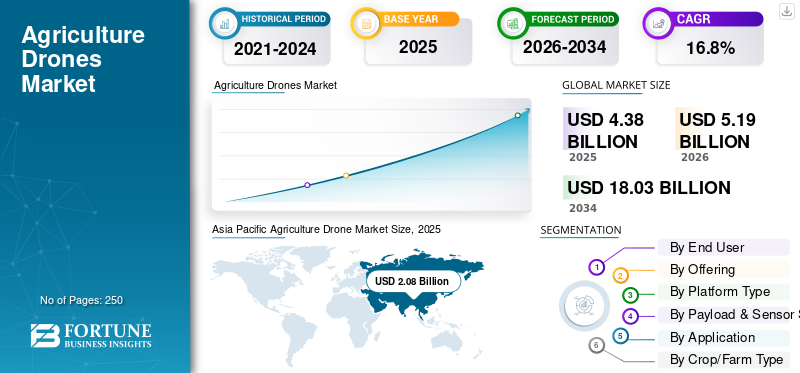
The global agriculture drone market size was valued at USD 4.38 billion in 2025. The market is projected to grow from USD 5.19 billion in 2026 to USD 18.03 billion by 2034, exhibiting a CAGR of 16.8% during the forecast period. Asia Pacific dominated the agriculture drones market with a market share of 47.49% in 2025.
Agriculture drones represent a rapidly expanding segment within the broader aerospace and agri-tech ecosystem, driven by the global transition toward precision farming and smart agricultural practices. Agricultural drones, or Unmanned Aerial Vehicles (UAVs), are equipped with advanced sensors, multispectral cameras, GPS systems, and AI-powered analytics to enable real-time crop monitoring, precision spraying of fertilizers and pesticides, soil mapping, field scouting, and yield forecasting. The market is witnessing mainstream adoption across both large commercial farms and smallholder agricultural operations, fueled by rising food security concerns, acute rural labor shortages, and the growing urgency for sustainable, resource-efficient farming solutions. Continuous innovation in drone hardware, software platforms, and drone-as-a-service (DaaS) business models is broadening accessibility and accelerating deployment across developed and emerging economies.
Key players in the market include DJI, XAG, Yamaha Motor Co. Ltd., Eavision Technologies, and Hylio. These companies compete through superior spraying precision, advanced multispectral and hyperspectral imaging capabilities, autonomous flight systems, AI-powered crop analytics platforms, modular payload architectures, and integrated drone-as-a-service models tailored for precision farming, crop scouting, field mapping, variable-rate application, and large-scale commercial as well as smallholder agricultural operations.
Download Free sample to learn more about this report.
AGRICULTURE DRONE MARKET KEY TAKEAWAYS
 Global Market Size & Forecast
- 2025 Market Size: USD 4.38 billion
- 2026 Market Size: USD 5.19 billion
- 2034 Forecast Market Size: USD 18.03 billion
- CAGR: 16.8% from 2026–2034
 Market Share
- Asia Pacific dominated the market with a 47.49% share in 2025.
- The Drone Service Providers/Custom Applicators segment held the largest market share in 2025.
- The Hardware segment held the largest market share in 2025.
 Key Regional Highlights
Asia Pacific
Reached USD 2.08 billion in 2025, driven by government subsidies, rural labor shortages, and rapid adoption of precision agriculture technologies.
North America
Projected to reach USD 1.32 billion by 2026, supported by widespread precision farming adoption, strong FAA regulations, and USDA-backed funding programs.
Europe
Projected to reach USD 0.92 billion by 2026, growing at a 15.9% CAGR, driven by sustainability-focused farm policies and advanced agri-tech infrastructure.
U.S.
The market is projected to reach USD 1.13 billion by 2026, growing at a 16.6% CAGR during the forecast period.
Japan
The market is projected to reach USD 0.28 billion by 2026, growing at a 15.9% CAGR, supported by smart agriculture initiatives and precision rice cultivation.
Read More

AGRICULTURE DRONE MARKET TRENDS
AI Integration and Autonomous Flight Systems are Redefining Precision Agriculture Operations
The market is experiencing a pronounced shift toward AI-driven autonomy, multispectral imaging, and data-platform convergence. Drones are increasingly embedded with machine learning algorithms that enable real-time crop stress detection, automated flight path optimization, and variable-rate application of inputs. The integration of IoT connectivity allows drones to sync field data collection seamlessly with farm management software, enabling predictive decision-making. Drone-as-a-service (DaaS) models are gaining significant traction, democratizing access for smallholder farmers who cannot afford outright hardware purchases. Simultaneously, regulatory progress around beyond-visual-line-of-sight (BVLOS) operations is enabling broader coverage per sortie, while hybrid drone architectures combining vertical takeoff with fixed-wing endurance are emerging as the next generation of precision agriculture platforms.
MARKET DYNAMICS
MARKET DRIVERS
Download Free sample to learn more about this report.
Rising Labor Scarcity and Mounting Pressure to Maximize Agricultural Productivity are Driving Market Expansion
Heightened global concerns over agricultural labor shortages, driven by rural-to-urban migration and aging farming populations, particularly acute in Japan, Europe, and parts of the U.S., are compelling farms to invest in automated aerial solutions. Agriculture drones directly address this challenge by automating labor-intensive tasks such as pesticide spraying, crop scouting, and field mapping, thereby reducing dependency on manual workforce while improving operational throughput. Additional drivers include escalating demand for food production to meet a projected global population of nearly 10 billion by mid-century, rising agrochemical input costs pushing farmers toward precision variable-rate application, and growing institutional support from governments and multilateral agencies promoting smart and climate-resilient agriculture as a policy priority. This is expected to boost the agriculture drone market growth in the coming years.
MARKET RESTRAINTS
Regulatory Complexity and High Upfront Investment Costs Continue to Inhibit Widespread Deployment
Stringent and fragmented airspace regulations across jurisdictions remain a persistent obstacle to large-scale agriculture drone deployment. The absence of standardized Beyond-Visual-Line-of-Sight (BVLOS) operational frameworks, particularly in North America and Europe, confines most drone operations to limited acreage per flight, undermining their efficiency advantage on expansive farm estates. Compliance with remote identification mandates adds incremental hardware cost to each unit. Simultaneously, the significant capital investment required for advanced drone platforms, combined with ongoing maintenance expenditures, sensor calibration requirements, and the cost of skilled drone operators, places adoption out of reach for many smallholder and resource-constrained farmers, especially in developing regions where financial access to agri-technology remains limited.
MARKET OPPORTUNITIES
Expanding Smallholder Farm Access and Emerging Market Penetration Unlock Transformative Growth
Significant untapped growth potential lies in extending drone adoption to smallholder farming communities across Asia, Africa, and Latin America, where food security pressures and labor shortages are acute. Government subsidy programs, such as India's Namo Drone Didi scheme and China's precision agriculture incentives, are actively catalyzing grassroots adoption. Additionally, the convergence of drone data with crop insurance systems and agri-credit platforms presents a compelling opportunity for financial inclusion in rural economies. AI-powered crop health monitoring, climate-resilient decision support tools, and land-use mapping services represent further high-growth application opportunities for drone manufacturers and agri-tech service providers.
MARKET CHALLENGES
Data Management Complexity and Operator Skill Gaps are Impeding Full Utilization of Drone Capabilities
Despite technological advances, translating the vast volumes of aerial data generated by agricultural drones into actionable agronomic insights remains a critical operational challenge. Farmers and agronomists frequently lack the data analytics expertise, GIS skills, and access to suitable software infrastructure required to effectively process and interpret multispectral imagery, NDVI maps, and sensor outputs. Integrating drone-collected data with existing farm management systems demands additional resources and technical capacity that many agricultural operations, particularly in emerging markets, do not possess. Furthermore, limited battery life constraining flight time to roughly fifteen to thirty minutes, narrow connectivity in rural areas, and sensitivity of sensor accuracy to adverse weather conditions compound operational inefficiencies and slow the transition from drone adoption to sustained, value-generating usage at scale.
Segmentation Analysis
By End User
Rising Outsourcing Trends Fueled Drone Service Providers/Custom Applicators Segment Growth
Based on end user, the market is segmented into individual farmers, agricultural cooperatives/FPOs/SHGs, drone service providers/custom applicators, and agribusinesses, research institutes & government agencies.
The drone service providers/custom applicators segment accounted for the largest market share in 2025, as farmers, especially smallholders, prefer outsourced aerial services over capital-intensive hardware ownership. These providers offer on-demand spraying, scouting, and mapping at cost-per-acre pricing, lowering barriers to precision agriculture adoption without requiring technical expertise from the farmer.
The agribusinesses, research institutes & government agencies segment is anticipated to rise with a CAGR of 16.6% over the forecast period.
To know how our report can help streamline your business, Speak to Analyst
By Offering
Increased Precision Agriculture Infrastructure Requirements Boosted Hardware Segment Growth
Based on offering, the market is segmented into hardware, sensors & payloads, software & farm analytics, drone-as-a-service/custom application services, training, maintenance & compliance services.
In 2025, the hardware segment dominated the global agriculture drone market share, as demand for advanced drone airframes, multispectral sensors, high-capacity spraying systems, batteries, and ground control stations intensifies. Farms expanding into precision agriculture require physically capable, durable platforms with longer flight times and greater payload capacity, sustaining hardware investment as the foundational layer of agricultural drone ecosystems.
The drone-as-a-service/custom application services segment is projected to grow at a CAGR of 20.9% over the forecast period.
By Platform Type
Multirotor Drones to Lead Market Due to Their Superior Maneuverability and Operational Flexibility in Complex Terrain
Based on platform type, the market is segmented into multirotor drones, fixed-wing drones, hybrid VTOL drones, single-rotor/heavy-lift spray drones, and autonomous dock-based/fleet drones.
The multirotor drones segment is anticipated to witness a dominating market share over the forecast period. Multirotor drones are gaining traction due to their ability to hover, take off and land vertically, and operate precisely in confined or irregular agricultural environments such as orchards, vineyards, and fragmented smallholder plots. Their versatility across spraying, close-range scouting, and mapping applications, combined with declining unit costs, makes them the preferred platform across diverse farm scales globally.
The autonomous dock-based/fleet drones segment is projected to grow at a high CAGR of 21.1% over the forecast period.
By Payload & Sensor System
Rising Fertilizer and Pesticide Expenses Boosted Spraying & Liquid Application Payloads Segment Growth
Based on payload & sensor system, the market is segmented into RGB/visual imaging cameras, multispectral & NDVI sensors, thermal/infrared sensors, LiDAR & terrain mapping sensors, spraying & liquid application payloads, and spreading/seeding/granular payloads.
The spraying & liquid application payloads segment dominated the market share in 2025. Rising fertilizer and pesticide expenses are incentivizing farmers to adopt precision spraying payloads that minimize chemical waste through variable-rate and targeted application. Agriculture drones equipped with spraying systems can reduce liquid input usage significantly versus conventional methods, delivering measurable cost savings while supporting regulatory compliance around chemical runoff and environmental sustainability requirements.
Spreading/seeding/granular payloads are projected to grow at a CAGR of 18.4% during the forecast period.
By Application
Early Detection Imperatives and Need for Scalable Field Intelligence Bolstered Crop Monitoring & Field Scouting Segment Growth
Based on application, the market is segmented into crop monitoring & field scouting, precision spraying/crop protection, fertilizer & nutrient application, irrigation planning & water-stress monitoring, seeding/cover-crop broadcasting & granular spreading, and yield estimation/insurance & damage assessment.
The crop monitoring & field scouting segment accounted for the largest market share in 2025, as farmers increasingly require timely, data-rich intelligence on pest infestations, nutrient deficiencies, water stress, and disease spread across large acreages. Drones equipped with multispectral and thermal sensors can scan hundreds of hectares daily, enabling early intervention that conventional ground-based scouting cannot match in speed or coverage.
The precision spraying/crop protection segment is anticipated to rise with a CAGR of 18.7% over the forecast period.
By Crop/Farm Type
Field Crops Segment Led Market Due to Food Security Pressures and Large-Scale Staple Crop Production Requirements
Based on crop/farm type, the market is segmented into field crops, fruits/orchards & vineyards, plantation crops, vegetables & high-value specialty crops, livestock/pasture & rangeland, and greenhouse & protected cultivation.
In 2025, the field crops segment dominated the global market. Field crops, including cereals, grains, oilseeds, and pulses, represent the primary application area for agricultural drones given the vast acreages involved and the critical importance of optimizing yields in staple food production. Precision spraying, NDVI-based health monitoring, and irrigation management across corn, wheat, rice, and soybean fields are generating sustained demand in this segment worldwide.
The greenhouse & protected cultivation segment is projected to grow at a CAGR of 19.7% over the forecast period.
By Farm Size/Operational Scale
Small Farms Below 2 Hectares Segment to Lead Due to Limited Capital Access and Rise of Affordable Service Models
Based on farm size/operational scale, the market is segmented into small farms below 2 hectares, semi-medium farms 2-10 hectares, medium farms 10-50 hectares, large commercial farms 50-500 hectares, estate/broadacre farms above 500 hectares, and multi-farm contract service operations.
The small farms below 2 hectares segment is anticipated to witness a dominating market share over the forecast period 2026-2034, as drone-as-a-service models and government subsidy schemes make aerial technology economically viable at the grassroots level. Programs targeting women-led cooperatives and smallholder groups in India and emerging markets are facilitating rental-based drone access, enabling this segment to benefit from precision spraying and crop monitoring without ownership burden.
The multi-farm contract service operations segment is projected to grow at a high CAGR of 21.9% over the forecast period.
By Mode of Operation
Assisted Flight & Waypoint-Based Operations Segment Led Due to Expanding Regulatory Acceptance
Based on mode of operation, the market is segmented into manual/pilot-controlled VLOS operations, assisted flight & waypoint-based operations, RTK/PPK precision navigation operations, BVLOS/extended-application operations, autonomous fleet/swarm operations, and AI-enabled prescription & decision-support operations.
The assisted flight & waypoint-based operations segment dominated market share in 2025, as farms seek consistent, repeatable aerial coverage with minimal pilot dependency. Pre-programmed flight paths ensure systematic field coverage for spraying and mapping tasks, reduce human error, improve operational efficiency over large estates, and align with evolving regulatory frameworks that prioritize controlled, traceable drone operations.
Autonomous fleet/swarm operations are projected to grow at a CAGR of 21.8% during the forecast period.
Agriculture Drone Market Regional Outlook
By geography, the market is categorized into North America, Europe, Asia Pacific, and the Rest of the World.
Asia Pacific
Asia Pacific Agriculture Drone Market Size, 2025 (USD Billion)
To get more information on the regional analysis of this market, Download Free sample
Asia Pacific held the dominant share in 2024, valued at USD 1.73 billion, and also maintained the leading share in 2025, with USD 2.08 billion. Asia Pacific is the fastest-growing regional market, led by China, India, and Japan. Government subsidies, acute rural labor shortages, large-scale staple crop cultivation, and proactive precision agriculture policies are accelerating the volume of drone deployment at a significant pace.
China Agriculture Drone Market
China’s market is projected to be one of the largest in Asia Pacific, with 2026 revenues estimated at around USD 1.30 billion. China dominates Asia Pacific by volume, with DJI and XAG serving millions of hectares through cost-effective spray drones. Government digital agriculture mandates, national food security priorities, and domestic manufacturing scale are fueling unmatched deployment rates.
Japan Agriculture Drone Market
The Japan market size in 2026 is estimated at around USD 0.28 billion, accounting for roughly 15.9% CAGR during the forecast period. Japan's aging farming population and acute rural labor scarcity are primary drivers, with Yamaha's long-established unmanned helicopter legacy and government smart agriculture programs sustaining strong adoption, particularly in precision rice cultivation.
India Agriculture Drone Market
The Indian market in 2026 is estimated at around USD 0.44 billion. India is a rapidly accelerating market, driven by government schemes such as Namo Drone Didi and NABARD subsidy programs, expanding drone service provider networks, and growing farmer awareness of the economic benefits of aerial spraying and crop scouting.
North America
North America is estimated to reach USD 1.32 billion in 2026 and secure the position of the second-largest region in the market. Market growth in North America is driven by widespread precision agriculture adoption, strong FAA regulatory frameworks, large commercial farm estates, and robust USDA-backed financial support programs incentivizing aerial platform investments.
U.S. Agriculture Drone Market
Based on North America’s strong contribution and the U.S. dominance within the region, the U.S. market can be analytically approximated at around USD 1.13 billion in 2026, representing roughly 16.6% CAGR over the forecast period. The U.S. commands global precision agriculture with over two million farms, FAA streamlining of commercial UAV permits, large-scale corporate farming reliance on precision inputs, and USDA conservation loan programs actively subsidizing aerial platform deployment.
Europe
Europe is projected to record a CAGR of 15.9% during the forecast period and reach a valuation of USD 0.92 billion in 2026. Europe holds a substantial market share, propelled by sustainability-linked farm subsidy policies, advanced agri-tech infrastructure in Germany, France, and the Netherlands, and EU digital agriculture directives that are embedding drone use into mainstream farm management practices.
U.K. Agriculture Drone Market
The U.K. market size in 2026 is estimated at around USD 0.13 billion, representing roughly 14.7% CAGR over the forecast period. The U.K. supports drone adoption through per-hectare government payments for camera-guided applications, with estates in arable and horticulture sectors increasingly deploying drones for compliance-driven, sustainable crop management.
Germany Agriculture Drone Market
Germany’s market is projected to reach approximately USD 0.22 billion in 2026. Germany is a leading European market, combining advanced farming infrastructure, strong agri-tech R&D investment, and EU Common Agricultural Policy sustainability compliance requirements that incentivize data-driven, drone-assisted precision farming practices.
Rest of the World
The rest of the world includes the Middle East & Africa and Latin America. These regions are expected to witness moderate growth in this market space during the forecast period. The Middle East & Africa and Latin America markets are set to reach a valuation of USD 0.22 billion and USD 0.26 billion in 2026. The Rest of the World, encompassing Latin America, the Middle East & Africa, is emerging steadily. Brazil's extensive agricultural base, Gulf food security initiatives, and growing African agri-tech investments are gradually expanding drone adoption in these regions.
COMPETITIVE LANDSCAPE
Key Industry Players
Major Companies Focus on Autonomous Spraying, Precision Farm Analytics, and Service-Based Drone Deployment to Boost Market Growth
The agriculture drone market is being strengthened by key players that are shifting farm drones from basic aerial imaging tools toward autonomous, data-driven, and application-ready precision agriculture platforms. Companies such as DJI, XAG, Yamaha Motor Co., Ltd., Eavision Technologies, and Hylio are focusing on high-capacity spraying drones, multispectral crop sensing, RTK-enabled mapping, autonomous flight planning, variable-rate application, farm-data analytics, and drone-as-a-service models. DJI is expanding large- and small-farm adoption through its Agras T50 and T25 platforms, while XAG is strengthening its international presence through autonomous spraying and spreading drones supported by regional partnerships in markets such as Thailand and the U.K.
Yamaha continues to support commercial agricultural spraying through its unmanned helicopter portfolio, especially in high-value and plantation-style crop applications. Meanwhile, Hylio is positioning its U.S.-built AgDrones around autonomous and swarm-enabled crop application, while AgEagle, Sentera, Wingtra, Delair, and DroneDeploy are contributing through multispectral sensors, high-accuracy aerial mapping, crop-health analytics, and cloud-based farm intelligence platforms. These strategies are helping shift the market from standalone drone hardware toward integrated precision-farming ecosystems, where farmers, cooperatives, agribusinesses, and custom applicators use drones to reduce labor dependency, improve input efficiency, enhance crop visibility, and support more scalable farm operations.
LIST OF KEY AGRICULTURE DRONE COMPANIES PROFILED
- DJI (China)
- XAG (China)
- Yamaha Motor Co., Ltd. (Japan)
- Eavision Technologies (China)
- Hylio (U.S.)
- AgEagle Aerial Systems (U.S.)
- Delair (France)
- Wingtra (Switzerland)
- Sentera (U.S.)
- DroneDeploy (U.S.)
KEY INDUSTRY DEVELOPMENTS
- December 2025: Jyoti Global Plast introduced AeroCrop UAS, a new agricultural drone developed to improve the efficiency, safety, and precision of crop-spraying operations. Backed by more than four decades of experience in plastic and FRP molding, the company is moving further into the unmanned systems space. With AeroCrop UAS, Jyoti Global Plast is targeting practical farming challenges in India while supporting the broader shift toward precision agriculture.
- April 2024: DJI, a leading civilian drone manufacturer, announced the global launch of its Agras T50 and Agras T25 agricultural drones. The Agras T50 is built for high-efficiency, large-scale farm operations, while the Agras T25 is positioned as a more portable option for smaller fields. Both models are integrated with DJI’s upgraded SmartFarm app, enabling more effective management of aerial application activities.
- March 2023: Avikus and Korea Shipbuilding & Offshore Engineering, a Hyundai subsidiary, signed an agreement to conduct a fuel-efficiency experiment using autonomous navigation systems. The project involved five organizations: POS SM, Pan Ocean, Korea Shipbuilding & Offshore Engineering, Korean Register of Shipping, and Avikus.
- February 2023: XAG, a smart agriculture technology company, partnered with FarmInno to introduce fully autonomous agricultural drones in Thailand. Through this collaboration, the companies aimed to launch autonomous farming drones equipped with intelligent control systems.
- January 2023: XAG announced that the U.K. Civil Aviation Authority granted operational approval for its P40 and V40 agricultural spraying drones. This marked the first approval allowing drone-based spraying and spreading operations on U.K. farms.
REPORT COVERAGE
The agriculture drone market report outlines key drivers of market growth and challenges to expansion, delivering a detailed overview of the maritime industry landscape. The research offers a detailed analysis of emerging trends and rapidly adopted technologies in the industry across key regions. The study highlights recent advancements to boost industry insights and support stakeholders in making well-informed decisions.
Request for Customization to gain extensive market insights.
Report Scope & Segmentation
| ATTRIBUTE | DETAILS |
| Study Period | 2021-2034 |
| Base Year | 2025 |
| Forecast Period | 2026-2034 |
| Historical Period | 2021-2024 |
| Growth Rate | CAGR of 16.8% from 2026 to 2034 |
| Unit | Value (USD Billion) |
| Segmentation | By End User, By Offering, By Platform Type, By Payload & Sensor System, By Application, By Crop/Farm Type, By Farm Size/Operational Scale, By Mode of Operation, and Region |
| By End User |
|
| By Offering |
|
| By Platform Type |
|
| By Payload & Sensor System |
|
| By Application |
|
| By Crop/Farm Type |
|
| By Farm Size/Operational Scale |
|
| By Mode of Operation |
|
| By Region |
|
Frequently Asked Questions
According to Fortune Business Insights, the global market value stood at USD 4.38 billion in 2025 and is projected to reach USD 18.03 billion by 2034.
In 2025, the market value in Asia Pacific stood at USD 2.08 billion.
The market is expected to exhibit a CAGR of 16.8% during the forecast period of 2026-2034.
By end user, the drone service providers/custom applicators segment dominated the market.
Rising labor scarcity and mounting pressure to maximize agricultural productivity are driving market growth.
DJI, XAG, Yamaha Motor Co. Ltd., Eavision Technologies, and Hylio are a few major players in the global market.
Asia Pacific dominated the market in 2025.



- 2021-2034
- 2025
- 2021-2024
- 250
Get 30-60 hrs Free Customization
Expand Regional and Country Coverage, Segments Analysis, Company Profiles, Competitive Benchmarking, and End-user Insights.




















Related Reports
-
US +1 833 909 2966 ( Toll Free )
-
Get In Touch With Us