Automotive Cabin Air Quality Sensor Market Size, Share & Industry Analysis, By Sensor Type (Gas Sensors, Particulate Sensors, and Others), By Technology (Optical Particle Sensing, Metal Oxide Semiconductors (MOS), Electrochemical Sensing, and Others), By Vehicle Type (Passenger Cars (Sedan/Hatchback, SUV), Commercial Vehicles (LCV, HCV), and Electric Vehicles), By Sales Channel (OEM and Aftermarket), and Regional Forecast, 2026-2034
 Download Free Sample
(Offer valid till 15th Oct 2026)

AUTOMOTIVE CABIN AIR QUALITY SENSOR MARKET SIZE AND FUTURE OUTLOOK
 Listen to Audio Version
The global automotive cabin air quality sensor market size was valued at USD 0.85 Billion in 2025 and is expected to increase from USD 0.91 Billion in 2026 to USD 1.64 Billion by 2034, reflecting a compound annual growth rate (CAGR) of 7.64% during the forecast period. North America dominated the global market with a share of 40.62% in 2025.
Automotive cabin air quality sensors are sophisticated devices designed to monitor and improve the air quality within a vehicle's interior by detecting various pollutants, such as Volatile Organic Compounds (VOCs), particulate matter, carbon dioxide, and other harmful gases. These sensors play a crucial role in enhancing passenger comfort and safety by ensuring that cabin air is clean and contaminant-free.
Their impact on the automotive industry is multifaceted; they contribute to the development of advanced climate control systems, improve vehicle resale values by ensuring healthier environments, and comply with increasingly stringent regulations regarding air quality and emissions. As consumer demand for healthier and more environmentally friendly vehicles rises, manufacturers are integrating these sensors into their designs, aligning with trends in electrification and automation. This stimulates innovation and helps automotive companies differentiate their products in a competitive market where air quality and passenger well-being are becoming paramount.
According to the OICA, overall vehicle sales experienced an upturn in 2023 compared to 2022, which indirectly reflects a rise in sales of luxury vehicles. As the market for luxury and premium vehicles expands, the demand for advanced cabin air quality sensors is also expected to grow.
The market is witnessing significant growth, driven by increasing consumer awareness of air quality and expanding regulations surrounding vehicle emissions. These sensors are essential to modern vehicles, designed to monitor and improve the air quality within the cabin by detecting harmful pollutants, allergens, and particulate matter. As the automotive industry shifts toward enhancing passenger comfort and safety, there is a growing emphasis on integrating advanced technologies such as Micro-Electromechanical Systems (MEMS) and gas detection technology into sensor design. Additionally, increasing electric vehicles and smart transportation systems further fuels the demand for advanced air quality management solutions, positioning automotive cabin air quality sensors as a critical component for future mobility innovations. Hence, manufacturers are increasingly investing in research and development to offer more efficient, accurate, and cost-effective solutions that cater to the evolving needs of both consumers and regulatory bodies.
Several key players, including Robert Bosch GmbH, Renesas Electronics Corporation, Hella GmbH, Honeywell International, and Valeo, dominate the automotive cabin air quality sensors market. These companies are at the forefront of developing innovative sensor technologies that enhance in-vehicle air quality monitoring. Robert Bosch GmbH is known for its advanced engineering and automotive solutions, while Renesas Electronics focuses on semiconductor solutions that support smart vehicle applications. Hella GmbH specializes in lighting and electronics, contributing to air quality management systems. Honeywell International brings extensive experience in environmental sensors, and Valeo is recognized for its commitment to sustainability and smart mobility solutions. Together, these companies are driving advancements in automotive cabin air quality sensors, responding to the increasing demand for healthier and more comfortable driving experiences.
The COVID-19 pandemic significantly affected the global industry, disrupting production, supply chains, and consumer demand. Factory closures led to a shortage of semiconductors and general supply chain issues, which increased prices for electronics, energy, and raw materials. However, the industry began to adapt, and a gradual recovery occurred as consumers shifted toward safety solutions. With the growing industry, the demand for automotive cabin air quality sensors is also anticipated to grow simultaneously.
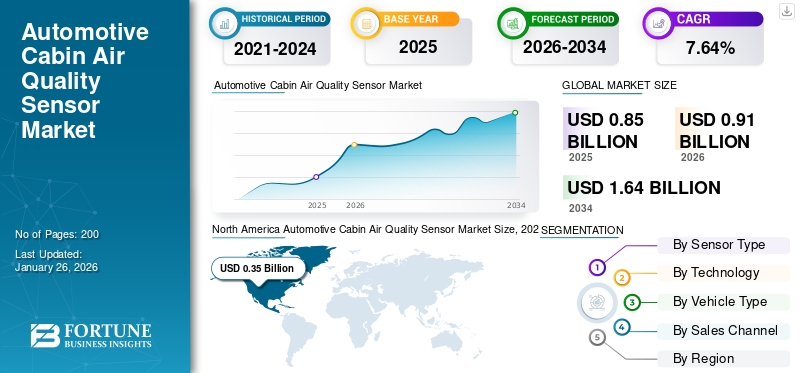
Download Free sample to learn more about this report.
Automotive Cabin Air Quality Sensor Market Takeaways
 Global Market Size & Forecast
- 2025 Market Size: USD 0.85 billion
- 2026 Market Size: USD 0.91 billion
- 2034 Forecast Market Size: USD 1.64 billion
- CAGR: 7.64% from 2026–2034
 Market Share
- North America dominated the automotive cabin air quality sensor market with a 40.62% share in 2025.
- The gas segment is projected to account for a 59.66% market share in 2026.
- The electrochemical sensing segment is expected to hold a 53.28% share in 2026 and is supported by the market's 7.64% CAGR during the forecast period.
 Key Regional Highlights
North America
North America generated USD 0.35 billion in 2025 and is projected to reach USD 0.37 billion in 2026, maintaining its leading market position.
Europe
Europe accounted for 27.21% of the global market in 2025, with revenue expected to increase from USD 0.23 billion to USD 0.25 billion in 2026.
Asia Pacific
Asia Pacific represented 21.34% of the global market in 2025, generating USD 0.18 billion, and is projected to reach USD 0.19 billion in 2026.
U.S.
The U.S. automotive cabin air quality sensor market is expected to reach USD 0.23 billion in 2026, driven by rising demand for advanced in-cabin air quality monitoring systems.
Japan
The Japan automotive cabin air quality sensor market is projected to reach USD 0.04 billion in 2026, supported by increasing adoption of smart vehicle technologies and stringent emission standards.
Read More

AUTOMOTIVE CABIN AIR QUALITY SENSOR MARKET TRENDS
Integration of Advanced Sensor Technologies Propel Market Growth
The integration of advanced technologies such as Micro-Electromechanical Systems (MEMS), optical sensors, and gas detection technologies is significantly transforming the automotive cabin air quality sensor. MEMS technology, known for its miniaturization and precision, enables the development of compact and cost-effective sensors that can efficiently detect a wide range of airborne pollutants with low energy consumption. Optical sensors, on the other hand, enhance the capability of these devices by providing real-time measurements of particulate matter and gas concentrations within the cabin, improving the accuracy of air quality assessments.
Gas detection technologies, particularly those utilizing advanced algorithms, allow for the identification of specific harmful gases, including Volatile Organic Compounds (VOCs) and carbon monoxide, ensuring that drivers and passengers are alerted to hazardous conditions immediately. The implementation of these sophisticated technologies boosts the functionality and reliability of automotive cabin air quality sensors. Additionally, it aligns with the growing consumer demand for healthier and safer in-vehicle environments. This technological evolution is enabling automakers to provide advanced and responsive air quality management systems, thus playing a crucial role in meeting regulatory standards and enhancing overall user experience.
According to the WHO, the combined impacts of ambient air pollution and household air pollution are linked to 6.7 Billion premature deaths each year. This disturbing statistic is driving manufacturers to create improved air quality sensors for vehicles.
MARKET DYNAMICS
MARKET DRIVERS
Amplified Demand for Sophisticated Air Quality Sensors in Response to Rising Air Pollution Fuels Market Growth
The growth of the automotive industry in emerging markets is playing a pivotal role in shaping the automotive cabin air quality sensor. As economies in regions such as Southeast Asia, Latin America, and Africa continue to expand, there is a significant rise in vehicle ownership and demand for advanced automotive features. Consumers in these markets are becoming increasingly aware of the importance of indoor air quality, driven by urbanization and heightened pollution levels in major cities. Therefore, there is a rising demand for vehicles to be equipped with technologies that ensure cleaner and safer cabin environments.
Automakers are responding to this demand by integrating sophisticated cabin air quality sensors that can detect and monitor pollutants in real time, enhancing the driving experience and ensuring compliance with emerging regulations focused on air quality. Furthermore, the increase in disposable incomes in these regions is fostering a shift toward premium vehicles that incorporate advanced features such as climate control systems and air quality monitoring, further bolstering the market. This development offers significant opportunities for manufacturers to innovate and tailor their offerings to meet the specific needs of consumers in emerging markets, ultimately driving the adoption of air quality technologies on a global scale.
MARKET RESTRAINTS
Maintenance and Calibration Need to Affect Buying Decisions of Consumers
Maintenance and calibration requirements present a significant barrier to the widespread adoption of cabin air quality sensors in the automotive market. These sensors need regular upkeep to ensure accurate and reliable operation, which includes periodic recalibration to account for sensor drift, environmental changes, and extended usage. For consumers, investing time and money into ongoing maintenance can be unappealing, especially when budgets are tight or when they perceive these sensors as secondary to other essential vehicle features.
Additionally, the complexity associated with such maintenance may deter consumers, as many may be unfamiliar with the technology and its requirements, resulting in concerns about potential costs and service availability. This reluctance may inhibit automakers from integrating advanced cabin air quality systems into their vehicles, as manufacturers must manage the appeal of new ideas against the practicality of consumer acceptance. Consequently, the necessity for maintenance and calibration can alter the perception of value-added features into an obstacle for both manufacturers and consumers, potentially stalling growth in the cabin air quality sensor market.
Download Free sample to learn more about this report.
Market Opportunities
Increasing Demand for Smart Vehicle Technologies Construct Growth Opportunities
The market is poised for significant growth, presenting a range of opportunities driven by increasing consumer demand for enhanced vehicle comfort and health. With rising awareness of air quality issues and their impact on passenger well-being, manufacturers are seizing the opportunity to integrate sophisticated sensors that monitor and evaluate air quality in real-time. This technology can detect pollutants, particulates, and allergens, enabling vehicles to automatically adjust ventilation systems and activate air purification features, thereby ensuring a healthier cabin environment.
Moreover, as smart vehicle technologies and Internet of Things (IoT) capabilities are evolving, there is a growing opportunity for the development of connected air quality solutions that can provide data analytics and insights to both consumers and manufacturers. These connected systems can enhance user experience by offering personalized settings and alerts based on real-time air quality data.
Market Challenges
Higher Costs for Integrating New Sensors into Existing Vehicle Systems Create Obstacles for Growth
The market faces several challenges that could impede its growth and wider adoption of vehicles. One of the primary challenges is the integration of these sensors into existing vehicle systems, which necessitates advanced technology and substantial investment in R&D and manufacturing processes. As automobiles become increasingly digitized, the complexity of ensuring seamless communication between cabin air quality sensors and other vehicle systems can pose technical hurdles. Furthermore, there are concerns about the accuracy and reliability of these sensors, as they must consistently deliver precise readings in varying environmental conditions, which can be difficult to achieve.
According to the Global Fuel Economy Initiative, In India, passenger cars make up about 13.4% of the total operating vehicle fleet. Integration of these sensors in such an expanding fleet is one of the significant challenges for the manufacturers.
SEGMENTATION ANALYSIS
By Sensor Type
Gas Sensors to Dominate with Their Critical Role in Monitoring and Maintaining a Safe and Healthy Environment within Vehicles
Based on sensor type, the market is segmented into gas sensors, particulate sensors, and others.
The gas sensors segment is poised to dominate the market, owing to its critical role in monitoring and assessing the various harmful gases and pollutants that can affect passenger comfort and health. The gas segment is projected to dominate the market with a share of 59.66% in 2026. Gas sensors, including those designed to detect carbon monoxide (CO), carbon dioxide (CO2), volatile organic compounds (VOCs), and nitrogen dioxide (NO2), offer real-time data that helps ensure a safe and pleasant cabin environment. With consumers’ increasing awareness of air quality issues, the demand for sophisticated solutions also increases, which effectively measure and manage these pollutants.
Furthermore, advancements in sensor technologies, such as miniaturization and improved sensitivity, have made gas sensors increasingly reliable and cost-effective, encouraging manufacturers to integrate them into their vehicle models. Additionally, stringent regulatory standards concerning emissions and cabin air quality are driving automotive manufacturers to equip vehicles with advanced gas detection systems. As a result, gas sensors are not only crucial for enhancing passenger safety and comfort. Still, they are also becoming an essential component in meeting regulatory compliance, positioning them as a dominant force within the market.
The particulate sensors segment is poised for robust growth, as consumers are increasingly prioritizing vehicles with enhanced air quality features, which align with broader trends in health consciousness and environmental sustainability in the automotive industry.
Moreover, the others segment containing Volatile Organic Compound (VOC) Sensors, Humidity & Temperature Sensors, and Carbon Dioxide (CO2) Sensors are anticipated to grow significantly during the forecast period.
To know how our report can help streamline your business, Speak to Analyst
By Technology
Electrochemical Sensing Technology to Lead Due to Its Precision and Effectiveness in Hazardous Gas Detection at Low Concentrations
Based on technology, the market is segregated into optical particle sensing, Metal Oxide Semiconductors (MOS), electrochemical sensing, and others.
Electrochemical sensing segment is expected to lead the market, contributing 53.28% globally in 2026 due to its high sensitivity, selectivity, and capability to detect trace levels of harmful gases, such as carbon monoxide, nitrogen dioxide, and volatile organic compounds. As vehicle manufacturers increasingly prioritize passenger health and comfort, the demand for advanced air quality monitoring systems has surged. Electrochemical sensors offer real-time data and rapid response times, enabling proactive measures to enhance cabin air quality. Moreover, their compact size and low power consumption prepare them for seamless integration into existing automotive systems at minimal cost. As vehicle emission standards become stricter, the adoption of electrochemical sensors is expected to accelerate. This encourages innovation and further developments in this sector, ultimately contributing to safer and more pleasant driving experiences.
The Metal Oxide Semiconductors (MOS) segment is expected to experience significant growth in the market due to its reliable operation and versatility in detecting a wide range of gases, including carbon monoxide and hydrocarbons. MOS sensors utilize the change in resistance of metal oxide materials when exposed to specific gases, which enables them to deliver rapid and reliable air quality assessments. As automotive manufacturers focus on developing smarter, more energy-efficient air quality monitoring systems to meet consumer demands and regulatory requirements, the MOS segment is likely to solidify its position as a critical component in ensuring healthier cabin environments, ultimately driving significant market growth.
Also, optical particle sensing and the others segments are anticipated to grow significantly owing to the increasing technological advancement in air quality sensing technology. The optical particle sensing segment is expected to exhibit a CAGR of 8.50% during the forecast period.
By Vehicle Type
Passenger Vehicles Lead Due to Consumer Priority for Comfortable and Safe Driving Experience for Longer Commutes
Based on vehicle type, the market is segregated into passenger cars, commercial vehicles, and electric vehicles. Further, the passenger cars segment is bifurcated into sedan/hatchback and SUV, the commercial vehicles segment is bifurcated into LCV and HCV.
The passenger segment will account for 47.24% market share in 2026. The passenger segment of vehicle types is substantially dominating the market growth, mainly motivated by rising consumer awareness regarding health and well-being inside vehicles. As more individuals prioritize a comfortable and safe driving experience, especially in the context of longer commutes and heightened concerns about air pollution, manufacturers are investing in advanced air quality management systems tailored for passenger vehicles. This segment benefits from the surge in demand for features that monitor and improve cabin air quality, such as sensors that detect harmful particulate matter and volatile organic compounds.
The commercial vehicle segment is anticipated to experience significant CAGR of 7.80% during the forecast period, fueled by increasing regulatory mandates and a heightened focus on driver health and safety. As governments worldwide implement stricter emissions standards and occupational health regulations, there is a growing demand for advanced air quality monitoring systems in commercial vehicles to ensure compliance and protect the well-being of drivers and passengers. Moreover, the electric vehicle segment is also gaining prominence owing to the shift of consumers from ICE to electric vehicles.
By Sales Channel
OEM Segment is Anticipated to Dominate Owing to Increasing Vehicle Production
Based on sales channel, the market is segregated into OEM and aftermarket.
The OEM (Original Equipment Manufacturer) segment is expected to account for 70.04% of the market in 2026, primarily fueled by the increasing vehicle production rates across the globe. As vehicle manufacturers strive to enhance the safety and comfort of their offerings, there is a notable shift toward incorporating advanced cabin air quality sensors within new models. OEMs are proactively investing in innovative sensor technologies to differentiate their vehicles in a competitive market, thus driving the adoption of sophisticated air quality monitoring systems. Moreover, the push for Electric Vehicles (EVs) and hybrids further accelerates the need for efficient cabin air quality management, as these vehicles are often equipped with advanced climate control technologies. The alignment of OEM strategies with market trends, coupled with expanding production capacities, positions the OEM segment as a critical driver of automotive cabin air quality sensor market growth in the coming years.
The aftermarket is expected to hold CAGR of 6.30% during the forecast period, driven by increasing consumer awareness of health and environmental issues related to air quality in vehicles. As drivers become more conscious of the pollutants and allergens present inside their cars, there is a growing demand for aftermarket solutions that can enhance cabin air quality. Additionally, an increase in used vehicle sales and the expansion of e-commerce platforms offering automotive parts contribute to the growth of the aftermarket segment, making these technologies more accessible to a broader audience. Furthermore, vehicle owners are increasingly seeking to customize their driving experience by integrating smart technologies that provide real-time air quality data, thereby enhancing the appeal of aftermarket sensors. As a result, the aftermarket segment is positioned for rapid expansion, reflecting a shift in consumer priorities for improved health and wellness in vehicular environments.
AUTOMOTIVE CABIN AIR QUALITY SENSOR MARKET REGIONAL OUTLOOK
The market is segmented into North America, Europe, Asia Pacific, and the rest of the world based on the region.
North America
North America Automotive Cabin Air Quality Sensor Market Size, 2025 (USD Billion)
To get more information on the regional analysis of this market, Download Free sample
North America Holds Highest Market Share Owing to Increasing Demand for Vehicle Technology
North America holds the highest automotive cabin air quality sensor market share, motivated by a notable rise in demand for advanced vehicle technology in the region. As consumers become more aware of the impact of air quality on health and well-being, automakers are prioritizing the integration of sophisticated sensors that monitor and improve cabin air quality. The advent of stricter regulatory standards concerning vehicle emissions and indoor air quality has further propelled the need for these innovative technologies. North America maintained a strong presence in the global market, reaching USD 0.35 billion in 2025, accounting for 40.62% share, and is expected to reach USD 0.37 billion in 2026.
The growing trend toward electric vehicles and the development of smart cities, which emphasize sustainable urban mobility, have accelerated the adoption of advanced air quality monitoring systems in vehicles. This surge in demand is supported by ongoing research and development activities aimed at enhancing sensor accuracy and functionality, thereby solidifying North America's leadership position in this market segment. As the automotive industry increasingly focuses on consumer comfort and health, the cabin air quality sensor market is expected to witness continued growth in the region, reflecting the intersection of technological advancement and consumer awareness.
The U.S. market is expected to stand at USD 0.23 Billion in 2026 and it is poised for significant growth, driven by increasing consumer awareness of air quality and health concerns associated with in-vehicle environments. As more people recognize the importance of clean air while driving, automakers are integrating advanced air quality sensors into their vehicles to monitor and improve cabin air conditions. Additionally, stringent regulations aimed at reducing vehicle emissions and enhancing passenger comfort are further propelling the demand for these sensors. Technological advancements, such as the development of more sensitive and accurate sensors and the integration of smart features that can automatically adjust air filtration systems, are also contributing to market expansion. As electric and hybrid vehicles gain popularity, the need for effective air quality management systems will likely continue to rise, positioning the market for robust growth in the coming years.
Asia Pacific
Asia Pacific is anticipated to witness significant growth owing to rapid urbanization in China and India, which are contributing to higher vehicle ownership and, consequently, a greater focus on air quality within vehicles. The Asia Pacific market accounted for USD 0.18 billion in 2025, representing 21.34% of the global industry, and is expected to reach USD 0.19 billion in 2026. This has led to a demand for advanced air quality monitoring systems in vehicles to ensure a healthier driving environment. The market value in China is expected to be USD 0.1 Billion in 2025.
On the other hand, India is projecting to hit USD 0.02 Billion and Japan is likely to hold USD 0.04 Billion in 2026.
Europe
Europe is expected to be the second dominating region owing to the government regulations and standards aimed at reducing emissions and improving cabin air quality, which encourages automotive manufacturers to integrate advanced sensors in their vehicles. In 2025, Europe generated USD 0.23 billion, contributing 27.21% to global market revenue, and is projected to grow to USD 0.25 billion in 2026. The market value in U.K. is expected to be USD 0.03 Billion in 2026.
On the other hand, Germany is projecting to hit USD 0.06 Billion in 2026 and France is likely to hold USD 35.4 Million in 2025.
Rest of the World
Moreover, the rest of the world market involving regions such as Latin America and the Middle East & Africa are also exhibiting stable growth, with manufacturers increasingly adopting innovative technologies, including environmental monitoring systems that enhance the driving experience. Rest of the World accounted for USD 0.09 billion in 2025, representing 10.80% of the global market share, and is projected to reach USD 0.1 billion in 2026.
COMPETITIVE LANDSCAPE
KEY INDUSTRY PLAYERS
Companies Focus on Providing Region-Specific Air Sensing Technologies to Gain Strong Foothold
Robert Bosch GmbH offers a wide range of automotive components, including sensors and electronics, that can be integrated into various vehicle models, making them a versatile supplier for automotive manufacturers. With increasing regulatory pressures and consumer demand for sustainable practices, Bosch's commitment to produce environmentally friendly technology aligns with the growing need for effective cabin air quality sensors.
The market is moderately diversified, incorporating a variety of established automotive suppliers, semiconductor companies, and newer entrants focused specifically on sensor technologies. This diversity leads to a mix of products and solutions available to automotive manufacturers. Different regions have varying levels of regulations, consumer preferences, and technological advancements, which allow both local and international companies to compete effectively. For example, companies in regions such as Asia Pacific may focus on specific sensor features that cater to local air quality issues.
LIST OF KEY AUTOMOTIVE CABIN AIR QUALITY SENSOR COMPANIES PROFILED:
- Robert Bosch GmbH (Germany)
- Renesas Electronics Corporation (Japan)
- Hella GmbH (Germany)
- Honeywell International (U.S.)
- Valeo (France)
- Amphenol Corporation (U.S.)
- Sensirion AG Switzerland (Switzerland)
- Sensata Technologies, Inc (U.S.)
- Figaro Engineering Inc (Japan)
- Infineon Technologies AG (Germany)
KEY INDUSTRY DEVELOPMENTS
March 2025: Emisense Technologies, LLC has announced a partnership to commercialize advanced sensors for Particulate Matter (PM) with a leading global Tier-1 automotive supplier. This agreement merges Emisense's electrostatic PM (ePM) sensor technology with the manufacturing expertise of a well-established leader in the global automotive sensor industry.
February 2025: Tesla, the leading electric vehicle manufacturer in the U.S., announced on Tuesday that it has begun providing advanced self-driving capabilities for its vehicles in China, which include autopilot functionalities on urban streets.
March 2024: Vaisala, a world-renowned leader in measurement instruments and climate action intelligence, introduced the Air Quality Transmitter 560 (AQT560). This state-of-the-art compact air quality sensor boasts an extensive detection range that includes PM1, PM2.5, and PM10, along with a distinctive calibration system and algorithms that provide exceptional detection accuracy and efficiency.
February 2024: SKF partnered with CabinAir, an expert in in-cabin air quality, to introduce an advanced air quality system for vehicles in the automotive aftermarket.
April 2023: CabinAir, a Swedish firm specializing in innovative solutions for cabin air quality, announced that it has secured a significant contract with one of the leading Electric Vehicle (EV) manufacturers based in California. Beginning in 2025, CabinAir's Active Air Quality solution, featuring cutting-edge sensor technology, will be incorporated into the manufacturer’s EVs.
September 2020: Volvo Cars has launched a groundbreaking premium air-quality technology in its vehicles, enabling Volvo drivers to enjoy clean and healthy air within their cars and to purify the cabin air before starting their journeys.
REPORT COVERAGE
The market report provides detailed market analysis and focuses on key aspects such as leading companies, services, and product applications. Besides this, the report offers insights into the market trends and highlights vital industry developments. In addition to the factors above, the report encompasses several factors that have contributed to the market's growth over recent years.
Request for Customization to gain extensive market insights.
REPORT SCOPE & SEGMENTATION
|
ATTRIBUTE |
DETAILS |
|
Study Period |
2021-2034 |
|
Base Year |
2025 |
|
Estimated Year |
2026 |
|
Forecast Period |
2026-2034 |
|
Historical Period |
2021-2024 |
|
Growth Rate |
CAGR of 7.64% from 2026 to 2034 |
|
Unit |
Value (USD Billion) |
|
Segmentation |
By Sensor Type
|
|
By Technology
|
|
|
By Vehicle Type
|
|
|
By Sales Channel
|
|
|
By Region
|
Frequently Asked Questions
Fortune Business Insights says that the market was valued at USD 0.85 billion in 2025 and is projected to reach USD 1.64 billion by 2034.
The market is expected to register a CAGR of 7.64% during the forecast period.
Amplified demand for sophisticated air quality sensors in response to rising air pollution fuels market growth.
North America dominated the global market with a share of 40.62% in 2025.
The U.S. is expected to lead the market during the forecast period.



- 2021-2034
- 2025
- 2021-2024
- 200
-
(Offer valid till 15th Oct 2026)
Get 30-60 hrs Free Customization
Expand Regional and Country Coverage, Segments Analysis, Company Profiles, Competitive Benchmarking, and End-user Insights.




















Related Reports
-
US +1 833 909 2966 ( Toll Free )
-
Get In Touch With Us