Automotive Crash Test Dummies Market Size, Share & Industry Analysis, By Dummy Type (Adult Dummies, Child Dummies, Infant Dummies, Obese and Specialized Dummies, and Pedestrian Dummies), By Application (Frontal Impact Testing, Side Impact Testing, Rear Impact Testing, Rollover Testing, and Pedestrian Protection Testing), By Component (Dummy Body Structure, Sensors and Instrumentation, Data Acquisition Systems, and Calibration and Maintenance Equipment), By End User (Automotive OEMs, Crash Testing Laboratories, Government Regulatory Agencies, & Others), and Regional Forecast, 2026-2034
 Download Free Sample
(Offer valid till 31st Oct 2026)

Automotive Crash Test Dummies Market Size and Future Outlook
 Listen to Audio Version
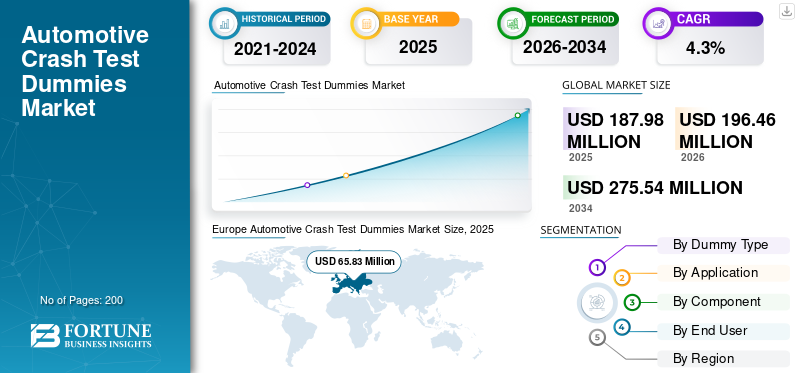
The global automotive crash test dummies market size was valued at USD 187.98 million in 2025. The market is projected to grow from USD 196.46 million in 2026 to USD 275.54 million by 2034, exhibiting a CAGR of 4.3% during the forecast period. Europe dominated the automotive crash test dummies market with a market share of 35.01% in 2025.
The automotive crash test dummies market represents a specialized segment of the automotive safety industry that focuses on the development and supply of anthropomorphic test devices used during vehicle crash experiments. These devices are engineered to stimulate human bodies and measure how passengers and pedestrians may be affected in different crash scenarios. Automotive companies and testing laboratories use these tools to understand human response to impact forces and to improve overall vehicle safety.
The market plays an essential role in modern vehicle design, as safety regulations require automakers to perform rigorous safety testing before vehicles are approved for sale. Governments and independent safety organizations evaluate vehicles through crash assessments that use sophisticated crash test dummies equipped with advanced sensor technologies. These sensors record detailed data such as head acceleration, chest compression, and neck loads, during simulated accidents.
The demand for crash test dummies continues to increase as countries strengthen vehicle safety standards and require more extensive testing. Automakers are launching more vehicle models each year, which increases the need for repeated crash simulations during product development. In addition, evolving safety protocols now include pedestrian protection, child occupant protection, and testing for different body types, further expanding the market for advanced crash test dummies.
Technological innovation is also shaping the industry. Modern testing solutions integrate high-precision sensors, digital data acquisition systems, and improved dummy biomechanics that better replicate human response during impact events. These improvements help engineers design safer vehicles while complying with strict global safety regulations.
As a result, the market growth is expected to boost over the coming years. Key companies such as Humanetics Innovative Solutions, Kristler, Cellbond and other manufacturers are investing in next-generation anthropomorphic test devices that support evolving safety requirements and new testing methodologies for future vehicle platforms.
Download Free sample to learn more about this report.
AUTOMOTIVE CRASH TEST DUMMIES MARKET Key Takeaways
 Global Market Size & Forecast
- 2025 Market Size: USD 187.98 million
- 2026 Market Size: USD 196.46 million
- 2034 Forecast Market Size: USD 275.54 million
- CAGR: 4.3% from 2026–2034
 Market Share
- Europe dominated the automotive crash test dummies market with a market share of 35.01% in 2025.
- The crash testing laboratories segment is expected to grow at a CAGR of 5.0% over the forecast period.
- The data acquisition systems segment is expected to grow at a CAGR of 6.1% over the forecast period.
 Key Regional Highlights
Europe
Europe held the dominant share in 2025, valued at USD 65.83 million. Europe leads the market due to its strict vehicle safety standards and strong automotive research ecosystem.
North America
North America is estimated to reach USD 58.96 million in 2026 and secure the position of the second-largest region in the market due to well-established safety assessment programs and advanced automotive R&D.
Asia Pacific
Asia Pacific is projected to record a 5.3% growth rate over the coming years and reach a valuation of USD 53.52 million by 2026 due to increasing vehicle production and stricter safety regulations.
U.S.
The U.S. automotive crash test dummies market can be analytically approximated at around USD 49.63 million, representing roughly 26.4% of the global market.
Japan
Japan is expected to witness steady market growth, supported by its advanced automotive manufacturing industry, strong focus on vehicle safety innovation, and ongoing adoption of sophisticated crash testing technologies.
Read More

AUTOMOTIVE CRASH TEST DUMMIES MARKET TRENDS
Integration of Advanced Sensor Technologies Improves Crash Data Accuracy
Manufacturers are increasingly integrating next-generation advanced sensor technologies into sophisticated crash test dummies to capture highly detailed crash performance data. These sensors enable engineers to measure complex human response patterns during simulated accidents and help refine vehicle design and occupant protection systems.
For instance, in October 2023, Humanetics introduced enhanced instrumentation for its crash test devices, enabling more accurate measurement of head and chest injury metrics during crash scenarios.
MARKET DRIVERS
Download Free sample to learn more about this report.
Increasing Vehicle Safety Regulations Drive Demand for Advanced Crash Testing Equipment
Stricter global vehicle safety standards are significantly increasing the demand for crash test dummies. Governments require extensive safety testing before vehicles enter the market, forcing automotive manufacturers to conduct more detailed crash experiments using anthropomorphic test devices. As testing protocols expand to include new crash scenarios, the market for advanced crash test dummies continues to grow.
- For instance, in April 2024, Euro NCAP updated its safety assessment protocols, introducing more advanced occupant and pedestrian testing procedures that require additional sophisticated crash test dummies during vehicle safety evaluations.
MARKET RESTRAINTS
High Development and Procurement Costs Limit Adoption of Advanced Testing Equipment
The high cost of manufacturing sophisticated crash test dummies and their integrated advanced sensor systems can limit market expansion. Each anthropomorphic test device requires complex engineering and calibration to accurately simulate human response in crash scenarios, thereby increasing procurement costs for laboratories and smaller testing facilities.
- For instance, in July 2023, NHTSA documentation highlighted that advanced crash test dummies can cost over USD 100,000 due to precision sensors and calibration requirements.
DUMMIES MARKET OPPORTUNITIES
Expansion of Vehicle Safety Programs in Emerging Economies Creates New Market Opportunities
Growing vehicle production in the Asia Pacific and the Middle East is creating new market opportunities. As governments introduce stricter vehicle safety standards, testing laboratories and automotive manufacturers increasingly invest in modern testing solutions and anthropomorphic test devices. These efforts drive automotive crash test dummies market growth.
- For instance, in March 2024, Global NCAP expanded its vehicle safety assessment programs across several Asian markets, encouraging manufacturers to increase safety testing and adopt improved crash evaluation tools.
MARKET CHALLENGES
Increasing Use of Digital Crash Simulation Tools Reduces Physical Testing Frequency
Advancements in computer modeling and digital crash simulation are creating challenges for the market. Some automotive manufacturers are increasingly using virtual testing solutions during early vehicle design stages to reduce development costs and limit the number of physical crash experiments.
- For instance, in February 2024, Several automakers reported increasing use of computer-based crash simulations to complement physical safety testing during vehicle development.
Segmentation Analysis
By Dummy Type
Adult Dummies Dominate Due to Universal Occupant Safety Testing Requirements
On the basis of dummy type, the market is segmented into adult dummies, child dummies, infant dummies, obese and specialized dummies, and pedestrian dummies.
Adult dummies dominate the global market as they are used in nearly every safety testing procedure involving occupant protection. These anthropomorphic test devices simulate the responses of adult passengers in frontal and side crash scenarios, making them essential for evaluating vehicle safety standards.
- For instance, in June 2023, Euro NCAP confirmed that adult occupant protection tests remain a core part of vehicle safety evaluation programs using advanced, sophisticated crash test dummies.
Pedestrian dummies segment is expected to grow at a CAGR of 6.9% over the forecast period.
By Application
Frontal Impact Testing Leads Due to Mandatory Safety Regulations
On the basis of application, the market is segmented into frontal impact testing, side impact testing, rear impact testing, rollover testing, and pedestrian protection testing.
Frontal impact testing holds the largest automotive crash test dummies market share, as most vehicle safety standards require extensive evaluation of head-on collision performance. These tests rely heavily on anthropomorphic test devices to analyze human response and improve vehicle design for occupant protection.
- For instance, in August 2023, NHTSA continues to require frontal crash tests as a key component of federal vehicle safety testing programs.
Pedestrian protection testing segment is expected to grow at a CAGR of 5.7% over the forecast period.
By Component
Sensors and Instrumentation Segment Dominates Due to Advanced Data Measurement Needs
On the basis of component, the market is segmented into dummy body structure, sensors and instrumentation, data acquisition systems, and calibration and maintenance equipment.
Sensors and instrumentation segment dominates the market, as each simulated human dummy contains dozens of advanced sensors that measure impact forces and injury risk during crash experiments.
- For instance, in September 2023, Humanetics highlighted the use of multiple embedded sensors within modern anthropomorphic test devices to capture real-time injury data during crash evaluations.
Data acquisition systems segment is expected to grow at a CAGR of 6.1% over the forecast period.
By End User
To know how our report can help streamline your business, Speak to Analyst
Automotive OEMs Segment Leads the Market Due to Extensive Vehicle Development Testing
On the basis of end user, the market is segmented into automotive OEMs, crash testing laboratories, government regulatory agencies, and research and academic institutions.
Automotive OEMs segment dominates the market, as it conducts extensive safety testing during new vehicle design programs. OEMs require multiple sophisticated crash test dummies and testing solutions to evaluate passenger safety before vehicles reach the market.
- For instance, in May 2024, several major automakers expanded internal crash testing programs to meet updated vehicle safety standards and improve occupant protection technologies.
Crash testing laboratories segment is expected to grow at a CAGR of 5.0% over the forecast period.
Automotive Crash Test Dummies Market Regional Outlook
By geography, the market is categorized into North America, Europe, Asia Pacific, and the rest of the world.
Europe
Europe Automotive Crash Test Dummies Market Size, 2025 (USD Million)
To get more information on the regional analysis of this market, Download Free sample
Europe held the dominant share in 2025, valued at USD 65.83 million, and also maintained the leading share in 2024, with USD 62.78 million. Europe leads the market due to its strict vehicle safety standards and strong automotive research ecosystem. Organizations such as Euro NCAP require extensive safety testing using anthropomorphic test devices across multiple crash scenarios. The region also hosts major suppliers and testing laboratories that support automotive manufacturers.
- For instance, in January 2024, Euro NCAP announced expanded pedestrian and occupant protection testing procedures requiring advanced, sophisticated crash test dummies in vehicle safety evaluations.
Germany Automotive Crash Test Dummies Market
Germany’s market in 2025 was estimated at around USD 18.43 million, accounting for roughly 9.8% of global revenues.
U.K. Automotive Crash Test Dummies Market
U.K. market in 2025 was estimated at around USD 11.86 million, accounting for roughly 6.3% of global revenues.
North America
North America is estimated to reach USD 58.96 million in 2026 and secure the position of the second-largest region in the market. North America remains a major market due to well-established safety assessment programs and advanced automotive R&D. Regulatory agencies require extensive safety testing using anthropomorphic test devices, while automakers invest in advanced testing solutions to improve passenger protection.
U.S. Automotive Crash Test Dummies Market
Based on North America’s strong contribution and the U.S. dominance within the region, the U.S. market can be analytically approximated at around USD 49.63 million, representing roughly 26.4% of global market.
Asia Pacific
Asia Pacific is projected to record a growth rate of 5.3% over the coming years, and reach a valuation of USD 53.52 million by 2026. The Asia Pacific region is expected to witness strong growth in the market for advanced crash test dummies due to increasing vehicle production and stricter safety regulations. Governments are expanding safety testing programs, increasing the demand for crash test dummies among local automotive manufacturers.
China Automotive Crash Test Dummies Market
China’s market is projected to be one of the largest market, with 2025 revenues valued at around USD 22.86 million, representing roughly 12.2% of global market.
India Automotive Crash Test Dummies Market
Indian Market in 2025 was estimated at around USD 5.07 million, accounting for roughly 2.7% of global revenues.
Rest of the World
Regions including the Middle East, Latin America, and Africa are gradually expanding the market for automotive crash safety equipment. As governments adopt stronger vehicle safety standards, laboratories and automotive manufacturers are increasing investments in sophisticated crash test dummies.
COMPETITIVE LANDSCAPE
Key Industry Players
Key Players Focus on Strategic Innovation and Partnerships to Shape Industry Competition
The competitive environment in the market for automotive crash safety equipment is characterized by a small group of highly specialized manufacturers focused on precision engineering and advanced measurement technologies. Companies operating in the global automotive crash test dummies market compete by developing highly accurate anthropomorphic test devices capable of replicating real human responses during different crash scenarios.
Major manufacturers invest heavily in research and development to improve the performance of sophisticated crash test dummies. These systems are designed to simulate the biomechanics of human bodies more accurately while incorporating advanced sensor technologies that capture detailed crash data. Continuous innovation in materials, sensor integration, and testing hardware allows companies to strengthen their market share and provide advanced testing solutions to automotive manufacturers.
Another important strategy involves partnerships with automotive safety laboratories and regulatory organizations. By collaborating with vehicle developers and safety agencies, companies ensure that their testing solutions meet emerging vehicle safety standards. These collaborations also allow manufacturers to refine their products based on real-world crash research.
Manufacturers are also expanding their product portfolios to include dummies designed for different body types and testing applications. This includes child dummies, pedestrian impact devices, and specialized dummies designed to simulate the effects of overweight occupants. Expanding product lines allows suppliers to address the growing demand for crash test dummies across global safety programs. Strategic investments in testing infrastructure and engineering support help suppliers serve the expanding market for advanced crash test dummies.
- For instance, in September 2023, Humanetics announced the launch of its new THOR-50M crash test dummy, designed to improve occupant safety evaluation through advanced sensor technology and improved human response measurement capabilities.
LIST OF KEY AUTOMOTIVE CRASH TEST DUMMIES COMPANIES PROFILED
- Humanetics Innovative Solutions (U.S.)
- Cellbond (U.K.)
- DTS – Diversified Technical Systems (U.S.)
- Kistler Group (Switzerland)
- MESSRING GmbH (Germany)
- JASTI Co., Ltd. (Japan)
- TS Tech Co., Ltd. (Japan)
- Toyota Boshoku Corporation (Japan)
- Instron (U.S.)
- ZwickRoell Group (Germany)
KEY INDUSTRY DEVELOPMENTS
- November 2025: American Honda Motor Co. announced a recall of approximately 295,000 vehicles in the U.S. to update the fuel injection Electronic Control Unit (ECU) software. The update aimed to correct improper fuel injection programming that could lead to engine hesitation or stalling. This development highlights the critical role of precise air–fuel calibration and robust control logic in modern engine management systems.
- November 2025: India announced Bharat NCAP 2.0, an upgraded vehicle safety assessment program that will introduce more advanced crash testing protocols, expanded crash scenarios, and stricter occupant protection evaluations. The program is expected to increase the use of sophisticated crash test dummies and advanced instrumentation during automotive safety testing in India.
- January 2025: Kistler expanded its crash test sensor portfolio by launching new piezoelectric accelerometers for integration within anthropomorphic test devices used in high-severity vehicle crash tests.
- December 2024: Diversified Technical Systems (DTS) launched an upgraded SLICE data acquisition system, designed to capture high-speed measurement data from crash test dummies and vehicle structures during automotive crash experiments.
- November 2024: Cellbond introduced an updated version of its Flex-PLI pedestrian legform impactor, designed to improve the measurement of knee ligament injuries during pedestrian protection crash tests conducted by vehicle safety programs.
- October 2024: MESSRING launched an enhanced MSD crash test data acquisition system capable of synchronizing high-speed cameras, sensors, and crash test dummy instrumentation for more precise crash analysis.
- June 2024: Humanetics upgraded the Hybrid III crash test dummy instrumentation system, improving measurement reliability for head and chest injury metrics during frontal impact testing procedures.
REPORT COVERAGE
The global automotive crash test dummies market analysis provides an in-depth study of market size and forecast for all the market segments included in the report. It includes details on the market dynamics and trends expected to drive the market over the forecast period. It offers information on the technological advancements, new product launches, key industry developments, and details on partnerships, mergers, and acquisitions. The research report also encompasses detailed competitive landscape with information on the market share and profiles of key operating players.
Request for Customization to gain extensive market insights.
Report Scope & Segmentation
| ATTRIBUTE | DETAILS |
| Study Period | 2021-2034 |
| Base Year | 2025 |
| Estimated Year | 2026 |
| Forecast Period | 2026-2034 |
| Historical Period | 2021-2024 |
| Growth Rate | CAGR of 4.3% from 2026-2034 |
| Unit | Value (USD Million) |
| Segmentation | By Dummy Type, Application, Component, End User, and Region |
| By Dummy Type |
|
| By Application |
|
| By Component |
|
| By End User |
|
| By Geography |
|
Frequently Asked Questions
Fortune Business Insights says that the global market value stood at USD 187.98 million in 2025 and is projected to reach USD 275.54 million by 2034.
In 2025, the Europe’s market value stood at USD 65.83 million.
The market is expected to exhibit a CAGR of 4.3% during the forecast period.
Automotive OEMs segment is leading the market by end user.
Increasing vehicle safety regulations is the key factor driving the market.
Humanetics, Cellbond, Kristler and MESSRING are some of the top players in the market.
Europe dominated the market in 2025 with the largest share.



- 2021-2034
- 2025
- 2021-2024
- 200
-
(Offer valid till 31st Oct 2026)
Get 30-60 hrs Free Customization
Expand Regional and Country Coverage, Segments Analysis, Company Profiles, Competitive Benchmarking, and End-user Insights.




















Related Reports
-
US +1 833 909 2966 ( Toll Free )
-
Get In Touch With Us