Automotive Electronic Expansion Valve Market Size, Share & Industry Analysis, By Propulsion Type (Internal Combustion Engine (ICE) Vehicles, Hybrid Vehicles (HEV & PHEV), and Battery Electric Vehicles (BEV)), By Vehicle Type (Hatchback/Sedan, SUV, LCV, and HCV), By Sales Channel (OEM/Factory-Fit and Aftermarket/Replacement), By Application (Cabin HVAC Systems, Battery Thermal Management Systems, and Heat Pump Systems), and Regional Forecast, 2026-2034
 Download Free Sample
(Offer valid till 15th Sep 2026)

Automotive Electronic Expansion Valve Market Size and Future Outlook
 Listen to Audio Version
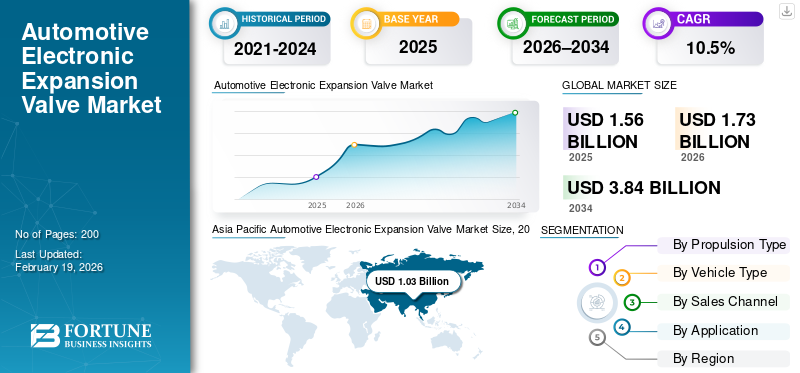
The global automotive electronic expansion valve market size was valued at USD 1.56 billion in 2025. The market is projected to grow from USD 1.73 billion in 2026 to USD 3.84 billion by 2034, exhibiting a CAGR of 10.5% during the forecast period. Asia Pacific dominated the automotive electronic expansion valve market with a market share of 66.03% in 2025.
It is a digitally controlled refrigerant metering device used in vehicle HVAC and advanced thermal management solutions systems to precisely regulate refrigerant flow, improving cooling efficiency, temperature accuracy, and energy performance under varying operating conditions. Growth is primarily driven by rising vehicle electrification, increasing adoption of heat pump systems, and stricter energy-efficiency regulations. The expanding use of battery thermal management in EVs, the demand for advanced climate control, and the shift toward electronically controlled HVAC architectures further accelerate EXV adoption globally. Leading players such as Denso, Sanhua, Valeo, Hanon Systems, Danfoss, and Parker Hannifin focus on high-precision EXVs for EV and heat pump applications. Key market trends include compact designs, CO₂-compatible valves, and deeper integration with vehicle thermal control software.
Download Free sample to learn more about this report.
Automotive Electronic Expansion Valve Market KEY TAKEAWAYS
 Global Market Size & Forecast
- 2025 Market Size: USD 1.56 billion
- 2026 Market Size: USD 1.73 billion
- 2034 Forecast Market Size: USD 3.84 billion
- CAGR: 10.5% from 2026–2034
 Market Share
- Asia Pacific dominated the automotive electronic expansion valve market with a 66.03% share in 2025.
- The Internal Combustion Engine (ICE) Vehicles segment held the largest market share.
- The Cabin HVAC Systems segment accounted for the largest market share.
 Key Regional Highlights
Asia Pacific
The region dominated the global market with a 66.03% share in 2025.
North America
The market is expected to witness strong growth, driven by rising EV adoption, increasing heat pump integration.
Europe
The market is projected to grow steadily, supported by stringent emissions regulations.
U.S.
The market was valued at USD 0.15 billion in 2025.
Japan
The market was valued at USD 0.10 billion in 2025.
Read More

AUTOMOTIVE ELECTRONIC EXPANSION VALVE MARKET TRENDS
Integration of Advanced Heat Pump and HVAC Architectures
Automotive thermal systems are rapidly evolving beyond basic air conditioning toward integrated heat pump and advanced HVAC architectures that enhance energy efficiency and range in electrified vehicles. These systems leverage electronic expansion valve (EEVs/EXVs) to finely control refrigerant flow across multiple subsystems, including air conditioning systems, battery, and power electronics, enabling optimal thermal performance. Manufacturers are increasingly adopting refrigerant-based heat pump loops instead of resistive heating, reducing the energy burden on batteries and improving winter driving efficiency. This shift supports broader electrification strategies and enhances driver comfort in extreme climates, particularly in EVs where energy efficiency directly impacting the automotive electronic, range, and performance.
- In July 2023, a Science Direct article highlighted that heat pump HVAC systems significantly boost EV energy efficiency and range compared with traditional HVAC approaches, underscoring this integration trend.
MARKET DYNAMICS
MARKET DRIVERS
Rising Electrification and Precise Thermal Control Demand to Propel Industry Expansion
The increasing adoption of electric and hybrid vehicles is driving the demand for electronic expansion valve (EEV), as these control components are essential for precise thermal management of both cabin comfort and battery systems. EVs require tighter temperature regulation to preserve battery life, maintain performance across climates, and support fast-charging without degradation. Electronic expansion valves enable the real-time adjustment of refrigerant flow based on multiple sensor inputs, significantly improving system responsiveness and efficiency compared to mechanical alternatives. Improved thermal systems also reduce parasitic energy loss, particularly important for extending driving range and helping OEMs meet stringent efficiency standards worldwide. Regulators’ emphasis on energy efficiency and emissions reductions further accelerates the shift toward advanced thermal controls such as EEVs.
MARKET RESTRAINTS
Complexity and Cost of Thermal System Integration May Restrain Market Expansion
A key restraint for the automotive electronic expansion valve market growth is the high complexity and cost associated with integrating advanced thermal management systems, particularly in mass-market vehicles. Implementing multi-loop HVAC and battery-cooling systems that rely on electronic valves requires significant engineering, calibration, and testing. Complex real-time control algorithms, scalable components, and integration with vehicle management systems increase development time and component costs. These challenges are more pronounced in regions with cost-sensitive consumer bases, where premium thermal features may be deprioritized. Additionally, advanced HVAC and heat pump systems often require additional supporting hardware, further increasing bill-of-materials costs. While these systems deliver efficiency benefits, the upfront cost burden can slow adoption in lower-priced vehicle segments.
MARKET OPPORTUNITIES
Growth in Multi-Functional Thermal Management Platforms to Offer New Avenues
The expanding need for multi-functional thermal management platforms presents a significant opportunity for electronic expansion valve suppliers. As vehicles become more electrified, thermal management demands span battery cooling, power electronics, cabin comfort, and heat pump heating, all of which can be addressed through optimized refrigerant loops tailored to EEVs/EXVs. Suppliers that innovate compact, high-precision valves and integrate them with intelligent control systems can unlock new value, particularly in premium EVs and advanced hybrid architectures. This opens the door to collaboration with OEMs on modular thermal platforms that serve multiple vehicle segments, reducing overall system complexity while improving energy efficiency and reliability.
MARKET CHALLENGES
Ensuring Battery Safety and Longevity through Thermal Reliability to Create New Challenges
One core challenge in the market is ensuring reliable and safe thermal management for high-energy lithium-ion batteries, which directly influences battery longevity, performance, and safety. Battery packs generate significant heat during rapid charge/discharge cycles and ineffective management can lead to degradation or thermal runaway. Developing valve and control systems robust enough to manage these extreme thermal stresses across diverse operating conditions from hot deserts to frigid winters requires rigorous design, testing, and quality assurance. Engineers must manage trade-offs between response time, durability, and system reduced energy consumption to maintain stable battery temperatures without compromising vehicle efficiency or safety.
- In August 2025, a comprehensive review highlighted that maintaining optimal battery temperatures is critical to preventing performance loss and safety issues, emphasizing the importance of advanced thermal regulation systems.
Download Free sample to learn more about this report.
Segmentation Analysis
By Propulsion Type
Established HVAC Integration across High-Volume ICE Platforms to Sustain Propulsion Segment Dominance
Based on propulsion type, the market is segmented into Internal Combustion Engine (ICE) vehicles, Hybrid Vehicles (HEV & PHEV), and Battery Electric Vehicles (BEV)).
The Internal Combustion Engine (ICE) vehicles segment remains the dominant segment, accounting for the majority of global vehicle production and the existing vehicle parc, driving consistent demand for EXVs in HVAC and thermal systems. Traditional OEMs continue strong ICE production alongside hybrid launches, supporting broad EXV integration. Even as EVs grow, internal combustion platforms maintain larger vehicle volumes globally, ensuring sustained market share for ICE-oriented EXVs.
The HEV & PHEV segment exhibits growth, but ICE historically and currently holds the largest installed base for EXV deployment.
- In January 2026, European EV sales surpassed petrol for the first time in December, yet petrol/ICE vehicles still dominate annual sales, underscoring the ongoing dominance of ICE vehicles.
The Battery Electric Vehicles (BEV) segment is projected to grow at a CAGR of 11.4% over the forecast period.
By Vehicle Type
High Global Production Volumes of Passenger Cars to Drive Hatchbacks/Sedans Segment Leadership
Based on vehicle type, the market is segmented into hatchbacks/sedans, SUVs, LCVs, and HCVs.
The hatchbacks/sedans segment dominate due to their continued global production leadership and broad consumer adoption, particularly in emerging and high-volume markets such as Asia. These vehicle types account for the largest share of registrations and production, ensuring consistent EXV deployments for HVAC systems across millions of units annually. Their dominance is reinforced by infrastructure investment and affordability in mass-market regions. The SUVs and commercial vehicles segments are expanding, but hatchbacks/sedans remain the primary global volume drivers for EXVs in the short-to-mid term. Global production trends confirm Asia Pacific’s large share in vehicle output, where hatchback/sedan models are especially prevalent.
The SUVs segment is projected to grow at a CAGR of 12.6% over the forecast period.
By Sales Channel
High Product Demand from Vehicle Assembly Lines Positions OEM/Factory-fit Segment as the Primary Revenue Contributor
Based on sales channel, the market is divided into OEM/factory-fit and aftermarket/replacement.
The OEM/factory-fit segment dominates the market as the majority of EXV demand originates directly from vehicle assembly lines as part of integrated HVAC and sophisticated thermal management systems. OEM contracts secure long-term supply volume, standardized quality, and embedded electronic systems with calibrated control logic. Aftermarket demand arises only when EXVs fail or vehicles age and EXV lifetime reliability is relatively high, limiting aftermarket penetration. OEM dominance is reinforced by automakers' increasing integration of electronic controls across multiple vehicle subsystems, including HVAC and battery cooling. Automotive industry production forecasts continue to project sustained OEM integration of advanced components through 2030.
The aftermarket/replacement segment is projected to grow at a CAGR of 12.9% over the forecast period.
By Application
To know how our report can help streamline your business, Speak to Analyst
Universal Cabin Climate Requirements Anchor HVAC Systems as the Largest Application Segment
Based on application, the market includes cabin HVAC systems, battery thermal management systems, and heat pump systems.
The cabin HVAC systems segment dominate, as they are universally required across all vehicle types and propulsion systems, making them the largest-volume application of EXVs. Every passenger and commercial vehicle with air conditioning uses refrigerant control valves and even as EV-specific thermal management grows, cabin HVAC remains the foundational application. The need for precision temperature control across global climate zones ensures sustained EXV demand in HVAC.
Heat pump and battery thermal management are growing niches but still trail in absolute volume compared with HVAC.
- In December 2025, global light vehicle production data continued to show high passenger-car unit volumes with HVAC systems standard, underscoring this dominant application.
The battery thermal management systems segment is projected to grow at a CAGR of 14.2% over the forecast period.
AUTOMOTIVE ELECTRONIC EXPANSION VALVE MARKET REGIONAL OUTLOOK
By geography, the market is categorized into Europe, North America, Asia Pacific, and the rest of the world.
Asia Pacific
Asia Pacific Automotive Electronic Expansion Valve Market Size, 2025 (USD Billion)
To get more information on the regional analysis of this market, Download Free sample
Asia Pacific dominates the global automotive electronic expansion valve market share due to its massive vehicle production base and leadership in electric vehicle manufacturing. China anchors regional growth with large-scale EV production and advanced thermal architectures, while Japan contributes through hybrid dominance and technology innovation. India adds long-term growth potential as HVAC penetration rises and EV adoption accelerates. Increasing demand for battery thermal management, heat pumps, and energy-efficient climate control systems ensures Asia Pacific remains the largest and most influential EXV market globally.
China Automotive Electronic Expansion Valve Market
China led with a maximum share of 63% in 2025 due to its dominant EV production scale and widespread adoption of heat pump-based thermal systems. Strong government support for electrification and high EV penetration significantly increases EXV usage across cabin HVAC, battery cooling, and power electronics applications.
Japan Automotive Electronic Expansion Valve Market
Japan’s EXV market is driven by its strong hybrid vehicle base and focus on high-efficiency thermal management technologies and was valued at USD 0.10 billion in 2025. Advanced HVAC systems, precision engineering standards, and continued electrification efforts support steady demand for electronic expansion valves across passenger vehicles.
India Automotive Electronic Expansion Valve Market
India represents an emerging EXV market and is poised to expand at the highest CAGR of 11.6% over the forecast period. The expansion is supported by rising passenger vehicle production, increasing HVAC penetration, and early-stage EV adoption. Government electrification initiatives and rising consumer demand for comfort features are gradually expanding the use of electronically controlled HVAC components.
North America
North America is depicting strong growth in the automotive electronic expansion valve market, driven by rising EV adoption, increasing heat-pump penetration, and demand for energy-efficient HVAC systems. The U.S. leads regional demand due to accelerating EV production, stricter efficiency regulations, and growing integration of battery thermal management systems. Mexico strengthens the regional supply base through expanding vehicle manufacturing and EV export activity while Canada supports demand through EV incentives. The high adoption of electronically controlled thermal systems in premium and electric vehicles positions North America as one of the fastest-growing EXV markets globally.
U.S. Automotive Electronic Expansion Valve Market
Rapid EV platform launches, growing heat pump adoption, and stringent efficiency standards drive the U.S. market with a value of USD 0.15 billion in 2025. OEM investments in advanced thermal management to improve battery longevity and optimize range significantly boost the demand for electronic expansion valves across passenger cars, SUVs, and electric commercial vehicles.
Europe
Europe represents a mature yet steadily expanding market for automotive electronic expansion valves, driven by strict emissions and environmental regulations, high penetration of automatic cabin climate control, and widespread adoption of heat pump systems in EVs. Countries such as Germany, the U.K., and France lead demand through strong EV sales, premium vehicle production, and early adoption of advanced thermal technologies. Europe’s focus on CO₂ refrigerant systems and energy-efficient HVAC architectures further increases EXV value per vehicle, ensuring stable long-term growth despite moderate vehicle production volumes.
U.K. Automotive Electronic Expansion Valve Market
The U.K. market benefits from accelerating EV adoption, supportive government incentives, and rising demand for energy-efficient cabin heating solutions. Increased heat pump integration in electric passenger vehicles drives EXV adoption, particularly in mid-range and premium segments focused on improving cold-weather driving efficiency. The U.K. market was valued at USD 0.05 billion in 2025.
Germany Automotive Electronic Expansion Valve Market
Germany remains a key European growth engine which held a share of 20.7% in 2025 due to strong OEM presence, premium vehicle manufacturing, and early adoption of advanced thermal management systems. High EV penetration, emphasis on heat pump efficiency, and the integration of battery-cooling systems drive sustained demand for high-precision electronic expansion valves.
Rest of the World
The market in the rest of the world, including Latin America, the Middle East, and Africa, shows gradual growth in demand for automotive electronic expansion valves. Expansion is driven by improving vehicle production, rising adoption of automatic climate control, and early electrification in select markets. While overall penetration remains lower than in developed regions, increasing urbanization, regulatory alignment, and imports of EV platforms support incremental EXV adoption, particularly in passenger cars and light commercial vehicles over the forecast period.
COMPETITIVE LANDSCAPE
Key Industry Players
Leading Players Emphasize Collaborations with OEMs to Strengthen their Competitiveness
The global automotive electronic expansion valve market is characterized by accelerating vehicle electrification, rising adoption of heat pump-based thermal architectures, and close collaboration between OEMs and Tier-1 suppliers. Leading players such as Denso, Sanhua Automotive, Valeo, Hanon Systems, Danfoss, Parker Hannifin, Mitsubishi Electric, and MAHLE compete through high-precision valve designs, compact form factors, and compatibility with advanced refrigerants, including R1234yf and CO₂ (R744). Competitive differentiation increasingly depends on integration capability with vehicle thermal controllers, reliability under wide operating conditions, and scalability across ICE, hybrid, and EV platforms. Suppliers are expanding manufacturing capacity, localizing production near EV hubs, and investing in software-enabled valve control to support intelligent thermal management. Strategic partnerships with OEMs and thermal system integrators, along with cost optimization and modular product platforms, are central to strengthening long-term competitiveness in this evolving market.
LIST OF KEY AUTOMOTIVE ELECTRONIC EXPANSION VALVE COMPANIES PROFILED
- Denso Corporation (Japan)
- Sanhua Automotive (China)
- Hanon Systems (South Korea)
- Valeo SA (France)
- Parker Hannifin Corporation (U.S.)
- Danfoss Group (Denmark)
- Mitsubishi Electric Corporation (Japan)
- Bosch Mobility Solutions (Germany)
- MAHLE GmbH (Germany)
- ZF Friedrichshafen AG (Germany)
- Keihin Corporation (Japan)
- Visteon Corporation (U.S.)
- Modine Manufacturing Company (U.S.)
- Zhejiang DunAn Automotive Parts Co., Ltd. (China)
- CAREL Industries S.p.A. (Italy)
KEY INDUSTRY DEVELOPMENTS
- November 2025: Valeo announced the readiness of its Compact 5-Ways Refrigerant Valve for EV heat-pump systems, set to enter series production in September 2026, for customer requests. By integrating multiple refrigerant-routing functions into a single compact valve block, it reduces circuit complexity and helps optimize refrigerant control, supporting tighter coordination with electronic expansion valves in next-gen thermal architectures. The company has been named a CES Innovation Awards 2026 honoree for this innovation.
- November 2025: Hanon Systems announced plans to showcase EV thermal management technologies at AAPEX 2025, including its 4th-generation heat pump system and natural-refrigerant modules. The focus on integrated controllers, compressors, and refrigerant modules highlights OEM/aftermarket momentum toward tightly controlled refrigerant flow, an area where electronic expansion valves remain a core enabling component.
- October 2025: Valeo announced the world premiere of its EDC-120 electric compressor (with integrated inverter) for electric buses at Busworld Europe 2025. The launch signals deeper integration of electrified HVAC systems where precise refrigerant metering (typically via EXVs) becomes increasingly critical for managing efficiency, reliability, and thermal loads in heavy-duty duty cycles.
- September 2025: Hanon Systems announced that the cumulative production of its eco-friendly R744 (CO₂) electric compressors had surpassed 1 million units, supplying the Volkswagen Group’s MEB platform. Higher-pressure CO₂ systems intensify demands on refrigerant circuit controls and valves, reinforcing the need for robust, high-accuracy electronic expansion valve strategies within EV thermal management.
- September 2025: MAHLE highlighted a compact thermal management module with an integrated heat pump, targeting up to a 20% improvement in EV range at low temperatures, at IAA Mobility. Integrated modules consolidate sensors/valves to reduce complexity and typically rely on electronically controlled refrigerant metering approaches, supporting expanding EXV content per electrified platform.
REPORT COVERAGE
Request for Customization to gain extensive market insights.
Report Scope & Segmentation
|
ATTRIBUTE |
DETAILS |
|
Study Period |
2021-2034 |
|
Base Year |
2025 |
|
Estimated Year |
2026 |
|
Forecast Period |
2026-2034 |
|
Historical Period |
2021-2024 |
|
Growth Rate |
CAGR of 10.5% from 2026 to 2034 |
|
Unit |
Value (USD Billion) |
|
Segmentation |
By Propulsion Type, By Vehicle Type, By Sales Channel, By Application, and By Region |
|
By Propulsion Type |
· Internal Combustion Engine (ICE) Vehicles · Hybrid Vehicles (HEV & PHEV) · Battery Electric Vehicles (BEV) |
|
By Vehicle Type |
· Hatchback/Sedan · SUV · LCV · HCV |
|
By Sales Channel |
· OEM / Factory-Fit · Aftermarket / Replacement |
|
By Application |
· Cabin HVAC Systems · Battery Thermal Management Systems · Heat Pump Systems |
|
By Geography |
· North America (By Propulsion Type, By Vehicle Type, By Sales Channel, By Application, and By Country) o U.S. (By Vehicle Type) o Canada (By Vehicle Type) o Mexico (By Vehicle Type) · Europe (By Propulsion Type, By Vehicle Type, By Sales Channel, By Application, and By Country ) o Germany (By Vehicle Type) o U.K. (By Vehicle Type) o France (By Vehicle Type) o Rest of Europe (By Vehicle Type) · Asia Pacific (By Propulsion Type, By Vehicle Type, By Sales Channel, By Application, and By Country) o China (By Vehicle Type) o Japan (By Vehicle Type) o India (By Vehicle Type) o South Korea (By Vehicle Type) o Rest of Asia Pacific (By Vehicle Type) · Rest of the World (By Propulsion Type, By Vehicle Type, By Sales Channel, and By Application) |
Frequently Asked Questions
Fortune Business Insights says that the global market value stood at USD 1.56 billion in 2025 and is projected to reach USD 3.84 billion by 2034.
In 2025, the market value stood at USD 1.03 billion.
The market is expected to grow at a CAGR of 10.5% during the forecast period of 2026-2034.
The OEM/factory-fit segment leads the market share in the sales channel segment.
Rising electrification and precise thermal control demand are key factors driving the market.
Top players in the market include ZF Friedrichshafen Denso, Sanhua, Valeo, Hanon Systems, and Danfoss.
Asia Pacific accounts for the largest share in the market.
North America, Europe, Asia Pacific, and the rest of the world are the regional markets considered.



- 2021-2034
- 2025
- 2021-2024
- 200
-
(Offer valid till 15th Sep 2026)
Get 30-60 hrs Free Customization
Expand Regional and Country Coverage, Segments Analysis, Company Profiles, Competitive Benchmarking, and End-user Insights.




















-
US +1 833 909 2966 ( Toll Free )
-
Get In Touch With Us