Automotive Integrated Onboard Charger Market Size, Share & Industry Analysis, By Propulsion (Battery Electric Vehicle (BEV) and Hybrid Vehicle (HV)), By Vehicle Type (Passenger Car and Commercial Vehicle), By Power (Up to 20kW and Above 20kW), By Component (On-board Charger and DC-DC Converter), and Regional Forecast, 2026-2034
 Download Free Sample
(Offer valid till 15th Oct 2026)

KEY MARKET INSIGHTS
 Listen to Audio Version
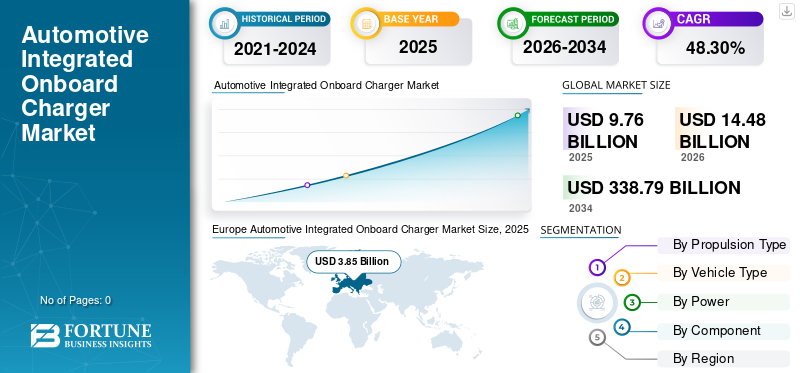
The global automotive integrated onboard charger market size was estimated at USD 9.76 billion in 2025. The market is expected to rise from USD 14.48 billion in 2026 to USD 338.79 billion by 2034, expanding at a CAGR of 48.30% from 2026 to 2034. Europe dominated the automotive integrated onboard charger market with a market share of 39.41% in 2025. Automotive Integrated Onboard Charger Market in the U.S. is projected to grow significantly, reaching an estimated value of USD 12070.7 million by 2030
The automotive integrated onboard charger is a technology that converts and regulates electrical power in electric and hybrid vehicles. It is a combined unit of onboard charger and DC-DC converter. The automotive integrated onboard charger or EV integrated charging control unit (ICCU), is an essential component in electric and hybrid vehicles. It enables efficient charging of the vehicle battery and conversion of high-voltage power from the battery to lower-voltage power required by other electrical systems in the vehicle.
The market is anticipated to experience significant growth in the coming years due to the adoption of electric and hybrid vehicles. In addition, the growing demand for advanced and efficient power conversion solutions with the advantage of reduced weight and complexity is expected to further drive market growth. The applications of automotive integrated onboard charger in diverse platforms are paving the way for new opportunities, which will augment the market's growth during the forecast period.
Download Free sample to learn more about this report.
AUTOMOTIVE INTEGRATED ONBOARD CHARGER MARKET KEY TAKEAWAYS
 Market Size & Forecast
- 2025 Market Size: USD 9.76 billion
- 2026 Market Size: USD 14.48 billion
- 2034 Forecast Market Size: USD 338.79 billion
- CAGR: 48.30% from 2026–2034
 Market Share
- Europe led the market with a 39.41% share in 2025.
- BEVs gained traction due to improved battery range.
- Passenger cars are driving demand as consumers shift toward electric and hybrid vehicles.
 Key Regional Highlights
North America
North America is growing due to rising investment in EVs and charging infrastructure.
Europe
Europe held the leading market value of USD 3.85 billion in 2025 and USD 5.71 billion in 2026.
Asia Pacific
Asia Pacific growth is supported by cost reduction in integrated charging control units.
U.S.
The market is projected to reach USD 12,070.7 million by 2030.
Japan
EV adoption and charging technology development are expected to support market growth.
Read More

Automotive Integrated Onboard Charger Market Trends
Developments in Wireless Integrated On-board Chargers (iOBCs) to Catalyze the Market Growth
Recently, Tesla has patented its wireless charging representing both conductive and inductive charging solutions. This might lead to the development of autonomous charging capability in EVs. Integration of a magnetic coupler with a transformer of DC-DC is also presented as a possible solution for a wireless iOBC system. Still, system architecture requires optimization to enhance operation efficiency.
In June 2022, Stellantis announced the successful charging of the Fiat 500 while running on a track in Italy, having inductive technology. Stellantis has also collaborated with HEVO to develop wireless fast charging of up to 50 KW capability. Hence, developments in wireless charging technology in combination with iOBC will propel the market growth.
DRIVING FACTORS
Growing Adoption of V2G, V2L, and V2H will Drive the Market Growth of Integrated Charging Control Unit
Vehicle-to-Grid (V2G), Vehicle to Load (V2L) or Vehicle to Home (V2H) enables an EV to transfer its power to the electric grid, specific load or home for further energy usage applications. This technology is enabled by integrating a bi-directional, i.e. a two-way charger that allows the electricity to flow from the vehicle to a specific load.
Major EV manufacturers are focusing on deploying electric vehicles that support these applications due to rising adoption amongst end-users. For instance, In December 2022, Toyota revealed to set up a pilot plant in the U.S. to focus on V2G technology. The company has partnered with a Texas-based electric distribution group Oncor. Hence, the rising adoption of V2G, V2L or V2H will proliferate the market of automotive integrated onboard charger in the coming years.
Download Free sample to learn more about this report.
RESTRAINING FACTORS
Complexity in Integration of ICCU in Current EV Models is Expected to Restrain the Market Growth
Ever-changing technologies for EVs to maximize the entire system efficiency make it difficult for manufacturers to adopt them in existing EV fleets as it requires major hardware ecosystem changes inducing high R&D costs associated with newer designs.
The majority of current EV models have individual components such as AC/DC and DC/DC converters, which are configured OBC rather than as integrated OBC. This will require major design changes to incorporate ICCU, making it tough to implement in the current production line of EV models supplied by manufacturers. Hence, the supplier needs to develop an entirely new design to support the integration of ICCU in respective EV models. Therefore, integration challenges may restrain the market growth.
Segmentation Analysis
By Propulsion Type Analysis
To know how our report can help streamline your business, Speak to Analyst
Advancement in Battery-based EVs Across Battery Electric Vehicles (BEVs) Drives the Market Growth
Based on the propulsion type, the market is sub-segmented into battery electric vehicles (BEV) and hybrid vehicles (HV).
The advancement in battery technology has led to an increased range of battery electric vehicles (BEV), making them a more practical option for everyday use. This fuels the segmental market growth during the forecast period.
Hybrid vehicles, which include the plug-in hybrid electric vehicle (PHEV), offer better fuel efficiency than traditional gasoline-powered vehicles, which helps automakers to meet the increasingly strict emissions regulations around the world. Moreover, the benefits of plug-in hybrid electric vehicles phev to generate electricity for V2G applications also propel the market growth in the region. This drives the segmental market growth over the forecast period.
By Vehicle Type Analysis
Inclination of People Towards Passenger Electric Vehicles Propels the Segment Growth
Based on the vehicle type, the market is sub-segmented into passenger car and commercial vehicle
The passenger car market growth is attributed to consumers' rising interests in hybrid and electric passenger cars as they are becoming more aware of the environmental benefits and cost savings of these vehicles. The increasing focus on the fuel efficient and zero-emission vehicles across the globe is expected to drive the demand for automotive integrated onboard chargers across passenger vehicles during the forecast period.
Many companies are embracing corporate social responsibility (CSR) goals and are interested in reducing their carbon footprint by transitioning to electric and hybrid commercial vehicles. many automotive manufacturers are emphasizing on the development of the commercial EVs to support the zero-emission initiatives started by many government authorities.
By Power Analysis
Demand for Fast Charging Technology in Electric Vehicles Augment the 20 kW Power Chargers
Based on the power, the market is sub-segmented into up to 20 kW and above 20 kW.
The cost of an integrated charging control unit with up to 20kW power rating is generally less expensive than higher power outputs unit. The use of up to 20 kW power charger reduces the overall cost of ownership of electric vehicles. This makes them more affordable for consumers and automakers, driving the market growth over the forecast period.
The growing demand for high-performance electric vehicles charge capabilities primarily drives the above 20 kW power output segment in the market.
By Component Analysis
Increasing Application of DC-DC Converter is Expected to Fuel the Market Growth
Based on component, the market is sub-segmented into the on-board charger and DC-DC converter. The development of advanced DC-DC converter technologies such as wide bandgap semiconductors and digital control, drives the demand for DC-DC converters in the market. Moreover, the application of integrated DC-DC onboard charger in electric vehicles to serve various purposes fuels the market growth.
The growth in demand for on board chargers is directly linked to the demand for electric and hybrid vehicles. Thus, the increase in the demand for electric vehicles drives the segmental growth during the forecast period. Robert Bosch GmbH developed its automotive integrated onboard charger called Integrated Onboard Charger Converter. Thus, the product development by major players in the market with new technologies drives market growth.
REGIONAL ANALYSIS
Europe Dominated the Market Owing to Well-Established Automotive Industry in the Region
The market is analyzed across North America, Europe, Asia Pacific, and the Rest of the World.
Europe
Europe Automotive Integrated Onboard Charger Market Size, 2025 (USD Billion)
To get more information on the regional analysis of this market, Download Free sample
The Europe held the dominant share in 2026 valuing at USD 5.71 Billion and also took the leading share in 2025 with USD 3.85 Billion. Stringent emission regulations in Europe drive the adoption of electric vehicles in the region. This, in turn, propels the demand for the market in Europe. For instance, the European Union has set a target to plummet the CO2 emissions by 40% by 2030. And as more electric vehicles will be in operation on the roads, energy demand will increase, creating a lucrative demand for conventional and bidirectional integrated onboard chargers in the region.
North America
In North America, expanding charging infrastructure, such as private or public charging stations, drives the electric vehicle market. Moreover, the major companies are focused on innovating and developing new products related to charging solutions and bidirectional charging. The North America region is witnessing significant investment in electric vehicles and charging infrastructure from private players and government authorities. This fuels the demand for automotive integrated onboard charger market growth in the region.
Asia Pacific
Asia Pacific regional market growth is attributed to the cost reduction feature of the integrated charging control unit. This will increase electric vehicle affordability, fueling the market growth during the forecast period.
Rest of The World
The Rest of the World's market growth is attributed to the countries such as Chile, Brazil, and South Africa introducing policies to encourage the use of EVs. This propels the market growth for electric vehicles in the region, which in turn drives the demand for integrated charging control units in EVs.
KEY INDUSTRY PLAYERS
Companies are Focusing on Innovation and Development of New Products for Competitive Advantage
The market is highly competitive, with several major players operating in the market. These include Toyota Industries Corporation, BorgWarner Inc., LG-Magna e-Powertrain Co., Ltd, and Yazaki Corporation, and others. These companies are persistently innovating and introducing new products to maintain their hold and achieve advancement in the market.
Lis of Key Companies Profiled:
- BorgWarner Inc. (U.S.)
- LG Magna e-Powertrain Co., Ltd (South Korea)
- Meta System S.P.A (Italy)
- Nichicon Corporation (Japan)
- Panasonic Corporation (Japan)
- Robert Bosch GmbH (Germany)
- Texas Instruments (U.S.)
- Toyota Industries Corporation (Japan)
- Vitesco Technologies GmbH (Germany)
- Yazaki Corporation (Japan)
KEY INDUSTRY DEVELOPMENTS:
- January 2023 – Valeo, a current vendor of TATA Motors, introduced a 3-in-1 combo unit combining OBC and DC-DC converters and a PDU – power distribution unit. The system will operate on different power ranges from 7kW, 11kW up to 22kW.
- November 2022– Zivian launched CT3.3, an onboard charger integrated with a DC-DC converter. The combined unit is equipped with water cooling, increased power density, an optional integrated DC-DC converter and input over-voltage protection. The CT3.3 functions as a rugged battery charger for onboard installations in electric vehicles.
- March 2022– ROHM Semiconductor partnered with Lucid, an advanced electric vehicle company based in California, U.S. Under the partnership with both companies focused on the development of the Wonderbox. The Wonderbox equipped in the Lucid Air integrates a DC-DC converter and the Bi-directional On-Board Charger (OBC). With the help of the SiC MOSFET developed by ROHM, the advanced power factor correction circuit can operate at high switching frequencies.
- June 2021– Xerotech signed a partnership with Meta System to develop Integrated Battery Systems. Under this partnership, Meta System will supply its leading-edge automotive-grade onboard chargers (OBCs) and DC-DC converters. The company launched 400V and 800V onboard chargers in 11 and 22 kW with integrated off-board fast-charge control along with 12 and 24V bi-directional and uni-directional DC-DC converters, also integrated with Hibernium battery packs.
- June 2021– Delta-Q Technologies unveiled a line of battery charging solutions and launched the XV3300. The XV3300 combines a high-performance 3.3kW charger, a 500W DC-DC converter, and an EV charging station interface in a highly compact package. This makes the charger an ideal solution for powertrain electrification.
REPORT COVERAGE
The report provides a detailed analysis of the market and focuses on key aspects such as leading companies, product types, and leading applications of the product. Besides, the report offers insights into the market trends and highlights key industry developments. In addition to the factors above, the report encompasses several factors that contributed to the growth of the market in recent years.
Request for Customization to gain extensive market insights.
Report Scope & Segmentation
|
ATTRIBUTE |
DETAILS |
|
Study Period |
2021-2034 |
|
Base Year |
2025 |
|
Estimated Year |
2026 |
|
Forecast Period |
2026-2034 |
|
Historical Period |
2021-2024 |
|
Growth Rate |
CAGR of 48.30% from 2026 to 2034 |
|
Unit |
Value (USD Million) |
|
Segmentation |
By Propulsion Type
|
|
By Vehicle Type
|
|
|
By Power
|
|
|
By Component
|
|
|
By Region
|
Frequently Asked Questions
As per the Fortune Business Insights study, the automotive integrated onboard charger market size estimated was USD 9.76 billion in 2025.
The market is probable to grow at a CAGR of 48.30% over the forecast period (2026-2034).
The above BEV segment is expected to lead the market due to the development of increased battery capacity extending the range of EVs.
The market size in 2025 in Europe stood at USD 3.85 billion.
The growing adoption of V2G, V2L, and V2H is the key factor that will drive the market.
Some of the top players in the market are Toyota Industries Corporation, BorgWarner Inc., LG Magna e-Powertrain Co., Ltd, and Yazaki Corporation.
Europe dominated the market with a share of 39.41% in 2025.
Integration of ICCU in current EV models requires major modifications in the overall system, which may hamper the market growth.



- 2021-2034
- 2025
- 2021-2024
- 173
-
(Offer valid till 15th Oct 2026)
Get 30-60 hrs Free Customization
Expand Regional and Country Coverage, Segments Analysis, Company Profiles, Competitive Benchmarking, and End-user Insights.




















Related Reports
-
US +1 833 909 2966 ( Toll Free )
-
Get In Touch With Us