Automotive Restoration Market Size, Share & Industry Analysis, By Restoration Type (Full Restoration and Partial Restoration), By Vehicle Type (Classic Cars, Muscle Cars, Vintage Cars, and Others), By Service Type (Body & Exterior, Mechanical Restoration, Interior Restoration, and Others), By End User (Individual/Personal Users and Institutional/Commercial Users), and Regional Forecast, 2026-2034
 Download Free Sample
(Offer valid till 15th Oct 2026)

Automotive Restoration Market Size and Future Outlook
 Listen to Audio Version
The global automotive restoration market size was valued at USD 6.01 billion in 2025. The market is projected to grow from USD 6.24 billion in 2026 to USD 9.56 billion by 2034, exhibiting a CAGR of 5.5% during the forecast period. Europe dominated the automotive restoration market with a market share of 30.94% in 2025.
The global automotive restoration market represents the ecosystem involved in refurbishing old, damaged, or aging vehicles to their original or improved condition. This includes mechanical restoration, interior restoration, body repairs, repainting, and sourcing specialized restoration parts. The market is primarily driven by increasing interest among car enthusiasts, rising participation in car clubs, and growing demand for preserving classic vehicles and vintage cars. Restoration activities are no longer limited to collectors but are expanding to a broader base of hobbyists seeking auto restoration projects.
The market is evolving with the integration of modern technologies into traditional car restorations, including digital diagnostics, 3D printing for rare parts, and the electrification of classic models. Additionally, the increasing popularity of muscle car restoration, especially in North America, is contributing to steady demand. The availability of specialized restoration services and skilled workshops is further strengthening the automotive restoration industry globally.
Applications of this market include private collections, automotive museums, auctions, and recreational usage. Restored vehicles are often showcased in exhibitions, rallies, and auctions, enhancing their economic and cultural value. Moreover, rising disposable income and interest in alternative asset classes are encouraging investments in classic car restoration projects.
In the future, the market is expected to grow steadily with increasing awareness about vehicle heritage preservation and expanding customization trends. Key players such as Porsche, Ferrari, and BMW are focusing on expanding their service portfolios, offering end-to-end restoration services, and collaborating with OEM heritage divisions to supply authentic components and enhance customer experience.
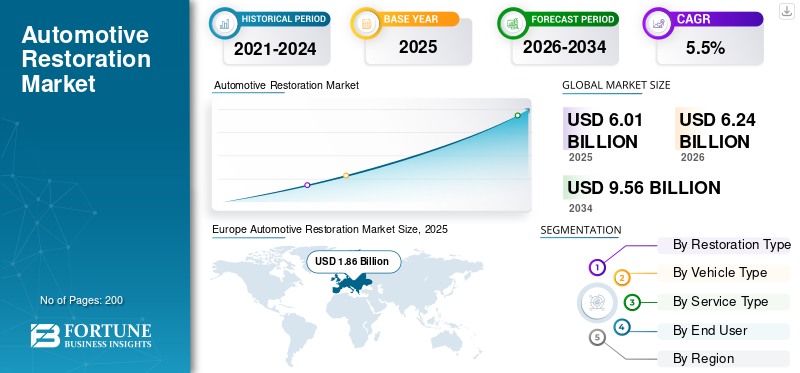
Download Free sample to learn more about this report.
AUTOMOTIVE RESTORATION MARKET KEY TAKEAWAYS
 Global Market Size & Forecast
- 2025 Market Size: USD 6.01 billion
- 2026 Market Size: USD 6.24 billion
- 2034 Forecast Market Size: USD 9.56 billion
- CAGR: 5.5% from 2026–2034
 Market Share
- Europe dominated the market with a 30.94% share in 2025.
- The Full Restoration segment is expected to dominate the market in 2026.
- The Classic Cars segment is expected to dominate the market in 2026.
 Key Regional Highlights
Europe
The market reached USD 1.86 billion in 2025 and is projected to witness steady growth by 2026, driven by a strong automotive heritage, premium vehicle brands, specialized restoration workshops, and active classic car communities.
North America
The market is projected to reach USD 1.69 billion by 2026, supported by strong demand for muscle car and classic vehicle restoration, a large collector base, and extensive aftermarket parts availability.
Asia Pacific
The market is projected to reach USD 1.87 billion by 2026, driven by rising interest in automotive restoration, expanding middle-class populations, and increasing participation of car enthusiasts across China, India, Japan, and Australia.
U.S.
The market reached USD 1.24 billion in 2025.
Japan
The market is projected to witness steady growth by 2026.
Read More

AUTOMOTIVE RESTORATION MARKET TRENDS
Growing Popularity of Digital Tools is a Key Market Trend
The adoption of digital tools such as 3D scanning, CAD modeling, and additive manufacturing is transforming the automotive restoration industry. These technologies help replicate rare restoration parts and improve efficiency in car restorations, particularly for vintage cars.
- For instance, in April 2024, SEMA’s Future Trends Report highlighted that classic vehicles continue to attract a passionate audience interested in modifications, upgrades, and restoration.
MARKET DYNAMICS
MARKET DRIVERS
Download Free sample to learn more about this report.
Rising Participation in Car Clubs to Drive Market Growth
Growing interest among car enthusiasts and increasing participation in car clubs are significantly boosting demand for classic car restoration and auto restoration services. Consumers are investing in classic models, muscle cars, and vintage cars to preserve automotive heritage and enhance resale value, thereby accelerating the automotive restoration market growth.
- For instance, in February 2025, Porsche Cars North America launched its fifth Porsche Classic Restoration Challenge, noting that over 100 non-roadworthy classic cars had been restored since 2020.
MARKET RESTRAINTS
High Restoration Costs and Limited Skilled Labor to Hinder Market Expansion
The high cost associated with car restorations, especially full-scale mechanical restoration and sourcing rare restoration parts, limits adoption among budget-conscious consumers. Additionally, the shortage of skilled professionals capable of restoring classic vehicles and vintage cars affects service availability and turnaround time.
- For instance, in March 2026, the Financial Times reported that the classic car industry is facing a shortage of skilled mechanics, with aging owners and experienced workers creating long-term pressure on restoration capacity.
MARKET OPPORTUNITIES
Expansion of Restomod and Customization Services Creates New Growth Avenues
The increasing trend of restomod projects, which combine classic aesthetics with modern technology, is creating significant opportunities for restoration services providers. Integrating electric drivetrains and advanced features into classic models is attracting a new generation of car enthusiasts.
- For instance, in February 2026, Lunaz unveiled its 50th commission, a re-engineered Aston Martin DB6 featuring a 5.0-liter, 350 bhp petrol engine and upgraded brakes.
MARKET CHALLENGES
Limited availability of Authentic Restoration Parts to Deter Industry Development
Sourcing original or high-quality restoration parts for older classic vehicles and vintage cars remains a major challenge. Counterfeit or incompatible parts can compromise restoration quality and vehicle performance, negatively impacting customer satisfaction.
- For instance, in December 2025, Wired reported rising replica vintage body-shell production, raising concerns regarding authenticity, IP, and quality standards among restoration shops and collectors.
Segmentation Analysis
By Restoration Type
Full Restoration Segment Leads due to its High Project Value
On the basis of restoration type, the market is segmented into full restoration and partial restoration.
The full restoration segment captures the dominant global automotive restoration market share due to its high project value and demand among collectors restoring classic vehicles and vintage cars to original condition. These projects involve extensive mechanical restoration, bodywork, and interior restoration, resulting in higher spending compared to partial restorations.
- For instance, in July 2023, Ferrari Classiche completed a full restoration of a 1960s Ferrari 250 GT, certifying authenticity and restoring original mechanical and body specifications.
The partial restoration segment is expected to grow at a CAGR of 7.2% over the forecast period.
By Vehicle Type
Classic Cars Segment Dominates due to Growing Interest in Classic Models
On the basis of vehicle type, the market is segmented into classic cars, muscle cars, vintage cars, and others.
Classic cars dominate the market due to their large population and widespread appeal among car enthusiasts. Demand for classic car restoration is supported by the availability of restoration services, growing interest in classic models, and participation in car clubs globally.
- For instance, in May 2023, Hagerty reported continued growth in classic car ownership, with increasing demand for restoration of widely available classic models across Europe and North America.
The muscle cars segment is expected to grow at a CAGR of 7.9% over the forecast period.
To know how our report can help streamline your business, Speak to Analyst
By Service Type
Body and exterior Segment Lead due to Restoration Requirements
On the basis of service type, the market is segmented into body & exterior, mechanical restoration, interior restoration, and others.
The body & exterior segment dominates as nearly all car restorations require repainting, rust repair, and structural refurbishment. These services form a critical part of restoring classic vehicles and vintage cars, contributing significantly to the total project cost.
- For instance, in September 2022, Jaguar Land Rover Classic expanded its restoration program, highlighting strong demand for body and exterior refurbishment, including paint and structural repairs.
The others segment is expected to grow at a CAGR of 8.6% over the forecast period.
By End User
Individual/Personal Users Segment Lead due to Rising Interest in Preserving Classic Models
On the basis of end user, the market is segmented into individual/personal users and institutional/commercial users.
Individual/personal users dominate the market, as most auto restoration projects are passion-driven initiatives undertaken by private collectors and car enthusiasts. Participation in car clubs and interest in preserving classic models continue to fuel demand for personalized restoration projects.
- For instance, in January 2024, Hagerty’s global collector survey indicated that the majority of restoration projects are undertaken by private owners rather than institutions.
The institutional/commercial users segment is expected to grow at a CAGR of 6.8% over the forecast period.
Automotive Restoration Market Regional Outlook
By geography, the market is categorized into North America, Europe, Asia Pacific, Latin America, and the Middle East & Africa.
Europe
Europe Automotive Restoration Market Size, 2025 (USD Billion)
To get more information on the regional analysis of this market, Download Free sample
Europe held the dominant share in 2024, valued at USD 1.80 billion, and also maintained its leading position in 2025, with USD 1.86 billion. The region dominates the market due to its strong automotive heritage, presence of premium brands, and well-established restoration ecosystem. Countries such as Germany, the U.K., and Italy have a high concentration of classic vehicles and vintage cars, supported by specialized workshops and OEM heritage programs. The region also benefits from favorable regulations and active car clubs, encouraging classic car restoration activities.
- For instance, in 2023, Porsche Classic expanded restoration services across Europe, strengthening its heritage vehicle refurbishment capabilities.
Germany Automotive Restoration Market
Germany’s market in 2025 stood at around USD 0.37 billion, accounting for roughly 6.2% of global revenues.
U.K. Automotive Restoration Market
The U.K.’s market in 2025 stood at around USD 0.34 billion, accounting for roughly 5.7% of global revenues.
Asia Pacific
Asia Pacific is estimated to reach USD 1.87 billion by 2026 and secure the position of the second-largest region in the market. The region is witnessing strong growth driven by rising interest in auto restoration, an expanding middle-class population, and increasing participation of car enthusiasts. Countries such as Japan and Australia have established restoration cultures, while India and China are emerging markets. Growing demand for restoration services and customization is accelerating market expansion.
China Automotive Restoration Market
China’s market is projected to be one of the largest worldwide, with 2025 revenues standing at around USD 0.27 billion, representing roughly 4.6% of global revenues.
India Automotive Restoration Market
The Indian market in 2025 was valued at around USD 0.34 billion, accounting for roughly 5.7% of global revenues.
North America
North America is projected to record a growth rate of 3.6% in the coming years. The market is likely to reach a valuation of USD 1.69 billion by 2026. North America shows stable growth supported by strong demand for muscle cars and classic vehicle restoration. The U.S. remains a key market with a large base of collectors and workshops offering specialized mechanical restoration services and aftermarket parts availability.
U.S. Automotive Restoration Market
Based on North America’s strong contribution and the U.S. dominance within the region, the U.S. market reached around USD 1.24 billion in 2025, representing roughly 27.4% of global market revenues.
Latin America
Latin America is witnessing steady growth in the market, with Brazil and Argentina leading the region. Increasing interest in classic car restoration and rising participation in automotive events are driving demand. However, lower disposable income levels continue to limit the adoption of high-cost restoration projects.
Middle East & Africa
The Middle East & Africa region is emerging as a promising market, driven by growing demand for luxury classic vehicle restoration, particularly in the UAE. South Africa contributes through a well-established automotive ecosystem, while increasing interest among collectors is supporting gradual market growth.
COMPETITIVE LANDSCAPE
Key Industry Players
Strategic Specialization And Heritage-Driven Positioning Define Competition
The global automotive restoration market is highly fragmented, comprising independent workshops, specialized service providers, OEM-backed restoration divisions, and niche players focusing on classic car restoration and auto restoration services. Companies compete based on craftsmanship quality, authenticity of restoration parts, turnaround time, and ability to handle complex mechanical restoration and interior restoration projects.
Moreover, key players are increasingly adopting strategies such as expanding restoration capabilities, forming partnerships with OEM heritage programs, and investing in advanced technologies such as digital scanning and 3D printing for rare components. Many firms are also targeting premium customers by offering bespoke restoration packages for classic vehicles and vintage cars. Additionally, participation in global automotive events and collaboration with car clubs helps companies strengthen brand positioning.
Another major strategy includes vertical integration, where companies control the sourcing of restoration parts and service delivery to ensure quality and cost-efficiency. Players are also leveraging digital platforms to connect with car enthusiasts and showcase restoration projects, enhancing customer engagement.
- For instance, in October 2025, Porsche crowned winners of the 2025 Classic Restoration Challenge in Durham, North Carolina. The event highlighted preservation, restoration, and individualization projects from Porsche Centers across U.S. regions.
LIST OF KEY AUTOMOTIVE RESTORATION COMPANIES PROFILED
- Porsche Classic (Germany)
- Ferrari Classiche (Italy)
- Jaguar Land Rover Classic (U.K.)
- Mercedes-Benz Classic (Germany)
- BMW Group Classic (Germany)
- Aston Martin Works (U.K.)
- Lunaz (U.K.)
- Singer Vehicle Design (U.S.)
- Classic Recreations (U.S.)
- Gateway Bronco (U.S.)
- Thornley Kelham (U.K.)
- Eagle E-Type (U.K.)
- Alfaholics (U.K.)
- Mechatronik (Germany)
- Dutton Garage (Australia)
KEY INDUSTRY DEVELOPMENTS
- February 2026: Lunaz revealed its 50th commission: a restored Aston Martin DB6 featuring a 5.0-liter straight-six engine, marking a shift from Lunaz’s usual electric classic conversions.
- December 2025: Porsche reintroduced historic interior fabrics, including Pepita, Pasha, and tartan. The fabrics allow owners to restore interiors of Porsche models from the 356 to the 911 using factory-quality materials.
- December 2025: Singer Vehicle Design introduced the Porsche 911 Carrera Coupe Reimagined by Singer. The new service restores and reimagines classic Type 964-generation Porsche 911s in collaboration with owners.
- November 2025: Singer Vehicle Design completed its first customer DLS Turbo commission, named Sorcerer. The reimagined Porsche 911 features carbon-fiber bodywork and a twin-turbo flat-six producing around 700 hp.
- November 2025: Ringbrothers unveiled “Kingpin,” an 800-hp 1969 Ford Mustang Mach 1 restomod at SEMA. The build required over 5,500 hours and combined classic muscle-car styling with modern engineering.
- September 2025: ECD Automotive Design signed a U.S. agreement with Chelsea Truck Company. The partnership covers bespoke Defender and INEOS Grenadier builds from ECD’s Kissimmee, Florida facility.
- September 2025: Everrati revealed an EV-converted classic Mini. The commissioned model expands Everrati’s portfolio of electrified classics, including the Porsche 911, Mercedes-Benz SL, and Land Rover Series models.
REPORT COVERAGE
The global automotive restoration market analysis provides an in-depth study of market size & forecast by all the market segments included in the report. It includes details on the market dynamics and market trends expected to drive the market in the forecast period. It offers information on the technological advancements, new product launches, key industry developments, and details on partnerships, mergers & acquisitions. The research report also encompasses a detailed competitive landscape with information on the market share and profiles of key operating players.
Request for Customization to gain extensive market insights.
Report Scope & Segmentation
| ATTRIBUTE | DETAILS |
| Study Period | 2021-2034 |
| Base Year | 2025 |
| Estimated Year | 2026 |
| Forecast Period | 2026-2034 |
| Historical Period | 2021-2024 |
| Growth Rate | CAGR of 5.5% from 2026 to 2034 |
| Unit | Value (USD Billion) |
| Segmentation | By Restoration Type, Service Type, Vehicle Type, End User, and Region |
| By Restoration Type |
|
| By Vehicle Type |
|
| By Service Type |
|
| By End User |
|
| By Geography |
|
Frequently Asked Questions
Fortune Business Insights says that the global market value stood at USD 6.01 billion in 2025 and is projected to reach USD 9.56 billion by 2034.
In 2025, the market value stood at USD 1.86 billion.
The market is expected to exhibit a CAGR of 5.5% during the forecast period.
The classic cars segment leads the market by vehicle type.
Rising participation in car clubs is a key factor driving the market.
Porsche, Ferrari, BMW, and Mercedes-Benz are some of the top players in the market.
Europe dominated the market.



- 2021-2034
- 2025
- 2021-2024
- 200
-
(Offer valid till 15th Oct 2026)
Get 30-60 hrs Free Customization
Expand Regional and Country Coverage, Segments Analysis, Company Profiles, Competitive Benchmarking, and End-user Insights.




















Related Reports
-
US +1 833 909 2966 ( Toll Free )
-
Get In Touch With Us