Automatic Identification System Market Size, Share & Industry Analysis, By Class (Class A AIS, Class B AIS, and AIS-based Stations), By Platform (Shipborne, Airborne, and Offshore-based Platform), By Application (Fleet Management, Vessel Tracking, Maritime Security, Search and Rescue, and Other Application), By Component (Transmitter, Receivers, Central Processing Unit, Display, and Others), and Regional Forecast, 2026-2034
 Download Free Sample
 KEY MARKET INSIGHTS
 Listen to Audio Version
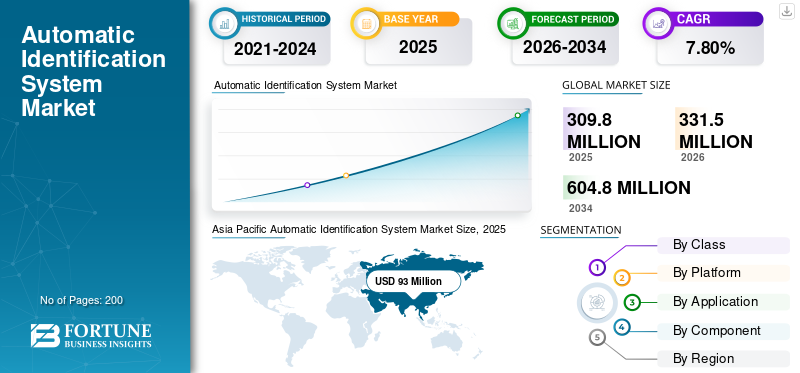
The global automatic identification system market size was USD 309.80 million in 2025 and is projected to grow from USD 331.50 million in 2026 to USD 604.80 million in 2034 at a CAGR of 7.80% over 2026-2034. Asia Pacific dominated the global automatic identification system market with a market share of 30.00% in 2025.
An Automatic Identification System is a tracking system shared the location of vessels in the vicinity. AIS, also known as broadcast transponder system, operates in the VHF mobile maritime frequency band. This provides a terrestrial-based monitoring system of suitably equipped ships. This information is collected by shore stations, other vessels, and satellites, thus enabling other equipped vessels to identify other vessels in their area. Vessel Traffic Services (VTS) ashore use AIS to identify, locate and monitor vessels. An AIS transponder normally works in an autonomous and continuous mode, regardless of operating in the open seas or coastal or inland areas. AIS transponders use two different frequencies, VHF maritime channels 87B (161.975 MHz) and 88B (162.025 MHz). The Panama Canal uses the AIS to provide information about rain along the canal and wind in the locks.
The AIS is also being used for different applications, including the widespread transmission of critical environmental conditions information, such as sea state and weather, to mariners, forecasters, and emergency response providers. Several pilot projects are in the research & development phase that will demonstrate the capacity and promise of AIS data and the AIS platform to serve multiple purposes, providing overall maritime domain awareness while maintaining its most important objective of tracking vessels to aid safe, secure, efficient and environmentally sound maritime operations. Considering the above factors, the market is expected to witness substantial growth in revenue during the forecast period.
During the COVID-19 pandemic, the naval and shipbuilding sectors experienced numerous difficulties, such as staff isolation, manufacturing halts, and disrupted supply chains. Shipbuilding investments decreased, which affected offshore operations and maritime trade services. There was less of a need for automatic identification systems as shipbuilding declined. A decline in demand and financial difficulties caused many small maritime businesses to fail. The United Nations Conference on Trade and Development (UNCTAD) 2020 report states that there was a 4.1% decline in global maritime trade, which had an impact on ports, shipping networks, cargo volumes, and growth prospects.
Download Free sample to learn more about this report.
Automatic Identification System Market Overview & Key Metrics
Market Size & Forecast:
- 2025 Market Size: USD 309.80 million
- 2026 Market Size: USD 331.50 million
- 2034 Forecast Market Size: USD 604.80 million
- CAGR: 7.80% from 2026–2034
Market Share:
- Asia Pacific dominated the automatic identification system market with a 30.00% share in 2025, driven by increasing maritime trade volumes, advanced shipbuilding capabilities, and rising defense investments from countries such as China, Japan, and South Korea.
- By application, vessel tracking accounted for the largest market share in 2023, supported by growing international trade and rising adoption of maritime surveillance technologies.
Key Country Highlights:
- China: Major driver in Asia Pacific due to rapid expansion in shipbuilding and maritime trade, supported by territorial surveillance requirements.
- Japan: Strong innovation in AIS technology through players like Furuno Electric Co. Ltd and Japan Radio Co. Ltd.
- United States: Growth supported by U.S. Navy contracts and the presence of leading companies such as ORBCOMM Inc. and Garmin Ltd.
- Europe: Significant advancements in autonomous ship projects and maritime safety initiatives by Saab AB and Kongsberg Gruppen ASA.
Automatic Identification System Market Trends
Growing Trend of Space-Borne Automatic Identification System to Boost Market Growth
Space-borne SAR and AIS are complementary and ship surveillance using an integrated combination has attracted considerable attention. At present, there is a growing demand for space-borne identification systems. Since more and more satellites are equipped with an AIS payload, corresponding software and hardware are being designed to boost market growth over the forthcoming years. For instance,
- ‘Ocean-2B’ satellite-based AIS payload is used to test the performance of the scene simulation system, which indicates that the method can simulate real scenes of receiving signals in orbit in a favorable manner.
- In October 2021, ExactEarth Ltd., a leading provider of Satellite-AIS data services, announced a USD 1.5 million one-year Satellite-AIS services contract with Geospatial Intelligence Pty Ltd. Under the terms of the agreement, ExactEarth will provide GI with the Company's real-time exact AIS Platinum Plus product, its Ship view web-based analysis tool, certain historical Satellite-AIS data sets and its Position Anomaly analytics application.
- Asia Pacific witnessed automatic identification system market growth from USD 79.1 Million in 2022 to USD 83.1 Million in 2023.
Download Free sample to learn more about this report.
Automatic Identification System Market Growth Factors
Adoption of IoT in Automatic Identification System to Boost Market Growth
The key players involved in the advancement of vessel tracking and monitoring technology are anticipating the future of intelligent global ocean trade and supply chains, utilizing satellite AIS, Internet of Things (IoT) connectivity, and Big Data to provide unmatched levels of visibility and control. The Internet of Things (IoT) represents the upcoming era of internet connectivity based on the Internet Protocol (IP). It allows the automated use of data generated by sensors or devices that are connected to wired communication networks. Due to the growing need for more effective decision-making systems as to what course of action to take in any given situation, AIS will play a vital role in marine IoT in general. Therefore, higher growth numbers are expected during the forecast period. For instance,
- BigOceanData has taken the lead in enabling AIS transmissions to carry data from more than one source, and its ability to fuse data from other systems, such as SSAS and Inmarsat-C that transmit data via low-orbit satellites, AIS as a critical system onboard any IoT vessel, and manned or autonomous, will be at the core of the IoT network.
Growth in International Seaborne Trade to Propel Market Growth
UNCTAD’s Maritime Transport Report 2020 projected that maritime trade growth would expand by 4.8% in 2021. The merchant ships are majorly used for seaborne trade. Asia Pacific is the largest seaborne trading region. In 2019, Asian seaports handled 6.9 billion tons of goods unloaded and 4.5 billion tons of goods loaded. Asian countries, such as China, Japan, and South Korea, have emerged as the leading countries in the shipbuilding sector. The automatic Identification system is the essential system of the naval ships. Thus, the expansion of naval sector due to growing international seaborne trade activities propels the market's growth during the forecast period.
- In November 2021, UNCTAD predicted that annual growth in maritime trade between 2022 and 2026 would slow to 2.4%, compared to 2.9% over the past two decades. The COVID-19 pandemic’s impact on maritime trade volumes in 2020 was less than initially expected, but its knock-on effects will be far-reaching and could transform maritime transport.
RESTRAINING FACTORS
Cybersecurity Threats to Hamper the Market Growth
The maritime sector has faced constant vessel alteration owing to the rising automation and digitization. Autonomous vessel infrastructure comprises a combination of highly integrated software & hardware and electromechanical systems forming computer networks. The publication AIS data is one of the major cyber threats on the world-wide-web, or elsewhere, subject to the provisions of their national laws and might create ships that may be more vulnerable to terror acts via piracy and cyber-attacks. These leaks in AIS data e could be detrimental to the safety and security of ships and port facilities, thus hindering the market development.
Automatic Identification System Market Segmentation Analysis
By Class Analysis
Class A AIS Segment Dominated Market in 2023
Based on class, the automatic Identification system market is segmented into class A AIS, class B AIS, and AIS-based stations. Class A AIS segment is anticipated to hold a dominant market share of 7.80% in 2026, as it has been mandated by the International Maritime Organization (IMO) for vessels of 300 gross tonnages and upwards engaged in international voyages, cargo ships of 500 gross tonnages and upwards not engaged on international voyages. The growing international maritime trade and cargo delivery services have boosted the segment growth. Class B AIS is one of the emerging segments as class B AIS transponders are mainly used by recreational vessels and smaller commercial vessels. Moreover, class B transponders also receive all class A and class B AIS transmissions. Thus, higher growth numbers are expected shortly.
By Component Analysis
Transmitter Segment to Dominate Market during 2026-2034
Based on component, this market is segmented into transmitter, receivers, central processing unit, display, and others. The receiver segment grows at a higher pace, owing to advancements in radars and satellite communication services. Moreover, the growing adoption of satellite-based automatic identification system (SAT-AIS) is a crucial factor responsible for segment growth during the forecast period. Furthermore, the demand for GNSS products and solutions has created a surge in demand for receivers operating at a very high frequency. The central processing unit is one of the major segments in the market. The fast, efficient, and real-time data is the need of the hour by naval and offshore service providers. The transmitter segment is anticipated to hold a dominant market share of 27.96% in 2026.
By Platform Analysis
Shipborne Segment to Witness Highest CAGR During Forecast Period
Based on platform, this market is segmented into airborne, shipborne, and offshore-based platforms. The shipborne platform to witness higher CAGR owing to increased naval and maritime activities. Moreover, the development of autonomous ships is one of the major factors driving the segment growth. These ships include the latest technology, such as data analysis technology, Internet of Things (IoT), and onshore monitoring bases connected by broadband communication. The airborne segment is expected to be the emerging market as an increase in patrol activities by navy and coast guard across international sea borders and international ports around the world.
- The Shipborne segment is anticipated to hold a dominant market 58.86% share in 2026.
To know how our report can help streamline your business, Speak to Analyst
By Application Analysis
Vessel Tracking Segment Witnessed Highest Market Share in 2025
Based on application, the automatic identification system market is segmented into fleet management, vessel tracking, maritime security, search and rescue, and other applications. The main purpose of the system is vessel tracking. This application helps border control agencies with better handling capabilities on maritime traffic. The growing maritime traffic worldwide due to increased trade activities is one of the major factors responsible for the segment during the forecast period. Maritime security and surveillance were two of the major drivers for the uptake of AIS technology. Maritime transportation was identified as a major threat vector and was one of the drivers behind the push from the coast guard and navy to have greater visibility and efficient security aid. Thus, higher growth of the maritime security segment is anticipated in revenue soon. Fleet management segment is anticipated to hold a dominant market share of 34.48% in 2026
REGIONAL INSIGHTS
The market is segmented into North America, Europe, Asia Pacific, Middle East & Africa, and Latin America.
Asia Pacific
Asia Pacific Automatic Identification System Market Size, 2025 (USD Million)
To get more information on the regional analysis of this market, Download Free sample
Asia Pacific maintained a strong presence in the global market, reaching USD 93 million in 2025, accounting for 30.00% share, and is expected to reach USD 99 million in 2026. The progress is expected due to the rapidly increasing maritime trade and economic development in the region. The UNCTAD Review of Maritime Transport 2020 states, Asia contributed about 65% of global container port traffic and persisted the prominent position in container port cargo handling. The Asia Pacific dominated the market in 2023. The growth is attributed to the well-developed shipbuilding industry involved the development of complex naval vessels, such as ferries, cruise ships, mega yachts, and submarines. Furthermore, the demand for the system in defense sector increases due to ongoing territorial conflicts among countries such as China, India, and Pakistan. The Japan market is projected to reach USD 15.98 million by 2026, the China market is projected to reach USD 38.92 million by 2026, and the India market is projected to reach USD 25.32 million by 2026.
Europe
The Europe region captured 28.20% of the global market in 2025, generating USD 87.4 million in revenue, and is projected to reach USD 94.6 million in 2026. The growth attributed to the rising investments in autonomous development of progressive ships projects from various European countries drive the automatic Identification system market growth. The rise in the number of ships due to growing international seaborne trade has led to rising demand for the systems across Europe. The UK market is projected to reach USD 26.88 million by 2026, and the Germany market is projected to reach USD 15.08 million by 2026.
North America
In 2025, the North America market stood at USD 81.1 million, representing 26.20% of global demand, and is projected to grow to USD 87.1 million in 2026. Increasing procurement contracts of naval vessels from the U.S Navy and rising demand for dry cargo and maritime tourism across the region propel the market's growth. For instance, market players such as L3Hariss Technologies Inc., Exact Earth, and Garmin Ltd are responsible for market growth in this region. The U.S. market is projected to reach USD 75.49 million by 2026.
Rest of the world
Rest of the world market stood at increasing maritime trade in the Middle East & Africa, and Latin American countries to drive the market growth during the forecasts period. The Unique Group in the UAE introduced a UnI-Cat vessel for unmanned surveys in shallow waters in the year 2019. The organization designed and integrated autonomous sensors, communications technology, and AIS in naval ships. Thus higher growth numbers are anticipated in this region. The Middle East & Africa market accounted for USD 32.03 million in 2025, representing 10.30% of the global industry, and is expected to reach USD 33.65 million in 2026. In 2025, Latin America represented USD 16.25 million, accounting for 5.20% of the worldwide market, and is projected to grow to USD 16.82 million in 2026.
List of Top Automatic Identification System Companies:
Technological Advancements in Automatic Identification System to Boost Market Growth
The competitive landscape of the AIS market depicts the domination of selected players such as ExactEarth Ltd, Orbcomm Inc., and Gramin. These companies focus on designing and developing advanced maritime traffic solutions. Moreover, these companies are expanding their geographic reach all over the world in the forthcoming years. For Instance, In May 2021, Unseen labs partner with ORBCOMM to provide maritime surveillance service for government and commercial AIS customers.
Key Industry Players
- Furuno Electric Co. Ltd (Japan)
- Japan Radio Co. Ltd. (Japan)
- Saab AB (Sweden)
- ExactEarth Ltd (Canada)
- Orbcomm Inc. (U.S.)
- Garmin Ltd (U.S.)
- Kongsberg Gruppen ASA (Norway)
- True Heading AB (Sweden)
- C.N.S. Systems AB (Sweden)
- Wartsila OYJ Abp (Finland)
- ComNav Marine Ltd (Canada)
- L3Hariss Technologies Inc. (U.S.)
KEY INDUSTRY DEVELOPMENTS:
- April 2024 - The Maritime Rescue and Safety Society (SASEMAR) under the Spanish Ministry of Transport and Sustainable Mobility selected Cellnex Spain to ensure maritime safety in Spain. Furthermore, Cellnex secured another contract with Maritime Rescue for the Automatic Identification System (AIS) data service. The coverage areas for satellite AIS have been expanded with the addition of a new web map service offering global coverage. The contract, which is valued at nearly USD 6.4 million and spans five years, demonstrates Cellnex's pivotal role in enhancing maritime safety infrastructure in Spain.
- February 2024 - Steadicopter, an Israeli company, added an automatic identification system to the payload of its Black Eagle 50H, a remotely unmanned air vehicle (RUAV) – the first hybrid-powered unmanned helicopter and the newest model in its RUAV family. The addition of the AIS enables maritime unmanned helicopter operators to identify ships better and focus on those that pose a threat. The AIS is carried by this advanced unmanned helicopter in addition to an electro-optic system and maritime radar.
- February 2024 - Spire Global, Inc., a leading global provider of space-based data, analytics, and space services, has been awarded two framework contracts by the European Maritime Safety Agency with a maximum overall budget of USD 9 million. Spire would provide space-based automatic identification system (SAT-AIS) data services for ship tracking for four years, including real-time, standard, and high-density backup SAT-AIS.
- June 2023 – Smart Eye, a company specializing in the development of Driver Monitoring System (DMS) technology for the automotive industry, entered into a contract with Linde, a German vehicle logistics company, for its AIS product, which comprises a comprehensive hardware and software DMS for aftermarket installation in vehicle fleets.
- October 2022 - ORBCOMM Inc., a leading global provider of Internet of Things (IoT) solutions, has been granted a multi-year contract by a U.S. Government Agency for a competitive renewal of its global Automatic Identification System (AIS) data services, which are utilized for ship tracking and other maritime navigational and safety initiatives. Additionally, ORBCOMM was awarded a separate competitive contract to deliver AIS services to multiple other U.S. government users.
REPORT COVERAGE
The global automatic identification system market report provides a detailed market analysis and focuses on key aspects, such as renowned manufacturers, products, demanding technologies, and end-users. Moreover, it offers insights into the trends and highlights key industry developments. In addition to the factors mentioned above, the market report encompasses several direct and indirect factors that have contributed to the market's growth over recent years.
Request for Customization to gain extensive market insights.
Report Scope & Segmentation
|
ATTRIBUTE |
DETAILS |
|
Study Period |
2021-2034 |
|
Base Year |
2025 |
|
Estimated Year |
2026 |
|
Forecast Period |
2026-2034 |
|
Historical Period |
2021-2024 |
|
Growth Rate |
CAGR of 7.80% from 2026 to 2034 |
|
Unit |
Value (USD Million) |
|
Segmentation
|
By Class
|
|
By Platform
|
|
|
By Application
|
|
|
By Component
|
|
|
By Geography
|
Frequently Asked Questions
Fortune Business Insights says that the global market size was USD 309.80 million in 2025 and is projected to reach USD 604.80 million by 2034.
Registering a CAGR of 7.80%, the market will exhibit steady growth over the forecast period (2026-2034).
The shipborne segment is the leading segment in the market.
Saab AB, ExactEarth, and L3Hariss Technologies Inc. are the leading players in the global market.
Asia Pacific dominated the global automatic identification system market with a market share of 30.00% in 2025.



- 2021-2034
- 2025
- 2021-2024
- 200
Get 20% Free Customization
Expand Regional and Country Coverage, Segments Analysis, Company Profiles, Competitive Benchmarking, and End-user Insights.




















Related Reports
-
US +1 833 909 2966 ( Toll Free )
-
Get In Touch With Us