Accelerometer Market Size, Share & Industry Analysis, By Technology (Capacitive MEMS Accelerometer, Piezoresistive Accelerometer, and Piezoelectric Accelerometer), By Platform (Airborne, Ground, Maritime, and Space), By End User (Aerospace & Defense, Consumer Electronics, Marine/Naval, Automotive, and Others), and Regional Forecast, 2026-2034
 Download Free Sample
KEY MARKET INSIGHTS
 Listen to Audio Version
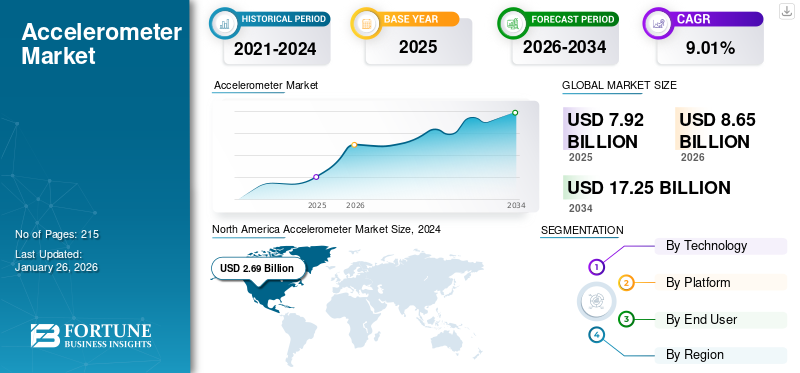
The global accelerometer market size was valued at USD 7.92 billion in 2025 and is projected to grow from USD 8.65 billion in 2026 to USD 17.25 billion by 2034, exhibiting a CAGR of 9.01% during the forecast period. North America dominated the accelerometer market with a market share of 36.46% in 2025.
An accelerometer is a device that measures the acceleration of an object, which is the rate of change of its velocity. In aerospace and defense, accelerometers are used for inertial navigation systems and vibration monitoring. In automotive, they are crucial for airbag deployment and stability control systems. The various types of accelerometers are capacitive MEMS accelerometers, piezoresistive accelerometers, and piezoelectric accelerometers.
The rising use of consumer electronics and industrial applications fuels the adoption of accelerometers. The current MEMS technology has made accelerometers more compact and cost-effective, and is increasingly promoting its adoption. The accelerometer is used for applications in the aerospace industry, such as navigation and monitoring of critical systems. The demand for accelerometers is rising due to advancements in technology and expanding applications. Key players in the market which include Honeywell International Inc., Northrop Grumman, Safran Electronics & Defense, Thales Group are advancing MEMS technology to deliver high-precision, tactical-grade sensors for aerospace, defense, and industrial applications. They are focusing on innovations such as vibration and shock-resistant designs, miniaturization, and enhanced reliability for use in harsh environments.
The COVID-19 pandemic disrupted the market due to supply chain issues and reduced demand in automotive and manufacturing industries. However, recovery was driven by increased applications in healthcare, industrial automation, and MEMS-based technologies, with the market regaining momentum as economies adapted and resumed growth.
Download Free sample to learn more about this report.
ACCELEROMETER MARKET KEY TAKEAWAYS
 Market Size & Forecast
- 2025 Market Size: USD 7.92 Billion
- 2026 Market Size: USD 8.65 Billion
- 2034 Forecast Market Size: USD 17.25 Billion
- CAGR: 9.01% from 2026–2034
 Market Share
- North America dominated the market with a 36.46% share in 2025.
- Capacitive MEMS accelerometers held a 46.63% market share in 2026.
- Airborne applications accounted for 29.39% of the global market in 2026.
 Key Regional Highlights
North America
North America held a 36.46% share in 2025, valued at USD 2.89 Billion, and is projected to reach USD 3.15 Billion in 2026.
Europe
Europe accounted for 30.76% of the market in 2025, valued at USD 2.44 Billion, and is expected to reach USD 2.67 Billion in 2026.
Asia Pacific
Asia Pacific captured 24.21% of global revenue in 2025, valued at USD 1.92 Billion, and is projected to reach USD 2.11 Billion in 2026.
U.S.
The market is projected to reach USD 2.23 Billion in 2026.
Japan
The market is projected to reach USD 0.77 Billion in 2026.
Read More

ACCELEROMETER MARKET TRENDS
Integration of Accelerometers with Advanced Sensor Fusion and Digital Avionics Systems
Aerospace and defense platforms are increasingly using accelerometers alongside gyroscopes, magnetometers, and GPS in integrated Inertial Measurement Units (IMUs) to achieve higher navigation accuracy and system redundancy. This trend is driven by the need for robust, multi-sensor solutions that can provide precise data for flight control, stabilization, and autonomous operations-even in GPS-denied or hostile environments.
- North America witnessed accelerometer market growth from USD 2.52 Billion in 2023 to USD 2.69 Billion in 2024.
Download Free sample to learn more about this report.
MARKET DYNAMICS
MARKET DRIVERS
Increase in Military Spending and Rising Adoption of UAVs and Fighter Jets to Stimulate Market Growth
The growth of the market in the aerospace and defense industry is significantly increasing due to various factors, such as the surge in global military spending and the rising adoption of Unmanned Aerial Vehicles (UAVs) and advanced fighter jets. The global military expenditure reached USD 2,443 billion in 2023, marking a real-term increase of 6.8% from 2022. This surge in military spending fuels the demand for advanced sensors such as accelerometers, which are essential for the modern systems of the military. China and India are increasing their defense budgets to modernize their armed forces and acquire advanced technologies. This will eventually support the advanced IMUs market, including components such as accelerometers.
Moreover, UAVs are increasingly used in military operations for surveillance and combat missions. UAVs depend on accelerometers for navigation and stabilization systems. Thus, the modernization of fighter jets with advanced avionics and control systems also drives the demand for high-end accelerometers. Accelerometers are utilized in the defense industry to enhance the operational capabilities of UAVs and fighter jets. It helps to maintain precise navigation and control. Therefore, the rise in the integration of accelerometers into these systems contributes to market growth.
MARKET RESTRAINTS
Technological Limitations such as Calibration and Accuracy Challenges to Limit Market Expansion
Calibration and accuracy challenges serve as a significant restraint in the market. The process of calibrating accelerometers is complex. It requires precise axial alignment to ensure accurate measurements. However, achieving this alignment is difficult, and even slight misalignments can lead to biased results. Furthermore, calibration processes involve intricate mathematical models and demand careful sensor placement, which can be time-consuming and prone to errors. The sensitivity of accelerometers to calibration errors means that small mistakes can significantly impact the accuracy of readings, making it challenging to ensure consistent and reliable data across different applications.
MARKET OPPORTUNITIES
Increase in Demand for High-End MEMS Accelerometers in Military is Expected to Positively Impact Market Growth
There is a growing demand for advanced accelerometers in military applications, driven by the need for precise navigation and control in unmanned vehicles and other defense systems. For instance, in December 2024, The U.S. Defense Advanced Research Projects Agency (DARPA) asked the industry to develop robust MEMS gyros and accelerometers for fast maneuvering unmanned vehicles. These sensors must withstand high G-forces to enhance precise positioning and navigation. The NIMBUS project aims to achieve velocities exceeding 200 meters per second, significantly improving sensor performance. Such technological advancement is expected to boost demand for high-performance accelerometers in the aerospace and defense industry. MEMS accelerometers are important to Inertial Measurement Units (IMUs) as they provide real-time data to achieve stable flight and precise navigation. They are also used in aircraft and spacecraft to maintain proper orientation and motion. In addition, the advancements occurring in MEMS technology have led to the design and development of accelerometers that are compact, low-power, and cost-effective.
Segmentation Analysis
By Technology
Capacitive MEMS Accelerometer Dominate Owing to Their High Sensitivity and Low Power Consumption
By technology, the market is segmented into capacitive MEMS accelerometer, piezoresistive accelerometer, and piezoelectric accelerometer.
The capacitive MEMS accelerometer segment led the market accounting for 46.63% market share in 2026. The capacitive MEMS accelerometer holds the largest share of the market and is expected to grow at the highest CAGR during the forecast period. In the aerospace and defense sector, capacitive MEMS accelerometers have dominated the market due to their high sensitivity and low power consumption. These features make them ideal for applications requiring precise motion detection and energy efficiency, such as in unmanned aerial vehicles and missiles. For instance, in April 2024, Gladiator Technologies, a sensor and INS manufacturer, launched GA50, a high-performance, single-axis MEMS open-loop accelerometer designed for precision and reliability in unmanned systems and autonomous applications. Therefore, the demand for advanced navigation systems in military operations fuels their adoption.
By Platform
Airborne Segment Leads owing to Increasing Need for Advanced Navigation Systems in UAVs and Aircraft
By platform, the market is segmented into airborne, ground, maritime, and space.
The airborne segment is expected to lead the market, contributing 29.39% globally in 2026. The airborne segment is experiencing significant growth in the market due to the increasing demand for accelerometers in advanced navigation systems in aircraft, drones, and UAVs.
- For instance, in April 2024, Kistler, one of the major players in the market, introduced the 8740A and 8788A accelerometer series. The accelerometer is designed for vibration testing in aviation and space applications. These high-sensitivity IEPE accelerometers offer low noise and wide frequency responses, available in 5g, 10g, and 50g ranges.
By End User
Aerospace & Defense Dominated Market Due to Strong Demand for Advanced Sensors
Based on end user, the market is segmented into aerospace & defense, consumer electronics, marine/naval, automotive, and others.
The aerospace and defense segment is expected to account for 33.51% of the market in 2026. The aerospace and defense segment is fueling significant growth in the market due to the high demand for advanced sensors. The advancements in precision sensing technology have improved the accuracy and reliability of accelerometers. Moreover, the rise in defense spending and investments is also creating new opportunities for the accelerometer industry.
Accelerometer Market Regional Outlook
By geography, the market is categorized into North America, Europe, Asia Pacific, and the rest of the world.
North America
North America Accelerometer Market Size, 2025 (USD Billion)
To get more information on the regional analysis of this market, Download Free sample
North America contributed 36.46% to the global market in 2025, with a valuation of USD 2.89 billion, and is projected to reach USD 3.15 billion in 2026. The reason for the growth of the market in the region is influenced by various factors. One of the factors is the rise in defense spending or military budget allocated toward the procurement of advanced jets and Unmanned Aerial Vehicles (UAVs). Moreover, the increase in the use of accelerometers in precision-guided munitions and advanced fighter jets is expected to drive the growth of the market in North America. In addition, the presence of companies such as Honeywell Inc, Inertial Labs, Silicone Designs, and others is expected to increase the region’s market share. The U.S. market is projected to reach USD 2.23 billion by 2026.
The U.S. accelerometer market for aerospace and defense is the largest globally, driven by high military spending and ongoing investments in advanced aircraft, missiles, and unmanned systems. Accelerometers are crucial for navigation, guidance, and vibration monitoring in harsh environments, with growing adoption of high-end MEMS sensors.
Europe
Europe accounted for USD 2.44 billion in 2025, representing 30.76% of the global market share, and is projected to reach USD 2.67 billion in 2026. Europe is known for its significant automotive industry and the strict safety standards established to promote the use of advanced safety standards in automobiles. The accelerometers are used in vehicles for proper vehicle control and driver safety. Thus, the surge in the demand for accelerometers for safety and electronic stability control in vehicles is expected to drive the growth of the market. Moreover, various space agencies, such as the European Space Agency (ESA), conduct unique projects such as satellite launches and space exploration. Accelerometers play a critical role in the space industry to provide navigation and stabilization, thereby increasing the demand for these systems in the region. The UK market is projected to reach USD 0.81 billion by 2026, while the Germany market is projected to reach USD 0.65 billion by 2026.
Asia Pacific
The Asia Pacific market was valued at USD 1.92 billion in 2025, capturing 24.21% of global revenue, and is estimated to reach USD 2.11 billion in 2026. Asia Pacific is the fastest-growing region in the market due to increasing investments in defense and aerospace sectors by China, India, and Japan. For instance, in 2025, China is making plans to increase defense spending by 7.2% due to current geopolitical tension. The country aims to achieve complete military modernization by 2035 with the development of new missiles, submarines, vessels, and surveillance technologies. The developing countries are focusing on the modernization of their defense capabilities. The advanced defense system will require high-performance accelerometers for correct navigation and accurate guidance, which is anticipated to propel the growth of the accelerometer market growth.
The Japan market is projected to reach USD 0.77 billion by 2026, the China market is projected to reach USD 0.61 billion by 2026, and the India market is projected to reach USD 0.57 billion by 2026.
Rest of the World
The Rest of the World region captured 8.57% of the global market in 2025, generating USD 0.68 billion in revenue, and is projected to reach USD 0.73 billion in 2026. The rest of the world includes regions such as Latin America and the Middle East & Africa. Countries in these regions are investing in military modernization, which includes the adoption of advanced defense systems that rely on high-performance accelerometers for navigation and guidance. The increasing use of Unmanned Aerial Vehicles (UAVs) in military operations across these regions fuels the demand for advanced navigation systems that utilize accelerometers.
COMPETITIVE LANDSCAPE
Key Industry Players
Continuous Development and Introduction of New Products by Key Companies Resulted in their Dominating Position
The global market is highly fragmented, with numerous players competing across various segments. Key players include Honeywell International Inc., Analog Devices Inc., Safran Navigation & Timing, Silicon Designs Inc, and others. These market players focus on developing high-performance, cost-effective accelerometers for aerospace and defense applications, leveraging advancements in MEMS technology to increase the accelerometer market share. The market is driven by strategic partnerships and investments in research and development to enhance product portfolios. Competition also arises from alternative technologies such as gyroscopes and magnetometers.
LIST OF KEY ACCELEROMETER COMPANIES PROFILED
- Honeywell International Inc. (U.S.)
- Northrop Grumman (U.S.)
- Safran Electronics & Defense (France)
- Thales Group (France)
- Innalabs Limited (Ireland)
- AMETEK Sensors and Fluid Management Systems (U.S.)
- Dytran Instruments, Inc. (U.S.)
- KVH Industries (U.S.)
- Physical Logic Ltd (Israel)
- Inertial Labs (by VIAVI Solutions) (U.S.)
- Murata Manufacturing (Japan)
KEY INDUSTRY DEVELOPMENTS
- November 2024: Analog Devices introduced the ADIS1657x IMU family, offering enhanced stability and vibration rejection in a compact package. This series includes precision MEMS IMU modules that feature triaxial digital accelerometer sensing with a full-scale range of ±8g.
- March 2024: Honeywell announced it will acquire Civitanavi Systems for approximately USD 222.4 million to strengthen its autonomous operations offerings in aerospace and expand its European presence. Civitanavi’s high-precision inertial navigation, geo-reference, and stabilization systems-including advanced Fiber Optic Gyro technology-will complement Honeywell’s existing navigation portfolio and support both commercial and defense customers.
- January 2024: Murata launched the SCH16T-K01, a next-generation 6DoF inertial sensor featuring a 3-axis gyroscope and 3-axis accelerometer, aimed at high-precision machine control and positioning applications.
- May 2023: InnaLabs introduced the AQUILA, a radiation-hardened, High-Reliability (Hi-Rel) quartz accelerometer designed for space applications. The AQUILA offers an input range of ±25g, a bias of less than 4 mg, and is radiation-hardened up to 50 krad, making it ideal for navigation and fault detection in satellites and spacecraft.
- March 2022: Honeywell launched the MV60, a high-performance MEMS accelerometer designed for aerospace and defense applications, offering reliability and precision in a compact package. The MV60 features a shock survivability of up to 5,000 g and a bandwidth greater than 300 Hz.
REPORT COVERAGE
The global accelerometer market research report provides an in-depth technical analysis of the market, covering its size, trends, growth analysis, and future projections. The report discusses key drivers such as technological advancements and increasing demand for advanced and innovative systems. It also examines the role of accelerometers in emerging technologies such as autonomous vehicles and drones. It also identifies factors contributing to market growth during the forecast period.
Request for Customization to gain extensive market insights.
Report Scope & Segmentation
|
ATTRIBUTE |
DETAILS |
|
Study Period |
2021-2034 |
|
Base Year |
2025 |
|
Estimated Year |
2026 |
|
Forecast Period |
2026-2034 |
|
Historical Period |
2021-2024 |
|
Growth Rate |
CAGR of 9.01% from 2026-2034 |
|
Unit |
Value (USD Billion) |
|
Segmentation |
By Technology
|
|
By Platform
|
|
|
By End-User
|
|
|
By Region
|
Frequently Asked Questions
Fortune Business Insights says that the global market value stood at USD 8.65 billion in 2026 and is projected to record a valuation of USD 17.25 billion by 2034.
In 2025, the market value stood at USD 2.89 billion in North America.
The market is expected to exhibit a CAGR of 9.01% during the forecast period of 2026-2034.
The capacitive MEMS accelerometer is the leading segment of the market in terms of technology.
The key factors driving the market are the increase in military spending and rising adoption of Unmanned Aerial Vehicles (UAVs).
Honeywell International Inc., Northrop Grumman, and Safran Electronics & Defense are the top players in the market.
North America dominated the market in 2025.



- 2021-2034
- 2025
- 2021-2024
- 215
Get 30-60 hrs Free Customization
Expand Regional and Country Coverage, Segments Analysis, Company Profiles, Competitive Benchmarking, and End-user Insights.




















Related Reports
-
US +1 833 909 2966 ( Toll Free )
-
Get In Touch With Us