Bioanalytical Testing Services Market Size, Share & Industry Analysis, By Analytical Testing Type (Pharmacokinetic/Toxicokinetic Analysis, Immunogenicity Testing, Biomarker & Pharmacodynamic Analysis, and Metabolite Profiling & Identification), By Molecule (Small Molecules, Large Molecules & Conventional Biologics, and Advanced Therapeutic Modalities), By Technology (Chromatography-Mass Spectrometry, Ligand-Binding & Immunoassays, and Flow Cytometry), By End User (Pharmaceutical & Biotechnology Companies, CROs & CDMOs, and Academic & Research Institutes), and Regional Forecast, 2026-2034
 Download Free Sample
Bioanalytical Testing Services Market Overview
 Listen to Audio Version
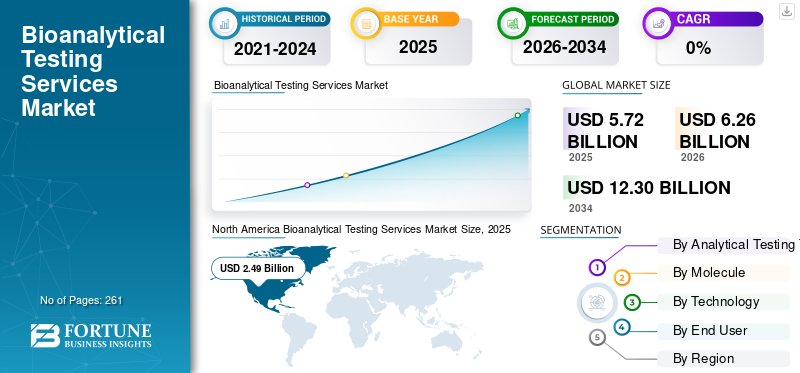
The global bioanalytical testing services market size was valued at USD 5.72 billion in 2025 and is projected to grow from USD 6.26 billion in 2026 to USD 12.30 billion by 2034, exhibiting a CAGR of 8.8% during the forecast period. North America dominated the bioanalytical testing services market with a market share of 43.53% in 2025.
Bioanalytical testing services refer to the process of identifying and quantifying metabolites and drugs within biological samples. The increasing development of biologics and therapeutic modalities, growing pharmaceutical and biotechnological expenditure, and increasing outsourcing by pharmaceutical and biotechnological companies are resulting in a growing adoption rate of these services in the market. The growing demand for precision medicine is further augmenting the adoption of bioanalytical testing services in the market.
- For instance, according to the 2025 data published by the Centers for Medicare & Medicaid Services (CMS), the healthcare expenditure is USD 5.3 trillion in the U.S.
The rising focus on the provision of services among companies, including Labcorp and Charles River Laboratories, among others, is further contributing to the demand for these services in the market.
Download Free sample to learn more about this report.
Bioanalytical Testing Services Market Key Takeaways
 Global Market Size & Forecast
- 2025 Market Size: USD 5.72 Billion
- 2026 Market Size: USD 6.26 Billion
- 2034 Forecast Market Size: USD 12.30 Billion
- CAGR: 8.8% from 2026-2034
 Market Share
- North America dominated the global market with a strong revenue share of 43.53% in 2025.
- Germany accounted for roughly 5.2% of the global market, driven by strong pharma R&D investment.
- China held a notable 6.6% share of the global market, driven by expanding bioanalytical lab capacity.
 Key Regional Highlights
North America
North America held the largest regional share at 43.53% in 2025, driven by growing clinical trial and biotech activity.
Europe
Europe is projected to record the second-highest growth rate, supported by rising LC-MS/MS analysis adoption.
Asia-Pacific
Asia-Pacific is set to be the third-largest region, supported by expanding lab capacity and healthcare expenditure.
U.S.
The U.S. accounted for roughly 40.4% of global sales in 2026, driven by a large number of ongoing clinical trials.
Japan
Japan accounted for roughly 4.6% of global revenues in 2026, supported by investment in drug metabolism studies.
Read More

Bioanalytical Testing Services Market Trends
Digitalization and Automation of Laboratory Workflows is a Key Market Trend
Bioanalytical testing laboratories are increasingly utilizing automated robotic liquid handlers, sample-preparation systems, laboratory information management systems, and cloud-connected analytical systems. The increasing number of samples generated during preclinical and clinical studies, consistent assay performance, and complete data traceability are resulting in an increasing shift toward advanced systems.
Automation can standardize repetitive activities, including dilution, aliquoting, plate preparation, extraction, and quality-control sample generation, further minimizing variability associated with manual handling. Additionally, digital platforms enable integration of instruments, real-time sample tracking, automated data transfer, and centralized review of analytical results, further fueling the adoption rate of these products in the market.
Market Dynamics
Market Drivers
Download Free sample to learn more about this report.
Expansion of R&D Pipelines across Pharmaceutical Companies to Drive Market Growth
Pharmaceutical and biotechnology companies are focusing on expanding their research pipelines to cater to growing demand across metabolic disorders, oncology, neurological diseases, rare diseases, and others. Each new drug candidate requires bioanalytical testing across discovery, preclinical development, and clinical trials, including services such as biomarker testing, pharmacokinetic and toxicokinetic analysis, immunogenicity assessment, metabolite identification, and the measurement of active metabolites and drugs in biological samples.
- For instance, according to the 2024 EU Industrial R&D Investment Scoreboard, health industries invested about USD 291.3 billion in R&D in 2023.
This, along with growing demand for expansion of R&D investments among pharmaceutical and biotechnological companies, and growing outsourcing services for drug development, is further fueling the adoption rate of these services in the market. Therefore, the factors above, along with the growing focus of key companies on providing novel services to boost development, are further likely to contribute to the global bioanalytical testing services market growth.
|
Rank |
Market Drivers |
Overall Impact Rank |
CAGR Contribution (2026-2034) |
Impact 2026-2028 |
Impact 2029-2031 |
Impact 2032-2034 |
|
1 |
Expansion of pharmaceutical and biotechnology R&D pipelines |
High |
+2.6% |
High |
High |
High |
|
2 |
Increasing outsourcing of bioanalytical testing activities |
High |
+2.3% |
High |
High |
High |
|
3 |
Growing development of biologics and advanced therapeutic modalities |
High |
+2.0% |
Medium |
High |
High |
|
4 |
Stringent regulatory requirements for bioanalytical data |
Medium |
+1.7% |
High |
High |
High |
|
5 |
Increasing adoption of biomarkers and precision medicine |
Medium |
+1.5% |
Medium |
High |
High |
|
6 |
Others (expansion of multiregional clinical trials, emerging-market laboratory capacity, automation and digitalization, microsampling and decentralized trials, integrated service models, and strategic laboratory expansions) |
Low |
+1.1% |
Low |
Medium |
Medium |
|
Total Positive Growth Contribution |
+11.2% |
Market Restraints
High Cost Associated with Advanced Bioanalytical Technologies to Hamper the Market Growth
Advanced bioanalytical testing depends on advanced devices, including high-resolution mass spectrometers, LC-MS/MS systems, flow cytometers, multiplex immunoassay platforms, and automated liquid-handling systems, which require high upfront cost, especially for small and mid-sized testing laboratories. Furthermore, additional costs, including investment in nitrogen generators, uninterrupted power supplies, laboratory renovations, data-storage infrastructure, and others, further increase the financial burden.
Moreover, advanced therapies projects require specialized platforms and advanced technology upgrades, making it challenging for small and mid-sized pharmaceutical and biotechnological companies to provide novel services, thereby hindering market growth.
- For instance, according to the 2025 data published by Amp Tech Solutions LLC, it was reported that a new 6475 Triple Quadrupole LC/MS System may range from USD 350,000.0 to over USD 500,000.0 depending on the specific configuration.
|
Rank |
Market Restraints |
Overall Impact Rank |
Negative CAGR Contribution (2026-2034) |
Impact 2026-2028 |
Impact 2029-2031 |
Impact 2032-2034 |
|
1 |
High cost of advanced bioanalytical technologies |
High |
-0.9% |
High |
Medium |
Medium |
|
2 |
Shortage of skilled bioanalytical scientists |
High |
-0.7% |
High |
High |
Medium |
|
3 |
Complexity of assay development and regulatory compliance |
Medium |
-0.5% |
Medium |
High |
High |
|
4 |
Others (radiation exposure concerns, reimbursement variability, workflow challenges, regulatory compliance, patient anxiety) |
Low |
-0.3% |
Low |
Low |
Low |
|
Total Negative Growth Impact |
-2.4% |
Market Opportunities
Expansion of Healthcare Infrastructure to Create Lucrative Opportunities
The expansion of healthcare and clinical research in emerging countries presents a lucrative opportunity in the global market. Private healthcare and governmental organizations are focusing on the expansion of hospitals, public health laboratories, clinical research centers, biobanks, and digital health networks, especially across emerging countries including Brazil, India, and others.
Moreover, the increasing number of institutions participating in clinical studies, collecting biological samples, and contributing to pharmaceutical research is creating significant opportunities for bioanalytical testing service providers. Additionally, the increasing number of CROs and CDMOs, along with growing healthcare expenditure, is resulting in growing demand for these services in the market.
- According to 2025 statistics published by the International Trade Administration (ITA), it was reported that the healthcare expenditure is about USD 135.0 billion in Brazil.
Market Challenges
Limited Number of Pharmaceutical Companies in Emerging Countries to Hamper Market Growth
There is a growing demand for novel drug development services among the patient population. However, the limited presence of research-intensive pharmaceutical and biotechnology companies in several emerging nations remains a key challenge for the market. While many emerging countries have pharmaceutical and biotechnological manufacturers, their operations are concentrated on generic drugs, formulations, packaging, and contract manufacturing rather than the discovery and clinical development of new potential drug candidates. This, along with a limited number of clinical studies and less-developed healthcare infrastructure, is limiting the adoption of bioanalytical testing services in the market.
SEGMENTATION ANALYSIS
By Analytical Testing Type
Increasing Number of Clinical Studies Led to Pharmacokinetic/Toxicokinetic and Drug Concentration Analysis Segmental Dominance
Based on the analytical testing type, the market is classified into pharmacokinetic/toxicokinetic and drug concentration analysis, immunogenicity testing, biomarker and pharmacodynamic analysis, metabolite profiling and identification, and others.
The pharmacokinetic/toxicokinetic and drug concentration analysis segment held the largest revenue share in 2025. The growth is owing to the growing number of drug developments, resulting in rising demand for bioanalytical tests among the pharmaceutical and biotechnological companies. This, along with the rising number of companies and CROs offering innovative services, is further anticipated to contribute to segment growth.
- For instance, according to 2025 data published by the International Federation of Pharmaceutical Manufacturers and Associations (IFPMA), there are over 12,900 medicines in various stages of clinical development globally.
The immunogenicity testing segment is expected to grow at a CAGR of 9.3% over the forecast period.
To know how our report can help streamline your business, Speak to Analyst
By Molecule
Increasing Approval of Large Molecules & Conventional Biologics Led to Segment’s Dominance
Based on the molecule, the market is segmented into small molecules, large molecules & conventional biologics, and advanced therapeutic modalities.
The large molecules & conventional biologics segment dominated the global market with a share of 39.9% in 2025 due to the increasing approval of large molecules, including biosimilars, monoclonal antibodies, and others. They require a complex bioanalytical testing package, further resulting in growing adoption of bioanalytical testing services and advanced tools, and others, thereby contributing to the segmental growth.
- For instance, according to 2025 statistics published by the European Medicines Agency (EMA), about 41 biosimilars received EMA authorization in Europe.
The advanced therapeutic modalities segment is set to flourish with a growth rate of 9.2% over the forecast period.
By Technology
Direct Chromatography–Mass Spectrometry Led Market Due to Its Benefits
Based on technology, the market is segmented into direct chromatography-mass spectrometry, ligand-binding & immunoassays, flow cytometry, and others.
The direct chromatography-mass spectrometry segment dominated the global market with a share of 37.8% in 2025 due to its benefits, including high throughput and others, resulting in a growing adoption of the technology.
- For instance, according to the 2025 data published by the Waters Corporation, it was reported that over 100 oligonucleotide samples per hour throughput was achieved using a rapid LC-MS method with the BioAccord LC-MS System with the Waters_connect INTACT Mass App.
The flow cytometry segment is set to flourish with a growth rate of 10.6% across the forecast period.
By End User
Increasing Development of Drugs Boosted Pharmaceutical & Biotechnological Companies Segment Growth
Based on end user, the market is bifurcated into pharmaceutical & biotechnological companies, CROs & CDMOs, academic & research institutes, and others.
The pharmaceutical & biotechnological companies segment dominated the market in 2025. The increasing development of drugs, the rising adoption of pharmacokinetic (PK) analysis and pharmacodynamic (PD) analysis, and the increasing number of pharmaceutical and biotechnological companies, among others, are some of the key factors contributing to segment growth. Furthermore, the segment is set to hold a 69.5% share in 2026.
- For instance, according to 2026 data published by Cross River Therapy, it was reported that there are about 5,000 companies in the U.S.
CROs & CDMOs are projected to grow at a 9.9% CAGR during the forecast period.
Bioanalytical Testing Services Market Regional Outlook
Based on region, the market has been studied across North America, Europe, Asia Pacific, Latin America, and the Middle East & Africa.
North America
North America Bioanalytical Testing Services Market Size, 2025 (USD Billion)
To get more information on the regional analysis of this market, Download Free sample
North America held the dominant bioanalytical testing services market share in 2024, valued at USD 2.33 billion, and also took the leading share in 2025 with USD 2.49 billion. The growing number of clinical studies and the increasing number of pharmaceutical and biotechnological companies are driving market growth in the region.
- For instance, according to 2025 statistics published by the World Health Organization (WHO), about 197,090 clinical trials were conducted in the U.S.
U.S. Bioanalytical Testing Services Market
Based on North America’s strong contribution and the U.S. dominance within the region, the U.S. market can be analytically approximated at around USD 2.53 billion in 2026, accounting for roughly 40.4% of global sales.
Europe
Europe is projected to record a growth rate of 8.1% in the coming years, which is the second highest among all regions, and reach a valuation of USD 1.73 billion in 2026. The growing adoption of bioanalytical testing services for LC-MS/MS analysis and others is likely to support the market growth.
U.K. Bioanalytical Testing Services Market
The U.K. market in 2026 is estimated at around USD 0.37 billion, representing roughly 5.9% of global revenues.
Germany Bioanalytical Testing Services Market
Germany’s market is projected to reach approximately USD 0.33 billion in 2026, equivalent to around 5.2% of global sales.
Asia Pacific
Asia Pacific is estimated to reach USD 1.27 billion in 2026 and secure the position of the third-largest region in the market. The expanding bioanalytical lab capacity and increasing healthcare expenditure are likely to contribute to the growth of the market.
Japan Bioanalytical Testing Services Market
The Japan market in 2026 is estimated at around USD 0.29 billion, accounting for roughly 4.6% of global revenues. Japan is expected to grow due to the increasing focus on bioanalytical assay development and investment in drug metabolism studies among the key companies in the market.
China Bioanalytical Testing Services Market
China’s market is projected to be one of the largest globally, with 2026 revenues estimated at around USD 0.41 billion, representing roughly 6.6% of global sales.
India Bioanalytical Testing Services Market
The India market size in 2026 is estimated at around USD 0.18 billion, accounting for roughly 2.9% of global revenues.
Latin America and Middle East & Africa
The Latin America and Middle East & Africa regions are expected to witness moderate growth in this market space during the forecast period. The Latin America market is set to reach a valuation of USD 0.32 billion in 2026. The growth is due to the increasing number of clinical studies and the growing demand for bioanalytical testing services in the region. Market growth in the Middle East & Africa region is driven by the rising number of research institutes and major companies expanding their geographical presence in the market. In the Middle East & Africa, the GCC is set to reach a valuation of USD 0.15 billion in 2026.
South Africa Bioanalytical Testing Services Market
The South Africa market is projected to reach around USD 0.05 billion in 2026, representing roughly 0.8% of global revenues.
Competitive Landscape
Key Industry Players
Expansion of Bioanalytical Laboratory by Key Companies to Support Their Dominance
Labcorp and Charles River Laboratories are major companies in the market. They focus on strong service portfolios, strategic initiatives, and the expansion of laboratory capacity to strengthen their market presence.
- For instance, in September 2024, Labcorp, a global company of innovative and comprehensive laboratory services, expanded its molecular bioanalytical laboratory in Greenfield, Indiana, with an aim to expand its molecular bioanalytical capacity.
Other key players, including Thermo Fisher Scientific Inc., Eurofins Scientific, and others, are also focusing on receiving certifications to strengthen their presence in the market.
List of Key Bioanalytical Testing Service Companies Profiled
- Thermo Fisher Scientific Inc. (U.S.)
- SGS Société Générale de Surveillance SA (Switzerland)
- Labcorp (U.S.)
- IQVIA (U.S.)
- Charles River Laboratories (U.S.)
- Eurofins Scientific (Luxembourg)
- Intertek Group plc (U.K.)
- Wuxi AppTec (China)
- Pharmaron (China)
- Frontage Labs (U.S.)
KEY INDUSTRY DEVELOPMENTS
- June 2026: SGS Société Générale de Surveillance SA acquired CMIC, INC., a specialized provider of bioanalytical testing services based in the U.S., to strengthen its presence in North America.
- May 2026: SGS Société Générale de Surveillance SA acquired Keystone Bioanalytical, a specialized provider of bioanalytical testing services, to strengthen its presence in North America.
- October 2025: BioAgilytix, the global company in bioanalysis, invested in Liquid Chromatography–Mass Spectrometry (LC/MS) capabilities, including new platforms and expanded lab space in Hamburg, Germany, and Durham, North Carolina.
- October 2024: Synexa Life Sciences, a specialist biomarker and bioanalysis service provider, acquired Alderley Analytical Ltd, with an aim to strengthen its presence in the market.
- October 2024: IQVIA expanded and relocated its central laboratory and biorepository operations in Valencia, California, into a new 134,000 square foot state-of-the-art facility.
REPORT COVERAGE
The report provides a detailed global bioanalytical testing services market analysis and focuses on key aspects such as leading companies and market segmentation, including analytical testing type, molecule, technology, and end user. Besides this, the global report offers insights into the market growth trends and highlights key industry developments. In addition to the aforementioned factors, the report encompasses several factors that have contributed to the growth and advancement of the market over recent years.
Request for Customization to gain extensive market insights.
Report Scope & Segmentation
| ATTRIBUTE | DETAILS |
| Study Period | 2021-2034 |
| Base Year | 2025 |
| Estimated Year | 2026 |
| Forecast Period | 2026-2034 |
| Historical Period | 2021-2024 |
| Growth Rate | CAGR of 8.8% from 2026 to 2034 |
| Unit | Value (USD Billion) |
| Segmentation | By Analytical Testing Type, Molecule, Technology, End User, and Region |
| By Analytical Testing Type |
|
| By Molecule |
|
| By Technology |
|
| By End User |
|
| By Region |
|
Frequently Asked Questions
Fortune Business Insights says that the global market size was USD 5.72 billion in 2025 and is projected to reach USD 12.30 billion by 2034.
In 2025, the North America regional market value stood at USD 2.49 billion.
Growing at a CAGR of 8.8%, the market will exhibit steady growth over the forecast period (2026-2034).
By analytical testing type, the pharmacokinetic/toxicokinetic and drug concentration analysis segment led the market.
Expansion of R&D pipelines across pharmaceutical companies is driving market growth.
Charles River Laboratories, Thermo Fisher Scientific Inc., Eurofins Scientific, and Labcorp are the major players in the global market.
North America dominated the market share in 2025.
The growing number of clinical studies, rising expansion of bioanalytical facilities, and growing outsourcing of bioanalytical testing services are some of the key factors expected to boost the adoption of these services globally.



- 2021-2034
- 2025
- 2021-2024
- 261
Get 30-60 hrs Free Customization
Expand Regional and Country Coverage, Segments Analysis, Company Profiles, Competitive Benchmarking, and End-user Insights.













.webp)






-
US +1 833 909 2966 ( Toll Free )
-
Get In Touch With Us