Biochar Gasification Market Size, Share & Industry Analysis, By Application (Farming, Livestock, Power Generation, and Others), and Regional Forecast, 2025-2032
 Download Free Sample
KEY MARKET INSIGHTS
 Listen to Audio Version
The global biochar gasification market size was valued at USD 107.24 million in 2024. The market is projected to grow from USD 117.37 million in 2025 to USD 233.46 million by 2032, exhibiting a CAGR of 10.32% during the forecast period.
Biochar gasification is a thermochemical process that converts biomass into a combustible gas mixture (syngas) and a solid residue called biochar, using high temperatures and limited oxygen. Biochar offers numerous benefits, primarily acting as a soil amendment to enhance soil health and fertility and contribute to carbon sequestration. It improves water retention, nutrient availability, and soil structure, increasing crop yields and reducing reliance on fertilizers. Additionally, biochar can help mitigate climate change by storing carbon in the soil and reducing greenhouse gas emissions.
Aires Clean Technologies, one of the key players in the market, employs a specialized fluidized bed gasification system tailored for the treatment of biosolids. This technology generates syngas, a synthetic fuel gas suitable for industrial applications, along with biochar, a valuable byproduct that can be used in various industrial and manufactured goods.
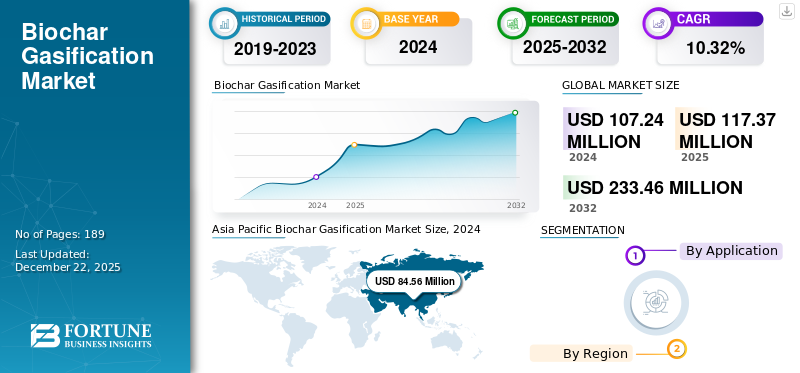
Download Free sample to learn more about this report.
Biochar Gasification Market Key Takeaways
 Global Market Size & Forecast
- 2024 Market Size: USD 107.24 Million
- 2025 Market Size: USD 117.37 Million
- 2032 Forecast Market Size: USD 233.46 Million
- CAGR: 10.32% from 2025–2032
 Market Share
- Asia Pacific dominated the global biochar gasification market in 2024.
- The Farming application segment held the dominant market share.
- The Livestock application segment accounted for a significant market share.
 Key Regional Highlights
Asia Pacific
Asia Pacific led the global market, driven by strong agricultural demand and sustainable farming initiatives.
North America
North America is witnessing robust growth due to rising adoption of carbon sequestration and circular economy practices.
Europe
Europe is expanding with support from EU carbon removal policies and climate change initiatives.
U.S.
The U.S. market is growing with increasing biochar adoption for agriculture, waste management, and carbon reduction.
Japan
Japan is expected to witness steady growth, supported by sustainable agriculture and environmental management initiatives.
Read More

MARKET DYNAMICS
MARKET DRIVERS
Growing Demand for Biochar in Farming Applications to Support Market Growth
The growing demand for biochar in farming applications is anticipated to support global biochar gasification market growth. With global population on the rise and impacts of climate change becoming more evident, there is a pressing requirement for agricultural practices that can boost crop production, improve soil quality, and lessen environmental harm. Biochar presents a viable solution by fostering soil fertility while tackling multiple environmental issues. The increasing awareness of biochar benefits and its role in mitigating climate change is driving its adoption. Biochar is a key component in sustainable agricultural practices, helping to reduce reliance on chemical fertilizers and pesticides while improving soil health and crop productivity.
MARKET RESTRAINTS
Lack of Standardized Production Methods to Impact Market Expansion
A major challenge for the market is the lack of standardized production methods, which leads to inconsistent biochar properties and hinders its widespread adoption. This inconsistency makes it difficult to predict biochar's performance in specific applications including soil amendment or carbon sequestration. Furthermore, the absence of clear standards can lead to production processes prioritizing cost-effectiveness over quality, potentially resulting in biochar that does not meet performance expectations. Biochar's properties, such as its carbon content, porosity, and surface area, are heavily influenced by the feedstock used and the production conditions (temperature, heating rate, and others.). Without standardized methods, these properties can vary significantly, making it challenging to predict the performance of biochar in a given application.
MARKET OPPORTUNITIES
Expanding Applications of Biochar to Encourage Market Growth
Biochar is gaining recognition for its varied potential across different sectors, fueling the expansion of the global biochar gasification market. These advancements broaden the advantages of biochar in environmental cleanup, energy generation, water purification, as well as building materials, making it a flexible and sustainable alternative to address global issues. Due to its extensive surface area and porous composition, biochar serves as a remarkable adsorbent for pollutants. It has been effectively utilized in wastewater management, eliminating heavy metals, organic substances, and toxins. Biochar's capacity to capture harmful chemicals and enhance water quality has resulted in its implementation in both industrial and municipal wastewater treatment plants, aiding in the reduction of water pollution problems.
BIOCHAR GASIFICATION MARKET TRENDS
Strategies Supporting Carbon Capture and Climate Change Reduction to Assist Market Expansion
Government initiatives aimed at encouraging carbon sequestration and climate mitigation are expected to assist the expansion of the biochar gasification market. As countries increasingly acknowledge the rising need to combat climate change, there is a significant drive for policies that promote carbon capture and lower greenhouse gas emissions. Biochar serves as a vital method for carbon sequestration, aligning perfectly with these goals because of its capability to retain carbon in the soil for extended periods, potentially mitigating a considerable portion of global CO2 emissions.
Download Free sample to learn more about this report.
Segmentation Analysis
By Application
Farming Segment to Dominate Market Share Owing to Soil Fertility and Productivity Needs
Based on application, the market is classified into farming, livestock, power generation, and others.
The farming segment is anticipated to dominate a major portion of the global biochar gasification market share. With farmers and agricultural enterprises grappling with issues such as soil degradation, reduced fertility, and the need for environmental sustainability, biochar has surfaced as a highly efficient and environmentally friendly remedy. When incorporated into soil, biochar improves its structural integrity and nutrient levels.
In livestock applications, biochar supplementation can lead to better feed conversion rates, increased body weight gain, and improved growth rates in livestock. It can also enhance nutrient digestion and reduce the risk of certain diseases, particularly those affecting the gut.
Biochar Gasification Market Regional Outlook
By geography, the market is categorized into North America, Europe, Asia Pacific, and rest of the world.
North America
Asia Pacific Biochar Gasification Market Size, 2024 (USD Million)
To get more information on the regional analysis of this market, Download Free sample
The North American market is experiencing growth due to increased focus on carbon sequestration, waste management, and the circular economy, with rising demand for biochar in agriculture sector and livestock farming. Biochar production utilizes agricultural, forestry, and municipal waste, promoting a circular economy and reduced landfill waste. Federal and state renewable energy mandates and initiatives aimed at reducing greenhouse gas emissions are further propelling the biochar gasification market.
Europe
The market in Europe is driven by its potential for carbon removal and contributions to climate change mitigation and circular economy goals. The European Union's (EU) policies and regulations are encouraging biochar production and applications, recognizing its role in meeting climate targets. The European Union is actively developing a Carbon Removal Certification Framework to standardize and verify carbon removal achieved through biochar and other methods. This framework will likely integrate with the EU Emissions Trading System (EU ETS), potentially allowing biochar producers to generate carbon credits and participate in carbon markets.
Asia Pacific
Asia Pacific accounted for largest market share due to heightened agricultural industry needs, governmental encouragement for sustainable farming practices, growing environmental consciousness, and the necessity for waste management solutions in fast-developing economies. The increasing focus on waste management and the circular economy is driving the demand for biochar, particularly in the context of converting agricultural and forestry residues into valuable products.
Rest of the World
The rest of the world’s market is anticipated to grow gradually over the forecast period. Growing environmental awareness, waste management concerns, and the need for sustainable soil improvement solutions are expected to support market expansion.
COMPETITIVE LANDSCAPE
Key Industry Players
Growing Carbon Capture Agreements by Key Players to Support Market Growth
Businesses globally are entering into carbon capture agreements as it offer several benefits, including enhanced brand reputation, risk mitigation, and other advantages. For instance, in March 2024, Microsoft signed a carbon capture agreement for the purchase of 95,000 tons of carbon dioxide removal credits from a biochar plant in Mexico. It has agreed a six-year purchasing deal with The Next 150 and its General Biochar Systems (GBS) business unit.
LIST OF KEY BIOCHAR GASIFICATION COMPANIES PROFILED:
- KMW Energy Group (Canada)
- ARIES CLEAN TECHNOLOGIES (U.S.)
- Frontline BioEnergy, LLC. (U.S.)
- Pacific Biochar (U.S.)
- Airex Energy (Canada)
- Inoplex (Australia)
- MASH Makes (Denmark)
- Swiss Biochar GmbH (Switzerland)
KEY INDUSTRY DEVELOPMENTS
- May 2025: Microsoft has finalized a 10-year agreement with Exomad Green to eliminate nearly 1.24 million metric tons of CO2e via its biochar initiatives in Bolivia. It is stated to be the largest-ever biochar removal agreement in terms of volume.
- July 2023: A group of Canadian and French firms, such as Airex Energy, Groupe Rémabec, and SUEZ, committed around USD 60 million to construct the largest biochar production facility in North America, located in Port-Cartier, Quebec, and Canada. This project seeks to create Canada's first industrial-scale biochar production plant and represents an important advancement in the nation’s efforts toward achieving net-zero emissions.
- July 2023: Eco Allies®, a StereoVision subsidiary, announced the expansion of Joint Venture terms with Biochar Now, LLC. An additional facility is established in Mexico, and the total number of kilns for each plant rises from 120 to 180, resulting in a combined total of 360 kilns.
- January 2023: CN Energy Group, Inc. established its U.S. headquarters in Washington, D.C., to expedite its biochar and wood-based activated carbon operations in both North and South America. The company intends to create partnerships in the U.S., Canada, Brazil, and Mexico to develop a marketing network that addresses the specific needs of clients.
- January 2023: ReEnergy Biomass Maine LLC, operator of biomass power plants in Androscoggin and Franklin counties, received a grant of USD 523,900 for the production of biochar. The grant is expected to cover 50% of the project expenses for obtaining the equipment necessary to create biochar through a gasification and biochar extraction method.
REPORT COVERAGE
The global biochar gasification market report delivers a detailed insight into the market. It focuses on key aspects, such as leading companies in the global market. Besides, it offers insights into the market trends and technology, and highlights key industry developments. In addition to the factors above, it encompasses several factors and challenges that contributed to the growth of the market in recent years.
Request for Customization to gain extensive market insights.
Report Scope & Segmentation
|
ATTRIBUTE |
DETAILS |
|
Study Period |
2019-2032 |
|
Base Year |
2024 |
|
Estimated Year |
2025 |
|
Forecast Period |
2025-2032 |
|
Historical Period |
2019-2023 |
|
Growth Rate |
CAGR of 10.32% from 2025-2032 |
|
Unit |
Value (USD Million, Ton) |
|
Segmentation |
By Application
|
|
By Region
|
Frequently Asked Questions
Fortune Business Insights says that the global market value stood at USD 107.24 million in 2024 and is projected to reach USD 233.46 million by 2032.
In 2024, Asia Pacifics market value stood at USD 84.56 million.
The market is expected to exhibit a CAGR of 10.32% during the forecast period.
The farming segment led the market by application.
Growing demand for biochar in farming applications drive market growth.
Airex Energy, Pacific Biochar, and Aries Clean Technologiesare some of the key players in the market.
Asia Pacific dominated the global biochar gasification market share in 2024.
Strategies supporting carbon capture and climate change reduction support this process.



- 2019-2032
- 2024
- 2019-2023
- 189
Get 30-60 hrs Free Customization
Expand Regional and Country Coverage, Segments Analysis, Company Profiles, Competitive Benchmarking, and End-user Insights.



















Related Reports
-
US +1 833 909 2966 ( Toll Free )
-
Get In Touch With Us