Biometrics as a Service (BaaS) Market Size, Share & Industry Analysis, By Deployment (Public Cloud, Private Cloud, and Hybrid), By Offering (Solutions and Services), By Trait Type (Physiological and Behavioral), By Enterprise Type (Large Enterprises and SMEs), By Industry (BFSI, Government, IT & Telecom, Healthcare, and Others (Entertainment, Transportation, etc.)), and Regional Forecast, 2026-2034
 Download Free Sample
Biometrics as a Service (BaaS) Market Size and Future Outlook
 Listen to Audio Version
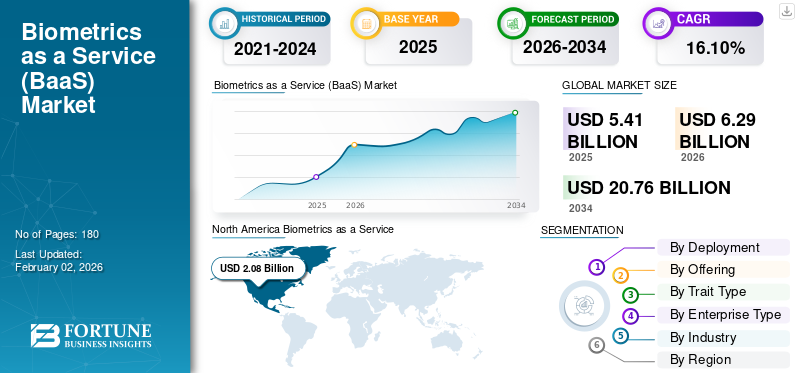
The global biometrics as a service (BaaS) market size was valued at USD 5.41 billion in 2025 and is projected to grow from USD 6.29 billion in 2025 to USD 20.76 billion by 2034, exhibiting a CAGR of 16.10% during the forecast period. North America dominated the global market with a share of 38.50% in 2025.
Biometric identification and certification distributed through the cloud, including fingerprint identity, facial identification, IRIS scanning, and voice identification, is referred to as a biometric as a service (BaaS). BaaS enables companies to incorporate biometric solutions through membership-based approaches, making it more cost-effective and scalable, especially if they were previously spending a significant amount on equipment, infrastructure, and maintenance.
Increasing concerns about data security, identity fraud, and cybercrime are major factors driving the market. Additionally, the rapid growth of digital banking, online transactions, and e-governance initiatives is further supporting its expansion. The demand for the market has been intensified by the shift to work-from-home model, the adoption of cloud solutions, and the need for contactless verification.
A few prominent players operating in the market are NEC Corporation, Thales Group, Leidos, Nuance Communications (Microsoft), Idemia, M2SYS Technology, Fulcrum Biometrics (Fujitsu), BioID, and others.
Download Free sample to learn more about this report.
Biometrics as a Service Market Key Takeaways
 Market Size & Forecast
- 2025 Market Size: USD 5.41 Billion
- 2026 Market Size: USD 6.29 Billion
- 2034 Forecast Market Size: USD 20.76 Billion
- CAGR: 16.10% from 2026–2034
 Market Share
- North America dominated the biometrics as a service (BaaS) market with a 38.50% share in 2025.
- Public cloud is projected to lead the deployment segment with a 43.35% share in 2026.
- Solutions are projected to dominate the offering segment with a 67.67% share in 2026.
 Key Regional Highlights
North America
North America generated USD 2.08 billion in 2025 and accounted for 38.50% of the global market.
Asia Pacific
Asia Pacific reached USD 1.42 billion in 2025, representing 26.20% of the global market and is a fast-growing region.
Europe
Europe recorded USD 1.19 billion in 2025, capturing 21.90% of global revenue.
U.S.
The market generated USD 1.48 billion in 2025 and is projected to reach USD 1.68 billion by 2026.
Japan
The biometrics as a service (BaaS) market is projected to reach USD 0.33 billion by 2026.
Read More

MARKET DYNAMICS
Market Drivers
Rising Demand for Digital Identity Verification and KYC Drives the Market Development
The rising demand for digital identity verification and KYC is driving the global biometrics as a service (BaaS) market growth. Driven mostly by the growing need for accurate digital identity verification and know your customer (KYC) procedures, the market is growing quickly. Traditional authentication techniques are insufficient as complex cyberattacks, including deepfakes and artificial identity theft, grow. By using sophisticated artificial intelligence and machine learning to examine distinctive physiological and behavioral characteristics like fingerprints, facial characteristics, and voice patterns, BaaS offers a strong solution. Often including "liveness detection," this technology confirms that a person is real and present during a transaction; therefore, banks, fintech, Companies, and e-commerce sites use it to fight fraud.
Recent market examples show this clearly: Certibio will make biometric onboarding possible for more than 50 million digital banking customers in Latin America by 2025. Mitek Systems will also debut its Digital Fraud Defender in early 2025 to scour injection attacks and deepfakes. The change to a cloud-based, API-first model is making BaaS more approachable so that companies of all sizes may include strong biometric authentication in their current platforms, without the need for a huge infrastructure restoration.
Market Restraints
Data Privacy and Security Concerns Hampers the Market Growth
The data privacy and security concerns act as a significant restriction factor for the market. Though expanding swiftly, the market is constrained by data privacy and security. The very traits that make biometric data so successful, its uniqueness and immutability, also render its breach much more disastrous than a conventional password theft. A stolen fingerprint or facial scan is a lifetime permanent vulnerability that can be abused; however, if a password is stolen, it may be reset. This natural danger can lead to doubt in acceptance and can also be a significant obstacle to customer trust.
Market Opportunities
Healthcare Digitalization & Telemedicine Offers Lucrative Growth Opportunities
The healthcare sector is changing significantly digitally, therefore creating a tremendous chance for the Biometrics as a Service (BaaS) market. The need for safe, dependable, and user-friendly patient identity verification has become absolutely necessary as telehealth, remote patient monitoring (RPM), and the extensive usage of electronic health records (EHRs) have developed. With a safe method to authenticate patients and medical professionals, guaranteeing data privacy and preventing fraud in a digital-first environment, BaaS is ideally developed to meet this need.
BaaS technologies offer significant benefits for the healthcare sector. In telemedicine, biometrics ensure that the correct patient is being treated, and verifying a patient's identity at the start of a virtual consultation helps prevent identity theft. It is particularly valuable in distant patient monitoring, where biometric sensors in wearable equipment can safely certify the individual and thus ensure the integrity of real-time information sent to healthcare providers.
Geisinger Medical Centre is now putting this into use, it has effectively introduced a biometric patient identification system based on facial recognition to cut waiting times and prevent errors in misidentification. Moreover, businesses like Biotricity are creating distant biometric monitoring systems, including the Biocore wearable device, which constantly monitors a patient's cardiac rhythm.
BIOMETRICS AS A SERVICE (BaaS) MARKET TRENDS
Cloud-Edge Hybrid Deployments Has Emerged as a Prominent Market Trend
From a simple cloud-centric model to a more complex cloud-edge hybrid implementation, the Biometrics as a Service (BaaS) market is transforming greatly. Driven by the need to reconcile the scalability and simplicity of the cloud with low latency, improved security, and data privacy, this trend is propelled. Local processing at the "edge" (that is, on the device itself or a close by server). With this hybrid approach, only non-sensitive, encrypted templates or confirmation tokens are transmitted to the cloud; the biometric data acquisition and preliminary processing take place at the edge. Keeping sensitive biometric data offline from the public internet helps to provide several benefits, including near-instantaneous authentication, lower bandwidth use, and improved data privacy.
For instance, Geisinger Medical Centre's biometric patient identification system, put in place in 2025, works on this model whereby first facial scans are processed locally at the Kiosk, guaranteeing speed and real-time authentication before a safe token is issued to the central EHR. Similarly, at airports, facial recognition is becoming increasingly used on e-gates. NEC Corporation and others have used cloud-edge solutions where the initial facial scan is checked at the gate for an almost instant match, therefore greatly lowering Network latency and traveler wait times are kept in check while the cloud preserves a master database for registration.
Download Free sample to learn more about this report.
SEGMENTATION ANALYSIS
By Deployment
Public Cloud Leads the Market Due to its Scalability and Cost-Effectiveness
Based on the deployment, the market is segmented into public cloud, private cloud, and hybrid.
In 2026, the cloud segment is projected to lead the market with a 43.35% share with a valuation of USD 2.10 billion. Its scalability, cost-effectiveness, and simplicity of installation make it a favored choice for companies of all sizes for quick integration of solutions using biometrics without major upfront infrastructural investment.
The hybrid deployment model, however, is projected to grow with the highest CAGR of 19.91%. There is a rising demand for a balanced approach that combines the scalability of the public cloud with enhanced security, privacy, and the low-latency advantages of on-premise or edge processing. Organizations with strong data governance rules prefer this model.
To know how our report can help streamline your business, Speak to Analyst
By Offering
Solutions Segment Dominates as It is the Foundation of BaaS Implementations
Based on the offering, the market is segmented into solutions and services.
The solutions segment is projected to dominate the market with a share of 67.67% in 2026, with a valuation of USD 3.22 billion as most BaaS deployments are built on solutions that include core biometric software and platforms.
The services segment is growing at the highest CAGR with 19.09%. This growth is ascribed to the rise in demand for professional services like consulting, integration, and continuing support, which are necessary for the effective implementation and maintenance of advanced technologies like biometric systems.
By Trait Type
Physiological Biometrics Leads Due to its Mature and Widespread Adoption
Based on the trait type, the market is segmented into physiological and behavioral.
The physiological segment is projected to dominate the market with a share of 73.83% in 2026, which includes fingerprints, facial recognition, and iris scans, dominated the market with a revenue of USD 3.52 billion in 2024. Particularly, fingerprint and facial recognition, the extensive uptake and sophisticated technology of these characteristics, help to drive this segment.
The Behavioral segment is expected to grow with the highest CAGR of 20.18%. Unique behavioral patterns such as keystroke dynamics, gait analysis, and voice recognition can provide a passive and continuous growth driven by advances in their analysis, making it difficult for criminals to duplicate any forms of verification.
By Enterprise Type
Large Enterprises Holds the Largest Share Due to Extensive Security Needs and Budgets
Based on the enterprise type, the market is segmented into large enterprises and SMEs.
In 2024, large enterprises held the largest biometrics as a service (BaaS) market share with a revenue of USD 2.84 billion. This is due to their strict security and compliance demands and greater budgets for installing complete biometric systems.
The SMEs segment is projected to grow with the highest CAGR of 19.08%. Among smaller companies, the BaaS model, eliminates the requirement of large up-front expenditures and committed IT infrastructure, affordability, and scalability which is speeding the adoption.
By Industry
BFSI Dominates Due to Critical Need for Fraud Prevention and Regulatory Compliance
Based on the industry, the market is segmented into BFSI, government, IT & telecom, healthcare, and others (entertainment, transportation, etc.).
The BFSI industry had the maximum market share in 2024, with revenue of USD 1.79 billion. The sector is dominated by online banking, fraud, and regulatory compliance (KYC/AML) due to the great demand for secure and spontaneous digital identity verification.
The healthcare industry is expected to grow at the highest CAGR of 19.40%. The factors that promote this growth include the increase in the digitalization of medical care (such as telemedicine and EHR), which requires safe and reliable authentication to execute legal processes to achieve protected health information, such as HIPAA.
BIOMETRICS AS A SERVICE (BaaS) MARKET REGIONAL OUTLOOK
Geographically the market is segmented into North America, Europe, Asia Pacific, South America, and Middle East & Africa.
North America
North America Biometrics as a Service (BaaS) Market Size, 2025 (USD Billion)
To get more information on the regional analysis of this market, Download Free sample
North America accounted for USD 2.08 billion in 2025, representing 38.50% of the global market share, and is projected to reach USD 2.37 billion in 2026. with sales from the U.S. market alone expected to reach around USD 1.48 billion in 2025. Supporting the North American BaaS market is a highly developed and technically advanced economy, an abundant presence of top-level tech and financial companies, and significant priority placed on cybersecurity and fraud prevention. One major growth driver in the market is the massive use of BaaS in key sectors of the U.S. economy, such as banking, government, and aviation, for digital identity verification, secure transactions, and access control. The U.S. market is projected to reach USD 1.68 billion by 2026.
For example, the Transportation Security Administration (TSA) is using biometric verification to process passengers at airports. Many financial firms utilise BaaS systems to reduce online fraud attempts by as much as 30%. The North American BaaS market is also reinforced by major players such as Leidos, Aware Inc., and HYPR Corp, whose activities will generate more than 40% of global BaaS revenues based in the U.S.
To know how our report can help streamline your business, Speak to Analyst
Europe
The Europe market was valued at USD 1.19 billion in 2025, capturing 21.90% of global revenue, and is estimated to reach USD 1.36 billion in 2026. It is mainly fueled by strong regulation in the region, such as GDPR and PSD2 of the European Union; these strict compliance requirements provide governance and increase the demand for safe and transparent identity verification. U.K., Germany, and France are the leading markets, earning USD 0.23 billion, USD 0.22 billion and USD 0.19 billion, respectively. The UK market is projected to reach USD 0.26 billion by 2026, while the Germany market is projected to reach USD 0.25 billion by 2026.
Asia Pacific
In 2025, Asia Pacific held 26.20% of the global market, reaching a valuation of USD 1.42 billion, and is projected to grow to USD 1.71 billion in 2026. The Asia Pacific thrives in the monumental national digital identity programs, the increase in mobile internet adoption and a housing host ecosystem. India and China lead this growth with contributions from USD 0.29 billion and USD 0.20 billion, respectively. The developments, such as the AADHAR scheme in progress in India, the incorporation of more than 1.3 billion citizens, together with the continuum implemented by China of financial services and surveillance with biometrics, show how far the region has arrived in the adoption of Baas. The Japan market is projected to reach USD 0.33 billion by 2026, the China market is projected to reach USD 0.35 billion by 2026, and the India market is projected to reach USD 0.24 billion by 2026.
Latin America
The Latin America region captured 5.80% of the global market in 2025, generating USD 0.31 billion in revenue, and is projected to reach USD 0.36 billion in 2026.
South America and Middle East & Africa
Middle East & Africa contributed approximately USD 0.41 billion to the global market in 2025, accounting for 7.60% share, and is expected to reach USD 0.49 billion in 2026. The growth in these regions comes mainly from rapid urbanization, continuous development of infrastructure and a large number of digital projects. The GCC countries represent a significant sector within the Middle East and Africa market, projecting a USD 0.13 billion in 2025.
COMPETITIVE LANDSCAPE
Key Industry Players
Growing Focus of Key Players on Innovation and New Launches Leads to their Dominating Market Positions
The global Biometrics as a Service (BaaS) market is highly fragmented, with numerous players competing across different regions. Key companies include NEC Corporation, Thales Group, Leidos, Nuance Communications (Microsoft), Idemia, M2SYS Technology, Fulcrum Biometrics (Fujitsu), and BioID. These organizations focus on strategies such as new product launches, mergers and acquisitions, technological advancements, and investments in cloud-based biometric solutions to enhance their market presence.
LIST OF KEY BIOMETRICS AS A SERVICE (BaaS) COMPANIES PROFILED
- NEC Corporation (Japan)
- Thales Group (France)
- Leidos (U.S.)
- Nuance Communications (Microsoft) (U.S.)
- Idemia (France)
- M2SYS Technology (U.S.)
- Fulcrum Biometrics (Fujitsu) (Japan)
- BioID (Germany)
- Aware, Inc. (U.S.)
- IrisGuard (U.K.)
- Certisign (Brazil)
- Iritech (U.S.)
- HYPR (U.S.)
- Lexis Nexis (U.S.)
- Affectiva (U.S.)
KEY INDUSTRY DEVELOPMENTS
- September 2025- HID Global, which specializes in trusted identity solutions, introduced its new form factor, the HID Amico biometric reader. The device represents the emerging cloud-edge hybrid deployment trend by performing multifactor authentication via face recognition, biometrics, cards, and mobile credentials directly on the device.
- September 2025- NEC Corporation, a global leader in biometric solutions, announced it is expanding its NeoFace facial recognition platform to another 20 airports in the Asia Pacific region. This development is in response to the growing demand for Biometric as a Service (BaaS) in the airport security sector to streamline the security checkpoint process and enhance the overall passenger experience.
- August 2025- Brazilian-based Certibio announced it has enabled biometric onboarding for over 50 million users in digital banking in Latin America. This is a use case for the mass adoption of BaaS in emerging markets to promote financial inclusion and customer acquisition.
- April 2025- Worldcoin, a company co-founded by Sam Altman, launched six new locations in the U.S. focused on eye-scanning verification for identity. It shows the market's attention to creating new and innovative types of biometric traits to leverage for secure online identity.
- February 2025- The Office of Biometric Identity Management (OBIM), which is part of the Department of Homeland Security, is kicking off a huge cloud migration project of its massive IDENT biometric identity system to the new cloud architecture called Homeland Advanced Recognition Technology (HART).
REPORT COVERAGE
The global report provides a detailed analysis of the market and focuses on key aspects such as prominent companies, deployment modes, offering, trait types, enterprise types, industry and end users of the product. Besides this, it offers insights into the market trends and highlights key industry developments and market share analysis for key companies. In addition to the aforementioned factors, the report encompasses several factors that have contributed to the growth of the market over recent years.
Request for Customization to gain extensive market insights.
Report Scope & Segmentation
|
ATTRIBUTE |
DETAILS |
|
Study Period |
2021-2034 |
|
Base Year |
2025 |
|
Estimated Year |
2026 |
|
Forecast Period |
2026-2034 |
|
Growth Rate |
CAGR of 16.10% from 2026-2034 |
|
Historical Period |
2021-2024 |
|
Unit |
Value (USD Billion) |
|
Segmentation |
By Deployment · Public Cloud · Private Cloud · Hybrid |
|
By Offering · Solutions · Services |
|
|
By Trait Type · Physiological · Behavioral |
|
|
By Enterprise Type · Large Enterprises · SMEs |
|
|
By Industry · BFSI · Government · IT and Telecom · Healthcare · Others (Entertainment, Transportation, etc.) |
|
|
By Region · North America (By Deployment, Offering, Trait Type, Enterprise Type, Industry, and Country/Sub-region) o U.S. (By Deployment) o Canada (By Deployment) o Mexico (By Deployment) · Europe (By Deployment, Offering, Trait Type, Enterprise Type, Industry, and Country/Sub-region) o U.K. (By Deployment) o Germany (By Deployment) o France (By Deployment) o Italy (By Deployment) o Spain (By Deployment) o Russia (By Deployment) o Benelux (By Deployment) o Nordics (By Deployment) o Rest of Europe · Asia Pacific (By Deployment, Offering, Trait Type, Enterprise Type, Industry, and Country/Sub-region) o China (By Deployment) o Japan (By Deployment) o India (By Deployment) o South Korea (By Deployment) o ASEAN (By Deployment) o Oceania (By Deployment) o Rest of Asia Pacific · South America (By Deployment, Offering, Trait Type, Enterprise Type, Industry, and Country/Sub-region) o Argentina (By Deployment) o Brazil (By Deployment) o Rest of South America · Middle East & Africa (By Deployment, Offering, Trait Type, Enterprise Type, Industry, and Country/Sub-region) o Turkey (By Deployment) o Israel (By Deployment) o GCC (By End User) o North Africa (By Deployment) o South Africa (By Deployment) · Rest of the Middle East & Africa |
Frequently Asked Questions
Fortune Business Insights says that the global market stood at USD 5.41 billion in 2025 and is projected to reach USD 20.76 billion by 2034.
The market is expected to exhibit steady growth at a CAGR of 16.10% during the forecast period.
Rising demand for digital identity verification and KYC drives the market growth.
NEC Corporation, Thales Group, Leidos, Nuance Communications (Microsoft), Idemia, M2SYS Technology, Fulcrum Biometrics (Fujitsu), and BioID are the top players in the market.
The North America region held the largest market share.
North America was valued at USD 1.83 billion in 2024.



- 2021-2034
- 2025
- 2021-2024
- 180
Get 30-60 hrs Free Customization
Expand Regional and Country Coverage, Segments Analysis, Company Profiles, Competitive Benchmarking, and End-user Insights.




















-
US +1 833 909 2966 ( Toll Free )
-
Get In Touch With Us