Boat Rental Market Size, Share & Industry Analysis, By Boat Type (Motorboat, Sailboats, Yacht, Rigid-Inflatable Boats (RIBs), and Others), By Propulsion (Fuel Powered, Sailboats, and Electric Boat), By Boat Size (Upto 20, 21-35, and Above 35), By Boat Rental Type (Peer to peer, Commercial Charter, Subscription, and Others), By Application (Luxury, sports, Fishing, and Commercial), and Regional Forecast, 2026-2034
 Download Free Sample
(Offer valid till 30th Sep 2026)

KEY MARKET INSIGHTS
 Listen to Audio Version
The global boat rental market size was valued at USD 24.34 billion in 2025. The market is projected to grow from USD 25.52 billion in 2026 to USD 39.10 billion by 2034, exhibiting a CAGR of 5.48% during the forecast period. North America dominated the global market with a share of 38.68% in 2025.
The market has become an active part of the global leisure and tourism industry. Changes in consumer lifestyles and a growing preference for experiences over asset ownership are driving this trend. Renting boats gives individuals and groups access to activities such as sailing, fishing, water sports, and luxury cruising without the financial burdens of ownership, such as purchase costs, maintenance, insurance, and docking fees. This cost-effectiveness appeals to both occasional users and frequent travelers.
The sector benefits from strong connections with marine tourism, coastal development, and rising disposable incomes, especially in emerging economies. Peer-to-peer digital platforms and mobile apps have greatly improved accessibility, allowing private owners to rent out their boats. This provides consumers with more flexibility regarding duration, location, and type of boat. Luxury yacht charters are becoming popular among wealthy individuals, while smaller motorboats and sailboats remain in high demand for leisure activities.
Boatsetter, GetMyBoat, Nautal, and Yachtico are major players in the boat rental industry. These businesses are well-known for their diverse fleets, user-friendly web platforms, and global reach, which enable boating in both well-known and up-and-coming tourist locations.
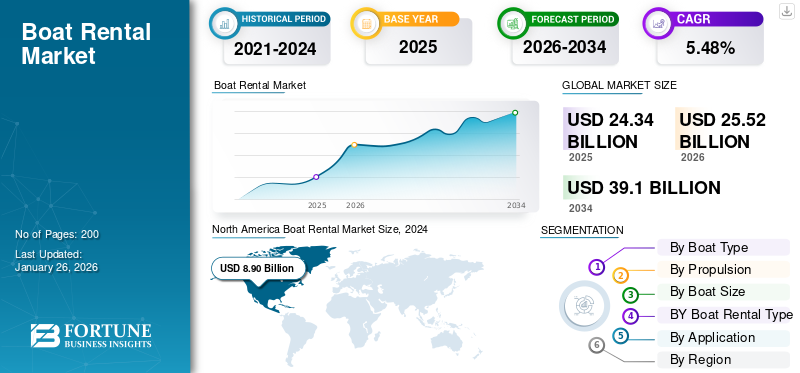
Download Free sample to learn more about this report.
BOAT RENTAL MARKET KEY TAKEAWAYS
 Market Size & Forecast
- 2025 Market Size: USD 24.34 Billion
- 2026 Market Size: USD 25.52 Billion
- 2034 Forecast Market Size: USD 39.10 Billion
- CAGR: 5.48% from 2026–2034
 Market Share
- North America dominated the boat rental market with a 38.68% share in 2025.
- The motorboat segment accounted for a 0.57% market share in 2026.
- The fuel-powered segment will hold a 16.04% market share in 2026.
 Key Regional Highlights
North America
North America generated USD 9.42 billion in 2025 with a 38.68% share and is projected to reach USD 9.94 billion in 2026.
Europe
Europe accounted for USD 6.31 billion in 2025 with a 25.93% share and is expected to reach USD 6.64 billion in 2026, growing at 6.1%.
Asia Pacific
Asia Pacific held a 22.07% share in 2025, valued at USD 5.37 billion, and is projected to reach USD 5.63 billion in 2026.
U.S.
The market is estimated to reach USD 7.41 billion in 2026, supported by strong tourism, marina infrastructure, and rental platform adoption.
Japan
Asia Pacific remains a key growth region, driven by rising marine tourism and increasing recreational boating activities across major economies.
Read More

MARKET DYNAMICS
MARKET DRIVERS
Rising Demand for Leisure and Marine Tourism to Fuel Market Growth
The global market is mainly driven by increasing demand for leisure and marine tourism. Recreational boating has become a popular lifestyle choice, especially among millennials and younger travelers who prefer experiences over ownership. The growth of coastal and island tourism in regions such as the Mediterranean, Caribbean, and Asia Pacific boosts demand for short-term rentals of yachts, sailboats, and motorboats.
Moreover, rising disposable incomes in developing countries and the expansion of marinas and coastal infrastructure are allowing more people to take part in boating activities. The market also benefits from businesses seeking charters for hospitality, events, and team-building activities.
MARKET RESTRAINTS
Stricter Environmental Regulations to Restrict Market Expansion
The industry is very seasonal, with revenues concentrated in the busy summer months or favorable weather conditions. This leads to inconsistent profits and limits usage in colder areas. High operating and maintenance costs for rental providers, such as fuel, docking fees, insurance, and regular upkeep, further reduce profitability, particularly for smaller operators. Safety concerns and regulations also pose challenges. Boating accidents or inexperienced users can create liability issues, driving up insurance costs and discouraging new entrants. Access to waterways varies by region, and many developing markets face limited marina infrastructure, which hinders expansion. The upfront investment in good vessels can also be high for operators, and depreciation adds to the burden, requiring a lot of capital. Rising fuel prices and stricter environmental regulations create additional cost pressures, as authorities demand more sustainable practices.
MARKET OPPORTUNITIES
Expansion into Emerging Lifestyle Segments Presents Significant Opportunities for Market Players
Beyond traditional tourism, boat rentals are gaining importance in emerging lifestyle markets. There is growing demand for wellness-focused experiences such as yoga cruises, eco-retreats, and culinary tours on the water. Younger travelers, in particular, seek unique adventures that are Instagram-worthy, creating chances for themed packages and event-based rentals. City dwellers are also looking for waterfront leisure, which opens up opportunities for short-term, affordable electric boat rentals in urban areas. Working with the entertainment, hospitality, and sports industries can widen usage beyond just tourism. By evolving with customer lifestyles, operators can increase revenue and attract audiences previously outside the traditional boating market.
BOAT RENTAL MARKET TRENDS
Rise of Peer-to-Peer (P2P) Rental Platforms is emerging as a Key Trend in the Market
The rise of peer-to-peer (P2P) rental platforms has changed how people access boats, mirroring the success of sharing economy models such as Airbnb and Uber. Platforms such as Boatsetter, Click&Boat, and GetMyBoat enable private owners to earn money from unused boats, significantly expanding fleet availability without needing large investments from operators. Another key trend is the growing focus on sustainability. Demand for electric boats and hybrid propulsion is rising, influenced by regulatory pressures, rising fuel costs, and consumer preferences for environmentally friendly leisure activities.
MARKET CHALLENGES
Infrastructure and Technological Gaps to Hamper Market Growth
The industry continues to face infrastructure and technological limitations. Many developing regions lack enough marina facilities, fueling stations, and docking areas, which restricts fleet growth. Even in more developed markets, digital booking platforms often remain separate, with limited integration into global travel systems. This leads to inefficiencies and inconsistent customer experiences. Maintenance facilities and access to spare parts are also unevenly distributed, increasing operational costs. Smaller operators, who make up most of the market, often do not have the funds to adopt technologies such as fleet management systems, IoT-based tracking, or green propulsion. Addressing these gaps is crucial for achieving global scalability.
Download Free sample to learn more about this report.
Segmentation Analysis
By Boat Type
Lower Rental Cost Encouraged the Motorboat Segment Growth
On the basis of boat type, the market is classified into motorboat, sailboats, yacht, Rigid-Inflatable Boats (RIBs), and others.
The motorboat segment led the market accounting for 0.57% market share in 2026. Its growth is supported by their relatively lower rental costs, ease of handling for amateur users, and strong popularity for short leisure trips, watersports, and weekend getaways.
To know how our report can help streamline your business, Speak to Analyst
The yacht segment is anticipated to grow at a CAGR of 6.0% during the forecast period.
By Propulsion
Reliability and Refueling Infrastructure Boosted the Growth of Fuel Powered Segment
In terms of propulsion, the market is categorized into fuel powered, sailboats, and electric boat.
The fuel powered segment will account for 16.04% market share in 2026. Its popularity is due to reliability, the widespread availability of refueling infrastructure, and suitability for long-distance or high-speed travel. Tour operators and charter companies particularly favor fuel-powered boats for their versatility and ability to meet diverse customer demands across fishing, leisure, and transport activities.
The sailboat segment is expected to grow at a CAGR of 5.0% over the forecast period.
By Boat Size
Easy Maneuverability and Convenient Access Supplemented the Upto 20 Segment Growth
Based on boat size, the market is segmented into upto 20, 21-35, and above 35.
The Upto 20 segment is anticipated to hold a dominant market share of 10.46% in 2026. Smaller boats attract cost-sensitive and casual renters, offering easy maneuverability and convenient access to lakes, rivers, and coastal waters. Their rising adoption on peer-to-peer sharing platforms and strong appeal among younger, first-time users are driving steady growth in the segment.
The 21-35 segment is set to flourish and is growing at a CAGR of 5.4% growth during the forecast period.
By Boat Rental Type
Rise in Tourism Activities Boosted the Commercial Charter Segment Growth
Based on boat rental type, the market is segmented into peer to peer, commercial charter, subscription, and others.
The commercial charter segment is poised to account for 13.32% of the market share in 2026. This segment benefits from the steady increase in tourism activities, organized group trips, and corporate or private events. Professionally managed fleets offer safety, convenience, and premium experiences, fostering greater trust and encouraging repeat bookings compared to peer-to-peer rentals.
The segment of peer to peer is set to flourish with a growth rate of 6.0% during the forecast period.
By Application
Advancements in Fish-Finding Technologies Boosted Fishing Segment Growth
Based on application, the market is segmented into luxury, sports, fishing, and commercial.
The fishing segment held a dominant position in 2024. Growth is driven by recreational angling emerging as a mainstream leisure activity, especially in North America and Asia Pacific. The integration of guided fishing tours into broader tourism packages, along with advancements in fish-finding technologies, is making fishing rentals more attractive to both casual and professional users.
The sports segment is set to flourish with a growth rate of 6.1% over the forecast period.
Boat Rental Market Regional Outlook
North America
North America Boat Rental Market Size, 2025 (USD Billion)
To get more information on the regional analysis of this market, Download Free sample
In 2025, North America represented USD 9.42 billion, accounting for 38.68% of the worldwide market, and is projected to grow to USD 9.94 billion in 2026, owing to the growing outdoor recreation trend, rising disposable incomes, and growing tourism. The U.S. and Canada both benefit from extensive coastlines, lakes, and inland waterways that encourage year-round rental demand. The presence of advanced marina infrastructure and the rise of peer-to-peer rental platforms make boat access more convenient for casual users. In 2026, the U.S. market is estimated to reach USD 7.41 billion.
Europe
The Europe market generated USD 6.31 billion in 2025, representing 25.93% of the global market landscape, and is expected to reach USD 6.64 billion in 2026. Europe is projected to record a growth rate of 6.1%, which is the second-highest amongst all the regions. Europe remains a global hotspot for yacht and leisure charters, with the Mediterranean and Adriatic Seas serving as prime destinations. Countries such as Spain, Italy, Greece, and Croatia attract millions of tourists annually, many of whom seek luxury charter experiences. Backed by these factors, countries including the U.K. are anticipated to record the valuation of USD 2.77 billion, and Germany to record USD 1.96 billion, in 2026. Following Europe, the market in Asia Pacific is estimated to reach USD 5.63 billion in 2026, securing its position as the third-largest region in the market.
Asia Pacific
Asia Pacific contributed 22.07% to the global market in 2025, with a valuation of USD 5.37 billion, and is projected to reach USD 5.63 billion in 2026.
Rest of the World
Rest of the World contributed approximately USD 3.24 billion to the global market in 2025, accounting for 13.32% share, and is expected to reach USD 3.32 billion in 2026. The rest of the world regions would witness a moderate growth during the forecast period. Popular destinations such as the Caribbean islands, the UAE, and South Africa are investing heavily in coastal infrastructure to attract international visitors.
COMPETITIVE LANDSCAPE
Key Industry Players
Strategic Alliance between Key Companies to Support their Market Dominance
The market is highly fragmented and competitive, with a mix of global digital platforms, regional charter operators, and numerous small local providers. Peer-to-peer models are reshaping competition by allowing private owners to monetize idle fleets and offering consumers wider access. Technology-driven players focus on user-friendly apps, transparent pricing, and value-added boat rental services, while established operators emphasize premium offerings such as luxury yachts and long-term charters. Competition also stems from differentiation in fleet size, boat type, geographic coverage, and customer service. Strategic partnerships with marinas, travel agencies, and hospitality groups are becoming increasingly critical for operators to boost their market position.
LIST OF KEY BOAT RENTAL COMPANIES PROFILED:
- GetMyBoat (U.S.)
- Boatsetter (U.S.)
- Click&Boat (France)
- Sailo (U.S.)
- Zizoo (Austria)
- SamBoat (France)
- GlobeSailor (France)
- Nautal (Spain)
- Borrow A Boat (U.K.)
- Incrediblue (Greece)
KEY INDUSTRY DEVELOPMENTS
- November 2023: GetMyBoat, the top marketplace for boat rentals and charters globally, initiated a new collaboration with Mariners Learning System, a well-known provider of boating education and licensing programs. This partnership offers unique discounts and enhanced access to US Coast Guard (USCG) Captain’s Licensing courses for boaters looking to acquire or improve their current licenses.
- April 2025: Boatsetter unveiled its most significant update in ten years. Featuring a redesigned, smoother user experience alongside unique offerings such as a VIP membership and groundbreaking guest protections, Boatsetter is enhancing contemporary boating with an emphasis on ease, safety, and exceptional access.
- July 2025: MYBA Charter Show secured a three-year agreement with Portosole Marina. As a significant trade-only event in the yearly yachting calendar, the MYBA Charter Show serves as a vital platform that connects yacht brokers and industry experts with the newest sailing and motor yacht charters in the area, offering guided tours, specialized seminars, and unique experiences designed to educate and inform all attendees at the event.
- April 2023: Getmyboat, a marketplace for boat rentals, teamed up with the group rideshare company Fetii to facilitate smooth summer boat outings for bigger groups. Initially launching in Austin and the Dallas-Fort Worth region, Fetii users can conveniently arrange both their boat outings and their rides to and from the marina or boat launch site.
- January 2024: Getmyboat and Your Boat Club collaborated to enhance their services to satisfy customer needs in important areas. As a result of this partnership, renters would have the opportunity to rent Your Boat Club's fleets through the Getmyboat platform, providing more individuals than ever with the chance to experience the pleasures of being on the water.
REPORT COVERAGE
The global analysis provides an in-depth study of market size & forecast by all the market segments included in the report. It includes details on the market dynamics and market trends expected to drive the market in the forecast period. It offers information on the technological advancements, new product launches, key industry developments, and details on partnerships, mergers & acquisitions. The report also encompasses a detailed competitive landscape with information on the market share and profiles of key operating players.
Request for Customization to gain extensive market insights.
Report Scope & Segmentation
|
ATTRIBUTE |
DETAILS |
|
Study Period |
2021-2034 |
|
Base Year |
2025 |
|
Estimated Year |
2026 |
|
Forecast Period |
2026-2034 |
|
Historical Period |
2021-2024 |
|
Growth Rate |
CAGR of 5.48% from 2026-2034 |
|
Unit |
Value (USD Billion) |
|
Segmentation
|
By Boat Type
|
|
By Propulsion
|
|
|
By Boat Size
|
|
|
By Boat Rental Type
|
|
|
By Application
|
|
|
By Geography
|
Frequently Asked Questions
Fortune Business Insights says that the global market value stood at USD 25.52 billion in 2026 and is projected to reach USD 39.10 billion by 2034.
In 2025, the market value stood at USD 9.42 billion.
The market is expected to exhibit a CAGR of 5.48% during the forecast period (2026-2034).
The motorboat segment led the market by boat type.
Rising Demand for leisure and marine tourism is a key factor driving the market growth.
GetMyBoat (U.S.), Boatsetter (U.S.), Click&Boat (France), Sailo (U.S.), and Zizoo (Austria) are some of the prominent players in the market.
North America dominated the market.



- 2021-2034
- 2025
- 2021-2024
- 200
-
(Offer valid till 30th Sep 2026)
Get 30-60 hrs Free Customization
Expand Regional and Country Coverage, Segments Analysis, Company Profiles, Competitive Benchmarking, and End-user Insights.




















Related Reports
-
US +1 833 909 2966 ( Toll Free )
-
Get In Touch With Us