Body Piercing Jewelry Market Size, Share & Industry Analysis, By Type (Product Type {Barbells, Studs, Rings, Plugs & Tunnels, and Dermal Jewelry} and Service Type {Initial Piercing Procedures, Follow-up & Aftercare Services, and Jewelry Change & Fitting Services}), By Base Material (Surgical Stainless Steel, Titanium, Gold, and Silver), By Piercing Location (Ear, Nose, Lip & Oral, Eyebrow, Navel, and Nipple), By End-User (Men, Women, and Unisex), By Distribution Channel (Professional Piercing Studios, Specialty Jewelry Stores, and Online Marketplaces), and Regional Forecast, 2026-2034
 Download Free Sample
(Offer valid till 15th Oct 2026)

Body Piercing Jewelry Market Size and Future Outlook
 Listen to Audio Version
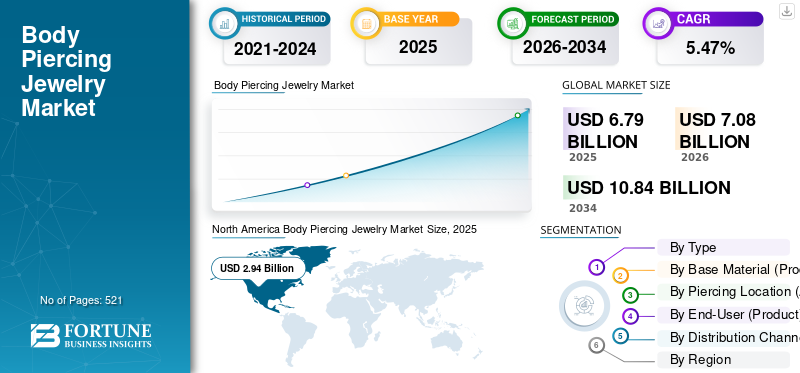
The global body piercing jewelry market size was valued at USD 6.79 billion in 2025. The market is projected to grow from USD 7.08 billion in 2026 to USD 10.84 billion by 2034, exhibiting a CAGR of 5.47% during the forecast period. North America dominated the body piercing jewelry market with a market share of 43.3% in 2025.
Specialized piercing jewelry is available in primary styles including barbells, captive bead rings, and labret studs. The growing number of millennials and Gen Z consumers who consider body modifications, facial styling, and ear piercing as a medium of self-expression and personal identity is driving the demand for piercing jewelry and related services globally. In addition, the increasing number of consumers suffering from skin allergies due to unsafe material-based pierced jewelry is favoring the global market expansion. Other growth factors include the rising demand for products made of premium and hypoallergenic materials, including implant-grade titanium, surgical stainless steel, niobium, and platinum.
Prominent companies in the global market include Lovisa Holdings Limited, Claire's Stores, Inc., Maria Tash, Rowan, Inc., and Body Vision Los Angeles (BVLA).
Download Free sample to learn more about this report.
BODY PIERCING JEWELRY MARKET TRENDS
Growing Popularity of Personalized Jewelry with Birthstone, Zodiac Symbol, and Septum Design to Favor Market Growth
The growing popularity of piercing jewelry featuring birthstone and zodiac symbol designs, reflecting birth month, astrological identity, or personal meaning, is favoring global market expansion. In addition, increasing consumer accessibility to products featuring decorative clickers, hinged rings, chains, and gemstone-set septum pieces with lucrative designs is encouraging them to buy such products, favoring product revenues worldwide. The growing trend of wearing products with matching nostril, eyebrow, lip, and ear placements for symmetry-focused social media styling is augmenting the product demand globally.
MARKET DYNAMICS
MARKET DRIVERS
Download Free sample to learn more about this report.
Expansion of Professional Piercing Studios, Improving Access to Safe and Specialized Services to Drive Market Growth
Professional piercing studios provide consultations, anatomy-based placement recommendations, jewelry sizing, sterilized single-use needles, and detailed aftercare instructions to visitors. An expanding base of such studios that are improving customers’ access to professional body piercings and barbell installation services is driving the global body piercing jewelry market growth. In addition, the growing number of studios seeking to implant jewelry made of implant-grade titanium, solid gold, niobium, and other premium bio-compostable materials based on the customers’ skin sensitivity, anatomy, and lifestyle is driving these products and services revenue growth globally.
Market Drivers - Impact & CAGR Contribution (2026–2034)
| Rank | Market Drivers | Overall Impact Rank | CAGR Contribution (2026-2034) | Impact: 2026-2028 | Impact: 2029-2031 | Impact: 2032-2034 |
|---|---|---|---|---|---|---|
| 1 | Growing social acceptance is increasing demand for body piercing jewelry and services | High | 2.15% | High | High | High |
| 2 | Multiple piercings and curated-ear styling are supporting repeat purchases | High | 1.65% | High | High | Medium |
| 3 | Demand for premium and hypoallergenic jewelry is strengthening market growth | High | 1.35% | Medium | High | High |
| 4 | Professional piercing studios are improving access to safe and specialized services | Medium | 1.15% | Medium | High | High |
| 5 | Social media and celebrity trends are encouraging new piercing styles | Medium | 1.00% | High | Medium | Medium |
| 6 | Others (growth of online jewelry retail, gender-neutral designs, personalized jewelry, gifting demand, and improved aftercare awareness, etc.) | Low | 0.60% | Low | Low | Low |
| Total Positive Growth Contribution | 7.90% | |||||
Source: Fortune Business Insights
Download Free sample For In-Depth Market Drivers & Impact Forecasts
MARKET RESTRAINTS
Greater Consumer Accessibility to Counterfeit and Poor-Quality Piercing Jewelry to Restrain Market Growth
Counterfeit and poor-quality piercing jewelry may contain unsafe materials, excessive nickel, rough surfaces, weak coating, or inaccurate material labels. These products cause allergic reactions, infections, and discoloration to the user’s skin. Increasing consumer accessibility to such products is hampering their confidence in spending on professional piercing services and installing such jewelry, restraining the global market growth. In addition, increasing consumer accessibility to poor-quality products that are designed with a lack of quality testing, sterilization, and material traceability is hampering the global market expansion.
Market Restraints - Impact & Negative CAGR Contribution (2026–2034)
| Rank | Market Restraints | Overall Impact Rank | Negative CAGR Contribution (2026-2034) | Impact: 2026-2028 | Impact: 2029-2031 | Impact: 2032-2034 |
|---|---|---|---|---|---|---|
| 1 | Infections and allergic reactions may discourage consumers from getting piercings | High | -0.95% | High | High | Medium |
| 2 | Uneven hygiene standards and regulations can limit professional service growth | Medium | -0.70% | High | Medium | Medium |
| 3 | Counterfeit and poor-quality jewelry can reduce consumer trust | Medium | -0.50% | Medium | Medium | Low |
| 4 | Others (social stigma, workplace restrictions, healing concerns, and premium pricing, etc.) | Low | -0.28% | Low | Low | Low |
| Total Negative Growth Impact | -2.43% | |||||
Source: Fortune Business Insights
Download Free sample For In-Depth Market Restraints & Risk Analysis
MARKET OPPORTUNITIES
Growing Brands’ Partnerships with Professional Studios for Technology-based Piercing Jewelry Services to Create Market Growth Opportunities
Professional jewelry piercing studios in collaboration with brands use digital ear mapping, virtual try-on tools, and 3D visualization to recommend suitable piercing placements and jewelry combinations based on consumers’ anatomy and style preferences. These collaborations increase consumer service-availing confidence, support curated-ear planning, and encourage multiple jewelry purchases. Increasing partnerships between jewelry brands and studios are creating new market growth opportunities.
MARKET CHALLENGES
Lack of Hygiene and Sterilization Standards to Challenge Industry Growth
Piercing studios must consistently sterilize reusable instruments, disinfect workspaces, use single-use needles & gloves, and safely dispose of contaminated materials. Lack of implementation of these hygiene and sterilization standards is causing the risk of infections, cross-contamination, and blood-borne disease transmission among studio visitors. This aspect is hampering consumer confidence in availing such jewelry piercing services, posing challenges to the industry growth.
Segmentation Analysis
By Type
Significant Spending on Premium-based Jewelry Products over Piercing Services Led to Dominance of Product Type Segment
By type, the market is bifurcated into product type and service type.
The product type segment exhibited the leading global body piercing jewelry market share in 2025. The segment is projected to grow at the fastest CAGR of 5.59% during 2026-2034. Compared to piercing services, studio visitors spend on personalized jewelry products that are installed on the body surfaces as per customer requirements. This aspect mainly generates considerable revenues from the product type segment. In addition, increasing purchases of piercing jewelry at professional studios, specialty retailers, and online retail platforms are augmenting the segment’s growth.
The product type segment is divided into barbells, studs, rings, plugs & tunnels, dermal jewelry, retainers, and others. The studs segment exhibited a leading global market share in 2025. Studs are available in minimalist, gemstone-set, birthstone, zodiac, and decorative designs, making them suitable for everyday wear and personalized styling. Rising demand for studs with a compact structure and secured fit, improving comfort and reducing snagging, is generating considerable revenues from this segment. In addition, the rising demand for studs made of surgical steel, implant-grade titanium, and solid gold is driving the segment’s growth.
The dermal jewelry segment is projected to grow at the fastest rate of 7.80% during 2026-2034. Rising consumer interest in distinctive single-point dermal piercings placed on areas such as the neck, cheek, back, face, and hips is driving this segment’s growth.
The service type segment is projected to grow at the second-fastest CAGR of 5.11% during 2026-2034. The growing consumer preferences for trained piercers, sterile procedures, anatomy-based placements, and correctly sized jewelry are driving demand for such services globally.
The service type segment is divided into initial piercing procedures, follow-up & aftercare services, jewelry change & fitting services, piercing repair & re-piercing services, stretching & body modification services, professional consultation services, training & certification services, and others. The initial piercing procedures segment exhibited a leading global market share of 57.44% in 2025. The segment is projected to grow at a CAGR of 4.14% during 2026-2034. Initial piercing procedures require professional placement before follow-up care or jewelry replacement can occur. The growing interest in multiple-year styling, nostril, septum, navel, lip, and cartilage piercings is driving this segment’s growth. In addition, the growing number of studios charging higher fees for complex procedures and multiple piercings completed during one appointment is further driving the segment’s growth.
Within the service type segment, the training & certification services segment is projected to grow at the fastest rate of 7.83% during 2026-2034. The growing number of piercing studios seeking qualified professionals who understand sterilization, anatomy-based placement, blood-borne pathogen prevention, jewelry materials, and aftercare practices through training services is driving this segment’s growth.
To know how our report can help streamline your business, Speak to Analyst
By Base Material (Product)
Greater Consumer Accessibility and Affordability of Stainless Steel-based Jewelry Led to Dominance of Surgical Stainless Steel Segment
Based on base material (product), the market is divided into surgical stainless steel, titanium, gold, silver, organic materials, polymers, and others.
The surgical stainless steel segment exhibited a leading global market share of 41.33% in 2025. The segment is projected to grow at a CAGR of 4.36% from 2026 to 2034. Greater consumer accessibility, durability, corrosion resistance, and affordability of the surgical stainless steel-based studs, barbells, rings, plugs, and other body jewelry across studios, specialty stores, and e-commerce platforms are generating considerable segmental revenues. In addition, the rising consumer demand for stainless steel-based jewelry with polished, matte, black-coated, gold-tone, and multi-color finishes is driving this segment’s growth.
The titanium segment is projected to grow at the fastest CAGR of 7.98% from 2026 to 2034. Increasing consumer preference for lightweight, corrosion-resistant, and skin-friendly body jewelry due to its biocompatibility and suitability for sensitive skin is driving this segment’s growth.
By Piercing Location (Application of Product)
Widespread Acceptance of Earlobe and Cartilage Piercing for Ear Jewelry Led to Dominance of Ear Segment
Based on the piercing location (application of product), the market is divided into ear, nose, lip & oral, eyebrow, navel, nipple, intimate (genital), and others.
The ear segment exhibited a leading global market share of 49.11% in 2025. The segment is estimated to grow at a CAGR of 4.89% from 2026 to 2034. Widespread acceptance of earlobe and cartilage piercings across different age groups is encouraging consumers to purchase lobe, helix, conch, tragus, rook, and industrial placements, generating considerable segmental revenues. The growing popularity of curated-ear styling, piercing stacks, and coordinated studs, hoops, chains, and charms further supports the segment.
The others segment, including cheek, chest, neck, back, hip, hand, and other surfaces, is projected to grow at the fastest CAGR of 8.90% during the forecast period. The growing trend of body piercing and personal styling is encouraging consumers to explore jewelry placements beyond traditional ear, nose, and navel piercings. Advances in dermal anchors, surface bars, implant-grade titanium jewelry, and specialized professional techniques are encouraging consumers to explore cheek, chest, neck, and hand piercing activities, driving this segment’s growth.
By End-User (Product)
Women Segment Dominated the Market due to Significant Consumer Demand for Body Piercing and Curated Jewelry
Based on end-user (product), the market is divided into women, men, and unisex.
The women segment exhibited a leading global market share of 57.49% in 2025. The segment is growing at a CAGR of 4.81% from 2026 to 2034. Significant demand for body piercing services among women consumers with curated ear styling, multiple piercings, gemstone studs, delicate hoops, birthstone pieces, and premium gold or titanium jewelry is generating considerable segmental revenues. In addition, increasing purchases of new jewelry by women for fashion coordination, personalization, gifting, and jewelry upgrades is driving this segment’s growth.
The unisex segment is projected to grow at the fastest CAGR of 7.29% during the forecast period. Increasing acceptance of gender-neutral fashion and body piercing as a form of self-expression among gender-biased consumers is driving the demand for piercing jewelry globally.
By Distribution Channel (Product)
Wide Product Selection and Expanding Global Brand Presence to Drive Professional Piercing Studios Segment’s Growth
Based on distribution channel (product), the market is divided into professional piercing studios, brand-owned stores, specialty jewelry stores, online marketplaces, brand websites, department stores, fashion accessory stores, and others.
The professional piercing studios segment exhibited a leading global market share of 32.34% in 2025. The segment is growing at a CAGR of 4.46% from 2026 to 2034. Consumers mainly purchase starter jewelry at the same location where the procedure is performed. Studios provide trained piercers, sterile procedures, anatomy-based placement, accurate sizing, material guidance, and professional jewelry insertion, strengthening consumer confidence in making product purchase decisions. This aspect mainly generates considerable segmental revenues. In addition, the growing number of body piercing studios seeking to broaden their base across international markets by launching new stores is positively contributing to the segment’s growth.
The brand websites segment is projected to grow at the fastest CAGR of 8.46% during the forecast period. The emergence of brand websites selling premium collections, limited editions, hypoallergenic jewelry, and replacement parts is driving this segment’s growth.
Body Piercing Jewelry Market Regional Outlook
By region, the market is categorized into North America, Europe, Asia Pacific, South America, and the Middle East & Africa.
North America
North America Body Piercing Jewelry Market Size, 2025 (USD Billion)
To get more information on the regional analysis of this market, Download Free sample
The North America region held the largest global market share of 43.38% in 2025. The region’s market size is estimated to reach USD 3.05 billion by 2026. The market is projected to grow at a CAGR of 4.79% during 2026-2034. The region’s market is driven by robust fashion accessories spending, a robust base of professional piercing studios, and greater acceptance of visible body art. In addition, the rising demand for premium, hypoallergenic, and professionally fitted jewelry such as titanium flat-backs, gold studs, niobium rings, internally threaded barbells, and threadless ends is driving the region’s market growth.
U.S. Body Piercing Jewelry Market
The U.S. market size reached USD 2.52 billion in 2025, accounting for around 37.10% of the global sales. Robust online jewelry replacement potential and growing popularity of celebrity-led fashion and gender-neutral styling are driving the product replacement rate nationwide.
Europe
Europe will exhibit the second-leading global market share during the forecast period. The region’s market size reached USD 1.90 billion in 2025, accounting for approximately 27.98% of the global sales. Shifting consumer preference toward nickel-safe, hypoallergenic, titanium, surgical steel, niobium, and 14K+ gold piercing jewelry to avoid skin sensitivity and allergy issues due to unsafe material-based products is sustainably developing the European market growth. In addition, rising adoption of online shopping for fashion goods, requiring consumers to spend on healed-piercing jewelry, retainers, plugs, tunnels, and decorative ends, is driving product revenues across the region.
U.K. Body Piercing Jewelry Market
The U.K.’s market reached around USD 0.36 billion in 2025, representing approximately 5.25% of global sales. Demand for eco-friendly body piercing jewelry is rising among sustainability-conscious consumers across the U.K.
Germany Body Piercing Jewelry Market
Germany’s market reached approximately USD 0.39 billion in 2025, equivalent to around 5.75% of global sales. Social media influencers are increasing the adoption of new body piercing styles across the country.
Asia Pacific
The Asia Pacific market is projected to grow at the fastest rate of 7.15% from 2026 to 2034. The region held a third-leading global market share of 20.16% and a market size of USD 1.37 billion in 2025. Significant fashion accessories consumption, a large youth consumer base, a deep jewelry-wearing culture, and increasing demand for body piercing and tattooing services are driving the region’s market growth. In addition, rising consumer preference for minimalist studs, ear jewelry, small hoops, retainers, premium metals, and discreet styling is favoring product revenues across the region.
China Body Piercing Jewelry Market
China’s market is projected to be one of the largest in the Asia Pacific, with revenues of around USD 0.47 billion in 2025, representing roughly 6.90% of global sales. Growing acceptance of body piercing is increasing demand for jewelry and professional services nationwide.
India Body Piercing Jewelry Market
The Indian market in 2025 stood at around USD 0.24 billion, accounting for roughly 3.55% of the global market revenues. High disposable incomes are increasing demand for premium body piercing jewelry and specialized services in India.
Japan Body Piercing Jewelry Market
The Japanese market stood at around USD 0.27 billion in 2025, accounting for roughly 3.94% of global revenues.
South America and Middle East & Africa
The markets in South America and the Middle East & Africa are expected to grow at a moderate pace from 2026 to 2034. The South American market in 2025 reached a valuation of USD 0.33 billion. The growing number of men and gender-biased consumers exploring body piercing and newer jewelry designs is favoring South American market growth. The growing number of professional piercing studios and specialty retailing stores expanding their base in international markets is positively contributing to the market growth in the Middle East & African region. In the Middle East & African region, the UAE market reached a valuation of USD 0.044 billion in 2025.
South Africa Body Piercing Jewelry Market
The South African market reached approximately USD 0.057 billion in 2025, accounting for roughly 0.84% of the global market revenues.
COMPETITIVE LANDSCAPE
Key Industry Players
Retail Network Building and Strategic Partnerships to Help Key Players Maintain Market Position
The key players in the global market are Lovisa Holdings Limited, Claire's Stores, Inc., Maria Tash, Rowan, Inc., and Body Vision Los Angeles (BVLA). These players focus on retail network building, frequent collection launches, accessible pricing, and in-store piercing services to attract mainstream consumers. In addition, they partner with jewelry brands to source premium-based products and deliver personalized services.
LIST OF KEY BODY PIERCING JEWELRY COMPANIES PROFILED
- Industrial Strength Body Jewelry (U.S.)
- Anatometal, Inc. (U.S.)
- NeoMetal (U.S.)
- Body Vision Los Angeles (BVLA) (U.S.)
- LeRoi Fine Body Jewelry (U.S.)
- Buddha Jewelry Organics (U.S.)
- Kiwi Diamond (U.S.)
- Claire's Stores, Inc. (U.S.)
- Lovisa Holdings Limited (Australia)
- Maria Tash (U.S.)
- Junipurr (Canada)
- Body Gems (U.S.)
- Bodycircle, Inc. (U.S.)
- Rowan, Inc. (U.S.)
- SkinKandy (Australia)
KEY INDUSTRY DEVELOPMENTS
- November 2025: Anatometal introduced The Anatometal Merchandising Guide, providing merchandising best practices to professional piercing studios to enhance product presentation and improve the customer shopping experience.
- August 2025: Lovisa Holdings Limited opened 162 new stores during FY2025, surpassing 1,000 stores globally and entering several new international markets, reinforcing its aggressive retail expansion strategy.
- September 2024: Maria Tash opened a new luxury piercing and fine jewelry boutique at Scottsdale Fashion Square, Arizona, further expanding its premium retail presence in the U.S.
- February 2024: Rowan opened its third Chicago-area studio, continuing the expansion of its nurse-led piercing model and strengthening its organized retail footprint.
- July 2023: Claire's launched "Pierced by Claire's," a rebranded ear-piercing concept featuring an enhanced in-store experience, refreshed visual identity, and improved aftercare offerings to strengthen customer engagement.
REPORT COVERAGE
The global body piercing jewelry market research provides an in-depth study of market insights, market sizing details, and market forecasts by product type and all other market segments included in the report. In addition, it provides details on the market outlook, dynamics, regional analysis, and trends expected to drive the market during the forecast period. The market report also includes information on technological advancements, new product launches, key product developments, partnerships, and mergers & acquisitions. Additionally, the report also includes a detailed competitive landscape, with market share and profiles of key players.
Request for Customization to gain extensive market insights.
Report Scope & Segmentation
| ATTRIBUTE | DETAILS |
| Study Period | 2021-2034 |
| Base Year | 2025 |
| Estimated Year | 2026 |
| Forecast Period | 2026-2034 |
| Historical Period | 2021-2024 |
| Growth Rate | CAGR of 5.47% from 2026 to 2034 |
| Unit | Value (USD Billion) |
| Segmentation | By Type, Base Material (Product), Piercing Location (Application of Product), End-User (Product), Distribution Channel (Product), and Region |
| By Type |
|
| By Base Material (Product) |
|
| By Piercing Location (Application of Product) |
|
| By End-User (Product) |
|
| By Distribution Channel (Product) |
|
| By Region |
|
Frequently Asked Questions
Fortune Business Insights says that the global market value stood at USD 6.79 billion in 2025 and is projected to reach USD 10.84 billion by 2034.
In 2025, North America’s market value stood at USD 2.94 billion.
The global market is forecast to grow at a CAGR of 5.47% from 2026 to 2034.
By type, the product type segment leads in the global market.
Expansion of professional piercing studios and improving access to safe and specialized services are driving product demand and global market growth.
Lovisa Holdings Limited, Claire's Stores, Inc., Maria Tash, Rowan, Inc., and Body Vision Los Angeles (BVLA) are the leading players in the market.
North America dominated the market in 2025 in terms of share.
The growing brands’ partnerships with professional studios for technology-based piercing jewelry services are expected to create new market growth opportunities.



- 2021-2034
- 2025
- 2021-2024
- 521
-
(Offer valid till 15th Oct 2026)
Get 30-60 hrs Free Customization
Expand Regional and Country Coverage, Segments Analysis, Company Profiles, Competitive Benchmarking, and End-user Insights.














Related Reports
-
US +1 833 909 2966 ( Toll Free )
-
Get In Touch With Us