Body Worn Insect Repellent Market Size, Share & Industry Analysis, By Product (Apparel, Sprays, Oils & Creams, Stickers & Patches), By Distribution Channel, and Regional Forecast, 2026-2034
 Download Free Sample
Body Worn Insect Repellent Market Overview
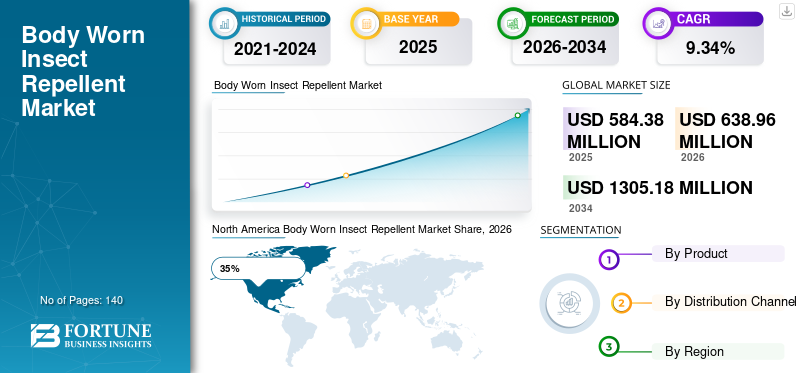
The global body worn insect repellent market size was valued at USD 584.38 Million in 2025. The market is projected to grow from USD 638.96 Million in 2026 to USD 1305.18 Million by 2034, exhibiting a CAGR of 9.34% during the forecast period.

The body worn insect repellent market is gaining significant attention due to increasing concerns regarding mosquito-borne and insect-borne diseases across urban and rural populations. Body worn insect repellent products include treated apparel, wearable patches, repellent-infused accessories, sprays, and topical solutions designed to provide continuous protection against insects. Rising participation in outdoor activities, growing travel frequency, and increasing awareness regarding personal protection are supporting market expansion. Manufacturers are focusing on long-lasting formulations, skin-friendly ingredients, and wearable technologies that improve user convenience. The body worn insect repellent market report highlights growing demand from consumers, military personnel, outdoor workers, and travelers seeking effective insect protection solutions.
The United States represents a major market for body worn insect repellent products due to high consumer awareness regarding vector-borne diseases and outdoor safety. Increasing participation in camping, hiking, fishing, and recreational outdoor activities supports demand for wearable insect protection products. Public health initiatives promoting mosquito prevention have encouraged broader adoption of insect repellents among households and travelers. Demand is particularly strong for insect-repellent apparel, patches, and skin-safe formulations designed for children and adults. The Body Worn Insect Repellent Industry Analysis indicates that product innovation, expanding retail availability, and growing interest in personal protection continue strengthening market penetration across the United States.
Download Free sample to learn more about this report.
body worn insect repellent market Key Takeaways
 Global Market Size & Forecast
- 2025 Market Size: USD 584.38 Million
- 2026 Market Size: USD 638.96 Million
- 2034 Forecast Market Size: USD 1,305.18 Million
- CAGR: 9.34% from 2026-2034
 Market Share
- North America dominated with a revenue share of 35% in 2025.
- Apparel led the market with approximately 36% share.
- Supermarkets and hypermarkets accounted for approximately 34% market share.
 Key Regional Highlights
North America
North America held the largest regional share at 35% in 2025.
Asia-Pacific
Asia-Pacific accounted for 28% of the global market.
Europe
Europe represented 27% of the global market, supported by demand for outdoor protection products.
U.S
The market is supported by demand for insect-repellent apparel and products among outdoor enthusiasts and travelers.
Japan
Japan accounted for 19% of the Asia-Pacific market, supported by demand for convenient insect protection products.
Read More

body worn insect repellent market Latest Trends
The body worn insect repellent market trends reveal increasing consumer preference for convenient, long-lasting, and environmentally responsible insect protection solutions. Manufacturers are introducing insect-repellent apparel incorporating advanced fabric treatment technologies capable of maintaining effectiveness through multiple washes. Wearable patches and stickers are becoming increasingly popular among parents seeking non-spray alternatives for children.
Download Free sample to learn more about this report.
Natural ingredient formulations are gaining traction as consumers look for products containing plant-based active ingredients. The market is also witnessing increased demand for multifunctional products combining insect protection with outdoor performance apparel. Advances in microencapsulation technology are allowing manufacturers to develop longer-lasting repellent effects without compromising comfort.
body worn insect repellent market Dynamics
DRIVER
Rising Incidence of Mosquito-Borne and Vector-Borne Diseases
The primary driver supporting body worn insect repellent market growth is the increasing incidence of mosquito-borne and vector-borne diseases across multiple regions. Health concerns related to dengue fever, malaria, chikungunya, Lyme disease, and other insect-transmitted illnesses have encouraged consumers to adopt preventive measures. Governments and healthcare organizations continue promoting personal protection strategies, increasing awareness regarding insect repellents. Outdoor workers, travelers, military personnel, and recreational users represent important customer groups driving product demand. The body worn insect repellent market analysis highlights growing preference for wearable protection products because they provide continuous defense without requiring frequent reapplication. As public health awareness expands globally, demand for reliable body worn insect repellent solutions continues increasing.
RESTRAINT
Limited Consumer Awareness in Developing Regions
A major restraint affecting the body worn insect repellent market involves limited consumer awareness regarding wearable insect protection products in certain developing markets. Many consumers remain dependent on traditional insect control methods such as sprays, coils, and household treatments. Price sensitivity can also restrict adoption of premium wearable products. In some regions, lack of product education limits understanding of the benefits associated with treated apparel, patches, and wearable repellents. Distribution challenges in remote locations further constrain market penetration. The Body Worn Insect Repellent Industry Report indicates that manufacturers must invest in consumer education, awareness campaigns, and distribution expansion strategies to overcome these barriers and improve market accessibility.
OPPORTUNITY
Growing Demand for Natural and Sustainable Repellents
The strongest opportunity within the body worn insect repellent market is the increasing demand for natural, eco-friendly, and sustainable insect protection solutions. Consumers are becoming more conscious of ingredient safety and environmental impact when selecting personal care products. This trend is encouraging manufacturers to develop wearable repellents utilizing plant-based active ingredients and biodegradable materials. Sustainable apparel technologies and eco-friendly production practices are creating additional differentiation opportunities. The body worn insect repellent market opportunities also extend to premium product categories targeting health-conscious consumers and families. Companies capable of balancing effectiveness, safety, and sustainability are expected to benefit from expanding market demand and stronger brand loyalty.
CHALLENGE
Regulatory Compliance and Product Performance Expectations
Manufacturers operating in the body worn insect repellent market face challenges associated with regulatory compliance and maintaining consistent product effectiveness. Insect repellent products often require extensive testing and regulatory approvals before commercialization. Different countries maintain varying standards regarding active ingredients, safety claims, and labeling requirements. Meeting these standards while ensuring product performance can increase development costs and complexity. Consumer expectations regarding comfort, durability, and protection duration continue rising. The body worn insect repellent market forecast indicates that manufacturers must continuously invest in research, testing, and innovation to satisfy regulatory requirements and maintain competitive positioning within an increasingly crowded marketplace.
body worn insect repellent market Segmentation
By Product
Apparel represents approximately 36% of the global body worn insect repellent market Share and remains the leading product category. Insect-repellent clothing includes shirts, pants, socks, jackets, hats, and outdoor gear treated with protective formulations. Demand is particularly strong among outdoor enthusiasts, military personnel, forestry workers, and travelers visiting insect-prone regions. Manufacturers continue improving treatment durability, allowing garments to maintain effectiveness through repeated laundering cycles. The body worn insect repellent market report highlights increasing adoption of treated apparel because it provides extended protection without requiring direct skin application.
Sprays account for approximately 29% of the body worn insect repellent market Share. These products remain widely utilized due to ease of application and immediate effectiveness. Consumers frequently use sprays during outdoor activities, travel, and seasonal insect outbreaks. Manufacturers are developing formulations offering extended protection periods while minimizing skin irritation. Demand is increasing for sprays containing natural ingredients and low-odor formulations. The body worn insect repellent market analysis indicates that portable packaging, improved spray mechanisms, and broad retail availability continue supporting strong market demand within this segment.
Oils and creams contribute approximately 21% of the body worn insect repellent market Share. These products are favored by consumers seeking targeted skin application and moisturizing benefits alongside insect protection. Increasing demand for skin-friendly formulations and natural ingredient blends has strengthened segment growth. Families with children often prefer creams and oils because of controlled application and perceived safety advantages. Manufacturers continue introducing dermatologically tested formulations designed to improve comfort and user experience.
Stickers and patches account for approximately 14% of the global body worn insect repellent market Share. These products are gaining popularity among parents, travelers, and outdoor enthusiasts seeking non-contact protection solutions. Wearable patches provide continuous insect repellent release without requiring skin application. Ease of use, portability, and suitability for children contribute to increasing adoption. Manufacturers are introducing longer-lasting patches and enhanced adhesive technologies that improve performance during outdoor activities.
To know how our report can help streamline your business, Speak to Analyst
By Distribution Channel
Supermarkets and hypermarkets account for approximately 34% of the body worn insect repellent market Share. Pharmacies and drug stores hold approximately 26% market share. Consumers often prefer these channels for medically recommended and health-focused insect repellent products. Online retail contributes approximately 22% of the body worn insect repellent market Share. Specialty stores represent approximately 12% market share. These outlets focus on outdoor recreation, travel, and adventure products, making them important distribution channels for premium insect repellent apparel and accessories. Convenience stores and other retail formats account for approximately 6% market share. These outlets primarily support impulse purchases and emergency protection needs during travel and outdoor activities.
body worn insect repellent market Regional Outlook
North America
North America Body Worn Insect Repellent Market Share, 2025 (%)
To get more information on the regional analysis of this market, Download Free sample
North America accounts for approximately 35% of the global body worn insect repellent market Share. The region benefits from strong consumer awareness regarding personal protection against mosquitoes, ticks, and other insects. Increasing participation in camping, hiking, fishing, hunting, and outdoor recreation activities supports consistent demand for wearable insect protection products. Consumers increasingly prefer insect-repellent apparel and long-lasting wearable products that provide convenience and comfort. The United States dominates regional demand due to its extensive outdoor recreation industry and strong retail distribution network. Seasonal outbreaks of mosquito-borne diseases have increased public awareness regarding preventive measures. Canada also contributes significantly through growing outdoor tourism and consumer interest in premium protection products. Manufacturers operating in North America focus on innovative product designs, natural formulations, and durable insect-repellent apparel technologies.
Europe
Europe represents approximately 27% of the body worn insect repellent market Share. The region benefits from increasing travel activity, growing awareness of insect-borne diseases, and strong demand for premium outdoor products. Consumers are increasingly adopting body worn insect repellents as part of travel preparation and outdoor safety practices. Demand is particularly strong among travelers visiting tropical destinations where mosquito-borne diseases are more prevalent. Outdoor sports participation and camping activities also contribute significantly to product sales. European consumers show increasing preference for environmentally friendly and skin-safe repellent formulations. Manufacturers are focusing on sustainable materials, plant-based active ingredients, and improved product comfort. Retail distribution through pharmacies, specialty outdoor stores, and online channels continues expanding. The body worn insect repellent market Research Report highlights increasing consumer interest in wearable patches and insect-repellent clothing designed for extended use.
Germany Body Worn Insect Repellent Market
Germany accounts for approximately 29% of the global body worn insect repellent market Share. Demand is supported by growing outdoor recreational activities, increasing travel frequency, and strong consumer awareness regarding personal health protection. German consumers favor high-quality insect-repellent apparel and wearable solutions offering long-lasting effectiveness. Sustainability plays a major role in purchasing decisions, encouraging demand for environmentally responsible formulations and materials. Specialty outdoor retailers and online platforms contribute significantly to product distribution. The body worn insect repellent market Insights indicate that Germany remains one of Europe's most influential markets due to its established consumer base and strong preference for innovative personal protection products.
United Kingdom Body Worn Insect Repellent Market
The United Kingdom contributes approximately 39% of the global body worn insect repellent market Share. Increasing international travel and rising awareness regarding insect-borne diseases continue supporting demand. Consumers increasingly purchase insect-repellent products before vacations and outdoor activities. Wearable patches and treated apparel are gaining popularity among families and adventure travelers. Retail expansion and online shopping growth have improved product accessibility throughout the country. The Body Worn Insect Repellent Industry Analysis identifies growing interest in natural ingredient formulations and sustainable product options. Manufacturers continue introducing innovative wearable solutions designed to meet evolving consumer preferences.
Asia-Pacific
Asia-Pacific accounts for approximately 28% of the global body worn insect repellent market Share and remains one of the most dynamic regional markets. High population density, tropical climates, and recurring mosquito-borne disease outbreaks contribute significantly to product demand. Consumers across the region increasingly recognize the importance of preventive protection against insects. Rapid urbanization, improving healthcare awareness, and rising disposable incomes support market expansion. Demand remains particularly strong in countries experiencing seasonal mosquito activity and elevated disease incidence. Manufacturers are introducing affordable wearable products tailored to regional consumer preferences. The body worn insect repellent market opportunities within Asia-Pacific are strengthened by expanding retail infrastructure and increasing digital commerce penetration. Government public health campaigns promoting mosquito prevention further support product adoption. Growing travel activity and outdoor recreation participation also contribute to rising demand for wearable insect protection solutions.
Japan Body Worn Insect Repellent Market
Japan accounts for approximately 19% of the global body worn insect repellent market Share. Demand is supported by high consumer awareness regarding personal health and hygiene. Japanese consumers prioritize product quality, convenience, and safety when selecting insect protection solutions. Wearable patches and advanced insect-repellent apparel have gained popularity among families and outdoor enthusiasts. Manufacturers focus on compact, lightweight, and aesthetically appealing products suitable for daily use. The body worn insect repellent market report indicates increasing adoption of innovative wearable technologies and skin-friendly formulations. Strong retail infrastructure and high product standards continue supporting market development.
China Body Worn Insect Repellent Market
China represents approximately 13% of the global body worn insect repellent market Share. Rising awareness regarding mosquito-borne diseases and expanding consumer spending support strong market demand. Urbanization and increasing outdoor recreation participation contribute significantly to product adoption. Domestic manufacturers continue expanding product portfolios to address diverse consumer requirements. Online retail platforms play a major role in product distribution and brand visibility. The body worn insect repellent market forecast highlights substantial opportunities driven by population size, healthcare awareness, and growing preference for preventive personal care products. Product innovation and expanding distribution networks continue strengthening China's market position.
Rest of World
The Rest of World region accounts for approximately 10% of the body worn insect repellent market Share. This segment includes Latin America, the Middle East, and Africa, where mosquito-borne diseases remain a significant public health concern. Demand for wearable insect protection products continues increasing as awareness regarding disease prevention improves. Government health campaigns and growing healthcare education efforts contribute to market development. Consumers increasingly seek affordable and effective protection solutions suitable for daily use. Outdoor workers and travelers represent important customer segments throughout these regions. Manufacturers are expanding regional distribution capabilities and introducing products tailored to local climate conditions. The body worn insect repellent market growth within these markets is supported by increasing urbanization, population expansion.
List of Top Body Worn Insect Repellent Companies
- S.C. Johnson & Son, Inc.
- Spectrum Brands Holdings, Inc.
- Reckitt Benckiser Group plc
- 3M Company
- ExOfficio LLC
- Insect Shield, LLC
- Godrej Consumer Products Limited
- Tender Corporation
- Sawyer Products, Inc.
- Dabur India Limited
Top Two Companies with Highest Market Share
- S.C. Johnson & Son, Inc. – 18%
- Spectrum Brands Holdings, Inc. – 14%
Investment Analysis and Opportunities
The body worn insect repellent market presents substantial investment opportunities due to growing public health awareness, increasing travel activity, and expanding outdoor recreation participation. Investors are focusing on companies capable of developing innovative wearable protection technologies and sustainable product formulations. Rising demand for natural ingredient-based repellents has created opportunities for manufacturers specializing in environmentally responsible solutions.
Product innovation remains a major investment area, particularly in insect-repellent apparel and long-lasting wearable technologies. Companies investing in advanced fabric treatments, microencapsulation technologies, and skin-friendly active ingredients are strengthening competitive positioning. Expansion of e-commerce channels has also created attractive growth opportunities by improving product accessibility and reducing distribution barriers.
New Product Development
Innovation within the body worn insect repellent market is focused on improving effectiveness, comfort, sustainability, and user convenience. Manufacturers are introducing advanced insect-repellent apparel capable of maintaining protection through numerous washing cycles while preserving fabric quality and comfort. These products are becoming increasingly popular among outdoor enthusiasts, travelers, and professional workers.
Wearable patches and stickers continue evolving through enhanced active ingredient delivery systems that provide longer-lasting protection. Manufacturers are also developing odor-free and skin-sensitive formulations designed to appeal to children and individuals with sensitive skin conditions. Natural ingredient-based repellents containing plant-derived compounds are receiving considerable attention due to increasing consumer demand for environmentally friendly alternatives.
Five Recent Developments (2023–2025)
- S.C. Johnson & Son, Inc. expanded its insect protection portfolio with new wearable and family-oriented repellent solutions during 2023.
- Insect Shield, LLC enhanced its insect-repellent apparel treatment technology in 2024 to improve durability and wash resistance.
- Godrej Consumer Products Limited expanded mosquito protection product distribution across multiple emerging markets during 2024.
- Sawyer Products, Inc. introduced upgraded insect-repellent treatment solutions targeting outdoor recreation and travel segments in 2025.
- Spectrum Brands Holdings, Inc. expanded product availability through additional retail partnerships and digital commerce initiatives in 2025.
Report Coverage
This body worn insect repellent market report provides a comprehensive evaluation of industry performance, product innovations, competitive developments, market trends, and future growth opportunities. The report examines major product categories including apparel, sprays, oils and creams, and stickers and patches. Detailed segmentation analysis highlights the contribution of each product type to overall market performance.
Request for Customization to gain extensive market insights.
The body worn insect repellent market Research Report also evaluates distribution channels including supermarkets and hypermarkets, pharmacies, specialty stores, online retail platforms, and convenience stores. Regional analysis covers North America, Europe, Asia-Pacific, and Rest of World markets while providing dedicated assessments of Germany, the United Kingdom, Japan, and China.
Frequently Asked Questions
Fortune Business Insights says that the global market value stood at USD 584.38 billion in 2025 and is projected to reach USD 1,305.18 billion by 2034.
The market is expected to exhibit a CAGR of 9.34% during the forecast period of 2026-2034.
Apparel was the leading product segment, accounting for approximately 36% of the market, driven by demand for treated clothing that provides extended protection without direct skin application.
Key players include S.C. Johnson & Son, Inc., Spectrum Brands Holdings, Inc., Reckitt Benckiser Group plc, 3M Company, ExOfficio LLC, and Insect Shield, LLC.
Major trends include rising demand for long-lasting, sustainable, and natural-ingredient repellents and growing adoption of repellent apparel, wearable patches, and microencapsulation technologies. North America led the market with approximately 35% share.



- 2021-2034
- 2025
- 2021-2024
- 140
-

(Offer valid till 31st Oct 2026)
Get 30-60 hrs Free Customization
Expand Regional and Country Coverage, Segments Analysis, Company Profiles, Competitive Benchmarking, and End-user Insights.


















-
US +1 833 909 2966 ( Toll Free )
-
Get In Touch With Us