Bone Densitometer Market Size, Share & Industry Analysis By Product Type (Central Bone Densitometers [Dual Energy X-ray Absorptiometry and Quantitative Computed Tomography (QCT)] and Peripheral Bone Densitometers [Quantitative Ultrasound, Radiographic Absorptiometry, and Others]), By Application (Osteoporosis & Osteoponia Diagnosis, Cystic Fibrosis Diagnosis, Body Composition Analysis, and Others), By Portability (Fixed and Portable), By End User (Hospitals, Specialty Clinics, Diagnostic Imaging Centers, and Others), and Regional Forecast, 2026-2034
 Download Free Sample
KEY MARKET INSIGHTS
 Listen to Audio Version
The global bone densitometer market size was valued at USD 262.6 million in 2025 and is projected to grow from USD 274.3 million in 2026 to USD 374.4 million by 2034, exhibiting a CAGR of 4.0% during the forecast period. North America dominated the global bone densitometer market with a share of 36.82% in 2025.
A bone densitometer is a medical device used to assess bone density and bone mineral density. The increasing prevalence of bone diseases such as osteoporosis and osteopenia is leading to a growing patient pool in clinical settings. The increasing geriatric population and rising number of patients with post-menopausal risk are thereby increasing the demand for health screening and monitoring among patients in the market.
- For instance, according to the 2024 statistics published by the National Center for Biotechnology Information (NCBI), osteoporosis affects 10% of the world’s population and 30% of postmenopausal women.
Additionally, the growing adoption of innovative diagnostic methods is further supporting investments in research and development activities by major players such as Hologic, Inc., and GE Healthcare, among others. These investments are focused on the launch of novel densitometers.
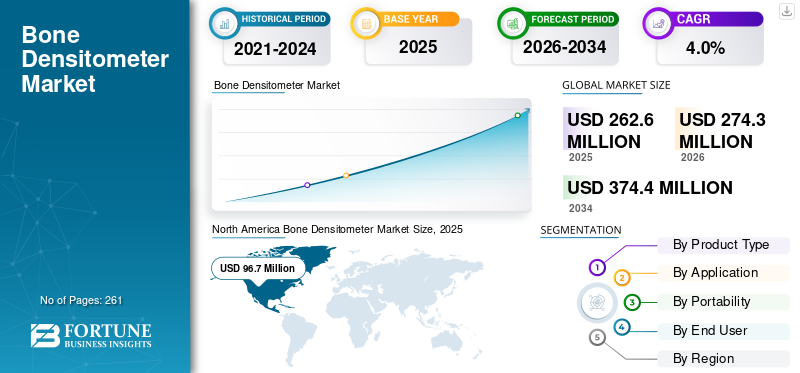
Download Free sample to learn more about this report.
BONE DENSITOMETER MARKET KEY TAKEAWAYS
 Market Size & Forecast
- 2025 Market Size: USD 262.6 Million
- 2026 Market Size: USD 274.3 Million
- 2034 Forecast Market Size: USD 374.4 Million
- CAGR: 4.0% from 2026–2034
 Market Share
- North America dominated the bone densitometer market with a 36.82% share in 2025.
- The central bone densitometers segment held the largest market share in 2025.
- The osteoporosis & osteopenia diagnosis segment dominated the market with an 81.9% share in 2025.
 Key Regional Highlights
North America
North America reached USD 96.7 million in 2025, maintaining its leading market position.
Europe
Europe was valued at USD 87.4 million in 2025 and is projected to grow at a CAGR of 3.2%.
Asia Pacific
Asia Pacific is expected to reach USD 60.8 million in 2026 as the third-largest regional market.
U.S.
The market was valued at approximately USD 88.3 million in 2025, accounting for 32.2% of global revenue.
Japan
The market is projected to reach around USD 14.5 million in 2026, representing 5.3% of global revenue.
Read More

Bone Densitometer Market Trends
Technological Advancements in Densitometer Devices to Fuel Product Demand
There is an increasing focus on the integration of technological advancements in these products, such as advanced software algorithms and others, which improve workflow automation and provide faster scan times. Prominent players are emphasizing on R&D initiatives to develop technologically advanced products with innovative features.
Advanced products integrate automated positioning, seamless integration with hospital systems such as EHRs and AI-enabled fracture risk assessment, enhancing the adoption of bone densitometer products. Furthermore, advancements such as portable designs, expanded analytics, low-dose imaging and other is also supporting the adoption rate of these products in the market.
- In August 2024, OSTEOSYS Corp., a company that manufactures BMD (Bone Mineral Densitometers) and related software solutions, received approval for OsteoSys from the European Union (EU) Medical Device Regulation 2017/745, commonly referred to as EU MDR.
Download Free sample to learn more about this report.
Market Dynamics
Market Drivers
Increasing Prevalence of Osteoporosis and Osteopenia to Drive Market Growth
The surging prevalence of bone disorders such as osteoporosis and other disorders is contributing to the growing demand for advanced bone densitometer devices and software among the patient population, consequently driving the adoption rate of these products in the market.
- For instance, according to 2023 statistics published by the National Center for Biotechnology Information (NCBI), osteopenia affects about 40% of adults, with prevalence varying among populations globally.
The primary factors contributing to the growing prevalence are the increasing geriatric population, post-menopausal risk, and the long term use of corticosteroids and other medications, among others. The increasing awareness campaigns regarding osteoporosis and bone health and growing emphasis on preventive healthcare and fracture risk screening in aging population further supports their demand in the market. Therefore, these factors and the increasing focus of prominent companies on the development and introduction of novel devices are anticipated to fuel the product adoption rate, thereby contributing to the global market expansion.
Market Restraints
High Cost Associated with these Systems to Limit the Market Growth
There is an increasing demand for technologically advanced central bone densitometers globally. However, the high cost is expected to limit the adoption rate of these devices, especially in developing nations, including India, Brazil, and others.
Moreover, the significant upfront expenditure combined with ongoing maintenance, training and calibration costs makes it challenging for smaller clinical facilities especially in low- and middle-income regions to adopt these advanced devices. Additionally, investments in the digitalization of these systems, workflow integration, and periodic software upgrades further adds to the overall financial burden.
- For instance, according to 2025 data published by the LabX Media Group, it was reported that the cost of new systems generally range from USD 25,000 to USD 100,000.
Market Opportunities
Expansion of Private Diagnostic Chains in Emerging Nations to Create Market Opportunity
There is a rapid expansion of multi-site imaging centers and private diagnostic service providers in emerging markets such as India, Mexico, and others. The prominent companies are focusing on investments in upgraded diagnostic capabilities and broader service portfolio, subsequently increasing the procurement of advanced imaging and screening systems and expanding access to specialized diagnostic tests such as bone mineral density assessments outside clinical settings. Moreover, improving reimbursement policies, increasing healthcare spending, and strategic initiatives among governmental organizations to promote the early detection of disorders are expected to contribute to the adoption rate of these devices in the market.
- According to 2025 statistics published by the International Trade Administration (ITA), the healthcare expenditure of Brazil is USD 135.0 billion.
Market Challenges
Reimbursement Variability for these Procedures to Hamper the Market Growth
There is a growing demand for diagnostic procedures for the assessment of bone mineral density globally. The variability in reimbursement policies for these procedures presents a major challenge limiting the adoption rate of advanced bone densitometer technologies. The diagnostic procedures, such as bone mineral density testing, is partially reimbursed at relatively low rates, which limits the return on investment for providers in emerging countries. This hinders the adoption of advanced devices among the hospital and diagnostic laboratories, thereby hampering the market growth.
Furthermore, the limited development of healthcare infrastructure, limited expertise among professionals, particularly in emerging countries, are some of the major factors resulting in limited access to healthcare settings among the patient population.
- For instance, according to 2020 data published by the Patients Rising, the medicare reimbursement for osteoporosis screening in physician offices has decreased by 70% over a decade, from USD 140 in 2007 to USD 42 in 2018.
The underdiagnosis of osteoporosis due to low screening rates in certain regions is another significant challenge affecting industry expansion.
SEGMENTATION ANALYSIS
By Product Type
Increasing Installations to Drive Central Bone Densitometers Segment’s Dominance
Based on product type, the market is classified into central bone densitometers and peripheral bone densitometers. Central bone densitometers is further divided into dual emerging X-ray absorptiometry and quantitative computed tomography (QCT). Additionally, peripheral bone densitometers are further subdivided into quantitative ultrasound, radiographic absorptiometry, and others.
To know how our report can help streamline your business, Speak to Analyst
The central bone densitometers segment held the largest revenue share in 2025. The growth is due to the increasing prevalence of osteoporosis and other conditions among patients, resulting in a growing demand for advanced diagnostic systems for the detection of bone mineral density globally. This, along with the rising focus of healthcare settings such as hospitals toward the installation of innovative dual energy X-ray absorptiometry and other advanced products, is further anticipated to support the global bone densitometer market growth.
- In February 2025, Texas County Memorial Hospital’s radiology department installed a new Hologic Horizon DXA bone densitometer which offers the latest technology in bone densitometry.
The peripheral bone densitometers segment is expected to grow at a CAGR of 4.6% over the forecast period.
By Application
Rising Disease Prevalence Led to the Dominance of the Osteoporosis & Osteoponia Diagnosis Segment
Based on application, the market is segmented into osteoporosis & osteoponia diagnosis, cystic fibrosis diagnosis, body composition analysis, and others.
The osteoporosis & osteoponia diagnosis segment dominated the global market in 2025 with a share of 81.9%. The segment growth is due to the increasing prevalence of osteoporosis, resulting in an escalating demand for diagnostic procedures, thereby supporting the adoption rate of advanced devices among the patient population in the market.
- For instance, according to the 2025 data published by John Hopkins Rheumatology, about 30% of Caucasian postmenopausal women in the U.S. have osteoporosis and 54% have osteopenia.
The body composition analysis segment is set to flourish at a growth rate of 4.9% during the forecast period.
By Portability
Increasing Product Installations for Fixed Devices Led to the Segmental Dominance
Based on portability, the market is segmented into fixed and portable.
The fixed segment dominated the market in 2025. One of the major factors comprise the growing benefits of fixed devices such as accurate diagnosis and others resulting in the increasing installations for these devices, thereby favoring the growth of the segment. Furthermore, the segment is set to hold a share of 83.8% in 2026.
- For instance, in February 2024, FUJIFILM Corporation, a player in diagnostic imaging solutions, announced the installation of its powerful DEXA (Dual-Energy X-ray Absorptiometry) machine “FDX Visionary-DR” at the grand inauguration of the Center for Sports Injury in Delhi, India.
The portable segment is set to flourish at a growth rate of 4.7% during the forecast period.
By End-user
Increasing Number of Hospitals Led to the Segmental Dominance
On the basis of end user, the market is categorized into specialty clinics, hospitals, diagnostic imaging centers, and others.
The hospitals segment captured a dominant share in the market in 2025. The growing prevalence of chronic conditions, rising patient admissions in hospitals, and increasing number of hospitals, among others are some of factors supporting the growth of the segment. Furthermore, the segment is set to hold a 56.2% share in 2026.
- For instance, according to a 2025 statistics published by the American Hospital Association (AHA), there are about 6,093 hospitals in the U.S.
In addition, the specialty clinics segment is anticipated to surge at a CAGR of 4.6% during the forecast period.
Bone Densitometer Market Regional Outlook
Based on region, the market has been studied across North America, Europe, Asia Pacific, Latin America, and the Middle East & Africa.
North America
North America Bone Densitometer Market Size, 2025 (USD Million)
To get more information on the regional analysis of this market, Download Free sample
The North America market held the dominant share in 2024, valued at USD 92.7 million, and also took the leading share in 2025 with USD 96.7 million. The increasing awareness of osteoporosis screening, strong reimbursement frameworks supporting widespread product adoption, and large installed base driving replacement demand and software upgrades are key factors supporting the regional market growth.
- For instance, according to 2024 data published by the American Medical Association, it was reported that about 10 million people had osteoporosis in the U.S.
U.S. Bone Densitometer Market
Based on North America’s strong contribution and the U.S. dominance within the region, the U.S. market can be analytically approximated at around USD 88.3 million in 2025, accounting for roughly 32.2% of global sales.
Europe
Europe is projected to record a growth rate of 3.2% over the forecast period, which is the second highest among all regions, and reached a valuation of USD 87.4 million by 2025. The increasing aging population and public health screening initiatives in the region sustain steady demand. Cost containment policies influence purchasing decisions in public healthcare systems.
U.K. Bone Densitometer Market
In 2026, the U.K. market is estimated at around USD 13.9 million, representing roughly 5.1% of global revenues.
Germany Bone Densitometer Market
The Germany’s market is projected to reach approximately USD 18.2 million in 2026, equivalent to around 6.6% of global sales.
Asia Pacific
The Asia Pacific market is estimated to reach USD 60.8 million in 2026 and secure the position of the third-largest region in the market. The rapidly aging populations in China, Japan, and South Korea and growing private diagnostic networks improve access to densitometry services expand the screening base. In the region, India and China are estimated to reach USD 9.0 million and USD 19.2 million respectively in 2026.
Japan Bone Densitometer Market
In 2026, the Japan market is estimated to reach around USD 14.5 million, accounting for roughly 5.3% of global revenues. Japan has historically reported a relatively high burden of osteoporosis, with strong governmental commitment to screening, healthcare access.
China Bone Densitometer Market
China’s market is projected to be one of the largest worldwide, with 2026 revenues estimated at around USD 19.2 million, representing roughly 7.0% of global sales.
India Bone Densitometer Market
In 2026, the India market size is estimated at around USD 9.0 million, accounting for roughly 3.3% of global revenues.
Latin America and Middle East & Africa
The Latin America and Middle East & Africa regions are expected to witness moderate growth in this market during the forecast period. The Latin America market is set to reach a valuation of USD 14.8 million in 2025. The growth is due to emerging demand linked to rising awareness and the gradual expansion of diagnostic infrastructure in these regions. In the Middle East & Africa, the GCC is set to reach a value of USD 4.5 million in 2026.
South Africa Bone Densitometer Market
The South Africa market is projected to reach around USD 2.1 million in 2026, representing roughly 0.8% of global revenues.
Competitive Landscape
Key Industry Players
Increasing Partnerships among Prominent Players to Support their Dominance
A significant product portfolio, along with a strong geographical presence globally, is one of the prominent factors supporting the dominance of these players in the market. GE Healthcare and OsteoSys Corp. emerged as major companies in the market in 2025. Additionally, prominent companies are placing a growing focus on acquisitions and mergers with other players to strengthen their presence.
- For instance, in November 2022, OsteoSys Corp. collaborated with MEDIMAPS GROUP with an aim to increase the availability of Trabecular Bone Score (TBS iNsight), a novel method for enhancing osteoporotic fracture risk assessment. The solution is an AI-powered surrogate of bone microarchitecture on the company’s diagnostic platforms.
Other key players, including Hologic, Inc., and others, are also growing in the market, primarily due to their increasing focus on R&D initiatives to strengthen their presence in the market.
List of Key Bone Densitometer Companies Profiled
- GE Healthcare (U.S.)
- Hologic, Inc. (U.S.)
- OsteoSys Corp. (South Korea)
- Swissray (Switzerland)
- BeamMed Inc. (Israel)
- FUJIFILM Corporation (Japan)
- Ecolight S.p.A (Italy)
- DMS Group (France)
- Hitachi High-Tech Corporation (Japan)
- FURUNO ELECTRIC CO.,LTD. (Japan)
KEY INDUSTRY DEVELOPMENTS
- October 2025 – Echolight, a global player in bone densitometry, attended an exhibition at the Radiological Society of North America (RSNA) 2025 Congress to demonstrate bone density scanning capabilities. This helped the company to increase its brand presence.
- September 2025 – Naitive Technologies, a medical technology company developing AI-driven software to reimagine orthopedic care, received 510(k) clearance from the U.S. Food and Drug Administration (FDA) for its flagship product, OsteoSight.
- June 2025 – Naitive Technologies published results showcasing the diagnostic performance of OsteoSight, its AI-powered tool, for identifying people at risk of low BMD (bone mineral density). The results, published in Osteoporosis International, validate OsteoSight’s utility in the detection of low BMD making use of routine X-rays that have been taken for other purposes. This helped the company to increase its brand presence.
- June 2025 – AI-driven bone microarchitecture imaging solutions provider Medimaps Group S.A. is further expanding its presence in the U.S. with the launch of its FDA-cleared next-generation TBS Osteo Advanced software to strengthen its product offerings.
- May 2025 – SimonMed launched a dual-energy x-ray absorptiometry (DEXA) scan that combines bone density and bone quality analysis for the early detection of osteoporosis.
REPORT COVERAGE
The market report provides a detailed global bone densitometer market analysis and focuses on key aspects such as leading companies, product type, application, portability, and end user. Besides this, the global report offers insights into the market growth trends and highlights key industry developments. In addition to the aforementioned factors, the report encompasses several factors that have contributed to the growth and advancement of the market over recent years.
Request for Customization to gain extensive market insights.
Report Scope & Segmentation
|
ATTRIBUTE |
DETAILS |
|
Study Period |
2021-2034 |
|
Base Year |
2025 |
|
Estimated Year |
2026 |
|
Forecast Period |
2026-2034 |
|
Historical Period |
2021-2024 |
|
Growth Rate |
CAGR of 4.0% from 2026-2034 |
|
Unit |
Value (USD Million) |
|
Segmentation |
By Product Type, Application, Portability, End User, and Region |
|
By Product Type |
· Central Bone Densitometers o Dual Energy X ray Absorptiometry o Quantitative Computed Tomography (QCT) · Peripheral Bone Densitometers o Quantitative Ultrasound o Radiographic Absorptiometry o Others |
|
By Application |
· Osteoporosis & Osteoponia Diagnosis · Cystic Fibrosis Diagnosis · Body Composition Analysis · Others |
|
By Portability |
· Fixed · Portable |
|
By End User |
· Hospitals · Specialty Clinics · Diagnostic Imaging Centers · Others |
|
By Region |
· North America (By Product Type, By Application, By Portability, By End User, and by Country) o U.S. (By Portability) o Canada (By Portability) · Europe (By Product Type, By Application, By Portability, By End User, and by Country/Sub-region) o U.K. (By Portability) o Germany (By Portability) o France (By Portability) o Italy (By Portability) o Spain (By Portability) o Scandinavia (By Portability) o Rest of Europe (By Portability) · Asia Pacific (By Product Type, By Application, By Portability, By End User, and by Country/Sub-region) o China (By Portability) o Japan (By Portability) o India (By Portability) o Australia (By Portability) o Southeast Asia (By Portability) o Rest of Asia Pacific (By Portability) · Latin America (By Product Type, By Application, By Portability, By End User, and by Country/Sub-region) o Brazil (By Portability) o Mexico (By Portability) o Rest of Latin America (By Portability) · Middle East & Africa (By Product Type, By Application, By Portability, By End User, and by Country/Sub-region) o GCC (By Portability) o South Africa (By Portability) o Rest of the Middle East & Africa (By Portability) |
Frequently Asked Questions
Fortune Business Insights says that the global market size was USD 262.6 million in 2025 and is projected to reach USD 374.4 million by 2034.
In 2025, the North America regional market value stood at USD 96.7 million.
The market will exhibit steady growth at a CAGR of 4.0% over the forecast period (2026-2034).
By product type, the central bone densitometers segment was the leading segment in this market in 2025.
The introduction of novel bone densitometry products is one of the major factors driving the market growth.
GE Healthcare, Osteosys Corp., and Hologic, Inc., are the major players in the global market.
North America dominated the market share in 2025.
The growing prevalence of osteoporosis and osteopenia disorders and the increasing number of product launches are some of the vital factors expected to boost the adoption of these products worldwide.



- 2021-2034
- 2025
- 2021-2024
- 261
Get 30-60 hrs Free Customization
Expand Regional and Country Coverage, Segments Analysis, Company Profiles, Competitive Benchmarking, and End-user Insights.













.webp)






Related Reports
-
US +1 833 909 2966 ( Toll Free )
-
Get In Touch With Us