Bottle Cap Market Size, Share & Industry Analysis, By Material (Plastic, Metal, and Others), By Type (Screw Caps, Flip-top Caps, Crown Caps, Push-pull Caps, Dispensing Caps, and Others), By Application (Beverages, Food, Pharmaceuticals, Personal Care & Cosmetics, Household, and Others), and Regional Forecast, 2026-2034
 Download Free Sample
(Offer valid till 31st Oct 2026)

Bottle Cap Market Size and Future Outlook
 Listen to Audio Version
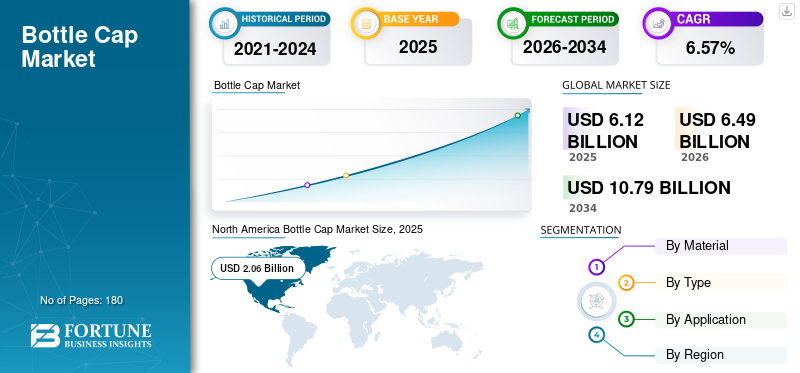
The global bottle cap market size was valued at USD 6.12 billion in 2025. The market is projected to grow from USD 6.49 billion in 2026 to USD 10.79 billion by 2034, exhibiting a CAGR of 6.57% during the forecast period. North America dominated the bottle cap market with a market share of 33.66% in 2025.
The global bottle cap industry encompasses the production, distribution, and sale of closures used to seal bottles across sectors such as beverages, pharmaceuticals, personal care, and chemicals. The increasing consumption of bottled beverages and packaged products, coupled with a rising demand for convenience and product safety, is propelling the market forward. Additionally, the expansion of pharmaceutical packaging and advancements in tamper-evident and sustainable closures are further contributing to the global market growth.
Many key players in the market, such as AptarGroup Inc., Amcor plc, and Silgan Holdings Inc., are focusing on developing innovative products and conducting R&D.
Download Free sample to learn more about this report.
Bottle Cap Market Key Takeaways
 Global Market Size & Forecast
- 2025 Market Size: USD 6.12 billion
- 2026 Market Size: USD 6.49 billion
- 2034 Forecast Market Size: USD 10.79 billion
- CAGR: 6.57% from 2026–2034
 Market Share
- North America dominated the bottle cap market with a 33.66% share in 2025.
- The metal segment is projected to grow at a 6.37% CAGR during the forecast period.
- The flip-top caps segment is projected to grow at a 6.64% CAGR during the forecast period.
 Key Regional Highlights
North America
North America remained the leading regional market, reaching USD 2.06 billion in 2025.
Asia Pacific
Asia Pacific ranked as the second-largest regional market with a value of USD 1.60 billion in 2025.
Europe
Europe reached USD 1.23 billion in 2025 and is projected to grow at a 6.29% CAGR over the forecast period.
U.S.
The market was valued at USD 1.63 billion in 2025, accounting for approximately 26.66% of global sales.
Japan
The market was valued at USD 0.30 billion in 2025, representing approximately 4.93% of global revenues.
Read More

BOTTLE CAP MARKET TRENDS
Shift Toward Sustainable and Lightweight Closures is a Prominent Trend Observed in Market
A significant trend in the global market is the growing shift toward sustainable, lightweight closure options. Manufacturers are focusing on minimizing material consumption through downgauging, while maintaining performance criteria such as sealing integrity and durability. Additionally, brands are allocating resources to developing bio-based and recycled-content caps to meet circular-economy objectives. This trend is further bolstered by consumer preferences for environmentally friendly packaging and regulatory pressures to reduce plastic waste, which, in turn, drive innovation in cap design and material engineering.
MARKET DYNAMICS
MARKET DRIVERS
Download Free sample to learn more about this report.
Growth in Packaged Beverage Consumption is Driving Market Growth
The main factor driving the global bottle cap market growth is the increasing consumption of packaged beverages, which includes bottled water, carbonated soft drinks, juices, and alcoholic drinks. Urbanization, shifts in lifestyle, and rising disposable incomes have driven greater demand for convenient, portable packaging solutions. Bottle caps are essential for maintaining product quality, preventing leaks, and providing tamper evidence, making them vital in beverage packaging. Furthermore, the growth of beverage production in developing countries, along with the rise of ready-to-drink products, continues to drive demand for innovative, high-performance closures across both plastic and metal categories.
MARKET RESTRAINTS
Volatility in Raw Material Prices Hinders Market Growth
One of the primary constraints influencing the global market is the fluctuation in raw material prices, especially for plastics such as polypropylene and polyethylene, in addition to metals such as aluminum and steel. Such fluctuations affect manufacturers' profit margins and pricing strategies, particularly in fiercely competitive markets where it is difficult to transfer costs to end users. Smaller companies are especially at risk, as they may not have the financial capacity to withstand price shocks, which, in turn, affect overall market stability and long-term investment strategies. Henceforth, the volatility in raw material prices impedes market growth.
MARKET OPPORTUNITIES
Expansion in Pharmaceutical Packaging Offers Potential Growth Opportunities
A major opportunity exists: global spending, an aging demographic, and the increasing demand for both over-the-counter and prescription drugs are fueling the need for secure, compliant packaging solutions. This situation presents manufacturers with an opportunity to create high-value, specialized closures that meet strict regulatory requirements. Additionally, the expansion of liquid medications, nutraceuticals, and wellness products is anticipated to further boost the demand for innovative and safety-oriented cap designs.
MARKET CHALLENGES
Stringent Environmental Regulations Pose a Critical Challenge to Market Growth
A significant challenge facing the global market is the growing stringency of environmental regulations aimed at reducing plastic waste and improving recyclability. Regulatory authorities and governments globally are enacting policies such as extended producer responsibility (EPR), bans on single-use plastics, and obligatory recycling targets. Moreover, the shift toward sustainable materials, while maintaining performance and avoiding cost increases, presents a complex issue. Manufacturers are required to navigate the balance between complying with regulations and ensuring economic feasibility, a challenge that poses a crucial challenge for both established companies and new market entrants.
Segmentation Analysis
By Material
Cost Efficiency, Versatility, and Scalability to Drive Dominance of Plastic Segment
Based on the material, the market is divided into plastic, metal, and others.
The plastic segment is expected to account for the largest bottle cap market share in the coming years, attributed to its exceptional cost-effectiveness, design adaptability, and capability for large-scale production. Its lightweight characteristics reduce transportation costs, while its excellent moldability enables manufacturers to easily create intricate designs, such as tamper-evident and dispensing caps. Moreover, plastic caps provide robust sealing capabilities, resistance to chemicals, and compatibility with a diverse array of products in the beverage, pharmaceutical, and personal care sectors. These collective benefits make plastic the material of choice for manufacturers seeking high performance, cost efficiency, and operational effectiveness.
The metal segment is expected to grow at a CAGR of 6.37% over the forecast period.
By Type
Convenience, Secure Sealing, and Compatibility Fueled Dominance of Screw Caps Segment
Based on type, the market is segmented into screw caps, flip-top caps, crown caps, push-pull caps, dispensing caps, and others.
In 2025, the screw caps segment dominated the global market, owing to its user-friendly nature, dependable sealing capabilities, and extensive compatibility across various industries. Their design facilitates the effortless opening and closing of bottles for consumers, thereby enhancing convenience. Moreover, screw caps are suitable for automated high-speed filling lines, which boosts manufacturing efficiency. The inclusion of tamper-evident features and customization options further enhances their attractiveness, establishing them as the most commonly used closure type globally.
The flip-top caps segment is projected to grow at a CAGR of 6.64% over the forecast period.
By Application
To know how our report can help streamline your business, Speak to Analyst
High Consumption Volumes, Frequent Usage, and Packaging Dependence Drive the Dominance of the Beverages Segment
Based on the application, the market is segmented into beverages, food, pharmaceuticals, personal care & cosmetics, household, and others.
The beverages segment is expected to hold a dominant market share over the forecast period. It is driven by substantial, ongoing consumption of bottled drinks, including water, carbonated soft drinks, juices, dairy beverages, and alcoholic products. In contrast to other industries, beverages are consumed daily in significant quantities, which greatly enhances packaging turnover. Furthermore, the rapid rise of ready-to-drink and on-the-go beverage formats increases demand for effective, reliable closure solutions. The growth of beverage production in emerging markets also strengthens this segment's dominant position.
The food segment is projected to grow at a CAGR of 5.37% over the forecast period.
Bottle Cap Market Regional Outlook
By geography, the market is categorized into Europe, North America, Asia Pacific, Latin America, and the Middle East & Africa.
North America
North America Bottle Cap Market Size, 2025 (USD Billion)
To get more information on the regional analysis of this market, Download Free sample
North America held the dominant share in 2024, valued at USD 1.94 billion, and maintained its leading position in 2025, with a value of USD 2.06 billion. Market growth is propelled by significant consumption of packaged beverages and a robust demand for premium, convenient, and resealable packaging. Technological innovations in closure design, coupled with a growing emphasis on sustainability and the use of recycled materials, are driving manufacturers to adopt high-performance bottle caps.
U.S. Bottle Cap Market
The U.S. market was valued at around USD 1.63 billion in 2025, accounting for roughly 26.66% of global sales. The U.S. market is driven by significant per capita consumption of bottled drinks and a robust presence of prominent packaging manufacturers. Ongoing advancements in intelligent, lightweight, and eco-friendly closures, coupled with automation in advanced manufacturing processes, foster steady demand and contribute to market maturity.
Europe
The European market reached a valuation of USD 1.23 billion in 2025 and is projected to grow at 6.29% over the coming years, ranking third among regions. Strict environmental regulations and circular-economy objectives mainly influence the European market. Moreover, a significant consumer inclination toward eco-friendly packaging, along with a well-established beverage industry, sustains a consistent demand for sustainable and compliant closure solutions.
U.K. Bottle Cap Market
The U.K. market in 2025 was valued at USD 0.23 billion, representing approximately 3.83% of global revenues.
Germany Bottle Cap Market
Germany's market was valued at approximately USD 0.27 billion in 2025, equivalent to around 4.34% of global sales.
Asia Pacific
Asia Pacific was valued at USD 1.60 billion in 2025 and ranked second-largest in the market. The growth is driven by rapid urbanization in countries such as China and India, rising disposable incomes, and increased consumption of packaged beverages. The demand is being propelled by the expanding food and pharmaceutical sectors, especially in nations such as China and India. Additionally, the presence of cost-effective manufacturing and a substantial population base further contributes to market expansion in this region.
Japan Bottle Cap Market
The Japanese market in 2025 was valued at USD 0.30 billion, accounting for roughly 4.93% of global revenues. Cutting-edge manufacturing technologies and a focus on high-quality, precision-engineered closures influence the market. Robust sustainability initiatives, along with demand for compact, functional packaging in beverages and pharmaceuticals, are driving innovation and sustained market growth.
China Bottle Cap Market
China's market was valued at approximately USD 0.51 billion in 2025, accounting for roughly 8.39% of global sales.
India Bottle Cap Market
The Indian market in 2025 was valued at around USD 0.43 billion, accounting for roughly 7.03% of global sales.
Latin America
Latin America is expected to witness moderate growth in this market space during the forecast period. The Latin America market was valued at USD 0.76 billion in 2025. In Latin America, the growth of urban populations and the escalating demand for packaged beverages and personal care products are significant factors driving market expansion. The advancement of the economy and improvements in retail infrastructure are driving the adoption of contemporary packaging formats, which, in turn, is increasing demand for reliable, cost-effective bottle cap solutions.
Middle East & Africa
In the Middle East & Africa, South Africa accounted for USD 0.12 billion in 2025. The Middle East & Africa region is experiencing growth driven by the expansion of the FMCG sector and improvements in manufacturing capabilities. The increasing demand for bottled water in arid areas, coupled with rising investments in packaging infrastructure for the food and beverage sectors, is driving the need for robust, efficient bottle cap solutions.
Saudi Arabia Bottle Cap Market
The Saudi Arabian market was valued at USD 0.16 billion in 2025, accounting for roughly 2.69% of global revenues.
COMPETITIVE LANDSCAPE
Key Industry Players
Top Companies Emphasize Product Introductions and Acquisitions to Strengthen Their Market Positions
The global market has a semi-consolidated structure, with key players including AptarGroup Inc., Amcor plc, and Silgan Holdings Inc. Several strategic initiatives such as alliances among operating entities to advance research, are contributing to these players' dominance.
- For instance, in March 2026, Amcor is supplying Vöslauer Mineralwasser with a tethered variant of its bespoke closure, designed to be functional, user-friendly, and easily recyclable. According to the EU's Single-Use Plastics Directive, tethered caps are required for single-use bottles with a capacity of up to 3 liters. This regulation is expected to reduce littering and increase collection and recycling rates in countries with the necessary infrastructure.
BERICAP, Closure Systems International, and Guala Closures are some other prominent companies in the market. They focus on new product launches, strategic partnerships, and other initiatives to boost their market share.
LIST OF KEY BOTTLE CAP COMPANIES PROFILED
- Amcor plc (Switzerland)
- AptarGroup Inc. (U.S.)
- Silgan Holdings Inc. (U.S.)
- BERICAP (Germany)
- Closure Systems International (U.S.)
- Guala Closures Group (Italy)
- Crown Holdings (U.S.)
- Pelliconi (Italy)
- Pano Cap (Canada)
- United Caps (Luxembourg)
- Alpla Group (Austria)
- Plastipak Holdings (U.S.)
- Retal Industries (Cyprus)
- Nippon Closures Co., Ltd. (Japan)
- Reliable Caps, LLC (U.S.)
KEY INDUSTRY DEVELOPMENTS
- December 2025: AptarGroup finalized the acquisition of the Brazilian firm Sommaplast, which focuses on oral dosing pharmaceutical packaging, including closures, droppers, and dosing cups. This strategic decision bolsters Aptar's presence in Latin America. It broadens its product range in closures and precision packaging for both pharmaceutical and consumer sectors, thereby improving operational synergies and regional manufacturing capabilities.
- September 2025: Amcor unveiled innovative closure designs at Drinktec 2025. During Drinktec 2025, Amcor presented its newest beverage closure innovations, featuring cutting-edge tethered and recyclable closures as well as sports cap designs. This product showcase highlighted Amcor's expanded closure portfolio following its merger with Berry Global, positioning the company as a versatile provider of sustainable packaging and bottle caps that meet evolving regulatory and consumer needs.
- October 2024: A partnership between Paboco and Blue Ocean Closures has led to the development of the first commercially viable paper bottle paired with a fiber-based cap, aimed at minimizing plastic consumption and promoting recyclable options. This advancement signifies a noteworthy sustainable alternative in the realm of caps and closures.
- November 2023: Kraft Heinz unveiled its first completely recyclable ketchup cap. The introduction of the first fully recyclable cap for its well-known squeezy ketchup bottle by Kraft Heinz Company exemplifies a collaborative success that leverages Berry Global's innovative design and manufacturing expertise, aiding retail brands in their transition to more sustainable packaging options.
- July 2022: Guala Closures, a prominent global manufacturer of closures for spirits, wines, beverages, and oil bottles, announced that it has finalized an agreement to acquire Labrenta. This acquisition is set to enhance Guala Closures' position in the luxury market. The purchase of Labrenta is expected to create significant synergies across both the industrial and commercial sectors by providing a comprehensive product range for the rapidly expanding luxury sector.
REPORT COVERAGE
The market analysis includes a comprehensive study of market size & forecast across all market segments included in the report. It includes details on the market dynamics and market trends expected to drive the market over the forecast period. It provides information on key aspects, including technological advancements, pipeline candidates, the regulatory environment, and product launches. Additionally, it details partnerships, mergers & acquisitions, and key industry developments, along with their prevalence by region. The global market research report also provides a detailed competitive landscape, including market share and profiles of key operating players.
Request for Customization to gain extensive market insights.
Report Scope & Segmentation
| ATTRIBUTE | DETAILS |
| Study Period | 2021-2034 |
| Base Year | 2025 |
| Estimated Year | 2026 |
| Forecast Period | 2026-2034 |
| Historical Period | 2021-2024 |
| Growth Rate | CAGR of 6.57% from 2026-2034 |
| Unit | Value (USD Billion) |
| Segmentation | By Material, Type, Application, and Region |
| By Material |
|
| By Type |
|
| By Application |
|
| By Region |
|
Frequently Asked Questions
According to Fortune Business Insights, the global market value stood at USD 6.12 billion in 2025 and is projected to reach USD 10.79 billion by 2034.
In 2025, the market value in North America stood at USD 2.06 billion.
The market is expected to grow at a CAGR of 6.57% over the forecast period of 2026-2034.
By material, the plastic segment is expected to lead the market.
Growth in packaged beverage consumption is driving market growth.
AptarGroup Inc., Amcor plc, and Silgan Holdings Inc. are the major players in the global market.
North America dominated the market in 2025.



- 2021-2034
- 2025
- 2021-2024
- 180
-
(Offer valid till 31st Oct 2026)
Get 30-60 hrs Free Customization
Expand Regional and Country Coverage, Segments Analysis, Company Profiles, Competitive Benchmarking, and End-user Insights.







Related Reports
-
US +1 833 909 2966 ( Toll Free )
-
Get In Touch With Us