Boxboard Packaging Market Size, Share, and Industry Analysis By Material (Virgin and Recycled), By Product Type (Boxes & Cartons, Inserts & Dividers, Trays, and Others), By End-use Industry (Food & Beverage, Pharmaceuticals, Cosmetics & Personal Care, Electronics, Automotive, Chemicals, and Others), and Regional Forecast, 2026-2034
 Download Free Sample
Boxboard Packaging Market Size & Industry Overview
The global boxboard packaging market size was valued at USD 74.0 billion in 2025 and is projected to grow from USD 78.94 billion in 2026 to USD 132.38 billion by 2034, exhibiting a CAGR of 6.68% during the forecast period. The market in Asia Pacific dominated with a revenue share of 34% in 2025.

The boxboard packaging market plays a critical role in the global packaging ecosystem, offering lightweight, durable, and customizable solutions for a wide range of industries. Boxboard packaging is widely used due to its printability, structural versatility, and compatibility with automated packaging lines. boxboard packaging market Analysis highlights increasing demand from food, pharmaceutical, and consumer goods industries that require protective yet visually appealing packaging. Sustainability considerations significantly influence market adoption, as boxboard materials are recyclable and biodegradable. The Boxboard Packaging Industry Report emphasizes growing preference for paper-based packaging over plastic alternatives. Advances in coating, barrier technologies, and folding carton design continue to enhance functionality. The boxboard packaging market Outlook remains stable, supported by regulatory pressure for eco-friendly packaging and the expansion of organized retail and e-commerce supply chains.
The United States boxboard packaging market is characterized by strong industrial demand, advanced manufacturing capabilities, and a mature retail infrastructure. boxboard packaging market Research Report insights indicate consistent usage across food & beverage, pharmaceuticals, and consumer electronics sectors. Sustainability regulations and corporate environmental commitments drive increased adoption of recyclable boxboard materials. The U.S. market favors high-quality printing and branding capabilities to enhance shelf appeal. Automation and digital printing technologies improve production efficiency and customization. Demand for lightweight yet durable packaging supports growth in folding cartons and trays. Domestic manufacturers focus on supply chain resilience and material optimization. The U.S. boxboard packaging market Outlook is supported by stable consumption patterns and ongoing innovation in paper-based packaging solutions.
Boxboard Packaging Market Key Takeaways
 Global Market Size & Forecast
- 2025 Market Size: USD 74.0 billion
- 2026 Market Size: USD 78.94 billion
- 2034 Forecast Market Size: USD 132.38 billion
- CAGR: 6.68% from 2026-2034
 Market Share
- Asia-Pacific dominated with a revenue share of 34% in 2025.
- Virgin boxboard accounted for approximately 58% market share.
- Boxes and cartons held approximately 46% market share.
 Key Regional Highlights
Asia Pacific
Asia-Pacific led with a 34% share, supported by expanding packaging demand across key industries.
North America
North America held 28% of the market, driven by demand for versatile and sustainable packaging solutions.
Europe
Europe accounted for 26% share, supported by established packaging industries and growing sustainability initiatives.
United Kingdom
Accounted for 7% of Europe’s market, supported by steady demand for boxboard packaging across consumer sectors.
Japan
Represented 6% of Asia-Pacific’s market, driven by established packaging applications and evolving consumer goods demand.
Read More

boxboard packaging market Latest Trends
boxboard packaging market Trends are strongly shaped by sustainability initiatives, branding requirements, and evolving consumer preferences. One of the most prominent trends is the shift toward recyclable and renewable packaging materials as industries reduce plastic usage. boxboard packaging market Analysis highlights increasing adoption of recycled boxboard to meet sustainability goals without compromising structural performance. High-quality digital printing enables improved branding, product differentiation, and customization.
Download Free sample to learn more about this report.
Another key trend is the growing use of barrier-coated boxboard to enhance moisture, grease, and oxygen resistance, particularly in food and pharmaceutical applications. Lightweighting trends focus on reducing material usage while maintaining strength. E-commerce growth drives demand for protective yet lightweight boxboard packaging formats. Automation-compatible designs improve packaging efficiency across manufacturing lines. Smart packaging features such as QR codes support traceability and consumer engagement. These trends collectively reinforce boxboard packaging market Growth and innovation across end-use industries.
boxboard packaging market Dynamics
DRIVER
Rising demand for sustainable and eco-friendly packaging solutions
The primary driver of boxboard packaging market Growth is the increasing demand for sustainable and eco-friendly packaging solutions. Regulatory pressure and corporate sustainability commitments encourage the replacement of plastic packaging with paper-based alternatives. boxboard packaging market Analysis shows that boxboard materials offer recyclability, biodegradability, and reduced environmental impact. Food and beverage companies prioritize boxboard packaging to align with sustainability branding. Pharmaceutical packaging relies on boxboard for compliance and safety labeling. Consumer preference for environmentally responsible packaging influences purchasing behavior. Advances in recycled fiber quality improve performance reliability. These factors collectively accelerate adoption across the Boxboard Packaging Industry.
RESTRAINT
Performance limitations compared to plastic packaging
Performance limitations compared to plastic packaging act as a restraint in the boxboard packaging market. boxboard packaging market Analysis highlights challenges related to moisture resistance, durability in extreme conditions, and barrier performance. Certain applications require additional coatings, increasing production complexity. Cost-sensitive markets may prefer alternative materials. Shelf-life requirements restrict usage in some food categories. Transportation conditions affect structural integrity. Manufacturers must invest in innovation to overcome these limitations, impacting margins. These factors moderately constrain expansion across specific end-use segments.
OPPORTUNITY
Growth in premium and customized packaging
The growth of premium and customized packaging presents a significant boxboard packaging market Opportunity. boxboard packaging market Forecast insights indicate rising demand for visually appealing packaging that enhances brand identity. Luxury goods, cosmetics, and specialty foods increasingly use customized boxboard designs. Advanced printing and finishing technologies enable differentiation. Small-batch production supports niche markets. E-commerce packaging personalization enhances consumer experience. These trends create new revenue opportunities for manufacturers and converters in the boxboard packaging market.
CHALLENGE
Volatility in raw material prices
Raw material price volatility poses a major challenge in the boxboard packaging market. boxboard packaging market Analysis highlights fluctuations in pulp and recycled paper prices driven by supply-demand imbalances. Energy and transportation costs further impact production economics. Supply chain disruptions affect material availability. Manufacturers must balance cost control with quality maintenance. Pricing instability complicates long-term contracts. These challenges require strategic sourcing and operational efficiency to maintain competitiveness.
boxboard packaging market Segmentation
Market share analysis indicates that the boxboard packaging market is segmented by material type, product type, and end-use industry to address diverse application requirements. By material, the market includes virgin and recycled boxboard, each offering distinct performance and sustainability benefits. By product type, boxboard packaging is used in boxes & cartons, inserts & dividers, trays, and other formats. By end-use industry, demand is driven by food & beverage, pharmaceuticals, cosmetics & personal care, electronics, automotive, chemicals, and other sectors. This segmentation structure supports targeted innovation and strategic planning in the boxboard packaging market Research Report.
By Material
Virgin boxboard accounts for approximately 58% of the boxboard packaging market share, making it the dominant material segment globally. boxboard packaging market Analysis highlights its superior strength, fiber consistency, and excellent surface smoothness as key advantages. Virgin boxboard delivers high rigidity, enabling reliable performance in automated packaging lines. Premium print quality supports strong branding and shelf appeal. Food & beverage manufacturers prefer virgin boxboard for primary and secondary packaging. Pharmaceutical companies rely on it for regulatory compliance and structural integrity. Cosmetics brands benefit from its premium look and finishing compatibility. Virgin fibers ensure uniform thickness and durability. Moisture resistance performance is higher compared to recycled grades. High-end packaging applications drive sustained demand. This segment remains critical to boxboard packaging market Size and premium positioning.
Recycled boxboard holds approximately 42% of the boxboard packaging market share, supported by sustainability initiatives and cost efficiency. Boxboard Packaging Industry Analysis highlights growing acceptance across secondary and tertiary packaging applications. Improved recycling technologies enhance fiber strength and consistency. Corporate sustainability commitments accelerate adoption across industries. Recycled boxboard supports circular economy objectives and waste reduction goals. Retail-ready packaging frequently uses recycled materials. Print quality improvements expand branding potential. Lightweight designs improve transportation efficiency. Cost advantages appeal to mass-market brands. Regulatory support strengthens market penetration. Food, electronics, and consumer goods sectors increasingly adopt recycled boxboard. This segment continues to expand as sustainability becomes a core boxboard packaging market Trend.
To know how our report can help streamline your business, Speak to Analyst
By Product Type
Boxes and cartons dominate the boxboard packaging market with approximately 46% market share. boxboard packaging market Analysis highlights their versatility across food, pharmaceutical, and consumer goods packaging. Folding cartons offer efficient storage and transportation. Custom die-cut designs enhance product protection. High printability supports branding and regulatory labeling. Retail shelf compatibility drives widespread adoption. Lightweight construction reduces logistics costs. Automated filling compatibility improves operational efficiency. E-commerce growth increases carton demand. Recyclability supports sustainability goals. Structural adaptability supports multiple product sizes. Boxes and cartons remain the backbone of the Boxboard Packaging Industry.
Inserts and dividers account for approximately 18% of the boxboard packaging market share, supporting product protection and organization. boxboard packaging market Analysis highlights strong demand in electronics, pharmaceuticals, and glass packaging. These components prevent product movement during transit. Structural customization improves damage prevention. Lightweight materials reduce overall packaging weight. Compatibility with cartons enhances packaging efficiency. Sustainability benefits support adoption over plastic alternatives. Precision die-cutting improves fit and performance. Cost-effective protection drives usage. Industrial and export packaging relies heavily on dividers. Growth in multi-product packaging supports demand. Inserts and dividers add functional value within the boxboard packaging market.
Trays represent approximately 22% of the boxboard packaging market share, driven primarily by food and beverage applications. boxboard packaging market Analysis highlights strong usage in bakery, ready-to-eat meals, and produce packaging. Trays provide structural support and display functionality. Stackability improves logistics efficiency. Coated boxboard enhances moisture resistance. Lightweight designs reduce material consumption. Retail visibility supports impulse purchases. Automation compatibility improves production speed. Sustainable alternatives to plastic trays gain traction. Food safety compliance supports adoption. Trays remain a high-volume product category within the Boxboard Packaging Industry.
Other boxboard product formats collectively account for approximately 14% of the boxboard packaging market share. This segment includes sleeves, wraps, carriers, and specialty designs. boxboard packaging market Insights highlight rising demand for customized and promotional packaging. Brand differentiation drives creative structural designs. Seasonal and limited-edition packaging supports this category. Lightweight construction enhances convenience. Specialty formats support e-commerce packaging innovation. Sustainable materials strengthen adoption. Printing flexibility enhances marketing impact. Low production volumes enable customization. Luxury and niche products rely on specialty formats. This segment supports innovation diversity within the boxboard packaging market.
By End-use Industry
Food & beverage is the largest end-use segment, holding approximately 34% of the boxboard packaging market share. boxboard packaging market Analysis highlights demand driven by food safety, branding, and sustainability. Folding cartons and trays dominate usage. Barrier-coated boxboard supports moisture and grease resistance. Regulatory labeling requirements increase packaging demand. Shelf appeal influences purchasing decisions. Ready-to-eat food growth accelerates adoption. Lightweight packaging reduces transportation impact. Recyclability aligns with consumer expectations. High consumption volumes ensure stable demand. Food & beverage remains the cornerstone of boxboard packaging market Growth.
Pharmaceuticals account for approximately 19% of the boxboard packaging market share, driven by compliance and safety requirements. boxboard packaging market Analysis highlights extensive use in secondary packaging. Clear labeling and tamper-evident features are critical. Structural integrity protects sensitive products. Regulatory standards influence material selection. High-quality printing supports dosage and safety information. Automation compatibility improves packaging efficiency. Global pharmaceutical supply chains drive consistent demand. Sustainability goals encourage paper-based packaging. Product traceability enhances value. Pharmaceuticals remain a high-value segment within the Boxboard Packaging Industry.
Cosmetics and personal care represent approximately 14% of the boxboard packaging market share, driven by premium branding needs. boxboard packaging market Analysis highlights strong demand for visually appealing packaging. High-quality finishes enhance shelf presence. Custom shapes support brand identity. Lightweight structures improve logistics efficiency. Sustainability positioning supports consumer trust. Short product lifecycles drive frequent redesigns. Luxury segments favor virgin boxboard. E-commerce beauty sales increase carton demand. Protective packaging ensures product integrity. This segment strongly influences premium boxboard packaging market Trends.
Electronics hold approximately 12% of the boxboard packaging market share, focused on product protection and logistics efficiency. boxboard packaging market Analysis highlights demand for inserts and dividers. Shock absorption and stability are key requirements. Lightweight packaging reduces shipping costs. Sustainable materials replace plastic foams. Custom designs support device security. E-commerce growth boosts electronics packaging demand. Anti-static coatings enhance functionality. Branding supports retail presentation. Global electronics production sustains volume demand. Electronics remain a stable contributor to boxboard packaging market Size.
Automotive applications account for approximately 9% of the boxboard packaging market share. boxboard packaging market Analysis highlights usage in component packaging and logistics. Inserts and dividers protect precision parts. Lightweight materials reduce transportation costs. Sustainable packaging aligns with OEM environmental goals. Custom designs support part differentiation. High durability is essential. Bulk packaging formats dominate usage. Global automotive supply chains drive demand. Reusability considerations influence design. Automotive remains a functional growth segment within the boxboard packaging market.
Chemicals represent approximately 7% of the boxboard packaging market share, primarily for secondary and tertiary packaging. boxboard packaging market Analysis highlights use in labeling, cartons, and protective packaging. Regulatory compliance influences material choice. Structural strength supports safe transport. Lightweight designs improve handling efficiency. Sustainability initiatives encourage paper-based solutions. Industrial users prioritize cost efficiency. Moisture resistance coatings enhance performance. Export packaging drives demand. Custom printing supports hazard communication. Chemicals contribute steady demand to the Boxboard Packaging Industry.
Other industries collectively account for approximately 5% of the boxboard packaging market share, including household goods and specialty products. boxboard packaging market Insights highlight diverse packaging requirements. Customization supports niche applications. Low-volume production enables flexibility. Sustainable materials strengthen adoption. Branding and protection remain key drivers. Seasonal demand influences usage. Specialty retail supports growth. Lightweight packaging enhances logistics efficiency. Innovation opportunities remain high. This segment adds diversification to the boxboard packaging market Landscape.
boxboard packaging market Regional Outlook
North America
North America holds approximately 28% of the global boxboard packaging market share, driven by mature retail infrastructure and strong pharmaceutical demand. boxboard packaging market Analysis highlights widespread adoption across food & beverage, healthcare, and consumer goods industries. Sustainability initiatives play a critical role in material selection and packaging design. Regulatory pressure encourages the use of recyclable and biodegradable boxboard materials. Advanced printing technologies support premium branding and compliance labeling. E-commerce growth increases demand for durable folding cartons and trays. Automation compatibility improves packaging efficiency across manufacturing facilities. Private-label brands contribute significantly to volume demand. High consumer awareness supports eco-friendly packaging adoption. Logistics efficiency favors lightweight boxboard solutions. North America remains an innovation-driven and value-focused boxboard packaging market.
Europe
Europe accounts for approximately 26% of the boxboard packaging market share, supported by strict environmental regulations and strong sustainability commitments. boxboard packaging market Analysis indicates high demand for recyclable and responsibly sourced packaging materials. Food & beverage and cosmetics industries drive premium boxboard usage. Regulatory frameworks influence coating, printing, and material standards. High-quality packaging enhances brand positioning across retail shelves. Specialty and premium retail formats support customized boxboard designs. Circular economy initiatives accelerate recycled boxboard adoption. Automation-ready packaging supports operational efficiency. Cross-border trade increases demand for standardized packaging formats. Consumer preference for sustainable packaging remains strong. Europe maintains a regulation-driven and quality-focused boxboard packaging market Outlook.
Germany boxboard packaging market
Germany represents approximately 9% of the global boxboard packaging market share, making it one of Europe’s most influential national markets. boxboard packaging market Analysis highlights strong demand from food, pharmaceuticals, and industrial goods sectors. German manufacturers prioritize structural strength and material consistency. High recycling rates support widespread use of recycled boxboard. Regulatory compliance strongly influences packaging design and labeling. Premium print quality supports branded and export-oriented packaging. Automation compatibility is critical for large-scale production. Sustainability certifications impact supplier selection. Logistics efficiency drives lightweight packaging adoption. Innovation focuses on barrier coatings and performance enhancement. Germany remains a precision-driven and sustainability-focused boxboard packaging market.
United Kingdom boxboard packaging market
The United Kingdom holds approximately 7% of the boxboard packaging market share, driven by food packaging and e-commerce expansion. boxboard packaging market Analysis shows strong adoption of folding cartons and trays. Online retail growth increases demand for protective yet lightweight packaging. Sustainability awareness influences purchasing decisions across brands. Private-label food products support consistent boxboard consumption. Digital printing supports short runs and customization. Convenience food demand drives tray packaging usage. Regulatory labeling requirements increase secondary packaging needs. Recyclability remains a key purchasing factor. Import-export activity supports standardized packaging formats. The UK remains a retail-driven and digitally influenced boxboard packaging market.
Asia-Pacific
North America Boxboard Packaging Market Share, 2025 (%)
To get more information on the regional analysis of this market, Download Free sample
Asia-Pacific dominates the global boxboard packaging market with approximately 34% market share, making it the largest regional contributor. boxboard packaging market Analysis highlights strong demand from food, electronics, and consumer goods industries. Population growth and urbanization drive packaged product consumption. Manufacturing expansion supports large-scale boxboard production. Cost-efficient labor and raw materials enhance competitiveness. E-commerce growth accelerates demand for cartons and inserts. Brand differentiation increases demand for printed boxboard packaging. Sustainability adoption is growing across developed markets in the region. Export-oriented manufacturing drives volume demand. Lightweight packaging improves logistics efficiency. Asia-Pacific remains the primary volume-driven engine of boxboard packaging market Growth.
Japan boxboard packaging market
Japan contributes approximately 6% of the boxboard packaging market share, characterized by high quality and precision standards. boxboard packaging market Analysis highlights strong demand for premium and functional packaging. Food safety and presentation are key priorities. Compact and efficient packaging designs align with consumer preferences. Advanced printing supports aesthetic appeal and information clarity. Automation compatibility enhances production efficiency. Sustainable materials are increasingly adopted. Electronics and food industries dominate usage. Consistency and reliability influence supplier selection. Lightweight packaging supports logistics optimization. Japan remains a quality-focused and innovation-oriented boxboard packaging market.
China boxboard packaging market
China holds approximately 14% of the global boxboard packaging market share, driven by massive manufacturing and consumption volumes. boxboard packaging market Analysis highlights strong demand from food, electronics, and e-commerce sectors. Domestic production capacity supports cost efficiency. Rapid urbanization increases packaged goods consumption. E-commerce expansion drives demand for folding cartons and inserts. Sustainability initiatives gradually influence material selection. Export packaging supports volume growth. Automation improves manufacturing scalability. Brand competition increases demand for printed packaging. Supply chain integration enhances efficiency. China remains a central force shaping boxboard packaging market Size and global supply.
Rest of the World
The Rest of the World region holds approximately 12% of the boxboard packaging market share, supported by retail modernization and infrastructure development. boxboard packaging market Analysis highlights growing adoption across food & beverage and consumer goods sectors. Urban population growth increases packaged product demand. Import-based supply chains support packaging consumption. Sustainability awareness is gradually rising. Lightweight packaging supports transportation efficiency. Retail expansion drives carton and tray demand. Food safety regulations influence packaging standards. Cost sensitivity impacts material selection. Local manufacturing capacity continues to expand. The region represents an emerging and opportunity-driven boxboard packaging market Outlook.
List of Top Boxboard Packaging Companies
- International Paper
- Mondi
- DS Smith Plc
- Smurfit Kappa
- Stora Enso
- Mayr-Melnhof Group
- Sappi
- Nippon Paper Group
- Metsa Board Oyj
- WestRock Company
Top Two Companies by Market Share
- International Paper – 15.2%
- Smurfit Kappa – 12.7%
Investment Analysis and Opportunities
Investment in the boxboard packaging market is increasingly driven by sustainability mandates, operational efficiency goals, and demand for premium packaging formats. boxboard packaging market Analysis highlights strong capital allocation toward recycled material processing facilities to support circular economy objectives. Manufacturers are investing in advanced pulping and fiber-recovery technologies to improve recycled boxboard quality. Automation investments across carton converting and finishing lines enhance productivity and cost efficiency. Digital printing infrastructure attracts funding due to customization and short-run packaging demand. E-commerce expansion creates new investment opportunities in lightweight and durable boxboard solutions. Emerging markets offer attractive expansion potential due to rising packaged goods consumption. Strategic mergers and acquisitions strengthen geographic reach and product portfolios. Investments in barrier-coated boxboard improve moisture and grease resistance. Supply chain optimization enhances resilience. These factors collectively reinforce boxboard packaging market Opportunities for long-term industrial growth.
New Product Development
New product development in the boxboard packaging market focuses on performance enhancement, sustainability, and visual differentiation. Manufacturers are developing lightweight boxboard structures that reduce material usage while maintaining strength. boxboard packaging market Trends show rising innovation in barrier coatings to improve moisture, oxygen, and grease resistance. Premium finishes such as matte, gloss, and textured coatings enhance shelf appeal. Digital and hybrid printing technologies enable high-quality graphics and customization. Smart packaging features, including QR codes and traceability elements, are increasingly integrated. Recyclable and compostable coatings support environmental compliance. Structural design innovation improves stackability and logistics efficiency. Food-grade compliance remains a key development focus. Faster prototyping accelerates product launches. These innovations collectively support boxboard packaging market Growth and competitive differentiation.
Five Recent Developments (2023–2025)
- Expansion of recycled boxboard capacity
- Launch of barrier-coated food packaging boards
- Automation upgrades in carton manufacturing
- Strategic acquisitions to expand regional presence
- Introduction of premium printed boxboard solutions
Report Coverage of boxboard packaging market
This boxboard packaging market Report provides comprehensive coverage of the global boxboard packaging industry, analyzing material types, product formats, and end-use industries. The report evaluates boxboard packaging market Size, Market Share, and Market Outlook across key regions. It examines market drivers, restraints, opportunities, and challenges influencing industry performance. Segmentation analysis covers virgin and recycled materials, cartons, trays, inserts, and specialty formats. End-use evaluation includes food & beverage, pharmaceuticals, cosmetics, electronics, and automotive industries.
Request for Customization to gain extensive market insights.
Regional outlooks assess demand patterns and manufacturing trends. Competitive landscape analysis reviews strategic positioning and expansion activities. Investment trends and innovation pipelines are analyzed in detail. This report supports B2B decision-making, strategic planning, and long-term growth assessment within the boxboard packaging market
SEGMENTATION
|
By Material |
By Product Type |
By End-use Industry |
By Geography |
|
|
|
|
Frequently Asked Questions
Fortune Business Insights says that the global market value stood at USD 74.0 billion in 2025 and is projected to reach USD 132.38 billion by 2034.
The market is expected to exhibit a CAGR of 6.68% during the forecast period of 2026-2034.
Boxes and cartons were the leading product type, accounting for approximately 46% of the market. Their versatility across food, pharmaceutical, and consumer goods packaging supports their dominance.
Key players include International Paper, Mondi, DS Smith Plc, Smurfit Kappa, Stora Enso, and Mayr-Melnhof Group.
Major trends include the shift toward recyclable and renewable packaging materials and growing adoption of digital printing, barrier coatings, lightweighting, and smart packaging features such as QR codes. Asia-Pacific led the market with approximately 34% share, driven by manufacturing expansion, e-commerce, and packaged-goods consumption.


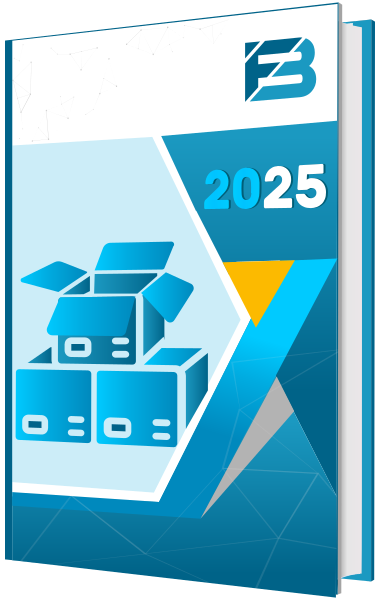
- 2021-2034
- 2025
- 2021-2024
- 150
-

(Offer valid till 31st Oct 2026)
Get 30-60 hrs Free Customization
Expand Regional and Country Coverage, Segments Analysis, Company Profiles, Competitive Benchmarking, and End-user Insights.








-
US +1 833 909 2966 ( Toll Free )
-
Get In Touch With Us