Brass Market Size, Share & Industry Analysis, By Type (Brass Wires, Brass Rods, and Others), By Application (Electrical & Electronic Components, Machinery & Industrial Components, Plumbing & Sanitary, Automotive, and Others), and Regional Forecast, 2026-2034
 Download Free Sample
KEY MARKET INSIGHTS
 Listen to Audio Version
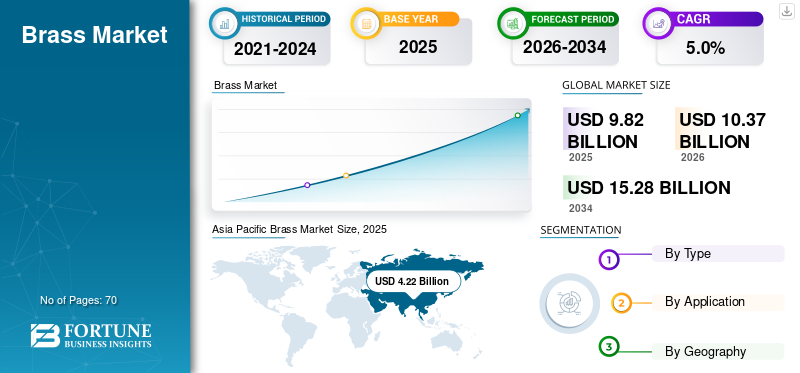
The global brass market size was valued at USD 9.82 billion in 2025. The market is projected to grow from USD 10.37 billion in 2026 to USD 15.28 billion by 2034 at a CAGR of 5.0% during the forecast period. Asia Pacific dominated the global market with a market share of 42.97% in 2025.
Brass is an alloy primarily composed of copper and zinc, valued for its excellent corrosion resistance, electrical conductivity, machinability, and aesthetic appeal. The brass market plays a critical role across the electrical & electronic industry, industrial machinery, plumbing systems, and automotive manufacturing. Variations in zinc content allow brass to be engineered for specific mechanical and functional requirements, enhancing its industrial versatility. Rising industrialization, infrastructure development, and electrification are driving demand for durable and conductive materials such as brass. Additionally, brass offers high recyclability without significant loss of properties, aligning with sustainability initiatives across manufacturing industries. Its widespread usage in precision components, fittings, and decorative applications ensures a stable baseline demand. Major manufacturers operating in the global market include Wieland Group, KME Group, Aurubis AG, Ningbo Jintian Copper, Mitsubishi Materials Corporation, Poongsan Corporation, and Luvata, which supply brass wires, rods, and specialty products across diverse end-use industries.
Download Free sample to learn more about this report.
Brass MARKET KEY TAKEAWAYS
 Market Size & Forecast
- 2025 Market Size: USD 9.82 billion
- 2026 Market Size: USD 10.37 billion
- 2034 Forecast Market Size: USD 15.28 billion
- CAGR: 5.00% from 2026–2034
 Market Share
- Asia Pacific dominated the global market with a market share of 42.97% in 2025.
- The automotive segment held the largest market share of 12.3% in 2025.
- The brass wires segment held the largest market share by type in 2025.
 Key Regional Highlights
North American
North America maintained a strong market position, supported by electrical infrastructure upgrades and industrial manufacturing.
Europe
Europe witnessed steady growth due to demand from industrial machinery and plumbing applications.
Asia Pacific
Asia Pacific led the global market, driven by manufacturing expansion and infrastructure development.
U.S.
The U.S. market can be analytically approximated at around USD 2.08 billion in 2025, accounting for roughly 20.1% of global sales.
Japan
The Japan market in 2025 is estimated at around USD 0.54 billion, accounting for roughly 5.2% of global market revenues.
Read More

BRASS MARKET TRENDS
Regulatory Compliance and Manufacturing Precision Shaping Market Evolution
The brass market is undergoing structural evolution driven by regulatory changes and technological advancements in manufacturing technologies rather than pure volume expansion. One prominent trend is the increasing shift toward lead-free and low-lead brass alloys, particularly in plumbing, sanitary, and potable water applications, in response to tightening health and environmental regulations across North America and Europe. Another key trend is the adoption of high-precision extrusion, drawing, and CNC machining technologies, which enable manufacturers to produce brass wires and rods with tighter tolerances for use in electrical and electronic components. Additionally, the use of recycled copper and zinc inputs is increasing as manufacturers strive to reduce their carbon footprints and enhance their sustainability credentials. Digitization of quality control and alloy formulation is also gaining traction to ensure consistency across batches. These trends reflect the market's adaptation in terms of product composition, compliance, and production sophistication.
Download Free sample to learn more about this report.
MARKET DYNAMICS
MARKET DRIVERS
Functional Superiority and Industrial Demand Drive the Market Development
The market is fundamentally driven by the material’s intrinsic functional advantages and steady industrial demand. Brass offers an optimal combination of electrical conductivity, corrosion resistance, strength, and machinability, making it indispensable in electrical & electronic components, machinery parts, plumbing systems, and automotive fittings. A major driver is ongoing demand from electrical and electronic component manufacturing, where brass is widely used in connectors, switches, terminals, and contact components. Another important driver is the growth of industrial manufacturing, which sustains the consumption of brass rods and machined parts across various equipment and tooling applications. Urbanization and building construction further drive demand for brass plumbing and sanitary fittings due to their long service life and reliability. Additionally, brass’s high recyclability enhances cost efficiency and material availability. These structural demand drivers ensure consistent usage across industries and drive the brass market in the long term.
MARKET RESTRAINTS
Raw Material Price Volatility Limiting Cost Predictability
Despite strong demand, the market faces restraints related to fluctuations in copper and zinc prices. Volatile raw material pricing has a direct impact on production costs and profit margins for manufacturers. Environmental regulations governing metal processing and emissions increase compliance costs, particularly for small and mid-sized producers. Additionally, the substitution of alternative materials, such as aluminum or plastics, in low-load applications limits the use of brass in cost-sensitive segments. Trade restrictions and import duties on copper and zinc also affect supply chain stability. These factors reduce pricing predictability and investment confidence for manufacturers, hence restraining market expansion in certain regions.
MARKET OPPORTUNITIES
Infrastructure Modernization and Electrification Expanding Future Demand
The brass market offers notable growth opportunities arising from long-term infrastructure modernization and global electrification initiatives. The expansion of power transmission networks, renewable energy systems, and electric vehicle charging infrastructure is creating a sustained demand for brass-based electrical connectors, terminals, and conductive components. Another key opportunity lies in urban water supply and sanitation upgrades, particularly in emerging economies, where brass fittings and valves are preferred due to their durability and resistance to corrosion. Additionally, rising investment in industrial automation and precision machinery is opening opportunities for high-performance brass rods used in machined components. The increasing emphasis on circular economy models also presents opportunities for manufacturers specializing in the production of recycled brass. The brass market in the Asia Pacific and the Middle East is supported by government-led infrastructure programs, which further enhance addressable demand. These factors are creating new application avenues beyond traditional uses, thereby strengthening the brass market growth.
MARKET CHALLENGES
Supply Imbalances and Logistics Constraints Affecting Market Stability
The market faces several challenges, including regional demand concentration and logistical limitations. Due to safety risks and high transportation costs, the product is typically consumed near production sites, limiting long-distance trade. This leads to regional oversupply in some markets and shortages in others. Another challenge is overcapacity in fertilizer-linked regions, which results in price pressure and margin volatility. Dependence on cyclical industries, such as agriculture, mining, and metals, further exposes the market to fluctuations in demand. Additionally, aging infrastructure in certain regions increases maintenance costs and operational risks. These structural and logistical challenges require careful capacity planning and regional alignment strategies, which in turn impact overall market stability.
TRADE PROTECTIONISM AND GEOPOLITICAL IMPACT
Trade protectionism and geopolitical developments have a significant impact on the market, affecting the availability of raw materials and cross-border trade flows. Import duties and trade restrictions on copper and zinc directly impact production costs and pricing strategies for brass manufacturers. Geopolitical tensions in key mining regions can disrupt supply chains, leading to price volatility and sourcing challenges. Additionally, regional trade agreements and localization policies encourage domestic production, reshaping global trade patterns. These factors increase supply chain complexity and cost uncertainty for manufacturers, therefore influencing investment decisions and regional competitiveness within the global market.
RESEARCH AND DEVELOPMENT (R&D) TRENDS
R&D in the market focuses on developing high-strength, corrosion-resistant, and lead-free alloys. Manufacturers are investing in precision extrusion, alloy optimization, and surface treatment technologies to improve performance. Research into the processing of recycled brass without property degradation supports sustainability goals. These innovations enhance regulatory compliance and application expansion.
SEGMENTATION ANALYSIS
By Type
Electrical Conductivity and Flexibility Driving Brass Wires Segment’s Dominance
Based on type, the market is segmented into brass wires, brass rods, and others.
Brass wires are the leading product segment in the global brass market, primarily due to their extensive use in electrical and electronic components. These wires offer an optimal balance of electrical conductivity, flexibility, corrosion resistance, and mechanical strength, making them suitable for connectors, terminals, springs, and winding applications. Rising investments in power distribution networks, renewable energy systems, and electronic devices continue to support demand for brass components.
Brass rods account for a significant share of the market due to their widespread use in machinery, industrial components, and precision-engineered parts. These rods are preferred for their excellent machinability, strength, and resistance to wear, which enables efficient CNC machining of valves, fittings, fasteners, and other mechanical parts. Growth in industrial manufacturing, automation, and infrastructure development continues to support demand for brass rods across multiple regions.
The “others” segment is projected to grow at a CAGR of 3.8% during the forecast period. The “others” segment includes brass sheets, plates, tubes, and customized profiles used in architectural, decorative, and specialty applications. These forms are widely utilized in interior design, musical instruments, heat exchangers, and ornamental hardware due to brass’s aesthetic appeal and corrosion resistance. Demand from this segment is supported by design flexibility and ease of fabrication.
By Application
To know how our report can help streamline your business, Speak to Analyst
Expansion of Power Transmission Infrastructure Fuels Electrical & Electronic Components Segment’s Dominance
Based on application, the market is segmented into electrical & electronic components, machinery & industrial components, plumbing & sanitary, automotive, and others.
Electrical and electronic components held the major global brass market share in 2025. The metal is widely used in connectors, terminals, switches, and contact components due to its excellent conductivity, durability, and resistance to corrosion. Expansion of power transmission infrastructure, renewable energy installations, and electronic device manufacturing continues to drive demand from this segment.
The metal processing segment is projected to grow at a CAGR of 4.9% from 2026 to 2034. The machinery and industrial components segment utilizes brass for gears, bearings, bushings, valves, and precision parts. Brass is preferred due to its low friction, good wear resistance, and ease of machining, which support high-performance industrial operations. Growth in manufacturing, automation, and equipment upgrades across industries such as oil & gas, manufacturing, and construction continues to support demand.
The plumbing and sanitary segment is projected to grow at the highest CAGR of 4.7% from 2026 to 2034. The segment represents a key application area for brass due to its corrosion resistance, durability, and hygienic properties. Brass fittings, valves, faucets, and connectors are widely used in residential, commercial, and industrial plumbing systems. Rising urbanization, housing construction, and infrastructure development are major factors driving demand.
BRASS MARKET REGIONAL OUTLOOK
By region, the market is categorized into Asia Pacific, North America, Europe, Latin America, and Middle East & Africa.
Asia Pacific
Asia Pacific Brass Market Size, 2025 (USD Billion)
To get more information on the regional analysis of this market, Download Free sample
Asia Pacific region dominates the global market due to manufacturing expansion and infrastructure development. China leads consumption, India benefits from urbanization, and Japan supports precision applications. Capacity expansions ensure long-term growth, therefore positioning Asia Pacific as the fastest-growing region.
China Brass Market
China’s sulfuric acid market is projected to be one of the largest worldwide, with 2025 revenues estimated at around USD 1.92 billion, representing roughly 18.5% of global market sales. China leads in consumption due to industrialization and the growth of the electrical industry.
India Brass Market
The India market in 2025 is estimated at around USD 0.77 billion, accounting for roughly 7.4% of global revenues. India follows, driven by growing demand from plumbing & sanitary applications.
Japan Brass Market
The Japan market in 2025 is estimated at around USD 0.54 billion, accounting for roughly 5.2% of global market revenues. The country contributes significantly through advanced electronics manufacturing, which is driven by growing product demand.
To know how our report can help streamline your business, Speak to Analyst
Europe
Europe’s market is driven by demand for industrial machinery and plumbing. Germany leads production and consumption due to strong manufacturing capabilities. The UK contributes through construction and sanitary applications. Strict lead regulations drive R&D in compliant alloys, hence supporting controlled growth.
U.K. Brass Market
The U.K. market in 2025 is estimated at around USD 0.27 billion, representing 2.6% of global market revenues.
Germany Brass Market
Germany’s market is projected to reach approximately USD 0.51 billion in 2025, equivalent to around 4.9% of global market sales.
North America
North America represents a mature market supported by electrical infrastructure upgrades, industrial manufacturing, and automotive production. The U.S. leads regional demand due to strong electrical component manufacturing and plumbing applications. Availability of recycled copper and zinc supports sustainable production. Stable industrial output ensures consistent consumption, thus reinforcing regional stability.
U.S. Brass Market
Based on North America’s strong contribution and the U.S. dominance within the region, the U.S. market can be analytically approximated at around USD 2.08 billion in 2025, accounting for roughly 20.1% of global sales. The U.S. dominates regional consumption due to strong demand from the electrical industry.
Latin America and Middle East & Africa
Latin America’s brass demand is driven by infrastructure development and the manufacturing of machinery. Brazil and Mexico lead consumption, despite cost sensitivity, steady industrial growth supports demand, hence contributing to country expansion. Demand in the Middle East & Africa is supported by construction, plumbing, and industrial projects, particularly in Saudi Arabia. Government infrastructure investments drive consumption, therefore strengthening regional importance.
GCC Brass Market
The GCC market is projected to reach around USD 0.40 billion in 2025, representing 5.9% of global market revenues.
COMPETITIVE LANDSCAPE
KEY INDUSTRY PLAYERS
Sustainability and Recycling Capabilities by Key Players Lead to the Strengthening of the Market
BASF SE, Nouryon, The Mosaic Company, PVS Chemicals, Inc., and Aurubis AG are the key players in the market. The market is moderately fragmented, with competition based on alloy quality, cost efficiency, and application expertise. Leading players focus on electrical-grade and lead-free alloys, while regional manufacturers compete on pricing and customization. Sustainability and recycling capabilities are key differentiators.
LIST OF KEY BRASS MARKET PLAYERS PROFILED IN THE REPORT
- Wieland Group (Germany)
- KME Group S.p.A. (Italy)
- Aurubis AG (Germany)
- Ningbo Jintian Copper (Group) Co., Ltd. (China)
- Mitsubishi Materials Corporation (Japan)
- Poongsan Corporation (South Korea)
- Luvata (Finland)
- Diehl Metall Stiftung & Co. KG (Germany)
- Midland Industries (U.S.)
- TS Brass (U.S.)
REPORT COVERAGE
The report provides a detailed analysis of the market. It focuses on key aspects, such as leading companies, Type, grade, and application. Additionally, it offers valuable insights into the market and current industry trends, as well as highlights key developments in the industry. In addition to the factors mentioned above, the report encompasses several factors contributing to the market's growth.
Request for Customization to gain extensive market insights.
Report Scope & Segmentation
|
ATTRIBUTE |
DETAILS |
|
Study Period |
2021-2034 |
|
Base Year |
2025 |
|
Estimated Year |
2026 |
|
Forecast Period |
2026-2034 |
|
Historical Period |
2021-2024 |
|
Unit |
Value (USD Billion), Volume (Million Ton) |
|
Growth Rate |
CAGR of 5.0% from 2026 to 2035 |
|
Segmentation |
By Type, By Application, By Region |
|
By Type |
· Brass Wires · Brass Rods · Others |
|
By Application |
· Electrical & Electronic Components · Machinery & Industrial Components · Plumbing & Sanitary · Automotive · Others |
|
By Region |
· North America (By Type, By Application, By Country) o U.S. (By Application) o Canada (By Application) · Europe (By Type, By Application, By Country) o Germany (By Application) o France (By Application) o U.K. (By Application) o Italy (By Application) o Spain (By Application) o Rest of Europe (By Application) · Asia Pacific (By Type, By Application, By Country) o China (By Application) o India (By Application) o Japan (By Application) o South Korea (By Application) o Rest of Asia Pacific (By Application) · Latin America (By Type, By Application, By Country) o Brazil (By Application) o Mexico (By Application) o Rest of Latin America (By Application) · Middle East & Africa (By Type, By Application, By Country) o GCC (By Application) o South Africa (By Application) o Rest of Middle East & Africa (By Application) |
Frequently Asked Questions
Fortune Business Insights says that the global market size was valued at USD 9.82 billion in 2025 and is projected to reach USD 15.28 billion by 2034.
Recording a CAGR of 5.0%, the market is slated to exhibit steady growth during the forecast period of 2026-2034.
The brass wire segment led in 2025.
Asia Pacific held the highest market share in 2025.
Functional Superiority and Industrial Demand Sustaining Consumption



- 2021-2034
- 2025
- 2021-2024
- 70
Get 30-60 hrs Free Customization
Expand Regional and Country Coverage, Segments Analysis, Company Profiles, Competitive Benchmarking, and End-user Insights.


















-
US +1 833 909 2966 ( Toll Free )
-
Get In Touch With Us