Bus Rapid Transit (BRT) Market Size, Share, & Industry Analysis, By Bus Type (Standard, Articulated, and Others), By Propulsion (ICE and Electric), By Application (Urban Areas and Others), and Regional Forecasts, 2026-2034
 Download Free Sample
(Offer valid till 30th Sep 2026)

KEY MARKET INSIGHTS
 Listen to Audio Version
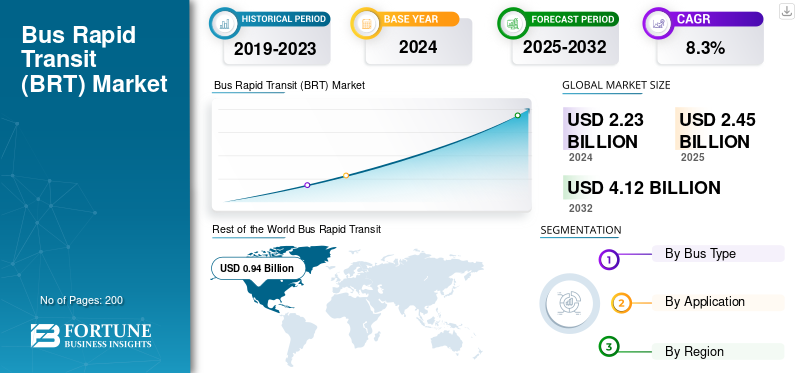
The global Bus Rapid Transit (BRT) market size was valued at USD 39.41 billion in 2025. The market is projected to grow from USD 42.52 billion in 2026 to USD 80.66 billion by 2034, exhibiting a CAGR of 8.33% during the forecast period. Rest of the World dominated the bus rapid transit market with a market share of 26.03% in 2025.
Bus rapid transit is a high quality bus transport system that offers fast, efficient, and comfortable public mobility solutions across the world in urban and rural areas. It is one of the most cost-effective mobility solutions compared to other forms of public transportation. BRT systems offer various conveniences to the customers, such as fast transportation through dedicated lanes, off-board fare collection, and alignment of stations & busways to the center of the roads. These features enable fast and frequent operations. They also offer safe and wide corridors for motor vehicles, pedestrians, and cyclists, reducing the risk of injuries and fatalities.
The growing demand for fast transportation services across metro cities is fueling the market growth. BRT systems are considered more reliable than metro and light rail systems. Therefore, increasing demand for road safety, passenger convenience, and comfort will drive the market growth in the upcoming years.
The market is dominated by a few key players, including AB Volvo, Tata Motors, MAN, and Ashok Leyland. These companies lead the market due to their strong partnerships with major government agencies in different regions, technological innovation, and ability to produce reliable buses.
Download Free sample to learn more about this report.
Bus Rapid Transit (BRT) Market Key Takeways
 Global Market Size & Forecast
- 2025 Market Size: USD 39.41 billion
- 2026 Market Size: USD 42.52 billion
- 2034 Forecast Market Size: USD 80.66 billion
- CAGR: 8.33% from 2026–2034
 Market Share
- Rest of the World dominated the bus rapid transit (BRT) market with a 26.03% share in 2025.
- The Standard segment is projected to hold the largest market share of 36.18% in 2026.
- The Electric segment is expected to lead the market with a 60.85% share in 2026.
 Key Regional Highlights
Asia Pacific
Asia Pacific accounted for 33.45% of the global market in 2025, generating USD 13.18 billion in revenue and reaching USD 14.38 billion in 2026.
Europe
Europe represented 22.40% of global demand in 2025, with the market valued at USD 8.83 billion and projected to reach USD 9.48 billion in 2026.
North America
North America contributed USD 7.14 billion in 2025, accounting for an 18.11% market share, and is expected to reach USD 7.62 billion in 2026.
U.S.
U.S. The U.S. bus rapid transit market is projected to reach USD 3.87 billion by 2026.
Japan
Japan The Japan bus rapid transit market is projected to reach USD 1.77 billion by 2026.
Read More

MARKET DYNAMICS
MARKET DRIVERS
Increasing Road Traffic Congestion to Drive Demand for Bus Rapid Transit Systems
The rising global population and increasing road traffic congestion will drive the demand for efficient public transportation to reduce the number of on-road vehicles and enable faster commutes. Asian countries, such as India and China are facing major issues of road traffic congestion due to surging population and rise in the number of on-road vehicles. Moreover, rapid urbanization and overburdened public transportation systems in these economies are anticipated to fuel the demand for efficient bus rapid transit systems for fast and comfortable commutes.
Positive Environmental Impact of Adopting BRT Systems to Augment Market Growth
Rapidly growing air pollution due to the emission of greenhouse gases and other harmful pollutants through vehicle exhausts is threatening public health. Cities with increasing traffic congestion also are threatened by air pollution. Therefore, the governments’ focus on encouraging the people to adopt public transit systems to reduce automotive emissions is anticipated to propel the market growth.
Moreover, governments’ policies to limit the sales and use of conventional vehicles have created significant uncertainty regarding the adoption of IC engine-powered vehicles. Therefore, rising consumer preference toward using public transit services instead of their own vehicles may drive the growth of the BRT industry in upcoming years.
MARKET RESTRAINTS
High Implementation Cost of BRT Systems to Hinder Market Growth
BRT systems are typically prevalent in urban areas where retrofitting these high-quality systems on an existing bus network is generally required. Retrofitting increases the costs associated with the project. Additionally, the high initial cost of deploying an electric bus fleet in the BRT network is one of the major challenges in adopting the emission-free BRT network. The initial investments can hike the public transportation budgets of government authorities. Mass rapid transit systems, such as the metros are still more popular in many developing countries due to the fewer complexities associated with their implementation. These factors can impede market progress.
MARKET OPPORTUNITIES
Cities Worldwide Seek Cost Effective, Sustainable, and Efficient Public Transportation Solutions Pose as a Market Opportunity
Urbanization and increasing traffic congestion have pushed governments and city planners to invest in mass transit infrastructure that delivers metro-like efficiency at a fraction of the cost. BRT systems offer dedicated lanes, intelligent traffic management, and high-capacity buses that reduce travel time and emissions, making them attractive for both developed and emerging economies. Regions such as Asia Pacific and Latin America are witnessing strong adoption due to rapid population growth and urban expansion, while North America and Europe are upgrading existing systems to meet new sustainability targets. Additionally, the shift toward electric and hybrid BRT buses aligns with global decarbonization goals, creating opportunities for OEMs, infrastructure providers, and technology suppliers. Public-private partnerships and smart city initiatives further support market expansion, making BRT a key pillar of the future urban mobility landscape.
BUS RAPID TRANSIT MARKET TRENDS
Growing Trend of Emission-Free Electric Buses Expected to Fuel BRT Market Expansion
The ongoing global megatrend of automotive electrification has also influenced the BRT market. The growing number of stringent government regulations for automotive emission control coupled with the low operating cost of electric vehicles is encouraging BRT fleet operators to adopt battery-powered buses for public transport. Moreover, a well-established charging station network in the developed economies across Europe and North America is accelerating the BRT system electrification efforts.
Furthermore, electric buses are equipped with advanced safety and comfort features, such as cruise control, lane departure warning, air conditioning, and others. Therefore, the increasing preference for electric buses among commuters for safety, comfort, and environmental concerns are anticipated to boost the electrification of bus rapid transit systems globally.
Various BRT system providers have already started taking various initiatives to increase their electric bus fleets to go green. For instance, in March 2021, Milwaukee County Transit System (MCTS), one of the largest transit agencies in Wisconsin, selected Nova Bus to supply 15 LFSe+ electric bus models to deploy in its transit system. Similarly, initiatives from other BRT system providers across the globe to convert their fleets into zero-emission are anticipated to boost the Bus Rapid Transit (BRT) market growth in the upcoming years.
Download Free sample to learn more about this report.
SEGMENTATION ANALYSIS
By Bus Type
Increasing Demand for High-Loading-Capacity BRT Buses to Boost Adoption of Standard Buses
By bus type, the market is segmented into standard, articulated, and others.
The Standard segment is projecteed to dominate the market with a share of 36.18% in 2026. Standard buses are easily available across various developed and underdeveloped economies. Additionally, standard buses are available at low cost. Therefore, their deployment is more economical for the BRT service provider. Moreover, as standard buses are economical to travel, significant consumer preference for standard buses across urban and rural areas further supports the dominance of the standard bus segment in the market.
The need to accommodate large-volume loading and ballooning ridership has increased the demand for articulated buses, which would positively impact the growth of this segment. Additionally, articulated buses’ advanced safety & comfort features are rapidly gaining popularity among the public. The standard buses segment is also expected to show good growth in the global market due to their greater affordability and better ability to maneuver in severely restricted spaces.
To know how our report can help streamline your business, Speak to Analyst
By Propulsion
Electrification to Accelerate Adoption of Bus Rapid Transit Leading to Segmental Growth
By propulsion, the market is classified into ICE and electric.
The Electric segment is expected to lead the market, contributing 60.85% globally in 2026. Electric power is on track to dominate bus rapid transit procurements this decade as policy, economics, and market momentum converge globally, such systems already serve 32.1 million passenger trips per day across 191 cities and 5,917 km of corridors, so drivetrain choices in this segment have outsized impact.
- According to IEA, in the underlying bus market, electric bus sales grew 30% in 2024 to greater than 70,000 units, with China’s share falling to less than 70% as other regions accelerate; in Europe, nearly half of all new city buses were battery‑electric in 2024 (up from just over 35% in 2023), and multiple countries now witness greater than 40% electric shares in new bus sales directly relevant for urban BRT fleets.
By Application
Rapid Urbanization in Metropolitan Cities to Drive BRT Adoption in Urban Areas
By application, the market is classified into urban areas and others.
The Urban Areas segment is projecteed to dominate the market with a share of 57.34% in 2026. The urban area segment held the largest global Bus Rapid Transit (BRT) market share in 2024. Rapid urbanization and increasing road traffic congestion are expected to drive the demand for affordable and high-quality bus transportation services for efficient urban mobility.
- For instance, according to the Federal Transit Administration, BRT has advanced throughout the U.S. in the past decade. The BRT systems operate in major cities, such as Pittsburgh and Los Angeles and are rapidly growing in popular mid-sized metro areas, such as Oregon, Cleveland, and Eugene. Non-urban areas are also witnessing significant growth in BRT system adoption to cater to various transportation needs.
BUS RAPID TRANSIT MARKET REGIONAL OUTLOOK
Road Traffic Congestion in Metropolitan Cities to Drive Market Growth in Rest of the World Segment
Regionally, the market is categorized into North America, Europe, Asia Pacific, and the Rest of the World.
Rest of the World
Rest of the World Bus Rapid Transit (BRT) Market Size, 2025 (USD Billion) To get more information on the regional analysis of this market, Download Free sample
In 2025, Rest of the World represented USD 10.26 Billion, accounting for 26.04% of the worldwide market, and is projected to grow to USD 11.05 Billion in 2026. The rest of the world segment, which covers Latin America and the Middle East & Africa, held the largest market share in 2024. An increasing number of bus transit systems and daily commuters using BRT systems will drive the global market progress. According to the Global BRT Data, Latin America accounted for nearly 60% of the global bus rapid transit passengers daily. The popularity of the rapid transit system is growing considerably across major cities in Latin America, such as Brazil, Colombia, and others. Therefore, an increasing number of BRT passengers in the region to boost the market growth in the future.
Asia Pacific
The Asia Pacific region captured 33.45% of the global market in 2025, generating USD 13.18 Billion in revenue, and is projected to reach USD 14.38 Billion in 2026. Asia Pacific is expected to register the fastest growth rate during the forecast period. Increasing road traffic congestion, coupled with the government's focus on expanding public transport capability to reduce traffic congestion, is expected to accelerate the market growth in the region. The Japan market is valued at USD 1.77 billion by 2026, the China market is valued at USD 6.44 billion by 2026, and the India market is valued at USD 3.8 billion by 2026.
North America
North America contributed approximately USD 7.14 Billion to the global market in 2025, accounting for 18.11% share, and is expected to reach USD 7.62 Billion in 2026. The market in North America is characterized by cities, such as Ottawa that support Transport-Oriented Development (TOD) by emphasizing on land use policy to promote future growth, as well as maintain and increase transit ridership. Another example is the transport system in Seattle, where dedicated bus lanes and tunnels have reduced surface street volumes by 20%. Also, buses using these tunnels recorded 40% fewer accidents than those in mixed-traffic operations. Therefore, the successful implementation of BRT in numerous cities is anticipated to fuel the market growth in this region. The U.S. market is valued at USD 3.87 billion by 2026.
Europe
In 2025, the Europe market stood at USD 8.83 Billion, representing 22.40% of global demand, and is projected to grow to USD 9.48 Billion in 2026. In Europe, the cost per kilometer of BRT systems is similar to that of the other regions, such as the Asia Pacific. However, the annual demand is substantially less due to this region's existing public transportation. Several cities in France operate multiple BRT lines, and the government provides significant financial support to expand these systems. Moreover, the high costs associated with light rail transit and heavy rail infrastructure will likely increase the popularity of a bus rapid transit system in Europe over the forecast period. The UK market is valued at USD 2.42 billion by 2026, and the Germany market is valued at USD 2.9 billion by 2026.
COMPETITIVE LANDSCAPE
KEY INDUSTRY PLAYERS
AB Volvo, Tata Motors, and MAN are Leading Market Players
A large number of manufacturers in the market are producing bus rapid transit buses. Large systems, such as the Metrobus in Mexico City and TransMilenio in Bogota operate buses from various manufacturers, particularly Volvo, Scania, and Mercedes. AB Volvo produces special bi-articulated buses operating in Curitiba, and the company's South American bus manufacturing plant is also located in Curitiba.
BRT buses in China are often produced by Chinese manufacturers or through joint ventures (for example, MAN and Huanghai produce buses for the Dalian rapid transit). Tata Motors has largely consolidated the market in India. Furthermore, Chinese manufacturers including Xiamen-based Kinglong are branching out and designing buses for Zaozhuang, Lianyungang, Guangzhou, and Lima, Peru, besides Xiamen's sophisticated bus transit system. Hence, expanding manufacturing capabilities, particularly in developing countries, represents a significant opportunity for key vendors operating in this market to increase profitability over the forecast period.
LIST OF KEY BUS RAPID TRANSIT COMPANIES PROFILED
- AB Volvo (Sweden)
- Tata Motors (India)
- MAN (Germany)
- Ashok Leyland (India)
- Yutong (China)
- Marcopolo S.A. (Brazil)
- King Long (China)
- BYD Company Ltd. (China)
- Mercedes Benz (Germany)
- Alexander Dennis Limited (U.K.)
KEY INDUSTRY DEVELOPMENTS
- October 2025 - Ashok Leyland, the Indian flagship of the Hinduja Group and a leading commercial vehicle manufacturer, has announced securing an order from the Tamil Nadu State Transport Undertakings (TNSTU) for 1,937 buses. This significant order further reinforces Ashok Leyland’s enduring partnership with TNSTU and underscores its strong leadership in the bus industry.
- September 2025 - MAN Truck & Bus is strengthening its global presence in the bus segment through a new strategic partnership in Azerbaijan. In collaboration with its long-standing local partner, Improtex Trucks & Buses, and the Government of Azerbaijan, the company aims to enhance economic cooperation in the country while promoting sustainable and emission-free urban mobility solutions.
- August 2025 - Golden Dragon Bus has achieved a new milestone in the Tanzanian market with the delivery of the largest batch of BRT buses exported to Africa. The official handover ceremony took place on July 17, 2025 at the Haicang plant of Xiamen King Long Travel Vehicles Co., Ltd., marking a significant step in the company’s growing presence across the continent.
- March 2023 - Senegal’s capital Dakar announced its plan to deploy Africa’s first 100% e-bus fleet in its BRT system. Dakar is focused on restructuring its transportation network by 2025 through a bus rapid transit project operated exclusively with e-buses.
- February 2023 – Mexico City’s transport authority, Metrobús introduced a fleet of 50 new articulated electric buses. The newly deployed fleet of e-buses will be incorporated into line 3 of Mexico City’s public transportation system.
REPORT COVERAGE
The global BRT market report provides detailed market analysis and focuses on key aspects, such as leading companies, bus types, design, and technology. Besides this, the report offers insights into the latest market trends and highlights key industry developments. In addition to the factors mentioned above, the report encompasses several factors that have contributed to the market’s growth in recent years.
Request for Customization to gain extensive market insights.
Report Scope & Segmentation
|
ATTRIBUTE |
DETAILS |
|
Study Period |
2021-2034 |
|
Base Year |
2025 |
|
Estimated Year |
2026 |
|
Forecast Period |
2026-2034 |
|
Historical Period |
2021-2024 |
|
Growth Rate |
CAGR of 8.33% from 2026 to 2034 |
|
Unit |
Value (USD Billion) |
|
Segmentation |
By Bus Type
By Propulsion
By Application
By Region
|
Frequently Asked Questions
Fortune Business Insights say that the market was valued at USD 39.41 billion in 2025 and is projected to reach USD 80.66 billion by 2034.
The market is expected to register a growth rate (CAGR) of 8.33% during the forecast period.
Increasing demand for cost-effective urban mobility solutions is expected to drive the global market growth.
The rest of the world segment led the market in 2025.
AB Volvo (Sweden), Tata Motors (India), MAN (Germany), and Ashok Leyland (India) are some of the prominent players in the market.


- 2021-2034
- 2025
- 2021-2024
- 200
-
(Offer valid till 30th Sep 2026)
Get 30-60 hrs Free Customization
Expand Regional and Country Coverage, Segments Analysis, Company Profiles, Competitive Benchmarking, and End-user Insights.














Related Reports
-
US +1 833 909 2966 ( Toll Free )
-
Get In Touch With Us